
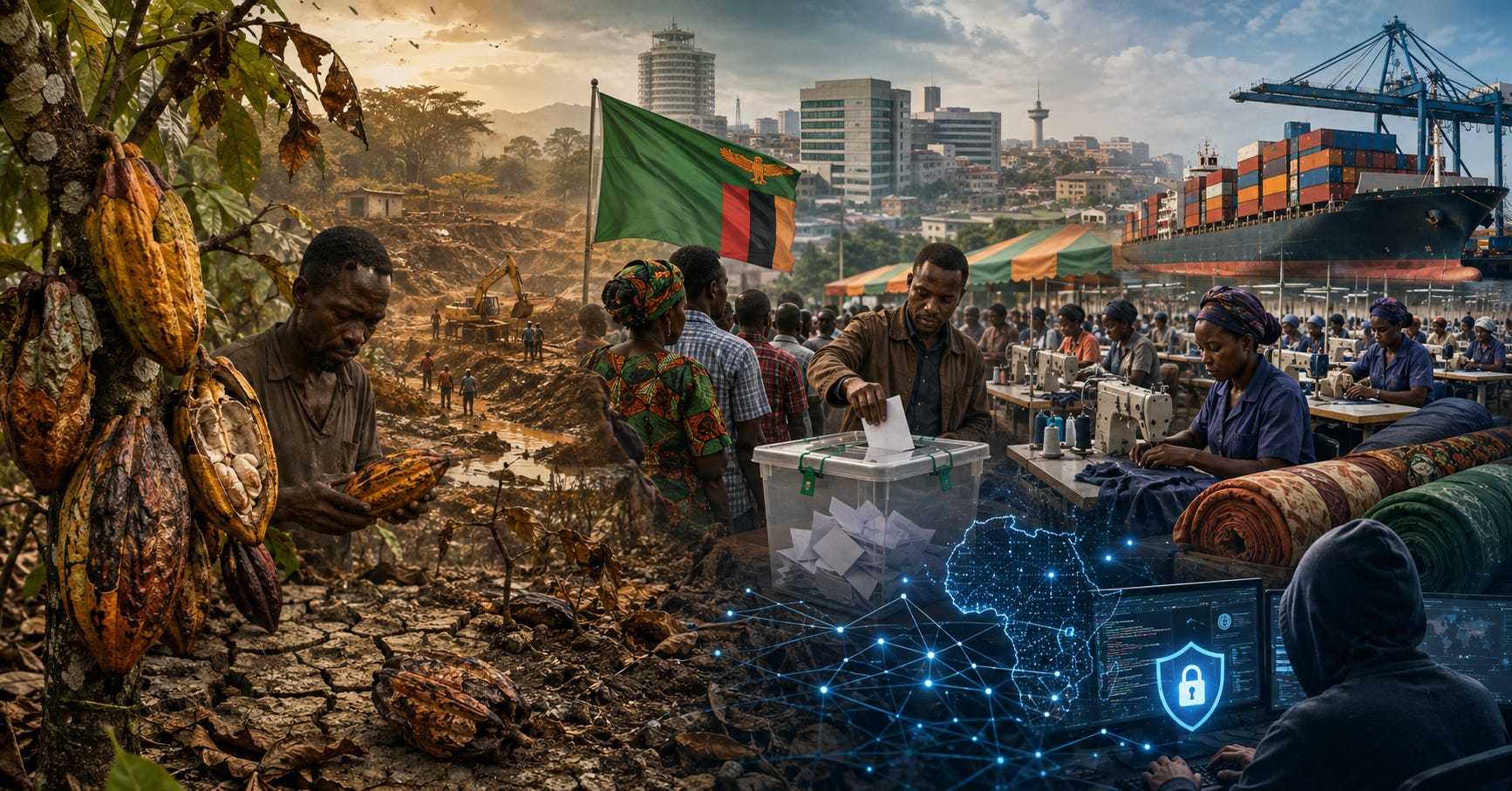
West Africa's cocoa sector is facing its worst supply outlook in years. Ghana projects a 16% production decline and Cote d'Ivoire more than 10%, driving cocoa futures above $5,900 per tonne. El Nino, disease, and illegal gold mining are all compounding simultaneously. Zambia votes on August 13, one week away, with Hichilema expected to win but urban frustration providing the only credible opposition path. African cybercrime losses have doubled to $484 million. And AGOA's extension runs only to year-end, leaving African textile exporters without certainty for 2027. The continent's commodity, political, and trade policy risks are all crystallising at once.
Lead Story »
Ghana projects at least a 16% production decline for the 2026/27 season. Cote d’Ivoire, the world’s largest producer, projects more than 10%. Together they control roughly 60% of global cocoa supply. The market is already pricing in the shortage.
COCOBOD, Ghana’s cocoa regulator, confirmed to Reuters this week that production is expected to fall by at least 16% in the 2026/27 crop season beginning September. The regulator cited El Nino-related weather disruption, the cocoa tree’s natural alternating yield cycle, swollen shoot disease, ageing plantations, and illegal gold mining as compounding factors. The Western and Western North regions, which account for more than half of Ghana’s output, are the most affected. Cocoa futures surged more than 9.4% on the news, rising above $5,900 per tonne, the highest level since July 10. Cote d’Ivoire, the world’s largest producer, has separately reported expected declines of more than 10% for its own next season. Nigeria has responded by banning raw cocoa bean exports to encourage domestic processing into cocoa butter, powder, and chocolate, targeting a doubling of processing revenues by 2030. The supply tightening affects an already volatile global cocoa market that has swung between $3,000 and $4,000 per tonne this year.
El Nino’s impact on cocoa is not a single-season disruption. The weather pattern expected to peak between late 2026 and early 2027 will affect multiple growing cycles. Galamsey has permanently degraded significant farming land in Ghana’s cocoa belt. COCOBOD has launched rehabilitation programmes and reintroduced a nationwide free fertiliser scheme, but remediation of decades-old plantations is a multi-year project.

WHY IT MATTERS:
For chocolate manufacturers, confectionery companies, and food and beverage operators with cocoa in their supply chains, the signal from West Africa is unambiguous: input costs are rising and supply is tightening structurally, not cyclically. Hedging decisions made in the next 90 days will determine margin positions through 2027. For investors in Ghanaian agriculture and the broader West African agri-processing sector, the supply decline has a counterintuitive upside: cocoa price strength improves farmgate economics even as volumes fall, and Nigeria's move to ban raw exports signals a value-addition opportunity in downstream processing that is attracting capital. The Ghana-Cote d'Ivoire cocoa price harmonisation deal signed in June provides some stability on farmgate pricing. But the structural supply question will not be resolved by pricing policy alone.
This Week
Political Risk · Zambia
Zambia’s general election takes place on August 13, eight days from today. President Hakainde Hichilema and the UPND are expected to win a second term. The 2021 electoral map remains largely intact: the new voters roll of 8.86 million mirrors the distribution that produced Hichilema’s 59% victory, rural regions continue to back social programmes introduced since 2021, and the opposition remains fragmented across more than a dozen candidates. The opposition’s only credible path runs through Lusaka and Copperbelt urban frustration: Hichilema needs to hold at least 47 to 48% in these battlegrounds to remain safe, and urban anger over cost of living, electricity shortages, and the perceived disconnect between macro stabilisation and lived experience is real. The BTI 2026 Zambia Country Report notes that the government has become less tolerant of dissent and more likely to clamp down on opponents as the election approaches. For mining investors and copper corridor operators, a Hichilema second term means continuity on debt restructuring, IMF programme adherence, and the Lobito corridor investment thesis. An opposition upset, while not the base case, would introduce policy uncertainty across all three.
Digital Assets · South Africa
South Africa’s National Treasury and the SARB jointly published the draft Crypto Assets Manual for Cross-Border Activities on August 3, the country’s first comprehensive framework for cross-border digital asset transactions. Any crypto transfer abroad must be conducted through a licensed Crypto Asset Service Provider and reported to the SARB’s Financial Surveillance Department. The framework introduces a three-tier authorisation system, applies exchange control regulations to crypto for the first time, and carries criminal penalties of up to R1 million or five years imprisonment for non-compliance. The comment period runs to September 30. For the financial services sector, South Africa’s regulatory clarity is a meaningful differentiator: firms operating under a defined regime attract institutional clients that unregulated peers cannot. Watch for the final regulations after September consultation closes.
Capital Markets · Nigeria
First HoldCo, Nigeria’s most valuable financial institution by market capitalisation at N6.09 trillion, opened a N1.4 trillion ($1 billion) share sale on the Nigerian Exchange on August 4. The offering is a secondary sale: 10.4 billion shares held by RC Investment Management, a bridge vehicle that bought the block at N31 per share during last year’s ownership restructuring, are being sold at N110 per share. The bank itself receives no proceeds. CEO Olusegun Alebiosu said demand has been overwhelming and the offer could close within a week. The sale resolves a complex corporate dispute and releases a large block of shares into the public market at a moment when Nigerian equities are rallying on improving macro conditions and the Dangote refinery IPO narrative. For investors tracking Nigerian capital markets, First HoldCo’s N6.09 trillion valuation makes it the country’s most capitalised banking group, and the speed of this sale will be read as a confidence signal for the broader NGX banking sector ahead of the CBN recapitalisation deadline.
Cote d’Ivoire is the world’s largest cocoa producer, controlling approximately 40% of global supply, which makes its projected 10% production decline in 2026/27 a global commodity event rather than a local agricultural problem. The irony for investors is that higher cocoa prices improve the economics of downstream processing investment, reinforcing Abidjan’s push to capture more of the cocoa value chain domestically. The broader economic picture is strong: GDP growth is projected at 6.5% in 2026, among the highest on the continent, driven by construction, financial services, and telecoms. Abidjan is Francophone West Africa’s leading commercial and financial hub. The June cocoa price harmonisation deal with Ghana strengthens both countries’ negotiating position with international buyers and reduces race-to-the-bottom farmgate pricing risk.
The operating environment is broadly favourable. The CFA franc’s euro peg provides monetary stability unusual in frontier markets. Abidjan’s port and road network are among the best in the subregion. Friction points include government procurement opacity, a slow bureaucracy, and security spillover from the Sahel in the north and west. President Ouattara has provided political stability, but succession dynamics as he ages are a medium-term watch item for investors with long time horizons.
Opportunities » Cocoa downstream processing including cocoa butter, powder, and chocolate manufacturing, agri-processing across coffee, cashew, rubber, and palm oil value chains, financial services and fintech in Abidjan, construction and infrastructure, telecoms, and manufacturing for the ECOWAS regional market. Abidjan’s port is one of West Africa’s busiest and most efficient.
Risks » Cocoa production decline of more than 10% in 2026/27 compresses volumes for processing operators even as prices rise. Security spillover from the Sahel affects the north and west. Government procurement lacks transparency. Presidential succession dynamics as Ouattara ages are a medium-term political risk. Some land tenure and community displacement risks in agri-processing and mining sectors.
Operating Tips » French is the language of business and government. Abidjan is the commercial hub and the base for Francophone West Africa operations. The CFA franc’s euro peg provides currency stability unusual in frontier markets. Legal system follows French civil law and is functional for commercial disputes. Relationship-building with government is important for large projects. Local partnerships are valued particularly in agri and extractives sectors.
Country intelligence sourced from the Africa.com Doing Business in Africa series. Read the full Cote d’Ivoire profile, including IOA’s research analysis.
Pan-African · Cybersecurity » INTERPOL’s African Cyberthreat Assessment Report 2026, based on 36 African countries, finds AI now enables 55% of reported cybercrimes on the continent. Financial losses rose from $192 million in 2024 to $484 million. AI-generated synthetic identities are bypassing biometric security systems to open bank accounts and obtain mobile loans. BEC schemes use AI to generate convincing corporate correspondence targeting victims in Europe and North America. INTERPOL warns that cybercrime legislation remains fragmented and law enforcement AI readiness is alarmingly low. The $484 million figure is a floor. Source: INTERPOL
Nigeria · Defence and Labour » President Tinubu approved an up to 80% salary increase for Nigerian soldiers, the largest single pay adjustment for the military in a decade. The increase reflects both security sector demands and the broader cost-of-living pressure on public sector wages following fuel subsidy removal and currency devaluation. The fiscal cost is significant but the security dividend of a better-compensated professional military matters for the operating environment in the Niger Delta and northern regions. Source: Premium Times / AllAfrica
Africa · Electric Vehicles » Africa is emerging as the world’s fastest-growing EV market, with Nigeria attracting the most investment in electric buses, cars, and charging infrastructure among African markets. The IEA projects EVs will account for 28% of new global car sales in 2026. For Nigeria specifically, the EV push complements the Dangote refinery’s capacity to produce cleaner refined fuels and the government’s compressed natural gas programme as a dual-track transition away from imported petrol. Source: The News Chronicle
South Africa · Manufacturing » South Africa’s ABSA PMI fell further to 46.8 in July from 47.3 in June, the fifth consecutive month below the 50 expansion threshold. Output, new sales orders, and employment all contracted. The rand has strengthened to around ZAR 16.5 per dollar, providing some import cost relief, but the structural weakness in manufacturing output reflects persistent electricity, logistics, and demand constraints that are not resolved by currency movements alone. Source: Business Tech Africa
Africa.com · Food Security » Africa.com reports that Russia’s food exports to Africa surged in 2026, with wheat, fertiliser, and sunflower oil volumes rising significantly as Moscow deepens its agricultural trade relationships across the continent. For African food importers managing the dual pressure of El Nino-driven domestic shortfalls and Middle East conflict-driven logistics disruptions, Russia’s increased food export capacity represents both a supply alternative and a geopolitical dependency risk. Read on Africa.com
Zambia General Election · August 13 » A Hichilema second term, the base case, provides continuity on IMF programme adherence, debt management, and the Lobito Corridor investment thesis. Watch turnout data from Lusaka and Copperbelt urban centres, where anti-incumbent sentiment is strongest. Results are typically declared within 48 to 72 hours of polls closing. An unexpected opposition lead in urban areas on election night would be the signal to watch.
West African Cocoa Season · Opens September » The 2026/27 cocoa season begins in September. Early pod counts and COCOBOD’s first monthly production data will confirm whether the 16% decline projection holds or worsens. For food and beverage companies with West African cocoa in their supply chains, September data is the first real read on 2027 input cost exposure.
AGOA · Renewal Deadline, End of 2026 » AGOA’s current extension runs only to December 31, 2026. The US Congress and White House have not committed to a long-term renewal. Corporate Council on Africa CEO Florie Liser has called publicly for at least a 10-year extension. African textile and apparel exporters, particularly in Mauritius, Lesotho, Ethiopia, and Kenya, need clarity before the next production and sourcing cycle. Watch for any Congressional movement before the September recess.
Published weekly by Africa.com
Edition 014 · August 6, 2026
Researched with AI. Edited by humans.
Sources: CNBC Africa · Reuters · Pulse Ghana · Ghanamma · Business Tech Africa
AllAfrica · The News Chronicle · Zambian Observer · BTI Project · Africa Center · Africa.com
Comments
Nothing yet. Say the first thing.
Sign in to join the conversation.