
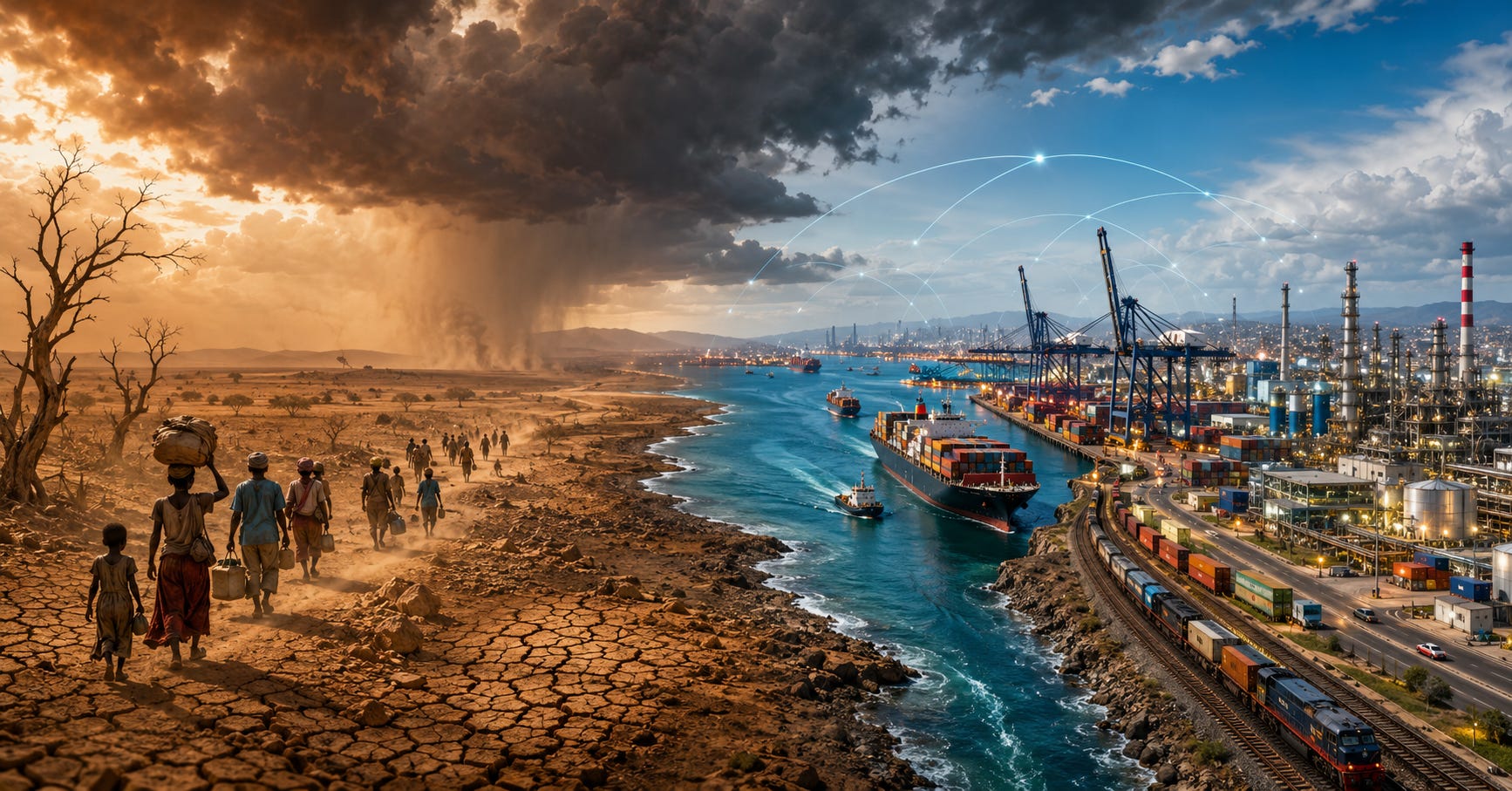
The African Development Bank warned yesterday that a strengthening super El Nino could cost the continent between 10 and 20 billion dollars and trigger mass migration from hard-hit areas. It arrives as a second major risk layer on top of a Middle East conflict that has already compressed Africa's fiscal space. At the same time, Standard Bank confirmed it has processed 1.2 billion dollars through China's renminbi settlement system in its first year of operation, Dangote confirmed Lamu in Kenya as the site of a 17 billion dollar second refinery, and China-Africa trade hit a record 196.6 billion dollars in H1 2026. The investment story is accelerating. So is the climate risk.
Lead Story »
The warning, issued yesterday, is not a distant forecast. El Nino conditions have already developed and are strengthening rapidly. Seven African countries face the most severe exposure, and the financial system risks are as significant as the agricultural ones.
The African Development Bank’s top climate expert told Reuters yesterday that an impending super El Nino is likely to inflict a combined 10 to 20 billion dollar hit on affected African countries and trigger mass migration from hard-hit areas. The World Meteorological Organization confirms El Nino conditions have already developed and are expected to peak between late 2026 and early 2027. The AfDB estimates African farmers are already facing nearly 330 million dollars in lost income this year. The price of maize, a staple food across much of the continent, is expected to double. Fisheries productivity could fall by one to four percent as sea temperatures rise.
The countries facing the most severe exposure are Sudan, South Sudan, the DRC, Somalia, Mali, Burundi, and Nigeria. All either face active conflict, institutional fragility, or limited fiscal buffers. The AfDB warned that consequences extend well beyond agriculture: damaged infrastructure could interrupt trade and economic activity, while financial institutions face increased credit risk as governments, businesses, and households struggle to recover from climate-related losses. The AfDB described a growing climate finance trap, where countries with limited fiscal space repeatedly sacrifice long-term investment to respond to increasingly frequent climate disasters. The AfDB plans a September seminar to assess El Nino’s impact on its existing investment pipeline and explore additional funding through the Green Climate Fund and other international climate finance mechanisms.

Why It Matters: This is not an aid story. It is a financial risk story. Agri-processing investors, food and beverage manufacturers, logistics operators, and sovereign lenders all carry direct exposure to El Nino's path across Southern and East Africa. For portfolio managers and DFIs with African exposure, the September AfDB seminar on pipeline impact is the critical date. For companies with supply chains that depend on African agricultural output, drought scenario planning should begin now. Maize prices doubling is not a peripheral consideration for food companies operating at African scale. It is a margin and pricing emergency in the making.
This Week
Trade Finance · Pan-African
Standard Bank confirmed this week that it has facilitated over CNY 8 billion, equivalent to 1.2 billion dollars, in transactions through China’s Cross-Border Interbank Payment System since going live in November 2025, the first year of operation. The bank has since expanded CIPS access beyond South Africa to Angola, Ghana, Kenya, Lesotho, and Tanzania, and has committed to extending it to additional African countries before the end of 2026. The scale of adoption confirms that the renminbi clearing capability announced in Edition 011 is not symbolic. It is processing real trade volumes at meaningful scale. China-Africa two-way trade hit a record 196.6 billion dollars in the first half of 2026, a 24 percent year-on-year increase driven by China’s zero-tariff policy for 53 African nations. For African companies importing from China, the ability to settle in renminbi rather than dollars removes correspondent banking fees, reduces currency risk, and accelerates transaction speed. The Standard Bank Trade Barometer shows Asian countries are now the preferred trade partners for 35 percent of businesses in 10 surveyed African markets, up from 24 percent in 2024.
Energy · Kenya
Aliko Dangote confirmed Lamu Island off Kenya’s northern coast as the site for a 700,000-barrel-per-day refinery costing 17 to 20 billion dollars, ending months of competition between Kenya and Tanzania. Devakumar Edwin, Dangote’s VP for Oil and Gas, confirmed to Reuters on July 8 that soil tests are under way and engineering work has commenced. The plant would serve Kenya, Uganda, Tanzania, South Sudan, and the DRC, connecting to the Lokichar-Lamu pipeline carrying waxy crude from Kenya’s South Lokichar Basin. Financing combines internal cash flow, bonds, and IPO proceeds. Kenya committed KES 21.5 billion in seed equity. Combined with the Lagos plant, Dangote would operate refining capacity no private African group has held. Nothing has been poured yet and Lamu’s heritage setting adds scrutiny. But the engineering start is real and the strategic logic is compelling.
Trade · Pan-African
China confirmed two-way trade with Africa reached a record 196.6 billion dollars in H1 2026, up 24 percent on H1 2025, driven by the zero-tariff policy for 53 African nations effective May 1. The growth is broad-based, with African exports to China rising alongside Chinese exports to Africa. The strategic question raised in Edition 004 remains unresolved: whether tariff access translates into manufactured goods exports, or reinforces Africa’s role as a raw material supplier. Morocco, South Africa, Egypt, and Ethiopia have the industrial capacity to convert access into value. Countries without it risk exporting more unprocessed commodities without capturing the processing premium.
Kenya has had a consequential month. Vodacom’s acquisition of a 55% Safaricom stake, completed June 30, consolidated one of the continent’s most valuable telecoms and fintech platforms into the Vodacom group, with M-PESA at its centre. Dangote’s selection of Lamu as the site for a 17 billion dollar second refinery positions Kenya as the anchor of East African energy independence. The JKIA airport expansion, being arranged by TDB and AFC at 1.2 billion dollars, will triple passenger capacity to 22 million. These three investments, in fintech infrastructure, energy, and aviation, represent the kind of simultaneous commitment that distinguishes Kenya from most of its regional peers as an investment destination. GDP growth is projected at 4.9% in 2026, with financial services, transport, and tourism leading expansion.
The operating environment challenges are real. The Finance Bill 2026 passed in June, but the underlying tension between the government’s revenue needs and public tolerance for new taxes remains unresolved. Fuel prices are only now beginning to ease as Brent falls toward 72 dollars. The Central Bank held rates at 8.75% in June, providing monetary stability, but the CBN faces a difficult balancing act if El Nino drives food price inflation. Corruption within government procurement and an unpredictable tax environment, including the government’s tendency toward retrospective tax changes, are the primary friction points for foreign operators. Kenya’s independent judiciary and functional legal system remain meaningful differentiators from most regional markets.
Opportunities: Financial services and fintech anchored by M-PESA and a deep startup ecosystem, energy infrastructure including the Dangote Lamu refinery supply chain, logistics and aviation through Mombasa port and JKIA expansion, agri-processing, renewable energy, and a consumer market of 56 million people. Nairobi is East Africa's undisputed commercial and diplomatic hub.
Risks: Retrospective and unpredictable tax policy. Government procurement corruption. Public debt remains elevated following post-pandemic borrowing. Political volatility between election cycles. El Nino-driven food price inflation is an emerging operating cost risk for food and beverage companies. Security risks in northern Kenya near the Lamu corridor.
Operating Tips: 100% foreign ownership is permitted in most sectors. Company registration is digital via the Business Registration Service. Nairobi is the base for regional East Africa operations. Swahili and English are widely used in business. Build government relationships carefully, particularly for infrastructure and extractives. The Lamu corridor's security environment requires dedicated risk assessment for operations in the north.
Country intelligence sourced from the Africa.com Doing Business in Africa series. Read the full Kenya profile, including IOA's research analysis.
Angola · Capital Markets » Sonangol’s IPO has slipped to 2027, removed from Angola’s current PROPRIV privatisation programme because there is insufficient time to complete a listing before the programme’s 2026 deadline. The sale of up to 30% of the state oil company remains a stated priority. Angola’s inflation has fallen sharply from 31% in mid-2024 to 14.6% in January 2026, and GDP growth is forecast at 3 to 4% annually through 2029, with Angola’s first non-associated gas project having come online in 2026. The investment case is improving even as the Sonangol listing timetable slips. Source: World Oil / Ecofin Agency
Pan-African · Private Capital » Kuramo Capital Management closed 500 million dollars from African pension funds and development finance institutions across several investment vehicles, one of the largest pools of African institutional capital assembled for continent-focused investment this year. The raise reflects the maturing of African pension systems as sources of long-term investment capital, a structural development the AFC and AfDB have been actively trying to accelerate. Source: ImpactAlpha
US-Africa · Diplomacy » The US-Africa Business Summit opens today in Mauritius, the first such summit since the Trump administration redefined US engagement with Africa as commercially rather than developmentally driven. The summit brings together African heads of state, US corporate executives, and investors. Watch for any signals on AGOA’s future, critical minerals deal structures, and the administration’s posture toward Section 301 tariff implementation against the eight named African nations. Source: Africa.com
Pan-African · Climate Finance » The Global Innovation Fund reached a 50 million dollar first close for GIF Growth, an evergreen debt fund providing growth financing to enterprises across Africa and Asia. The fund targets climate-resilient agriculture, clean energy, and healthcare, sectors directly exposed to El Nino risk. The timing of the close against the AfDB’s El Nino warning reinforces the investment case for climate-adaptive business models across the continent. Source: ImpactAlpha
Africa.com · Digital Economy » Africa.com reports that China-Africa trade hit a record high in H1 2026, driven by the zero-tariff policy, with the critical question now being whether African economies can build the industrial capacity to export manufactured goods rather than raw commodities before the policy expires in April 2028. The analysis examines which African countries are best positioned to make that shift and what industrial policy interventions are needed. Read on Africa.com
AfDB El Nino Seminar · September 2026 » The AfDB’s September seminar will assess El Nino’s impact on its existing investment pipeline and explore additional multilateral climate finance. For investors with African agricultural, food, logistics, and infrastructure exposure, the seminar’s findings will set the analytical baseline for scenario planning through 2027. Watch for the Green Climate Fund’s response and whether DFIs begin repricing African climate risk ahead of the seminar.
Dangote Lamu Milestones » Three milestones will confirm whether the Lamu refinery moves from engineering studies to committed construction: publication of an Environmental and Social Impact Assessment, a formal investment agreement or MOU with the Kenyan government, and a confirmed groundbreaking date. Ruto has suggested construction could begin this year. Watch for any of these three signals before year-end.
Published weekly by Africa.com
Edition 013 · July 29, 2026
Sources: Reuters · Times Live · CNBC Africa · Tech Africa News · Billionaires Africa
ImpactAlpha · World Oil · Ecofin Agency · Top Africa News · Africa.com
Comments
Nothing yet. Say the first thing.
Sign in to join the conversation.