
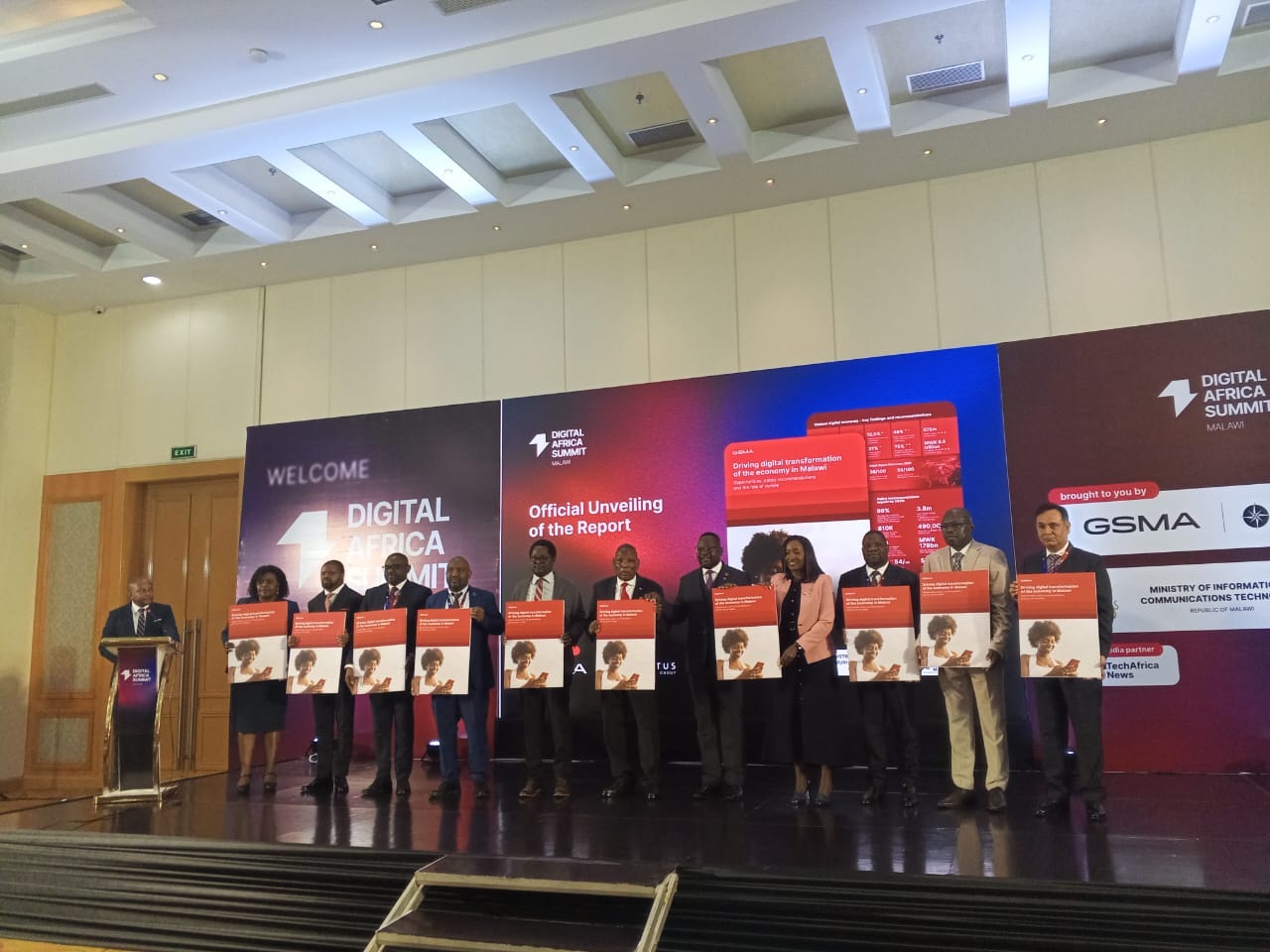
LILONGWE, Malawi— Malawi has spent a decade building one of the most extensive mobile networks in the region, according to a new report presented Thursday at the Digital Africa Summit Malawi. But almost nobody is using it — and a fight over taxes may be a big reason why, writes Winston Mwale.
That was the paradox at the centre of a new report presented to scores of policymakers, telecom executives and international delegates gathered at the Bingu International Convention Centre for the Digital Africa Summit.
The report, “Driving Digital Transformation of the Economy in Malawi,” was produced by the GSMA, the global trade body representing mobile network operators, and lays out five sequenced policy reforms that its authors say could convert Malawi’s already-built network coverage into a genuine digital economy by 2030.
The numbers presented on stage were stark. Some 87% of Malawi’s population — roughly 18 million people — already lives within range of a 4G signal. Yet only about 12% of the population actually uses mobile internet.
The distance between those two figures, what the GSMA calls the “usage gap,” is the largest pool of unconnected potential users in the country’s economy, according to the report.
“We have the networks already running,” said Caroline Mbugua, the GSMA’s senior director of public policy and communications for sub-Saharan Africa, who opened the summit’s presentation of the findings.
“The objective of this report is to look at where we are, what we are doing, and how we can make this digital future happen. We are not seeing a failure of infrastructure; we are seeing a bottleneck of adoption.”
The GSMA’s data traces how far Malawi has come. In 2015, 60% of the population had no network coverage at all. By 2025, that “coverage gap” had fallen to just 8%, a decline the report calls “a genuine national achievement.”
Over the same period, though, the share of Malawians actually using mobile internet crept up only slowly — from 8% in 2015 to 9% in 2018, 11% in 2021, and 12% by 2023, where it has since stalled through 2025.
That leaves 80% of the population sitting in the “usage gap” — covered by a signal but not online — a group the report describes as “the largest single pool of new users in the economy.” One slide put it bluntly: 18 million people are “covered and ready to connect.”
“The hardest part is done: the signal is there,” the report states. “Devices, data prices and digital skills are what turn coverage into users.”
Malawi’s 12% mobile internet penetration rate compares poorly with its neighbors. The Eastern Africa average sits at 21%, and the broader sub-Saharan African average is 28% — meaning Malawi would more than double its number of online users simply by catching up to the regional norm.
Smartphone ownership tells a similar story: only 26% of mobile connections in Malawi are smartphones (33% by unique subscriber count in the GSMA’s benchmarking chart), compared with 43% across Eastern Africa and 59% across the continent as a whole.
Unique mobile subscriber penetration in Malawi stands at 37%, versus 43% regionally and 48% continent-wide.
“Reaching the African average would more than double the number of Malawians online,” the report notes. “The headroom is the opportunity.”
Malawi also lags close regional peers on network reach itself. Uganda has achieved 98% 4G population coverage and Senegal 97%, compared with Malawi’s 87%.
Rural 4G coverage tells an even bigger story: Uganda’s rural coverage stands at 89% and Senegal’s at 92%, while Malawi’s sits at 71%.
Closing an 11-percentage-point gap would put Malawi’s national coverage on par with Uganda; closing a 21-point gap in rural coverage would match Senegal.
The report frames this as more than a domestic milestone — Malawi, it notes, “competes with Kampala and Dakar for the same regional cloud, data-centre and platform investment.”
Nationally, 90% of Malawians have 2G coverage, 92% have 3G, and 87% have 4G — coverage that is close to universal in urban areas (100% across all three technologies) but weaker in rural areas, where 2G reaches 76%, 3G reaches 80% and 4G reaches 71%.
“Operators have taken 4G to 87% of the population,” the report states. “Reaching the final 13% is a question of site economics, and policy shapes those economics.”
Mbugua tied the numbers directly to government policy already on the books.
“Mobile is the delivery channel for every strategy the government has already adopted,” she said, pointing to the National Digital Economy Strategy (2024-2029) and the National Financial Inclusion Strategy.
“Whether we talk about a cash-lite economy where digital payments are the default, or making 100% of government services available online, everything runs on mobile networks and mobile money. But you cannot have a digital nation if 80% of your people are locked out of the network.”
Those targets are not new. Malawi’s national policy blueprint, the Malawi 2063 vision and its first implementation plan, MIP-1, along with the National Digital Economy Strategy, already commit the country to 80% of adults holding a transaction account by 2027, 30% of the population using the internet by 2027, and 100% of government services available online.
“The targets are not in dispute,” the report states. “The question before this room is what has to change for the mobile sector to deliver them on time.”
Mayamiko Nkoloma, the director general of the Malawi Communications Regulatory Authority, used his remarks to argue that the country’s regulatory foundation has not kept pace with the technology it now needs to govern. MACRA still operates under the Communications Act of 2016.
“In 2016, there was no 5G, there was no artificial intelligence,” Nkoloma told the summit.
“Technology can change in a few weeks or months, while traditional regulatory cycles take years. Our friends in America are already discussing 6G, yet we are still bound by a law from 2016. As regulators, we must ask ourselves a fundamental question: Are we enabling African opportunities, or are we a delay to the African future?”
Nkoloma said MACRA is now rewriting the Communications Act and related frameworks, with the goal of shifting the regulator from a “reactive” posture to one that is “adaptive” and “enabling.” But he was careful to distinguish flexibility from a retreat on enforcement.
“Agility means understanding where to intervene, how to intervene, and where to create space for innovation,” he said.
“But let me be very clear: being agile does not mean becoming weak. Where quality of service is unacceptable, where consumers are treated unfairly, or where competition is threatened, MACRA will act firmly and decisively.”
He said digital transformation cannot be financed by government alone and that attracting private capital requires giving investors confidence in the durability of the rules.
“An investor making a long-term commitment needs confidence in the market, in the spectrum pricing, and in transparent competition frameworks,” Nkoloma said.
“Without that confidence, the capital will simply go elsewhere.”
To bring down the cost of expanding coverage, Nkoloma pointed to supply-side measures already under discussion: mandatory infrastructure sharing, tower co-location, national roaming and the introduction of mobile virtual network operators.
And he closed with a caution that regulation of technology cannot be separated from public trust in it.
“Technology without trust cannot transform our society,” Nkoloma said. “Consumers must trust the networks, they must trust that their money is safe, and they must know that their personal information is protected. Data protection, consumer rights, and cyber security are not separate from digital transformation — they are its foundation.”
The summit’s sharpest exchange came in back-to-back addresses from two Cabinet ministers whose portfolios sit on opposite sides of Malawi’s digital tax debate.
Dr. Shadric Namalomba, minister of information and communications technology, opened by crediting operators for reaching 87% 4G coverage but argued forcefully that more towers are not the answer.
“We have done exceptionally well on physical infrastructure,” Namalomba said.
“But the question we must ask is this: Do we need more towers? I don’t think we need more towers. We need electricity connected to the existing towers, yes, but we do not need to keep building redundant infrastructure. We must shift our discussion from infrastructure to adoption.”
He then challenged Airtel Malawi and TNM directly, urging them to use their mobile money infrastructure to help finance smartphone purchases for their existing customers.
“You are already providing mobile money services,” Namalomba said.
“Can you now begin to provide a smartphone on a credit model? These customers are already with you, they transact with you daily. Why can we not come together to create a device-financing model that reduces the upfront cost of a smartphone? If we do that, we can dramatically increase usage.”
Namalomba’s most pointed appeal was aimed at his own Cabinet colleague, Finance Minister Joseph Mwanamvekha.
“Honorable Minister of Finance, remove the taxes!” he said, drawing applause from the room.
“We cannot say internet access is a luxury. It is not a luxury; it is a necessity. It should not be taxed like a luxury good.”
He argued that a tax on digital financial transactions has already begun pushing consumers back toward cash, undercutting the government’s own cash-lite ambitions.
“Since the introduction of these taxes, we have seen a highly regressive trend,” Namalomba said.
“People are withdrawing cash from ATMs and mobile wallets to avoid the transaction levies. Instead of moving toward a cash-lite economy, we are driving people back into informal, cash-based transactions. We are spending resources to replenish cash in machines because people are running away from digital platforms. This is backward. We must align our tax policies with our digital ambitions.”
Mwanamvekha acknowledged the passion behind Namalomba’s remarks but pushed back on the premise that tax relief comes without cost.
“I saw you talking about the need to move up,” Mwanamvekha said, smiling at his colleague.
“Yes, it was quite impassioned. But allow me to put this in perspective. My team and the budget producers are very concerned. The government is operating in a very tough economic environment, and we need revenue to finance public services.”
He drew a firm boundary around the state’s financial role in digital infrastructure.
“Government’s role is not necessarily to finance towers, fiber cables, data centers, or digital platforms,” Mwanamvekha said.
“Our role is to create the necessary conditions under which private investors can finance these projects.”
He said the government is exploring public-private partnerships, guarantees, technical assistance and risk-sharing instruments to draw in private capital, but insisted that “fiscal innovation” does not mean reckless tax cuts.
“Every new financing instrument, every tax incentive, has to be assessed carefully for affordability, value for money, fiscal risks, and sustainability,” he said.
Even so, the finance minister signaled a shift in how his ministry intends to think about digital taxation going forward — away from evaluating individual levies in isolation and toward what he called a “total economic impact” model.
“We can build network infrastructure that meets most of our needs, but if the system cannot afford the cost of data, the economic benefits of those networks will remain unrealized,” Mwanamvekha said.
“This raises the critical question: How do we broaden our tax base and mobilize national revenue while ensuring that taxes do not make digital services unaffordable?”
He acknowledged that “excessive taxing on devices, data, and digital services can raise the cost of investment in the digital economy and suppress the very economic activities from which future tax revenue should come.”
“Our approach is therefore to consider the total economic impact of taxation rather than looking at individual taxes in isolation,” he said.
“A tax that raises revenue today may significantly reduce digital adoption, causing a far larger negative economic impact overall. Our objective must be a broad and sustainable tax base that provides an environment in which digital services are more affordable and widely used.”
Mwanamvekha added that tax rates are only part of what investors weigh.
“When investors are considering material investments in digital infrastructure, they need to know what the policy and digital environment will look like over the life of that investment,” he said, citing the need for clear traffic laws, licensing, predictable customs procedures and reliable access to foreign exchange.
“Achieving our digital ambitions requires an environment that provides clarity, consistency, and transparency.”
The GSMA’s own modeling backs Namalomba’s position with figures. Malawi currently levies a 10% excise duty on mobile data and airtime — a rate that sits in the top half of the 21 African countries that impose such sector-specific charges.
Zambia’s rate is 17.5%, Tanzania’s is 17%, Kenya’s and Somalia’s are both 15%, Burundi’s and Uganda’s are 12%, and Malawi sits alongside the Democratic Republic of Congo, Rwanda and Zimbabwe at 10%. By contrast, Madagascar charges 8%, Ghana and Senegal charge 5%, and Côte d’Ivoire charges just 3%.
Removing Malawi’s 10% excise duty on data would cost the treasury roughly 10 billion kwacha in forgone revenue in the first year, according to the report.
But the GSMA’s macroeconomic modeling projects that the resulting surge in adoption would generate a cumulative net fiscal return of 179 billion kwacha by 2030 — an 18-fold return — driven by four channels: economic growth that expands the taxable base, formalization of previously informal businesses, better tax compliance through digital audit trails, and lower collection costs for the Malawi Revenue Authority.
“No market that reduced a sector-specific tax lost revenue,” the report states. “In each case a larger, more active user base more than replaced the rate.”
The report cites several international precedents. Kenya cut excise duty on airtime and data and saw sector revenue continue to grow as usage expanded. Ghana reduced its electronic transaction levy after transaction volumes fell, and digital payments recovered.
Pakistan removed a handset levy, and both smartphone imports and data revenue rose.
Colombia removed VAT on low-cost handsets, and ownership among poorer households rose sharply.
And South Africa, in April 2025, exempted smartphones priced below 2,500 rand from ad valorem duty; sales of those exempted handsets rose 49% in the following months, with their share of the market climbing from 23% to 31%.
The GSMA’s recommendations, presented alongside Mbugua by Bienvenu Comlan Agbokponto Soglo, the organization’s spectrum director for sub-Saharan Africa, are organized into five pillars, each tied to a specific, modeled outcome.
Reform one: a sustainable environment for network investment. This pillar calls for publishing a multi-year spectrum roadmap with indicative kwacha-denominated prices, moving to technology-neutral, unified licensing so operators can re-farm existing 2G or 3G spectrum for 4G and 5G without a new licensing process, mandating passive infrastructure sharing and “dig-once” rules for public road and grid works, extending the electricity grid to tower sites, and streamlining rights-of-way and municipal tower levies into a single national framework.
The economics behind this reform are significant. Roughly 30% of Malawi’s existing 4G sites sit more than a kilometer from the electricity grid, and more than 87% of the new sites needed to reach 99% coverage would also be off-grid.
Operating an off-grid, diesel-powered rural site costs two to three times more than a grid-connected urban one.
ESCOM, the state power utility, loses an estimated 3 billion kwacha a year to vandalism of grid infrastructure, which further undermines tower uptime.
Under current conditions, reaching 99% 4G coverage — from today’s 87% — would require $60 million in additional capital investment. With the recommended reforms in place, the same outcome would cost about $40 million, roughly a third less.
The remaining 1% of the population would still need to be served by satellite or other alternative technology.
“None of these decisions require new public spending,” Soglo said. “Each decision simply lowers the cost of extending coverage to the hardest-to-reach rural areas.”
Reform two: letting mobile money finish the job on financial inclusion. The report calls for completing full interoperability between mobile money providers, commercial banks and the national payment switch with transparent wholesale pricing; applying risk-proportionate, tiered “Know Your Customer” rules so a national ID or voter card is enough to open a basic wallet; regulating mobile money on the same functional basis as bank transfers rather than as a separate, more heavily taxed product; protecting the commissions and float liquidity that sustain Malawi’s network of 656,276 mobile money agents; and routing government salaries, pensions, subsidies and social cash transfers through mobile money.
Mobile money is already a systemic part of Malawi’s economy, moving the equivalent of 2% to 4% of GDP in 2023.
Yet only 30% of Malawians currently hold a mobile money account, against a national target of 80% of adults by 2027.
The report notes that Malawi has fewer than 200 bank branches, concentrated in urban centers, compared with 656,276 mobile money agents that already reach rural and informal users — a retail footprint the report says banks “would take decades to replicate.”
Across Africa more broadly, the wider mobile sector generated $220 billion in economic value in 2024, or 7.7% of the continent’s GDP, contributed roughly $30 billion in taxes to African governments, and supported about 8 million jobs.
Reform three: digital revenue mobilization instead of sector-specific taxes, discussed above, centers on removing the 10% excise duty, ruling out new sector-specific levies for the life of the digital strategy, and publishing a medium-term tax framework so investors can build cases on stable assumptions.
Reform four: bridging the device and skills barrier. With smartphones making up just 26% of connections against a 51% African average, the report calls this “the single biggest brake on adoption.”
Recommendations include removing import duty and VAT on entry-level smartphones, following the South African and Colombian examples; supporting device-financing and installment models; funding a national digital-skills program delivered through schools, colleges and agricultural extension services; prioritizing Chichewa-language digital content so language is not a barrier to first-time users; and using Malawi’s Universal Service Fund for demand-side measures such as devices and skills training, not only for towers.
Reform five: a unified national digital strategy. Digital policy in Malawi is currently fragmented across MACRA, the Reserve Bank, the Malawi Revenue Authority and multiple line ministries, which the report says creates policy inconsistency that investors price into their cost of capital.
The recommendation is to mandate a single coordinating office within the Office of the President and Cabinet, align the relevant agencies behind one strategy, publish an implementation plan with named owners and dated milestones on a public dashboard, modernize the legal framework governing data protection, cybersecurity and consumer protection, and report annually to Cabinet against the report’s Digital Policy Readiness Index indicators.
“This reform costs almost nothing and makes the other four deliverable,” the report states. “It is the enabling condition for everything else.”
Ten of the index’s underlying indicators — covering areas from spectrum roadmaps to handset affordability programs — currently score zero for Malawi, according to the GSMA’s diagnostic.
The report frames that starting point not as a criticism but “a shortlist,” noting each gap “can be closed by a decision this Government already has the power to take.”
Soglo said the fifth pillar matters disproportionately to how investors price risk. “Policy certainty is the cheapest form of investment promotion,” he said.
“When investors see a unified strategy and a single rulebook, perceived risk drops, and capital flows in at a much lower cost.”
Industry executives used the summit’s panel sessions to describe the operational and financial pressure of running Malawi’s networks today, including Aashish Dutt, managing director of Airtel Malawi, and Lloyd Gowera, chief technical officer of TNM.
Network congestion during peak hours emerged as a recurring concern. “When a customer accesses the network during peak hours, the speed depends heavily on the number of active users on that specific sector,” one technical representative explained.
“When utilization hits 85% to 90%, congestion occurs, and users experience a dramatic drop in data speeds.”
Operators facing congestion have only two real options, the representative said: acquire additional spectrum or build new physical sites.
“Building new sites is an incredibly expensive option, especially in the current economic environment where equipment must be imported using scarce foreign exchange,” the representative said.
Temporary spectrum allocations — including one-year access to the 2600 MHz band granted during periods of extreme congestion — complicate investment planning.
“Should we invest millions in deploying equipment for spectrum we might lose in twelve months? We need long-term, predictable spectrum policies so we can invest with confidence.”
Gowera, TNM’s chief technical officer, echoed the point, framing infrastructure sharing as a partial solution to capital constraints.
“We are operating in a very tough environment at the moment,” he said.
“Because of our cost structure and the difficulty of accessing foreign exchange, it takes a long time to realize a return on equipment purchases. If we want to resolve congestion issues and expand 4G and 5G faster, we must look at a collaborative approach, such as active infrastructure sharing, which can significantly reduce capital strain on individual operators.”
Dutt, Airtel Malawi’s managing director, focused on the economics of the final stretch of rural coverage. “Operating a rural tower site that relies on diesel generators is two to three times more expensive than operating a grid-connected urban site,” he said.
“When you combine those high operational costs with the low purchasing power of rural communities, the business case for rural expansion becomes extremely difficult. That is why the GSMA’s recommendation to connect tower sites to the national grid and treat them as productive energy users is so vital. It shifts the economics of rural coverage.”
The GSMA’s modeling projects what full implementation of the five reforms would mean for Malawi by 2030, measured against a business-as-usual baseline that extrapolates current investment and adoption trends without policy change.
Mobile internet subscribers would rise from 2.78 million in 2025 to 4.19 million under business as usual, or to 5.00 million with the reforms in place — a gain of 810,000 additional users attributable to policy change alone.
Mobile internet penetration would rise from 12% to 20% of the population.
The usage gap — people covered but not online — would shrink from 80% to 75% of the population, while the coverage gap would fall from 8% to 5%. Overall 4G population coverage would climb from 87% to 99%.
The cumulative economic value added to the Malawian economy by 2030 would reach 1.103 trillion kwacha, according to the report’s input-output modeling.
The gains would not be concentrated in telecommunications: agriculture is projected to capture the largest share, at 350 billion kwacha, followed by manufacturing at 221 billion kwacha, government at 176 billion kwacha, healthcare at 161 billion kwacha, transport at 109 billion kwacha and trade at 86 billion kwacha.
Agriculture, manufacturing and government together account for roughly two-thirds of the total value added — evidence, the report argues, that digital reform functions as broad economic policy rather than a sector-specific intervention.
The reforms are projected to directly and indirectly support 490,000 jobs by 2030. On the fiscal side, the Treasury’s roughly 10 billion kwacha in first-year revenue forgone from removing the excise duty would be recovered nearly 18 times over, reaching a cumulative net fiscal gain of 179 billion kwacha by 2030 — driven by VAT and corporate tax on a larger user base, formalization of informal trade, improved compliance, lower collection costs and growth in adjacent sectors such as agriculture, trade and finance.
On policy readiness, Malawi’s Digital Policy Readiness Index score would rise 19 points, from 55 to 74, moving the country into the top quartile of African nations for enabling policy environments and placing it ahead of where Senegal stands today.
Malawi’s companion Digital Nations and Society Index score, which measures actual digital development outcomes rather than policy quality, would rise 18 points, from 36 to 54 — bringing Malawi level with Senegal’s current score.
The report’s scatter-plot comparison shows Malawi sitting below the African trend line today, with South Africa, Kenya and Mauritius clustered well ahead on both measures; the modeled 2030 position would move Malawi into that same cluster.
“Policy is the lever Malawi controls directly,” the report notes. “Move the policy score and the development score follows — the two track each other closely. Peers at similar income levels already sit further right: the constraint is policy design, not national wealth.”
The GSMA closed its presentation by assigning each reform to the government body positioned to act on it: the Ministry of Information and Digitalisation alongside MACRA, tasked with publishing the spectrum roadmap and moving to technology-neutral licensing; the Ministry of Finance and the Malawi Revenue Authority, tasked with removing the 10% excise duty on data and duty on entry-level smartphones; the Reserve Bank of Malawi, tasked with completing interoperability and applying risk-proportionate, tiered KYC rules; the Ministry of Energy and ESCOM, tasked with treating tower sites as productive users in grid-extension planning; and the Office of the President and Cabinet, tasked with mandating a single office to coordinate delivery of the digital strategy.
“Malawi has the network, the mobile money base and the national strategy,” the report concludes. “These five decisions are what turn them into a digital economy.”
As the summit broke for its networking lunch, the message from the stage was consistent across government officials, regulators and industry executives alike: the physical work of building Malawi’s mobile network is essentially finished.
What remains is a set of choices about taxation, spectrum, energy access and institutional coordination — choices that, according to the GSMA’s modeling, now stand between Malawi and a fundamentally different digital economy by the end of the decade.
Comments
Nothing yet. Say the first thing.
Sign in to join the conversation.