
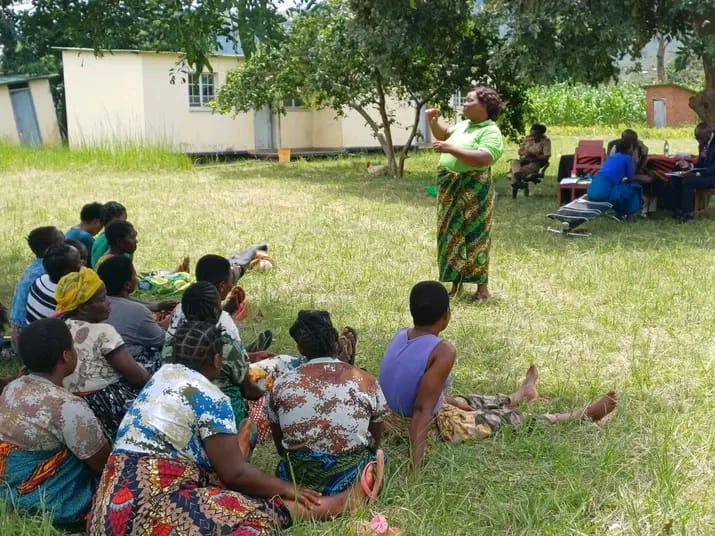
CHITIPA, Malawi — For nearly two decades, residents of Senior Chief MweneWenya’s area in Chitipa have lived without a functioning magistrate’s court, forcing victims, defendants and witnesses to travel long distances for justice and leaving some cases unresolved, writes Patricia Kayuni.
Senior Chief MweneWenya describes the situation as a denial of justice, warning that the continued absence of court services is creating a dangerous gap in the administration of justice in the area.
The chief says traditional leaders routinely handle civil disputes within their communities, but their powers are limited when cases cross into the criminal justice system.
“As chiefs, we can’t go as far as handling criminal cases, that’s for the courts but then, courts are far with high traveling costs.”
According to MweneWenya, the nearest operational court is at Chitipa Boma, creating a substantial financial and logistical burden for people who need to pursue cases.
He said the consequences have been particularly severe for poor residents who cannot afford transport, accommodation and other expenses associated with repeated journeys to Chitipa.
“Some cases have disappeared, died, gone unattended to, leaving perpetrators free because people can’t afford to travel to Chitipa Boma,” he said.
The chief said he had previously raised the matter with authorities and was informed that the Judiciary faces shortages of key personnel, including magistrates, court clerks and court messengers.
MweneWenya fears that if the situation continues unchecked, frustration could deepen and undermine confidence in the formal justice system.
A court dependent on temporary projects
The problem is not new.
First Grade Magistrate Billy Ngosi says the Chitipa Magistrate Court has for years depended on support from development organisations to extend justice services to Wenya.
He said the court previously benefited from a project implemented by Church and Society at Nthalire.
“Years ago, we had Church and Society who had a project at Nthalire so we would always stop at Wenya and attend to some cases.”
When that project ended, World Vision later provided another opportunity for court officials to reach the area.
Ngosi said the current arrangement involves SPRODETA, which is supporting the court through its project in Mlembe and Chisenga.
The support has enabled magistrates and court officials to periodically travel to communities that would otherwise have little access to formal court services.
But Ngosi cautioned that relying on development projects is not a permanent solution.
“The arrangements are not sustainable because projects have timelines,” he said.
Once a project ends, the court’s ability to conduct outreach in the affected communities can disappear with it.
The result is a justice system that, in practice, depends partly on whether an organisation happens to be implementing a project in the area.
A 90-kilometre journey for justice
For residents, the consequences are more than theoretical.
Jonathan Msango, who has lived in Wenya since 1981, remembers having to travel to Chitipa Magistrate Court for a case in the late 1990s.
Msango said the case was heard in Chitipa because the local court was already non-operational.
“In 1998 through to 1999, I had a case which was taken to Chitipa Magistrate Court because ours here is non-operational,” he said.
Msango was able to travel by car because he could afford it.
The defendant and his wife, however, had to walk.
“I managed to travel by car because I had the capacity but the defendant and his wife walked all the way to Chitipa, a journey of close to 90 kilometers,” he said.
The experience illustrates one of the central problems facing people in remote communities: access to justice can depend on one’s ability to pay.
For wealthier residents, travelling to a distant court may be inconvenient.
For poor families, it can be impossible.
Transport costs, lost working days, food and accommodation expenses can all turn a legal right into a service that is effectively inaccessible.
Cases left behind
Msango said the problem remains relevant today.
He cited a defilement case earlier this year in which the alleged perpetrator fled, leaving the victim and her mother without justice.
The case, he said, illustrates how vulnerable people can be when formal justice services are difficult to access.
For victims of serious crimes, delays can have consequences that cannot easily be reversed.
Evidence may become more difficult to obtain, witnesses may become unavailable and suspects may evade arrest or prosecution.
For families already dealing with trauma, repeated travel over long distances can add another burden.
The absence of a functioning court therefore affects more than the convenience of attending hearings.
It can influence whether cases are reported, pursued and ultimately resolved.
Traditional leaders fill the gap — but only so far
In the absence of a functioning court, traditional leaders remain an important first point of contact for people seeking to resolve disputes.
MweneWenya says chiefs can mediate and settle many civil matters within their communities.
But criminal cases require the involvement of the formal justice system.
This creates a difficult situation.
Traditional authorities can help resolve some disputes, but they cannot substitute for magistrates, prosecutors, police and other institutions responsible for handling criminal offences.
The chief’s concern is that the longer the formal system remains absent, the greater the risk that serious cases will remain unresolved.
He fears that this could eventually undermine respect for the rule of law.
Judiciary acknowledges the challenge
The Judiciary says it recognises the importance of restoring court services in Wenya and other parts of the country facing similar challenges.
Judiciary Public Relations Officer Ruth Mputeni said financial constraints remain one of the major obstacles preventing the institution from extending services to every community that needs them.
She said one possible solution would be to prioritise the rehabilitation and expansion of the Wenya Magistrate Court through the Constituency Development Fund (CDF).
Under the proposal, the community would support the rehabilitation and extension of the court infrastructure through CDF, while the Judiciary would provide technical assistance and facilitate the deployment of staff.
Such an arrangement could potentially address two of the biggest obstacles identified by residents: inadequate infrastructure and the absence of permanent court personnel.
But it would also require sustained commitment beyond the construction or rehabilitation of the physical court.
As Ngosi pointed out, court buildings alone cannot deliver justice.
Magistrates, clerks, court messengers and other personnel must be available to operate them.
A national problem
The situation in Wenya is not necessarily an isolated one.
Across Malawi, communities in remote and underserved areas face challenges accessing formal justice because of distance, infrastructure limitations, staff shortages and financial constraints.
For residents of such areas, the location of a courthouse can determine whether justice is realistically accessible.
The Constitution guarantees access to justice and the protection of fundamental rights, but those guarantees become difficult to realise when people must travel tens of kilometres simply to have their cases heard.
The Wenya experience exposes the gap between justice as a constitutional principle and justice as a practical service.
Nearly 20 years without a functioning local court means generations of residents have grown accustomed to travelling elsewhere when they need formal judicial services.
Some have been able to make the journey.
Others have not.
And, according to local leaders, some cases have simply disappeared from the system.
For MweneWenya, the answer is not complicated: the formal justice system must return to the community.
Traditional leaders can continue resolving disputes within their mandate, but serious criminal cases must be handled by the courts.
Without that access, he warns, the community remains vulnerable to a cycle in which victims struggle to pursue justice, suspects can evade accountability and confidence in formal institutions gradually erodes.
The Judiciary’s proposal to rehabilitate and extend the Wenya Magistrate Court through CDF could provide a route forward.
But after almost two decades, residents need more than another temporary outreach arrangement.
They need a functioning court, permanent personnel and a justice system that is close enough to be used by everyone — not only those who can afford the journey to Chitipa.
For the people of Wenya, the phrase “justice delayed is justice denied” is no longer simply a legal maxim.
It has become a description of everyday life.
Comments
Nothing yet. Say the first thing.
Sign in to join the conversation.