
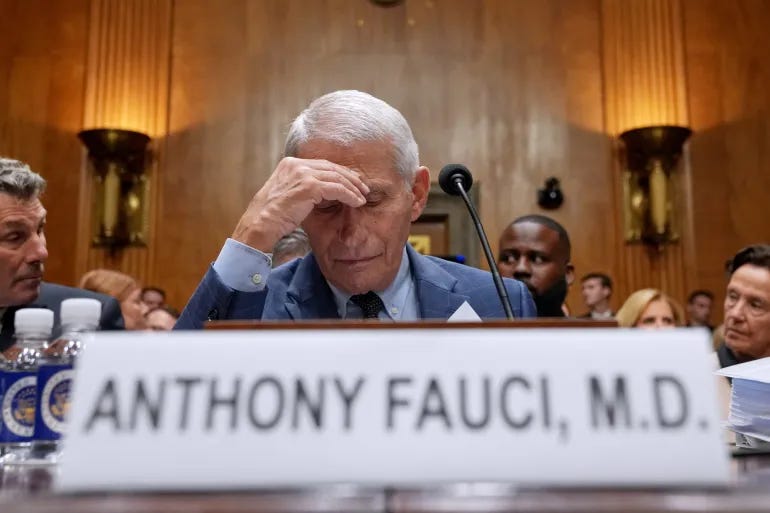
Dr. Anthony Fauci, the former face of the federal government’s response to COVID-19, is once again running from congressional accountability. On Friday, an attorney representing Fauci formally notified Senator Ron Johnson’s office that the former National Institute of Allergy and Infectious Diseases director will not voluntarily appear before Johnson’s Permanent Subcommittee on Investigations, opening yet another chapter in a years-long saga of a public official who has repeatedly dodged serious scrutiny over his role in the pandemic response.
The refusal comes at a particularly telling moment. Just over a week earlier, Republicans on the Senate Homeland Security and Governmental Affairs Committee voted along party lines to hold Fauci in contempt of Congress.
That vote followed his combative appearance before the same committee on July 29, during which Fauci invoked his Fifth Amendment right against self-incrimination more than one hundred times. For a man who spent years insisting to the American public that he had nothing to hide and welcomed oversight, the sheer volume of those Fifth Amendment invocations speaks volumes on its own.
In an August 14 letter obtained by reporters, Fauci’s attorneys David Schertler and Danny Onorato argued that a second Senate appearance would amount to little more than political harassment. The letter claimed Fauci had already answered questions honestly and transparently during his numerous congressional appearances and that he stands by all of his prior testimony. That argument might carry more weight if Fauci had not spent his last appearance under oath refusing to answer questions well over one hundred separate times.
Senator Johnson, who chairs the Permanent Subcommittee on Investigations, did not mince words in response. He noted that Fauci had previously claimed, in years past, that he was very happy to testify before any congressional oversight committee and had nothing to hide. Johnson’s response to the latest refusal was pointed and direct: apparently, he has a lot to hide. It is hard to argue with that assessment given the pattern of behavior on display.
Johnson’s investigation is examining the federal government’s broader response to the COVID-19 pandemic, including outstanding questions about the safety and efficacy of the COVID-19 vaccines that were developed and distributed under Fauci’s guidance at NIAID.
These are not fringe questions. They are exactly the kind of oversight the legislative branch is constitutionally empowered to conduct, particularly given the scale of the federal government’s intervention into American life during the pandemic, from lockdowns to vaccine mandates to school closures that upended an entire generation’s education.
The broader Homeland Security Committee, which held the July hearing where Fauci repeatedly invoked the Fifth Amendment, had already received more than 1,000 pages of Fauci’s personal diary ahead of that appearance. That is a significant volume of material for a man whose attorneys now claim he has already been fully transparent. If Fauci truly believed his record was clean, there would be little reason to treat a follow-up appearance before a different Senate panel as an act of harassment rather than a routine extension of the oversight process already underway.
At the center of this entire standoff is a critical legal question that Fauci’s team has conveniently avoided addressing head on: whether he can continue to invoke the Fifth Amendment at all, given that former President Joe Biden issued him a sweeping, preemptive pardon before leaving office.
Senator Rand Paul, who chairs the Senate Homeland Security and Governmental Affairs Committee, has been particularly vocal on this point, arguing that the pardon should have effectively removed any risk of federal prosecution that would normally justify invoking the Fifth Amendment. If there is no risk of prosecution because the outgoing president already shielded Fauci from one, then the constitutional basis for refusing to answer questions becomes far shakier.
Paul has pursued an aggressive path to hold Fauci accountable, seeking to send the committee’s contempt referral directly to the U.S. Attorney’s Office in the District of Columbia rather than routing it through a full Senate floor vote first. Paul has described the underlying legal reasoning as a strong case, one he intends to press directly with the Department of Justice as the referral moves forward. Given the current leadership at the Justice Department, which has shown a clear commitment to pursuing accountability for pandemic-era abuses, that referral could carry real weight.
It is worth remembering just how central Fauci was to the federal government’s pandemic response and how much authority he wielded with remarkably little day-to-day accountability. As director of NIAID for nearly four decades, Fauci became arguably the most powerful unelected bureaucrat in the country during 2020 and 2021, shaping policy on lockdowns, mask mandates, social distancing guidelines, and vaccine rollout, often with contradictory public statements that shifted based on political winds rather than settled science. Millions of Americans lost jobs, businesses, and irreplaceable time with loved ones based on guidance that came directly from Fauci’s office.
Questions about the origins of COVID-19 itself remain deeply intertwined with Fauci’s legacy. NIAID funded gain-of-function research at the Wuhan Institute of Virology through subgrants routed via EcoHealth Alliance, funding arrangements that Fauci downplayed and, critics argue, mischaracterized in earlier congressional testimony. The lab leak theory, once dismissed by much of the media and public health establishment as a fringe conspiracy pushed by conservatives, is now treated as a plausible, mainstream explanation for the virus’s origins by intelligence agencies and scientists alike. Fauci’s role in shaping the early public narrative around that theory, and his private communications suggesting internal concern even as he publicly downplayed the possibility, remain a significant part of what congressional investigators are trying to pin down.
Fauci’s pattern of resistance to oversight is not new. Throughout his tenure, he cultivated an image as an apolitical scientist simply following the data, even as his public guidance shifted dramatically over time on issues ranging from mask efficacy to natural immunity to the necessity of prolonged school closures. Now, faced with a Senate committee seeking direct answers about vaccine safety and the broader pandemic response, he has chosen silence over transparency, invoking constitutional protections against self-incrimination rather than defending the record he claims to stand by.
Florida Attorney General James Uthmeier has separately vowed that his state will pursue every tool available to seek the truth about Fauci’s conduct during the pandemic. That statement reflects a growing sentiment among state-level officials that federal accountability mechanisms alone may not be sufficient, and that states have an independent interest in uncovering the full record of decisions that affected their residents so profoundly.
Senator Johnson has also reportedly obtained a copy of Fauci’s cellphone data from the pandemic era, adding another avenue of investigation that does not depend on Fauci’s voluntary cooperation. Whether that data will yield the kind of direct answers Congress has been seeking for years remains to be seen, but it underscores that lawmakers are not simply relying on Fauci’s willingness to testify. They are building an independent record through subpoenaed materials and documentary evidence that exists whether or not Fauci chooses to sit for an interview.
It remains unclear whether Johnson’s committee will move to formally subpoena Fauci following this latest refusal. Fox News Digital reached out to Johnson’s office for comment on that question but had not received a definitive answer by publication. Fauci’s attorney was also asked directly whether his client would comply with a subpoena compelling testimony, a question that similarly went unanswered.
That silence is itself notable. If Fauci and his legal team were confident that a subpoena would simply result in another appearance where he answers questions honestly, as his attorneys claim he has always done, there would be little reason to avoid a clear commitment either way. The refusal to answer even that basic procedural question suggests Fauci’s team is trying to buy time and avoid a firm public position for as long as possible.
Unhinged liberals have characterized these efforts as politically motivated harassment of a retired public servant. That framing conveniently ignores the scale of authority Fauci wielded for decades over public health policy affecting every American, funded almost entirely by taxpayer dollars, and the fact that Congress retains a legitimate constitutional oversight role regardless of whether the official in question has left government service.
Retirement does not erase accountability, particularly when the underlying questions involve the safety and efficacy of medical products administered to hundreds of millions of Americans.
The pattern here is unmistakable to anyone who has followed Fauci’s public conduct over the past several years. When facing friendly interviewers or ceremonial appearances, Fauci has been perfectly willing to speak at length about his career and his role in combating the pandemic. When facing pointed, adversarial questioning under oath from lawmakers seeking specific accountability, he has repeatedly found reasons to avoid engagement, whether through Fifth Amendment invocations or outright refusals to appear voluntarily.
Thanks for reading! This post is public so feel free to share it.
No posts
Comments
Nothing yet. Say the first thing.
Sign in to join the conversation.