
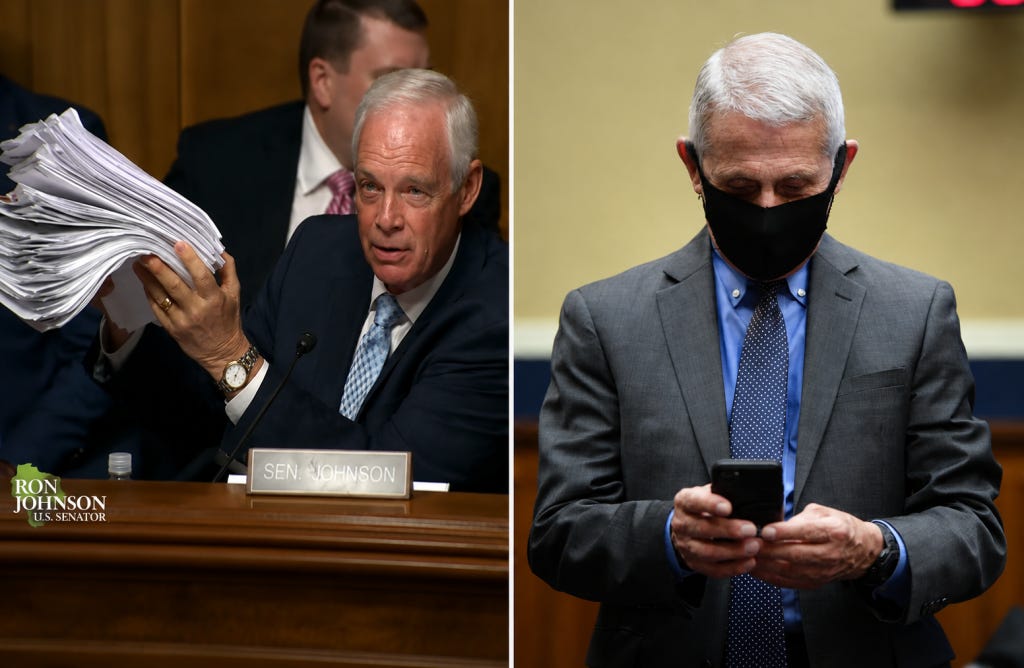
Dr. Anthony Fauci spent nearly a decade as one of the most powerful unelected officials in Washington, and the device he carried through the worst years of the pandemic is now raising fresh questions about what he may have tried to hide. Senate investigators reviewing Fauci’s government-issued iPhone say the phone contains more than 34,000 text messages and over 500 voicemails spanning from 2014 until just days before he left the National Institutes of Health in December 2022. Yet despite nearly eight years of near constant communication, the device’s contact list holds only three names.
Sen. Ron Johnson of Wisconsin, who chairs the Senate’s Permanent Subcommittee on Investigations, disclosed the discrepancy this week and did not hide his suspicion. Nearly every other text message on the phone is tied only to a raw phone number rather than a saved name, a pattern Johnson says is highly unusual for a device used so heavily by a top government official for the better part of a decade.
“What’s odd about it, Benny, is there are only three contacts in this contact list. Every other text has a phone number attached,” Johnson told conservative podcast host Benny Johnson this week. He went further, telling reporters the pattern suggests to him that Fauci, or someone else with access to the phone, deliberately deleted the contact list to obscure who he was really talking to during the pandemic response.
Johnson has been careful to note that investigators cannot yet prove when or by whom the contacts were removed. Still, the sheer scale of the gap between 34,000 messages and three saved names has struck even seasoned Capitol Hill staffers as remarkable. Investigators are now left with the tedious task of tracing thousands of individual phone numbers to determine exactly who was on the other end of Fauci’s private conversations throughout the pandemic.
The phone itself was handed over last month by the Department of Health and Human Services after Johnson’s subcommittee formally requested it as part of a broader investigation into the government’s COVID response and Fauci’s prior statements to Congress. That investigation has already produced friction. The Senate Homeland Security and Governmental Affairs Committee previously voted to hold Fauci in contempt of Congress, and the decision on whether to pursue criminal charges now rests with the Justice Department.
This Substack is reader-supported. To receive new posts and support our work, consider becoming a free or paid subscriber.
Fauci’s team has argued in the past that his 2022 pardon from President Biden should shield him from prosecution. Johnson and other Republicans have countered that a pardon does not erase the public’s right to know what happened, nor does it prevent Congress from digging into a taxpayer-funded response that upended American life for years.
The first batch of text messages released by Johnson and Sen. Rand Paul this week already contained a significant revelation. In messages from January 2021, Fauci wrote that he was concerned the second dose of the COVID vaccine “theoretically could be associated with miscarriage in the 1st trimester.” Those private concerns stand in stark contrast to the public messaging pushed by federal health agencies at the time, which urged pregnant women to get vaccinated with little public acknowledgment of the risk Fauci was privately weighing.
Critics have long pointed to data from the Vaccine Adverse Event Reporting System showing a dramatic spike in reported miscarriages and stillbirths following the mRNA vaccine rollout. For years, those concerns were dismissed by health officials and much of the legacy media as misinformation. The newly released texts suggest that at least some of those concerns were shared privately by the very official who insisted publicly there was nothing to worry about.
That gap between Fauci’s private doubts and his public certainty is exactly what critics have accused him of for years. Throughout the pandemic, Fauci was treated by much of the press as an infallible scientific authority whose recommendations were beyond question. Now, with tens of thousands of his private messages finally in the hands of investigators, that carefully managed public image is being tested against the paper trail he left behind.
The missing contacts add another layer to the mystery. A device used by one of the most consequential public health officials in modern American history, over a period spanning nearly a decade, would ordinarily contain dozens if not hundreds of saved contacts. Colleagues, staff, fellow scientists, government officials and reporters would all typically appear in some form. Instead, investigators found just three names attached to a mountain of correspondence.
Johnson has suggested two possible explanations. Either the contact list was scrubbed deliberately to prevent easy identification of who Fauci was communicating with, or Fauci simply never bothered to save numbers that could later become inconvenient. Neither explanation reflects well on a man who spent years assuring the American public of his transparency and scientific integrity.
Conservative commentators have seized on the discovery as further proof that Fauci operated with far less oversight and far more secrecy than the public was ever told. For years, Republicans in Congress pushed for access to Fauci’s communications only to be met with resistance from the Biden administration and NIH lawyers. The current investigation, now armed with an actual copy of the phone’s contents, represents the most direct look yet into how Fauci actually operated behind closed doors.
It is worth noting the scope of what investigators are now working through. More than 34,000 text messages is an enormous volume of material, and reviewing it in full will take time. Johnson has cautioned the public not to expect every revelation to surface immediately, but has signaled that his subcommittee intends to work through the material systematically and release additional findings as they are confirmed.
The timing of the phone’s contents, stretching back to 2014, means investigators may also uncover material well outside the pandemic itself. Fauci held enormous influence over federal health policy and research funding for decades before COVID ever emerged, including his agency’s role funding research at the Wuhan Institute of Virology. Years of communications predating the pandemic could shed new light on decisions that Republicans have long argued deserve far more scrutiny than they received.
For millions of Americans who lived through lockdowns, school closures, mandates, and shifting public health guidance, Fauci became the face of a government response many now view as deeply flawed. The revelation that his own phone appears to have been stripped of nearly all identifying contact information, even as it retained tens of thousands of messages, is likely to reinforce the belief among his critics that accountability was actively avoided rather than embraced.
Democrats and Fauci’s defenders have largely stayed quiet since the disclosure, though it is likely they will eventually argue the missing contacts have an innocent explanation, such as a settings change or a lost backup. Johnson’s investigators will need to determine whether any forensic evidence supports or contradicts that kind of explanation as they continue combing through the data.
What is not in dispute is the raw number involved. A government phone used by a top federal official for the better part of a decade produced more than 34,000 text messages and over 500 voicemails, yet only three names survived in the contact list. That imbalance alone has been enough to convince a sitting United States senator that something was deliberately hidden.
Johnson has indicated that identifying the individuals behind the anonymous phone numbers is now a top priority for his subcommittee. Doing so could reveal previously unknown lines of communication between Fauci and other officials, scientists, pharmaceutical executives, or members of the media during the most consequential public health crisis in a generation.
This Substack is reader-supported. To receive new posts and support our work, consider becoming a free or paid subscriber.
Thanks for reading! This post is public so feel free to share it.
Comments
Nothing yet. Say the first thing.
Sign in to join the conversation.