
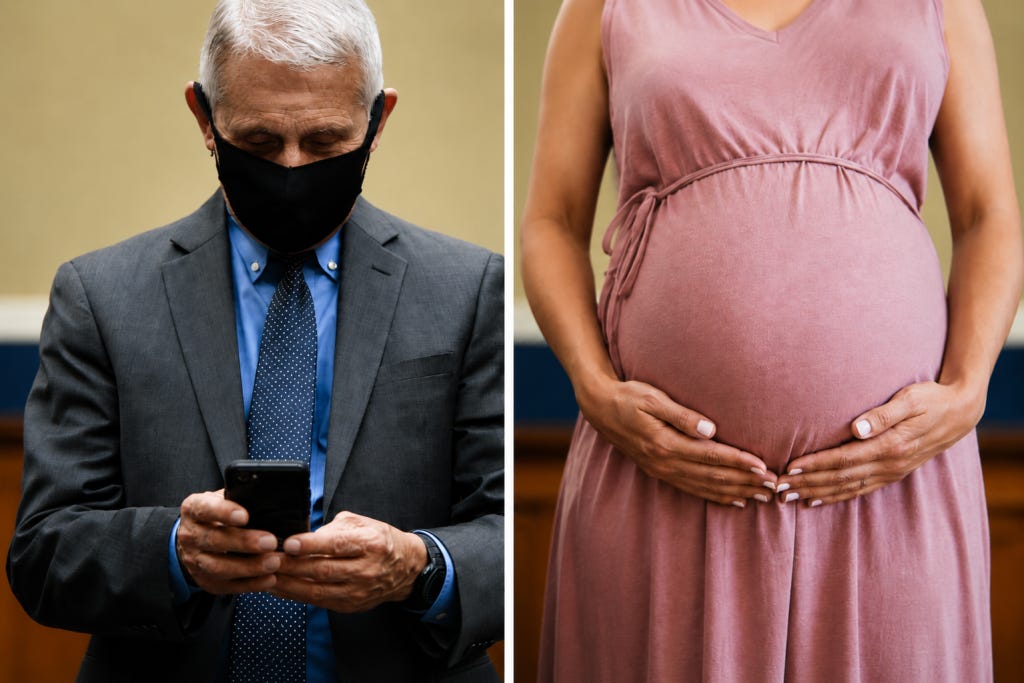
For years, Dr. Anthony Fauci stood before cameras and told pregnant American women that the COVID-19 vaccines posed no meaningful risk to them or their unborn children. Newly released text messages from his own government-issued phone tell a very different story, one that raises serious questions about whether the nation’s most trusted pandemic messenger was being fully honest with the public he was supposed to serve.
The messages were obtained and released by Republican Senators Ron Johnson of Wisconsin and Rand Paul of Kentucky, who have led the GOP investigation into Fauci’s handling of the coronavirus pandemic. The senators say they obtained a forensic copy of Fauci’s phone from the Department of Health and Human Services, part of a trove containing more than 34,000 texts and 522 voicemails pulled by the Senate Homeland Security Committee.
Among the most damning exchanges is a January 25, 2021 text chain between Fauci, then CDC Director Dr. Rochelle Walensky, and Dr. Vivek Murthy, who would go on to serve as Joe Biden’s surgeon general. In that exchange, Fauci wrote plainly that because many people experience significant cytokine storm and fever after a second mRNA vaccine dose, that reaction theoretically could be associated with miscarriage in the first trimester.
That is not a vague or speculative aside buried in an obscure memo. It is Fauci, in his own words, privately acknowledging a specific and named risk to pregnant women just as the vaccine rollout was accelerating across the country. Yet in his public statements during the same period, that specific warning never surfaced.
Instead, roughly nine days after this private exchange, Fauci told the public that approximately 10,000 pregnant women had been vaccinated with no issues reported, and that there were, in his words, no red flags. In a separate public comment cited by investigators, Fauci said the number was closer to 20,000 pregnant women vaccinated under Emergency Use Authorization with no red flags, monitored by the CDC and FDA.
The contrast between the private warning and the public reassurance is precisely what has triggered outrage from Senate investigators. Fauci privately flagged a theoretical miscarriage risk tied to a specific biological mechanism, fever and cytokine storm following the second dose, and then turned around and told expectant mothers there was nothing to worry about, without ever mentioning that specific concern.
The texts also reveal that the World Health Organization had, at the time, advised against routine use of Moderna’s vaccine in pregnant women specifically because of a lack of safety data. Murthy flagged this recommendation to the group, warning that a strong stance against vaccination based on insufficient data could be, in his words, potentially quite damaging to public confidence among pregnant women.
Fauci’s response to that warning is telling in its own right. Rather than pause and reconsider the public messaging, he wrote that officials had to weigh the potential risks of vaccination against the risks posed by COVID-19 itself. He pointed to guidance from the FDA, the CDC’s Advisory Committee on Immunization Practices, and the American College of Obstetricians and Gynecologists, all of which allowed pregnant women to choose whether to be vaccinated, and he noted that animal toxicology studies had not raised red flags of their own.
That may sound reasonable on its face, but it sidesteps the central problem entirely. The public was never told that a specific theoretical mechanism for first-trimester miscarriage had been discussed at the highest levels of the government’s pandemic response. Informed consent requires that patients be told what the experts themselves are actually worried about, not a sanitized version scrubbed of anything that might dent public confidence.
Senator Johnson did not mince words when discussing the discovery on Fox News, stating flatly that officials lied. He also raised concerns about the conduct of Dr. Tom Shimabukuro, the CDC’s head of safety and surveillance, accusing him of deleting emails tied to a related safety study, both from his own devices and from HHS servers, a matter Johnson said needs to be fully investigated as a possible violation of the Federal Records Act.
Senator Roger Marshall of Kansas, a physician himself, has gone further still, calling for a special counsel investigation into Fauci in light of the newly uncovered texts. Marshall’s criticism centers on the gap between what Fauci knew privately and what he told the American public, a gap that, if confirmed, would represent a serious breach of the trust placed in him as the government’s top infectious disease official.
It is worth remembering that this is not the first time Fauci’s private conduct has diverged sharply from his public messaging during the pandemic. His early insistence that Americans should not wear masks, a position he later admitted was a so-called noble lie meant to preserve supply for medical workers, already damaged his credibility with much of the public. These newly released texts suggest that the pattern of managed messaging extended into matters as consequential as pregnancy and miscarriage risk.
For context, the CDC today maintains that studies covering more than one million vaccinated pregnant women have found no increased risk of miscarriage, preterm delivery, stillbirth, or birth defects. A 2021 Vaccine Safety Datalink study examining more than 105,000 pregnancies, including over 13,000 miscarriages, similarly found no increased odds of vaccination in the 28 days before a miscarriage compared to ongoing pregnancies. Even Fauci himself, in later remarks, appeared to downplay the risk by noting that there is always some baseline risk of spontaneous miscarriage in any pregnancy.
But the existence of later, larger studies does not erase the central issue raised by these texts. The question is not simply whether the vaccines ultimately proved safe for most pregnant women. The question is whether Fauci and his colleagues were transparent with the public about the specific theoretical concerns being discussed behind closed doors at the exact moment they were urging pregnant women to roll up their sleeves.
Critics of Fauci have long argued that his public persona as the unimpeachable voice of science masked a willingness to shade the truth when he judged it necessary for compliance. These texts, released directly from his own phone, provide documentary evidence for that argument in a way that goes beyond mere suspicion or partisan accusation.
The timing of this release is also significant. It comes as Fauci has already faced heightened scrutiny after invoking his Fifth Amendment right against self-incrimination during a July hearing covering the pandemic response and federally funded gain-of-function research. That refusal to answer questions under oath, paired now with these newly surfaced private messages, paints a picture of a former official increasingly unwilling to account fully for his actions during the pandemic.
Paul and Johnson have said the Senate Health Committee has referred Fauci to the Justice Department for further investigation, and the committee has extended an invitation for a transcribed interview. Whether Fauci, who has previously claimed he is not afraid of congressional oversight, will accept that invitation remains to be seen.
For pregnant women who took the vaccine on the strength of Fauci’s public assurances, and for the families who may have experienced pregnancy complications during that period, these revelations are likely to reopen painful questions that many had assumed were long settled. Informed consent is not a bureaucratic formality. It is the foundation of the doctor patient relationship, and by extension, the relationship between public health officials and the citizens who trusted them during a national emergency.
Thanks for reading! This post is public so feel free to share it.
No posts
Comments
Nothing yet. Say the first thing.
Sign in to join the conversation.