
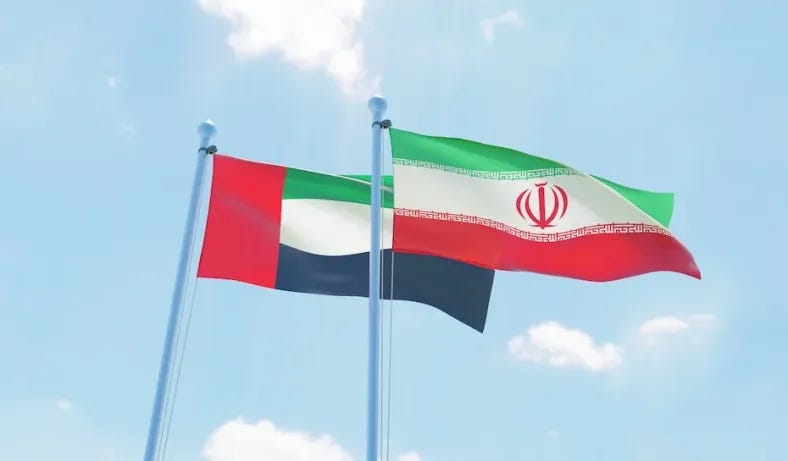
The United Arab Emirates announced this week that it is suspending all trade and financial transactions with Iran, a dramatic move that severs one of Tehran’s last major economic lifelines as President Trump’s pressure campaign against the Islamic Republic continues to intensify.
The decision came after the UAE said it detected two ballistic missiles fired from Iranian territory on Tuesday night, triggering a nationwide shelter-in-place alert across Dubai. Emirati air defense systems tracked both projectiles, with one landing in international waters and the other falling inside the UAE’s own territorial waters.
Afra Al Hameli, director of the Strategic Communications Department at the UAE’s Ministry of Foreign Affairs, announced the suspension bluntly, stating that “in light of regional escalations that undermine regional and international peace and security, all trade, commercial exchanges, and financial transactions with Iran have been halted until further notice.”
Iran, predictably, denied any responsibility for the attack, calling the UAE’s allegation “baseless.” Tehran has repeatedly denied responsibility for a string of similar incidents throughout its ongoing conflict with the United States and Israel, even as evidence continues to mount pointing back to Iranian forces.
The economic significance of this move cannot be overstated. The UAE has functioned for years as Iran’s largest trading partner and its most critical financial gateway to the outside world, a relationship that has allowed Tehran to soften the blow of sweeping American sanctions. According to the World Trade Organization, trade between the two countries reached roughly $28 billion in 2024 alone, with the UAE accounting for more than 30% of Iran’s total imports.
Beyond direct commerce, Dubai in particular has served as a critical re-export hub, giving Iranian businesses backdoor access to third-country goods and financial infrastructure that sanctions were specifically designed to block. Thousands of Iranian-linked businesses are registered in the UAE, and Emirati exchange houses have long served as a workaround for Iranian firms needing to move money internationally.
The timing lines up directly with the Trump administration’s broader strategic shift. The president recently signaled he was moving away from direct military strikes and toward maximizing financial hardship on Tehran instead. Treasury Secretary Scott Bessent reinforced that approach last week, saying the administration’s strategy going forward would combine deepening economic isolation with the continued U.S. naval blockade of Iranian ports in the Persian Gulf and Gulf of Oman.
Those blockades have already proven devastating to Iran’s economy. The International Monetary Fund now forecasts Iranian inflation approaching a staggering 70% this year, alongside an economic contraction of 5.4%. The Iranian rial has meanwhile collapsed to record lows against the dollar, compounding an already dire financial picture for ordinary Iranians.
This is not the UAE’s first punitive step against Tehran during the ongoing conflict. Abu Dhabi recalled its ambassador from Iran early in the war and has since shuttered several Iran-linked schools and at least one hospital operating inside the UAE. The country also bore the brunt of Iran’s early retaliatory strikes, absorbing more than 3,000 missiles and drones aimed at its territory and hosted U.S. military assets during the opening phase of the conflict.
Trade between the two nations had partially resumed in late June as hostilities briefly eased, according to Iran’s own state-run IRNA news agency. Tuesday’s renewed missile fire, the first confirmed strike on UAE territory since May, appears to have erased whatever fragile détente had developed over the summer.
The suspension arrives alongside other troubling signs for Iranian shipping in the Strait of Hormuz. Just this week, a commercial vessel reported being struck by an unknown projectile, damaging its engine room and injuring a crew member, according to the U.K. Trade Maritime Operations Centre. A separate vessel was reportedly struck by a drone just days earlier.
Crude oil flow through the Strait of Hormuz, one of the most strategically vital waterways on earth, has reportedly fallen to less than a quarter of its pre-war levels, a testament to just how disruptive this conflict has become to global energy markets, even as it inflicts maximum pain specifically on Iran’s own export capacity.
Notably, Iran has still managed to profit from elevated global energy prices during the war. Iran’s own Fars news agency reported last month that the country earned $7.5 billion from oil exports in just the first four months of the current Iranian year, roughly 1.5 times what it earned during the same period a year earlier, suggesting Tehran retains some capacity to weather sanctions through elevated pricing even as volume and trading partners dwindle.
Dubai-based academic Abdulkhaleq Abdulla framed the UAE’s decision in stark terms this week, telling reporters that repeated Iranian provocations had simply exhausted Emirati patience. “This was a breach of whatever understanding there was, and the UAE is saying enough is enough,” Abdulla said. “We don’t need to trade or exchange finances with Iran.”
Not everyone in the region is convinced the rupture will be permanent. Some analysts note that the UAE, as a small nation heavily dependent on its status as a regional trade and finance hub, has strong incentives to eventually restore some functional relationship with its neighbor once the current crisis subsides, regardless of how serious tensions appear today.
Emirati officials, for their part, have pushed back on suggestions that Dubai has served as a sanctions-evasion hub for Tehran. Anwar Gargash, a diplomatic adviser to Emirati President Mohammed bin Zayed, dismissed such allegations this week as “untrue information and part of desperate media campaigns,” even as the government simultaneously moved to formally cut off the very financial relationships critics have long flagged as problematic.
For the Trump administration, the UAE’s decision represents a significant diplomatic and economic win in its broader campaign to isolate Tehran without further direct military escalation. Losing its largest trading partner, on top of an ongoing naval blockade and soaring inflation, leaves the Iranian regime with fewer and fewer economic options as the war grinds toward its sixth month.
Thanks for reading! This post is public so feel free to share it.
No posts
Comments
Nothing yet. Say the first thing.
Sign in to join the conversation.