
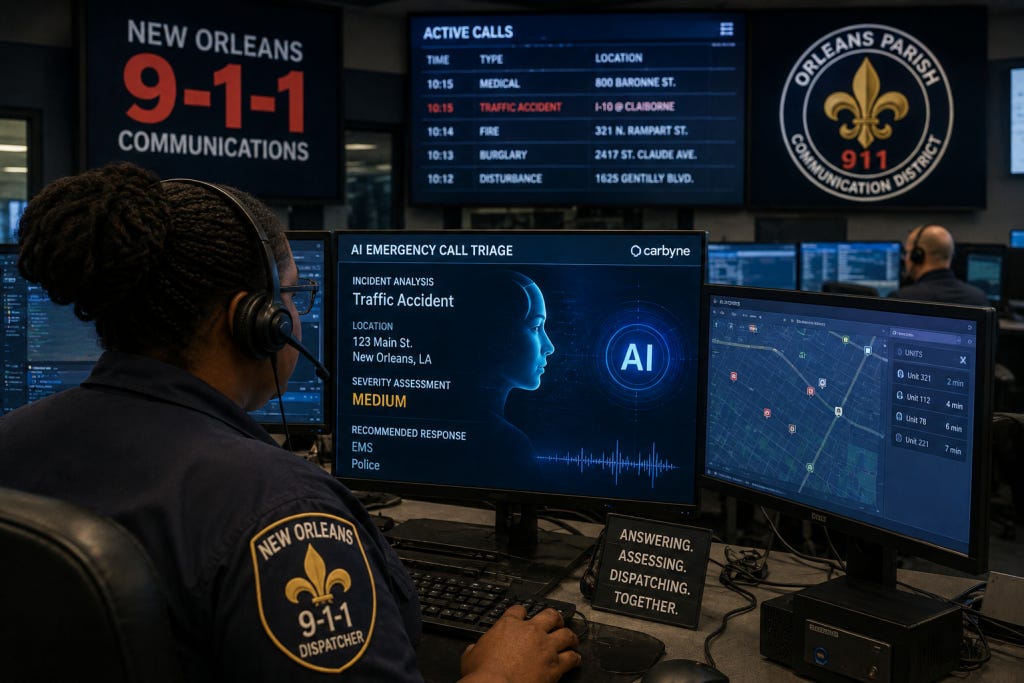
New Orleans has become the first major American city to publicly confirm that artificial intelligence is now helping to answer and triage 911 emergency calls, a development that has sparked both cautious optimism and sharp criticism from first responders and residents alike.
The Orleans Parish Communication District, the agency responsible for handling emergency calls throughout the city, has deployed an AI-powered system built by emergency communications technology firm Carbyne. The tool, known as AI Emergency Call Triage, went live in late July after first being tested on the city’s non-emergency 311 hotline beginning in April.
According to OPCD Executive Director Karl Fasold, the system is not intended to replace human dispatchers outright. Instead, its primary function is to identify and manage duplicate calls reporting the same incident, particularly during high-volume periods such as rush hour traffic accidents, when dispatchers can receive dozens of calls about a single crash within minutes.
The logic behind the deployment is straightforward from an operational standpoint. Because 911 calls are generally answered in the order they arrive, a flood of redundant reports about one already-known incident can slow response to entirely separate and potentially more urgent emergencies, such as a heart attack, a shooting, or a house fire happening at the same time elsewhere in the city.
New Orleans operates one of the busiest 911 systems in the entire country, fielding more than a thousand emergency calls every single day. Supporters of the AI rollout argue that in a system under that kind of sustained pressure, any tool capable of reducing redundant call volume and freeing up human dispatchers for genuine emergencies deserves serious consideration.
Not everyone is convinced. Critics, including some who identify themselves as current or former 911 dispatchers, have voiced alarm over the decision to let an artificial intelligence system interact directly with callers during moments of genuine crisis. One online commenter, identifying as a first responder with more than a decade of dispatch experience, called the move the worst idea she could imagine for a public safety system.
The concerns are not merely emotional. AI voice systems, even sophisticated ones, have documented and well-established limitations when it comes to interpreting spoken language during chaotic, high-stress situations. People calling 911 are rarely calm, articulate, or easy to understand, and mistaking distress signals or misjudging the severity of a situation could carry life-or-death consequences.
Independent research backs up some of these worries. One study published earlier this year found that AI voice tools similar to widely used consumer chatbots produced false or fabricated details in emergency-adjacent scenarios at a startlingly high rate, sometimes approaching fifty percent, all while sounding entirely confident and convincing to the listener. In a 911 context, that kind of unreliable confidence could prove dangerous.
Security researchers have also raised concerns about the technical vulnerability of these systems. A team from a university in China reported success rates between 79 and 96 percent when attempting to manipulate how similar AI voice models behaved, raising uncomfortable questions about whether bad actors could exploit vulnerabilities in emergency dispatch systems for malicious purposes.
Reporting on the rollout initially led to some public confusion, with early headlines suggesting AI was fully replacing human 911 operators in New Orleans. That characterization has since been clarified. The AI system functions as an initial triage layer, screening calls related to already-known incidents, such as duplicate crash reports, while still routing any call it identifies as a distinct or dire emergency straight to a trained human dispatcher.

New Orleans is not entirely alone in exploring this technology, though it does appear to be the first city to let AI directly answer and interact with emergency callers rather than simply assisting dispatchers behind the scenes. Seattle has reportedly been quietly using AI in a more limited capacity to help route calls, and Atlanta has implemented AI tools that assist live human dispatchers by pinpointing caller locations and pulling up relevant medical information in real time.
The broader trend reflects a nationwide challenge facing emergency dispatch centers, chronic staffing shortages combined with steadily rising call volumes. As more cities grapple with the same pressures, New Orleans is likely to serve as a closely watched test case for whether AI-assisted dispatch genuinely improves outcomes or introduces new risks into an already high-stakes system.
There remains, notably, limited independent and publicly available data confirming whether AI-assisted emergency dispatch actually improves response times, boosts caller satisfaction, or leads to better real-world outcomes during genuine emergencies. Most deployments of this kind remain quite recent, and rigorous, arms-length evaluations of their performance are still scarce, leaving many of the practical questions unanswered for now.
Some residents and commentators have raised a separate but related concern about equity, questioning whether cities might be more inclined to deploy unproven AI systems in lower-income neighborhoods first, where residents may have fewer resources to pursue legal recourse if something goes wrong. City officials have not directly addressed that criticism, though it echoes broader conservative concerns about government experimenting with untested technology on vulnerable populations without full transparency or consent.
For conservatives who value both technological innovation and government accountability, the New Orleans rollout presents a genuine tension. On one hand, reducing wasted dispatcher time on duplicate calls represents a sensible, efficiency-minded reform of a strained public service. On the other, handing any piece of the emergency response chain over to unproven artificial intelligence, without robust independent oversight, runs directly counter to the principle that government should move cautiously when public safety is on the line.
City officials have defended the rollout as a measured, limited use of the technology rather than a wholesale replacement of trained personnel. They emphasize that human dispatchers remain in the loop for any call the AI system flags as a distinct or urgent emergency, and that the tool’s core function, at least for now, is narrowly focused on reducing redundant call traffic rather than making life-or-death triage decisions on its own.
Whether that reassurance proves sufficient will likely depend on how the system performs in the coming months, particularly during a major weather event, mass casualty incident, or other high-stress scenario that could genuinely test its limits. New Orleans, a city no stranger to hurricanes and large-scale emergencies, may not have to wait long to find out.
Thanks for reading! This post is public so feel free to share it.
No posts
Comments
Nothing yet. Say the first thing.
Sign in to join the conversation.