
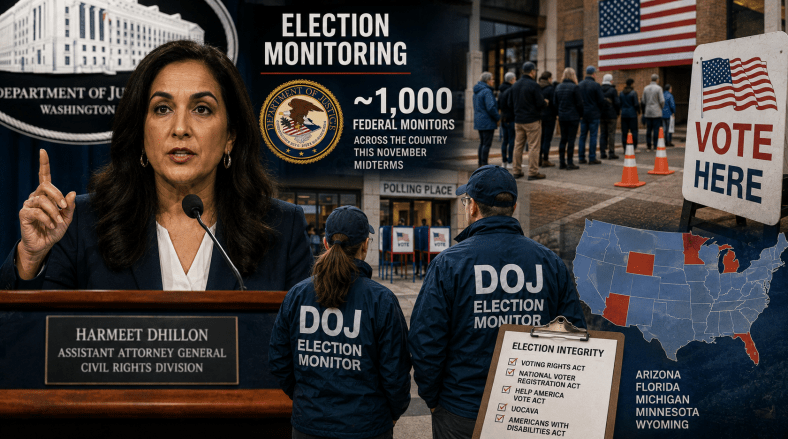
The Department of Justice is preparing what officials are calling one of the largest election monitoring operations in the agency’s history, with plans to send approximately 1,000 federal monitors to polling locations across the country during the November midterm elections. The announcement, delivered by Assistant Attorney General for Civil Rights Harmeet Dhillon, marks a significant escalation in the federal government’s role in overseeing how states conduct their elections, and it comes at a moment when confidence in the integrity of American elections remains a top concern for millions of voters nationwide.
Dhillon disclosed the scale of the operation during an interview on Bloomberg’s “Balance of Power,” where she laid out the administration’s broader approach to election security. She noted plainly that deploying monitors is simply something the Justice Department does as a matter of course, and that this year’s number would likely represent a historic figure for a Republican administration.
The timing is notable. Confidence in the electoral process has been a driving issue for the Trump administration since day one of the second term, and this latest move signals that the Justice Department intends to put real manpower behind its stated commitment to clean, transparent elections. Unlike the vague assurances often offered by federal bureaucracies, this is a concrete, measurable step, and one that voters concerned about ballot integrity should welcome.
According to Dhillon, the monitors will not intervene in the voting process itself. Their role is purely observational, watching to ensure that voting is conducted fairly and in compliance with federal law. That includes monitoring for language access issues, disability access problems, and any indicators of potential voter fraud. The department has stated the goal is to boost public confidence in outcomes, not to influence them.
It is worth remembering that election monitoring is nothing new. The Justice Department’s Civil Rights Division has monitored federal elections since the passage of the Voting Rights Act of 1965. Past administrations of both parties have dispatched federal personnel to polling places. Under the Biden administration, the DOJ sent monitors to 86 jurisdictions during the 2024 presidential election and 64 jurisdictions during the 2022 midterms. In 2020, the department deployed monitors to 44 jurisdictions.
What separates this year’s effort is the sheer scale. A deployment approaching 1,000 monitors would dwarf recent operations and reflects an administration that is taking election integrity seriously rather than treating it as an afterthought. Critics on the left have predictably cried foul, framing the expanded presence as some sort of intimidation tactic. But the facts tell a different story. These monitors operate under the same legal authority and training used by prior administrations, and they are bound to respect state law regarding buffer zones and access.
Dhillon made that point directly, noting that when a state establishes a 150-yard perimeter around polling places, the department will respect it. She also emphasized that federal monitors work in partnership with, not opposition to, state and local election officials, reinforcing rather than undermining the state-run nature of American elections.
The DOJ has already put this framework into action. During the 2026 primary season, the department sent monitors to polling locations in Michigan, including Detroit, Hamtramck, Lansing, and East Lansing. Monitors were also dispatched to three Arizona counties in July, and more recently to primary elections in Miami-Dade County, Florida, and Laramie County, Wyoming. Across the primary season, the DOJ says it has already deployed more than 75 monitors to over 200 polling locations spanning five states, including Arizona, Florida, Michigan, Minnesota, and Wyoming.
The department has framed this ongoing work as being about transparency, ballot security, and compliance with federal law, three principles that should be uncontroversial regardless of political affiliation. Yet Democratic officials in some of these states have pushed back. Arizona Secretary of State Adrian Fontes filed a public records request seeking to understand why the department was monitoring three counties during the primary, a request that suggests discomfort with federal scrutiny rather than any genuine legal objection.
It should be noted that pleading for less oversight of elections is an odd position for anyone who claims to care about voter confidence. If elections are being run properly, additional federal eyes on the process should pose no threat to anyone. The only people who should fear increased scrutiny are those who have something to hide.
To hit the ambitious 1,000 monitor target, the department is recruiting volunteers from its own workforce, including personnel from Civil Rights Division and United States Attorney’s Offices around the country. A complete list of jurisdictions receiving monitors is expected to be finalized once the primary season wraps up, giving the department flexibility to respond to emerging concerns as Election Day approaches.
Dhillon indicated that possible target locations could include areas with documented concerns involving language access, disability access, or suspected voter fraud, a sensible, needs-based approach rather than a blanket deployment without justification.
Predictably, the announcement has drawn criticism from Democratic lawmakers and left-leaning legal advocacy groups, some of whom have attempted to frame the effort as unprecedented federal overreach. This ignores the inconvenient truth that the Biden administration ran similarly extensive monitoring operations, just under different branding and with considerably less media scrutiny at the time.
Some critics have also tied the monitoring announcement to a separate and contentious legal fight over the department’s efforts to obtain full statewide voter registration databases from states, including sensitive data such as driver’s license and Social Security numbers, under Title III of the Civil Rights Act of 1960. The department has lost that fight in every district court case decided so far, and the Sixth Circuit Court of Appeals recently declined to rehear the matter. Dhillon has suggested the issue could eventually reach the Supreme Court.
While that legal battle continues to play out separately, it should not be conflated with the election monitoring program itself, which rests on a different and far less contested legal foundation. Monitoring polling places for compliance with the Voting Rights Act, the National Voter Registration Act, the Help America Vote Act, the Uniformed and Overseas Citizens Absentee Voting Act, and the Americans with Disabilities Act is standard practice, not a novel expansion of federal power.
Some critics have also tied the monitoring announcement to a separate and contentious legal fight over the department’s efforts to obtain full statewide voter registration databases from states, including sensitive data such as driver’s license and Social Security numbers, under Title III of the Civil Rights Act of 1960. The department has lost that fight in every district court case decided so far, and the Sixth Circuit Court of Appeals recently declined to rehear the matter. Dhillon has suggested the issue could eventually reach the Supreme Court.
While that legal battle continues to play out separately, it should not be conflated with the election monitoring program itself, which rests on a different and far less contested legal foundation. Monitoring polling places for compliance with the Voting Rights Act, the National Voter Registration Act, the Help America Vote Act, the Uniformed and Overseas Citizens Absentee Voting Act, and the Americans with Disabilities Act is standard practice, not a novel expansion of federal power.
Thanks for reading! This post is public so feel free to share it.
No posts
Comments
Nothing yet. Say the first thing.
Sign in to join the conversation.