
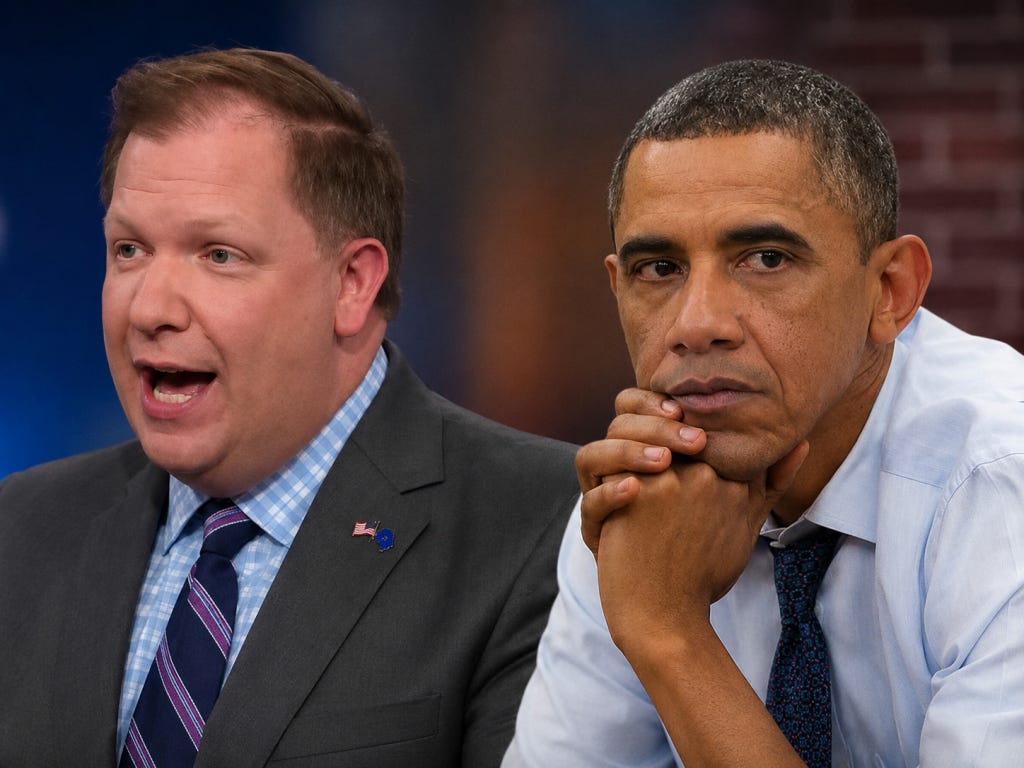
A former Bush White House spokesman stunned CNN viewers this week when he calmly informed Barack Obama’s own former strategist that the future president only made it onto the 2008 Indiana Democratic primary ballot because of forged petition signatures.
Pete Seat, who served as a spokesman during the George W. Bush administration and is a longtime Indiana Republican, made the remarks during a panel discussion on Anderson Cooper 360.
Sitting just a few feet away was David Axelrod, the man who helped engineer Obama’s rise to the presidency and who has spent years as a cable news fixture lecturing Republicans on the sanctity of elections.
The exchange began innocently enough, with the panel discussing election security in the wake of ongoing concerns raised by President Trump and his allies about voter rolls and ballot integrity. Axelrod, according to those familiar with the segment, mocked the idea that election fraud is a serious problem in America, invoking Arizona’s so called cyber ninjas as an example of what he views as conspiracy thinking on the right.
That is when Seat, a native of Indiana, decided to bring the conversation home, literally.
“I’ll give you an example of where it has been determinative,” Seat told Axelrod. “And that’s in my home state of Indiana, Saint Joseph County. The gentleman you previously worked for, David Axelrod, Barack Obama got on the ballot because Democrats in that county submitted fraudulent ballot petition signatures. People, including the Democrat county chair, went to jail over that.”
Seat did not mince words about what it meant for the legitimacy of that primary contest. “Barack Obama should not have been on the primary ballot in the state of Indiana,” he said flatly.
Former Illinois Republican congressman turned CNN commentator Adam Kinzinger attempted to wave away the significance of the revelation, suggesting it was somehow not a real voting issue. Seat pushed back immediately, noting that the fraud directly determined who Hoosier Democrats were even allowed to vote for in that primary.
Axelrod, for his part, appeared genuinely caught off guard, asking how investigators had determined that a problem existed in the first place. It was a telling moment. The man who ran Obama’s political operation seemed to have no idea, or at least no memory, that Democrats in his candidate’s home turf of Indiana had been convicted felons.
The facts back up Seat’s claim in full. The scheme first came to light in 2011, a full three years after the primary, when a Yale University undergraduate combed through the petition signatures that Indiana election officials had accepted to put Obama on the ballot. That student, working alongside a former Obama White House intern named Ryan Nees, discovered something remarkable: page after page of voter names and signatures from Saint Joseph County were written in identical handwriting.
Nees later explained that the fraud was almost laughably easy to detect once someone actually looked. The same handwriting appeared over and over again on documents that were supposed to represent the individual signatures of thousands of different registered voters.
A forensic document examiner brought in to review the petitions confirmed what the amateur investigators had already suspected: the signatures were forgeries.
The scandal ultimately led to criminal charges against several prominent St. Joseph County Democrats. Butch Morgan, the county’s Democratic Party chairman at the time, was convicted on two felony counts of conspiracy to commit petition fraud and two felony counts of conspiracy to commit forgery. He was sentenced to a year behind bars, though he had faced the possibility of up to 22 years in prison.
Dustin Blythe, a Democratic Party volunteer and former board worker, was convicted on nine felony counts of forgery and one count of felony petition falsification. Pam Brunette, a Democratic member of the county’s Board of Voter Registration, and Beverly Shelton, a registration board worker, also faced charges connected to the scheme.
Investigators concluded that the group had forged a staggering 22 petitions in an effort to ensure that Obama, along with Hillary Clinton and John Edwards, made the primary ballot.
Under Indiana law, a candidate needed 500 valid signatures from each of the state’s nine congressional districts to qualify. In Saint Joseph County, that threshold was met the old-fashioned way, through fraud rather than genuine grassroots support.
Even more remarkable is the detail that a former Democratic governor of Indiana discovered his own name had been placed on one of the fraudulent petitions, despite the fact that he never signed it. If a sitting or former governor’s identity could be forged without detection, it raises obvious questions about how many ordinary voters were victimized in the same way, never knowing their names had been used without consent.
Prosecutor Stanley Levco later stated plainly that had election officials done their jobs properly, or had the Clinton campaign challenged the petition signatures at the time, Obama would not have appeared on the Indiana primary ballot at all.
That single fact changes the entire calculus of the 2008 Democratic primary. Because Clinton’s petitions contained enough legitimate signatures on their own to meet the threshold, she would have been entitled to all 72 of Indiana’s delegates by default had Obama been disqualified.
Instead, systemic fraud committed by local Democratic officials allowed Obama’s name to remain on a ballot he had not legally earned a spot on. Voters across Indiana cast ballots in a contest whose very foundation rested on forged paperwork, and the man who benefited went on to become president of the United States.
What makes this story especially relevant today is the sheer hypocrisy on display from figures like Axelrod and Kinzinger, who have spent years on cable news dismissing conservative concerns about election integrity as baseless conspiracy theories. Yet here is a documented, prosecuted, and adjudicated case of Democratic officials committing forgery to manipulate a presidential primary, and the very people who built their careers around that campaign claim to have no memory of it.
The timing of Seat’s comments is notable as well. They come as Republicans continue to raise alarms about vulnerabilities in the voting system, from noncitizens appearing on voter rolls to a hacker compromising the personal data of more than 630,000 Arizona voters.
Thanks for reading! This post is public so feel free to share it.
No posts
Comments
Nothing yet. Say the first thing.
Sign in to join the conversation.