
Our two-week journey through Turkey began with a late-night arrival in Istanbul. After checking into the Millennium Golden Horn Hotel and getting a much-needed night’s sleep, we set out the following morning for the first stop on our itinerary: the Blue Mosque. There couldn’t have been a better introduction to the city’s remarkable history.
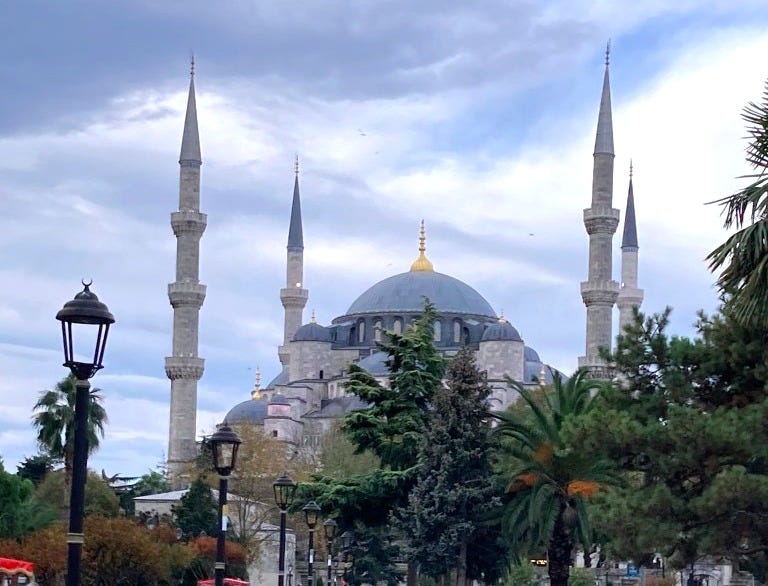
Officially known as the Sultan Ahmed Mosque, the Blue Mosque was constructed between 1609 and 1617 during the reign of Sultan Ahmed I. Before entering, our guide shared one of Istanbul’s more entertaining legends. According to the story, the sultan wanted the mosque crowned with golden minarets. The architect supposedly misunderstood the Turkish word altın (gold) as altı (six), resulting in six minarets instead. Historians generally dismiss the tale as folklore, but it’s one of those stories that’s simply too good not to repeat.
In another telling of this story, the architect did not have the funds to fashion the minarets from gold. To solve this problem, he used the semantic proximity of the words “gold” and “six” in Arabic, designing the mosque with six minarets.
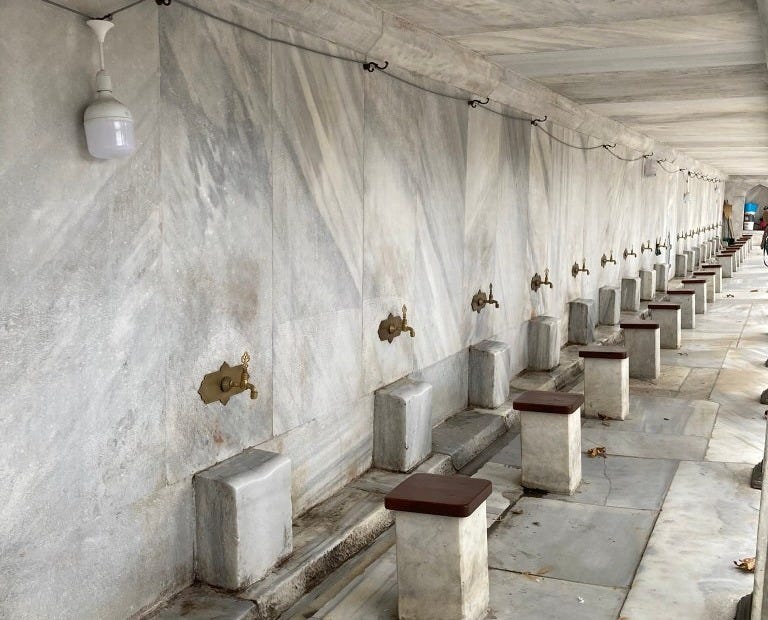
Because the Blue Mosque remains an active place of worship, visitors are asked to dress modestly, women are required to cover their heads, and everyone removes their shoes before entering. Near the entrance sits the traditional ablution fountain, where worshippers perform ritual washing before prayer. Seeing these traditions still practiced today reinforced that this is much more than a historic monument. It continues to serve the community just as it has for more than four centuries.
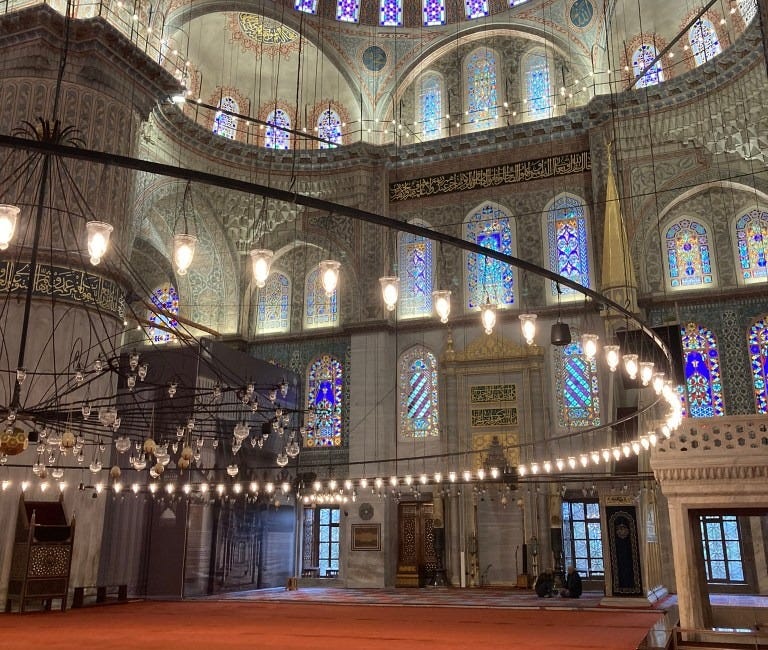
Stepping inside left an indelible impression. The soaring interior immediately draws your eyes upward toward the magnificent central dome, while thousands of hand-painted İznik tiles decorate the walls with intricate floral and geometric patterns. I had expected the famous blue tiles to dominate the interior even more than they do, but what struck me most was the craftsmanship. Every surface seemed to reveal another level of detail, and it was astonishing to think that all of this was completed more than 400 years ago.
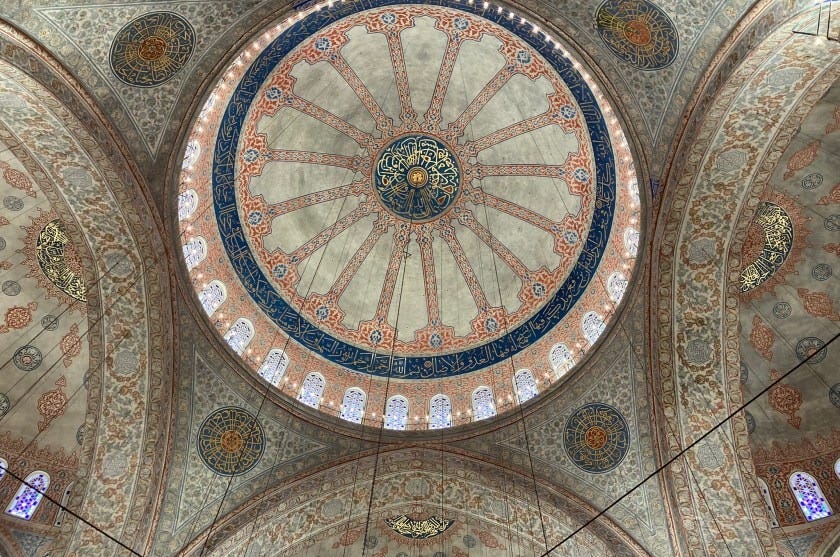
The central dome, supported by four enormous arches, creates a vast open space that feels both grand and surprisingly peaceful. Sunlight filtered through the mosque’s many windows, highlighting the colorful tile work and elegant Arabic calligraphy. Even with other visitors quietly moving through the building, the atmosphere encouraged reflection and appreciation rather than hurried sightseeing.
After retrieving our shoes, we stepped back into the courtyard to continue our walk toward nearby Hagia Sophia. While Hagia Sophia ultimately became my favorite of the two because of its immense scale and extraordinary history, the Blue Mosque possesses a beauty and character all its own. Its elegant Ottoman design, intricate decoration, and continued role as a living mosque make it one of Istanbul’s essential landmarks.
If you’re visiting Istanbul, I would strongly recommend seeing both. They stand only a short walk from one another, yet each tells a different chapter of the city’s remarkable story. Just remember that the Blue Mosque closes to visitors during the five daily prayer times, so it’s worth checking the schedule before you arrive. The experience is well worth planning around.
Affordable Travel is a reader-supported publication. To receive new posts and support my work, consider becoming a free or paid subscriber.
Comments
Nothing yet. Say the first thing.
Sign in to join the conversation.