
Vote counts from the 2026 Republican primary election in Utah County aren’t final, but the results are clear enough. Here are the races that would have been on my ballot, if I were still a registered Republican. These candidates will almost certainly win office in November.
The race that most interested me didn’t go the way I wanted, but I’ll include a bit of election geekery about that one, in case you’re into that sort of thing. Then I’ll offer a quick comparison of convention and primary votes.
Turnout countywide was about 27%, which isn’t terrible for a primary with no US Senate or gubernatorial races, and with only one race for US House of Representatives, which included part of the county, but not my part.
Here’s my source for Utah County results; you can find results from around the state at the same site. And here’s an interactive precinct map for Utah County, in case you want to study results precinct by precinct.
Michelle Kaufusi 54.4%
Brent V. Bowles 45.6%
David Spencer 42.7%
Isaac Paxman 34.7%
Carolina Herrin 22.6%
Corey K Astill 55.3%
Aaron Davidson 44.7% (incumbent)
Brady Brammer 56.9% (incumbent)
Kelly Smith 43.2%
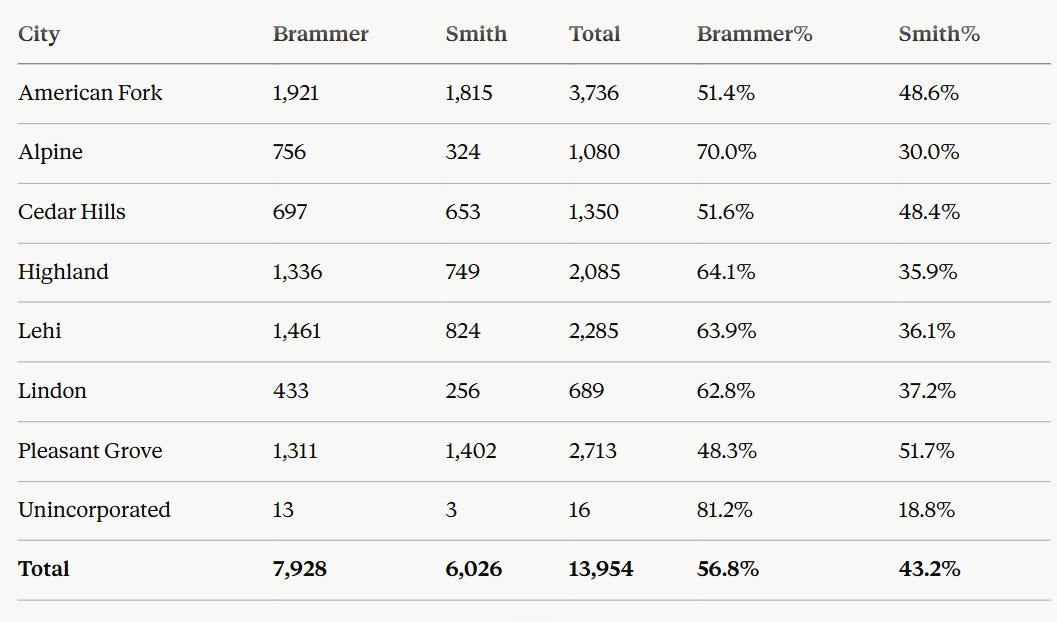
I used a small amount of cybergeekery to point Claude (that’s AI) to this race’s data and said pretty please, because I wanted to see the results by city and didn’t want to tally all of it by hand. Here they are, of course still unofficial. (I manually checked American Fork’s numbers for accuracy, because my trust for AI is limited.) As you see, Kelly Smith won Pleasant Grove overall and narrowly lost American Fork and Cedar Hills. Brady Brammer, the very well funded incumbent, won everywhere else by larger margins.
Given the right data, I’d enjoy checking to see if precinct results correlate with household income, number of years residing at the current address, per capita percentage of attorneys, or something else. But I don’t have the data.
At the convention, any candidate with 40% of the vote advanced to the primary. To the vexation of some, signatures are able to put candidates on the ballot with less than 40% of the delegate vote. Let’s see how they correlate. The percentages I’ll give below are generally margins of victory, not percentage of the vote. I’ll round to the nearest unit.
Brent Bowles won at convention by 29%. He lost in the primary by 9%. Difference: 38%.
David Spencer and Carolina Herrin advanced to the primary at the convention. Spencer had 52% of delegates and Herrin had 48% on the last ballot. Isaac Paxman had been eliminated. It’s not very useful to compare results with two candidates and three candidates, but if we exclude Paxman’s primary results, Spencer increased his margin from 4% to 31%. Difference: 27%
Aaron Davidson won at convention by 17%. He lost in the primary by 11%. Difference: 28%.
Brady Brammer defeated Kelly Smith by 36% at convention. He won the primary by 14%. Difference: 22%.
In these four races:
The primary reversed the results of two races, and none of the margins was small.
The other two races had the same winners, but the margins were dramatically different.
One is tempted to argue that convention delegates don’t always represent primary voters very well, to put it mildly.
I’m fine with having caucuses, delegates, and conventions, but for the sake of broader representation, we need to keep the alternative route to the primary ballot: signatures. That’s heresy to some Republicans.
Seriously, thanks to all the candidates for running. It’s not easy, but it’s important. Even when the odds of victory are slim, our self-government is much healthier when candidates don’t run unopposed.
No posts
Comments
Nothing yet. Say the first thing.
Sign in to join the conversation.