
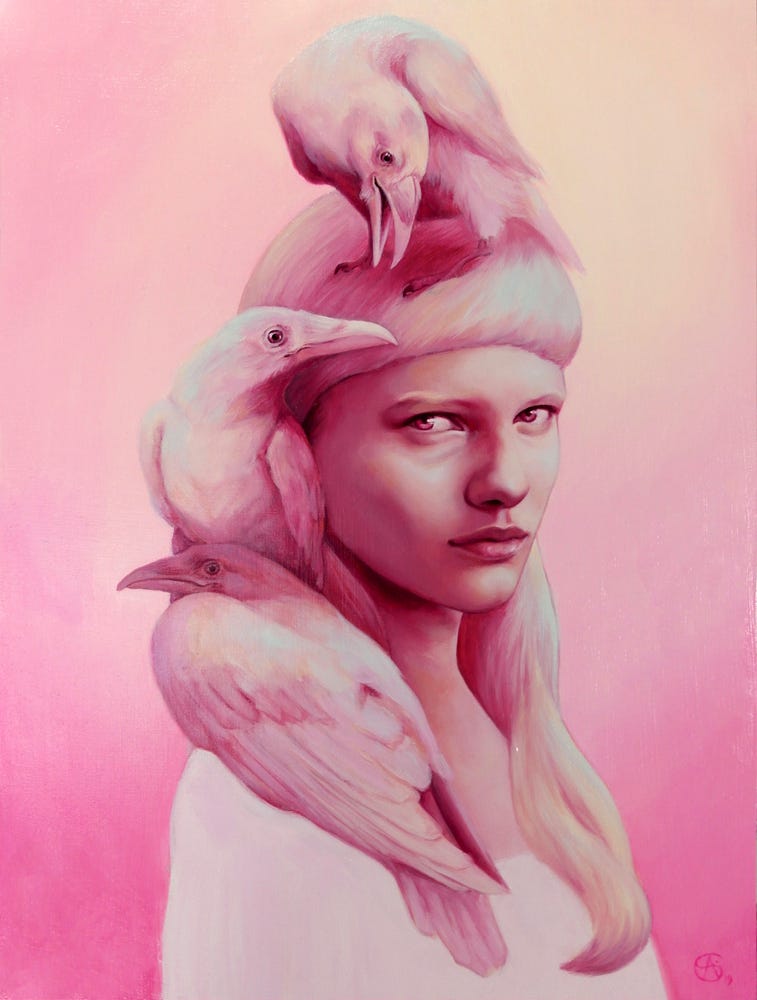
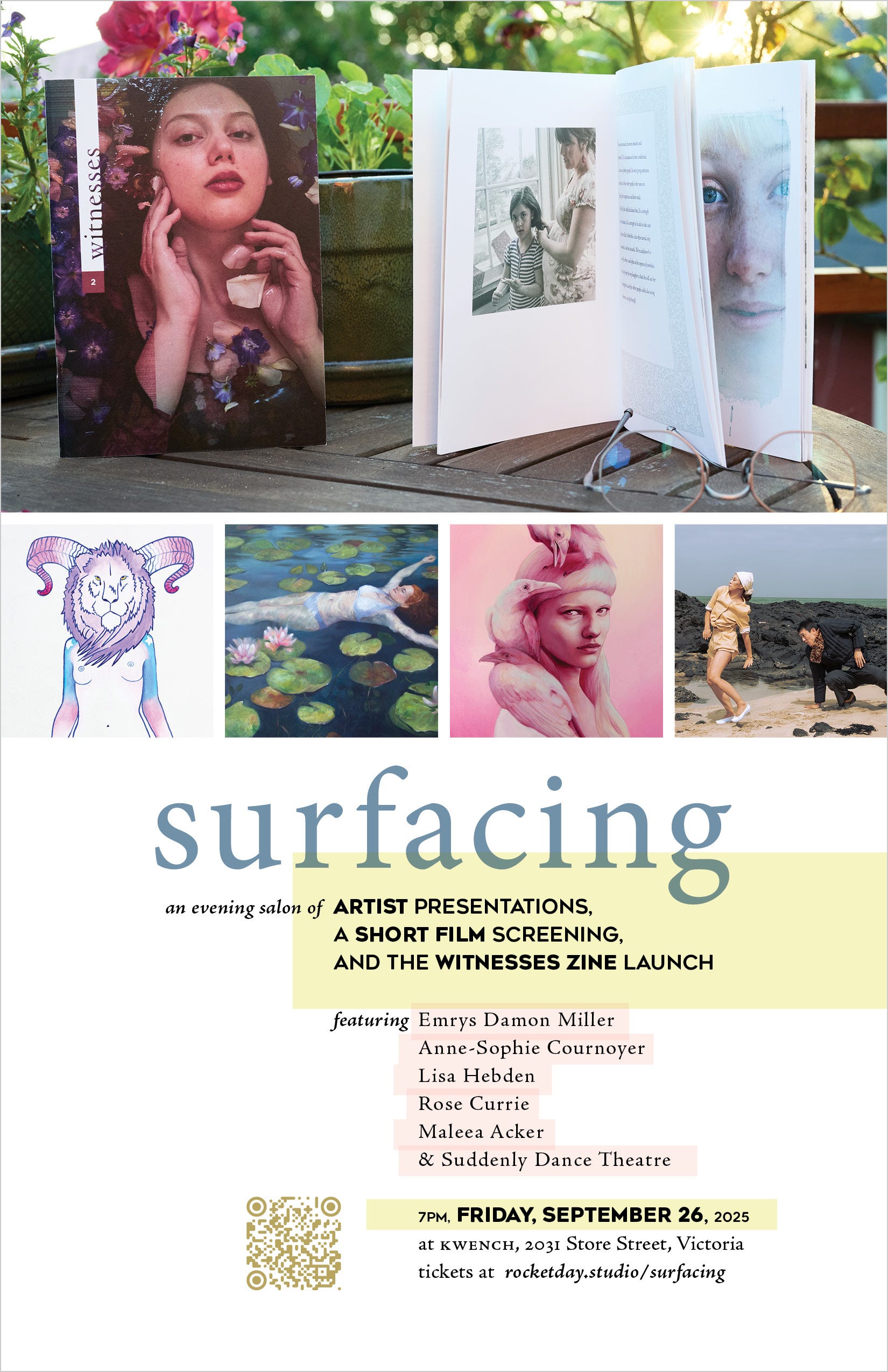
I’ve been invited to speak about my art practice at my friend Emrys Damon Miller’s zine launch on September 26. His project, witnesses, is inspired by the Pre-Raphaelites—a 19th-century symbolic-realist movement romanticizing two prominent themes: women and nature. These have long been muses for me, symbolic expressions of an archetype I’m endlessly drawn to: the Feminine.
In anticipation of the talk, I thought I’d unpack the Feminine by doing a little writing, curious about what the process might reveal.
What is the Feminine?
I don’t claim to understand the nature of Reality, but I sense that recurring archetypal motifs shape how we construct meaning and map our existence. These inherited patterns, symbols, and images woven into our psyche attempt to pin down laws and principles words fail to fully express. Words like Feminine and Masculine.
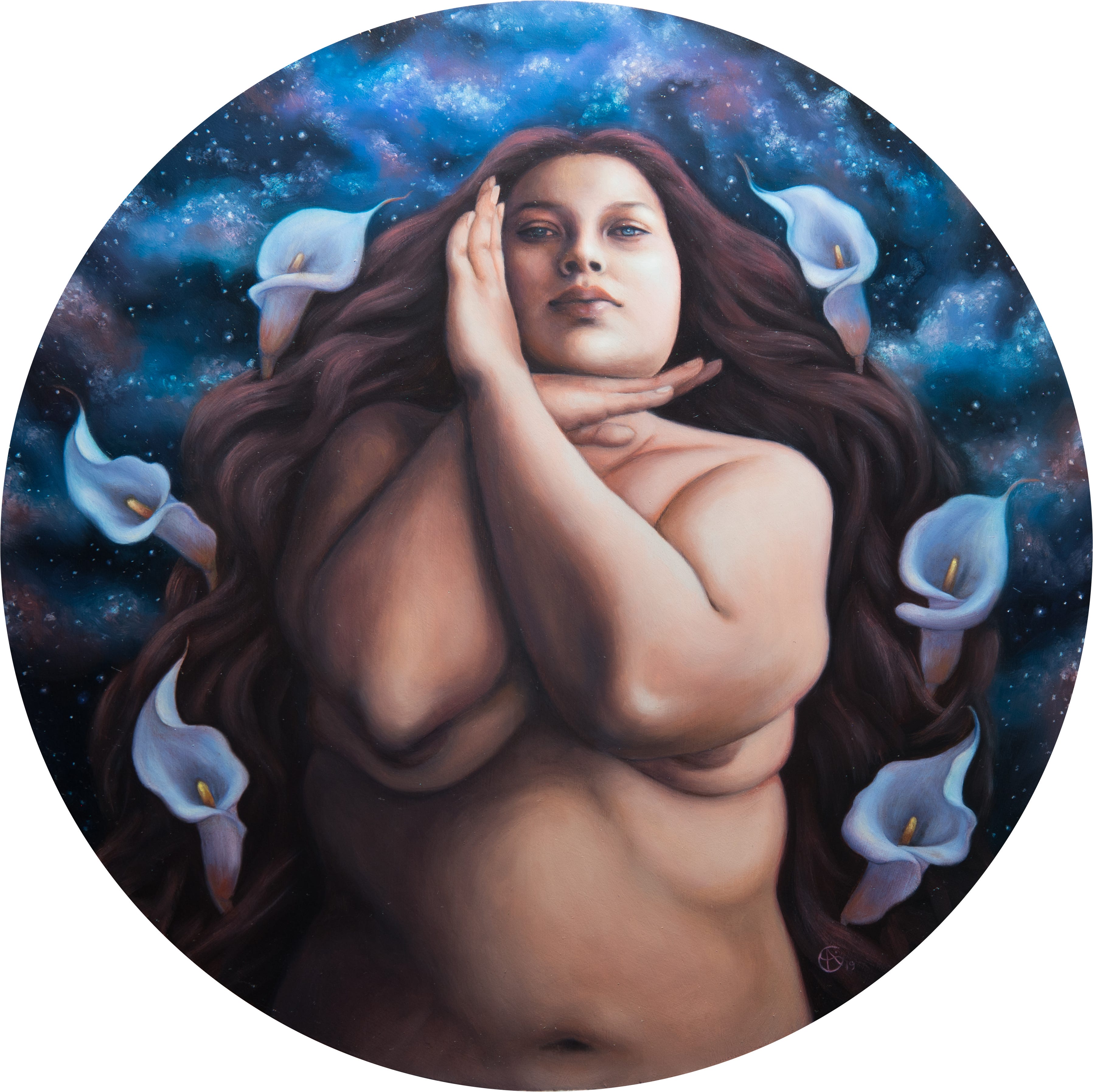
The ancient archetypal dualism of the Feminine and the Masculine reflects the underlying paradox of our universe: Day/Night, Life/Death, Mind/Body, Self/Other, Active/Receptive, Yin/Yang. This motif of primordial syzygy points to complementary opposites that give rise to one another. Polarities that sometimes exist in tension but that must ultimately be balanced, harmonized, reconciled, and alchemized.
This is the dance of creation.
To explore the elusive meaning of the Feminine, I turn to three recurring archetypes in my work: the Femme Fatale, the Witch, and the Cyborg.
Aethereal Moods is a reader-supported publication. To receive new posts and support my work, consider becoming a free or paid subscriber.
The Femme Fatale: Creative Eroticism
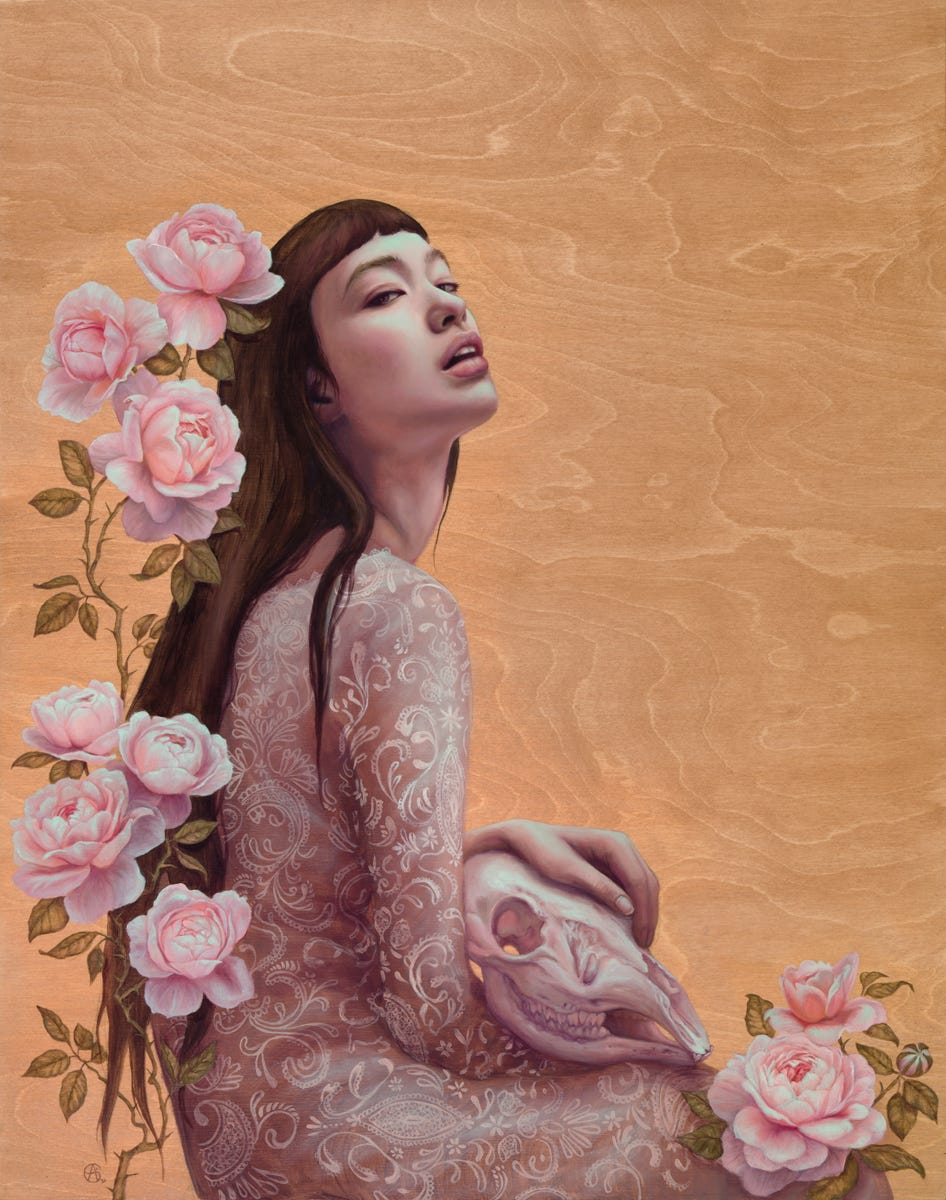
The Femme Fatale embodies the Western world’s fraught history with the Feminine. She is the dark mirror of a culture that fears what it cannot dominate: the erotic, the cyclical, the fluid, the wild.
You notice the culture’s unsettling discomfort in how her domains—birth, sex, and death—have been made taboo, sanitized, or pathologized. Deep down, we all sense that these are not only biological events, but mysterious thresholds that confront us with transformation, loss of control, and ego dissolution.
She evokes an element of risk.
The Feminine is self-cannibalizing Nature churning through endless cycles—a serpent eating its tail. We are confined to her embodied, material limits. She evokes a deep, primal fear of death and chaos, of ego dissolution, for she is endowed with the mysterious power to undo, to break down, and recycle. Creation is a constant flux of transformation. Birth, sex, and death.
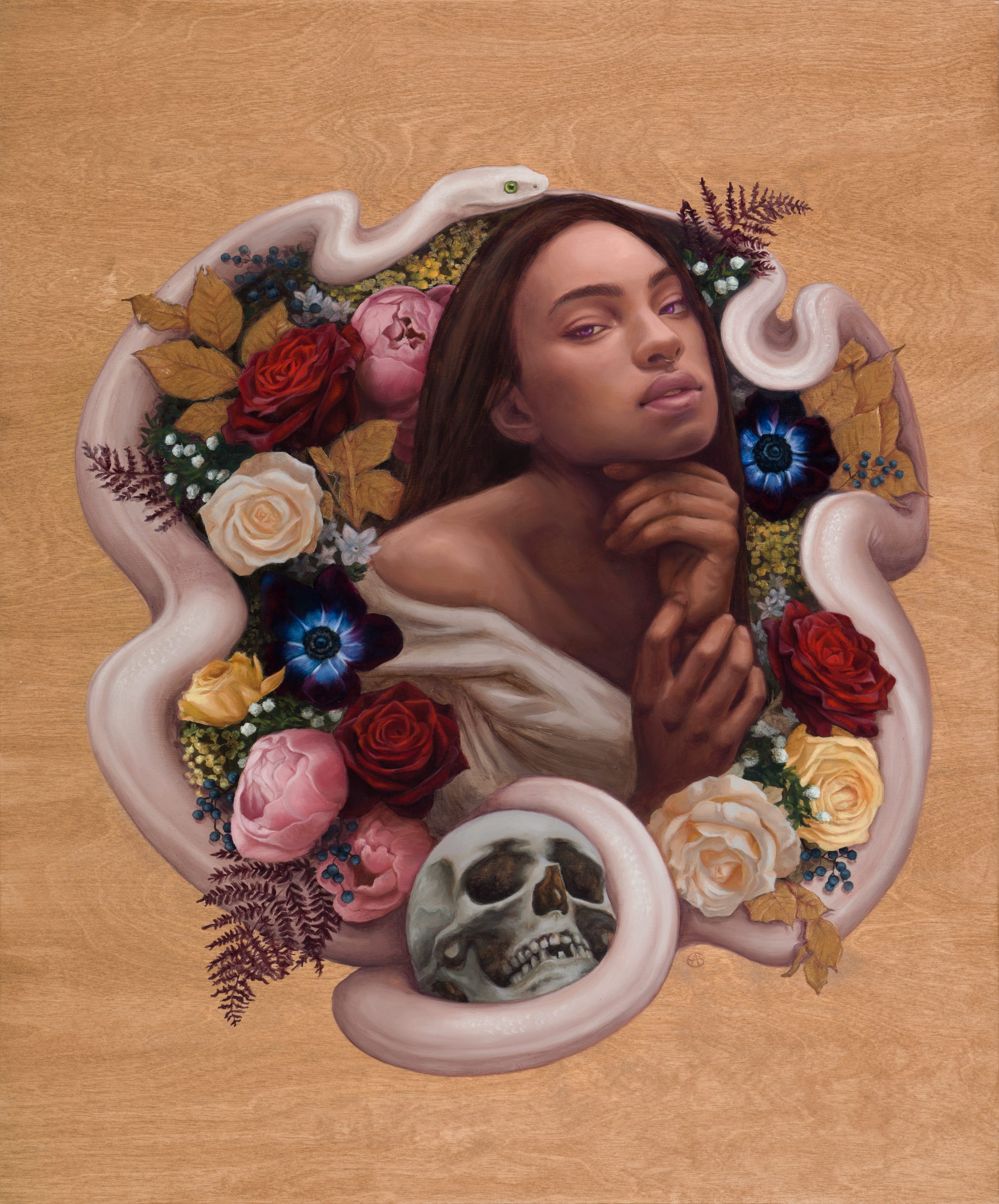
As an eroticized figure, the Femme Fatale seduces us into surrendering our separate sense of self. She compels us to confront the dazzling darkness and to be aroused by the Mystery—open and receptive to the sacred procreative and creative force that courses through our bodies and dissolves the boundary between ourselves and the Great Body of Nature. Though nature continually renews itself through sexuality, this cycle of renewal is given meaning through love—Eros. Eros urges us toward wholeness. Eros binds together. Eros transforms.
Engaging with the Femme Fatale archetype in my creative practice revealed the inherently erotic nature of self-expression. She is the all-consuming muse, the attention seeker demanding the artist’s devotional gaze. Don’t look away—she requires one-pointedness, and she gives back on her own terms. If you hold on too tight, she will torment you and make you suffer, for the muse was never yours to begin with.
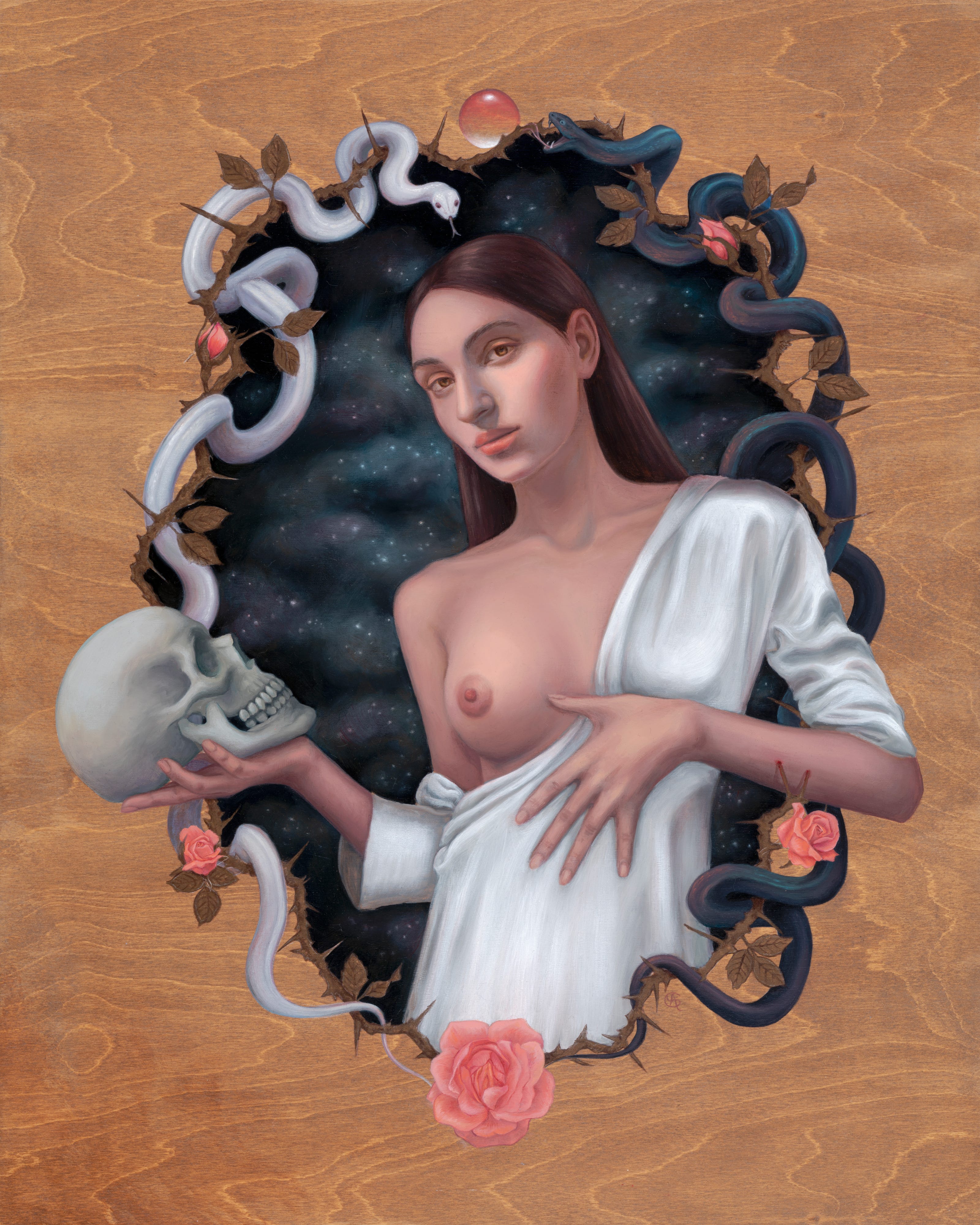
Yield. Let go. Surrender to her timeline. Let the same force that gave birth to the cosmos gestate new life within you. Let strange things emerge from your deep, dark core. Trust what feels good. Follow the spark. Fan the flame. Your burning desires beckon you home. You will die a little in the process, and that’s the point.
The Witch: Transgressive Knowledge
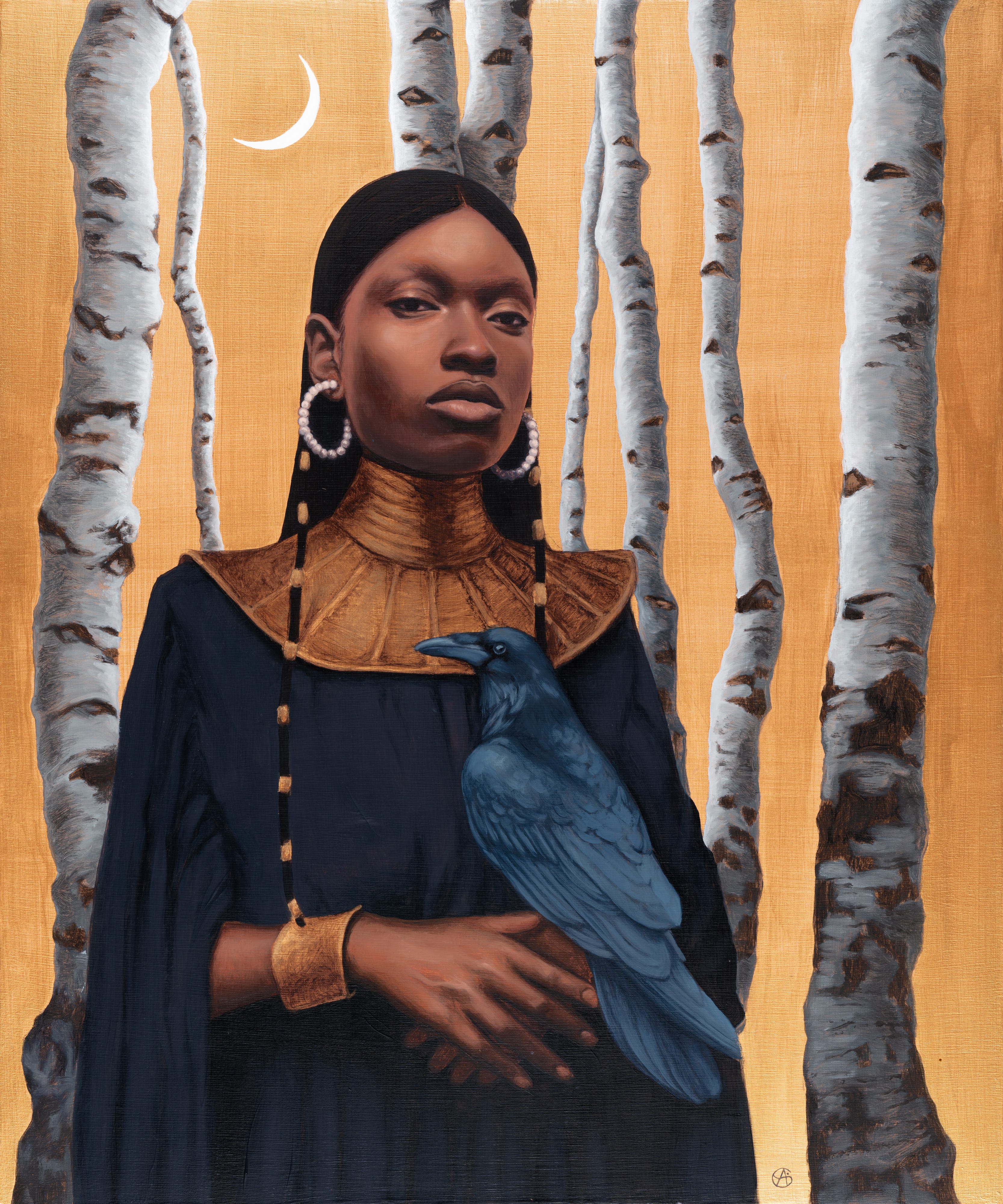
Whereas the Femme Fatale embodies the erotic and transformational power of the Feminine, the Witch represents her transgressive, forbidden knowledge—ways of knowing that challenge dominant narratives and the prevailing model of reality.
The Witch archetype has long lingered at the margins of Western culture, shapeshifting through the centuries to mirror evolving anxieties and aspirations about the Feminine. The persecution of earth-based spiritualities—especially by dominant religious institutions—was instrumental in casting the Witch as a symbol of demonized and forbidden traditions. To modern science, she became discredited as a charlatan and a quack.
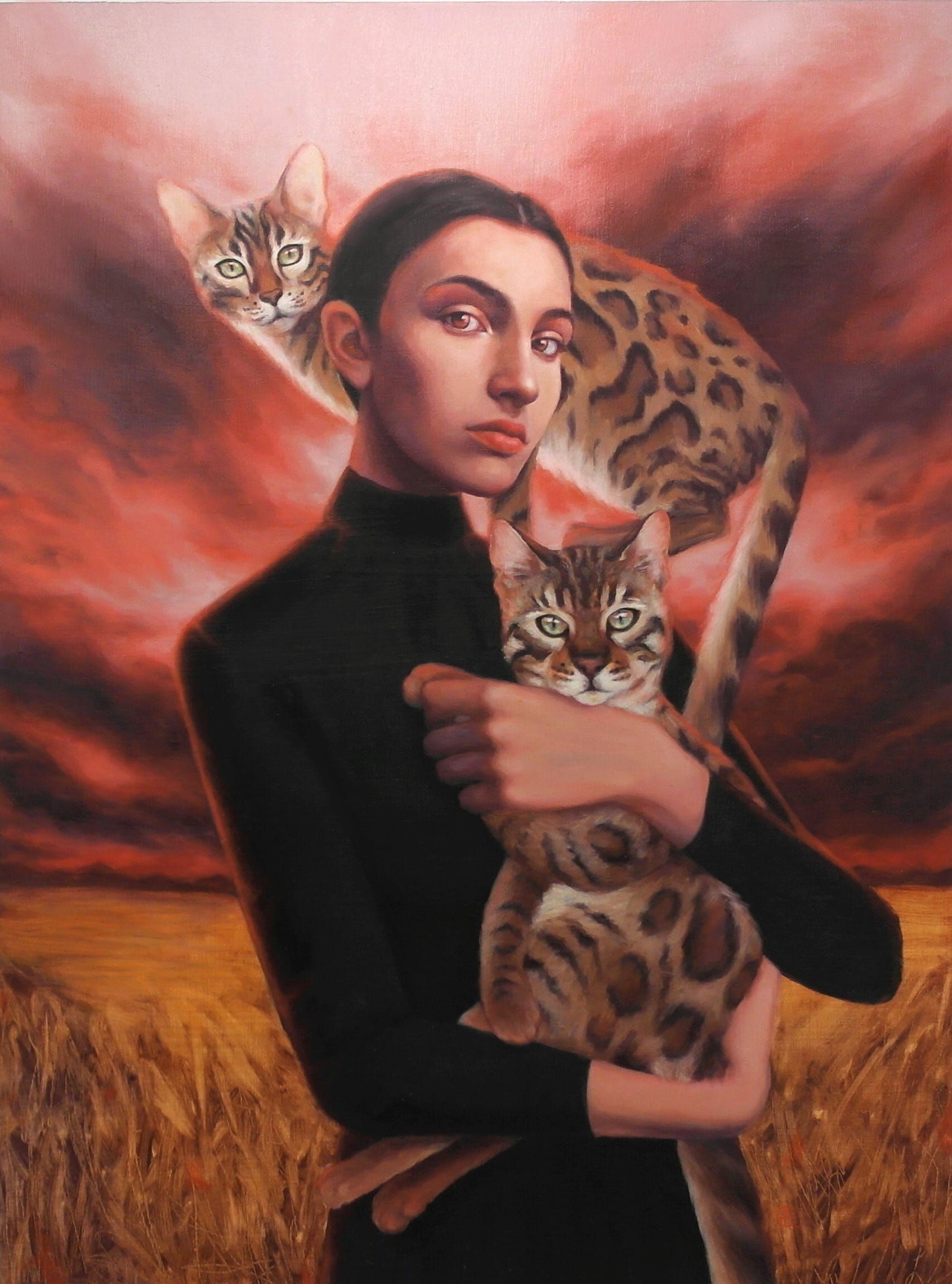
The Witch continues to reveal our culture’s deep unease with knowledge sourced outside accepted norms. Western myth often portrays feminine curiosity as dangerous, as if a clear moral boundary delineates acceptable and unacceptable ways of knowing. Eve bites the apple. Pandora opens the box. In both cases, great suffering follows.
The Witch’s wisdom is transgressive and thus threatening. Gleaned outside traditional power structures, her arcane knowledge is feared as heretical or dismissed as irrational. Her knowing is sensual, instinctive, intuitive, relational, ecological. She learns directly from the natural and unseen worlds, and preserves ancestral knowledge in kinship with other women. The Witch is midwife, healer, and seer—she can see beyond the veil.
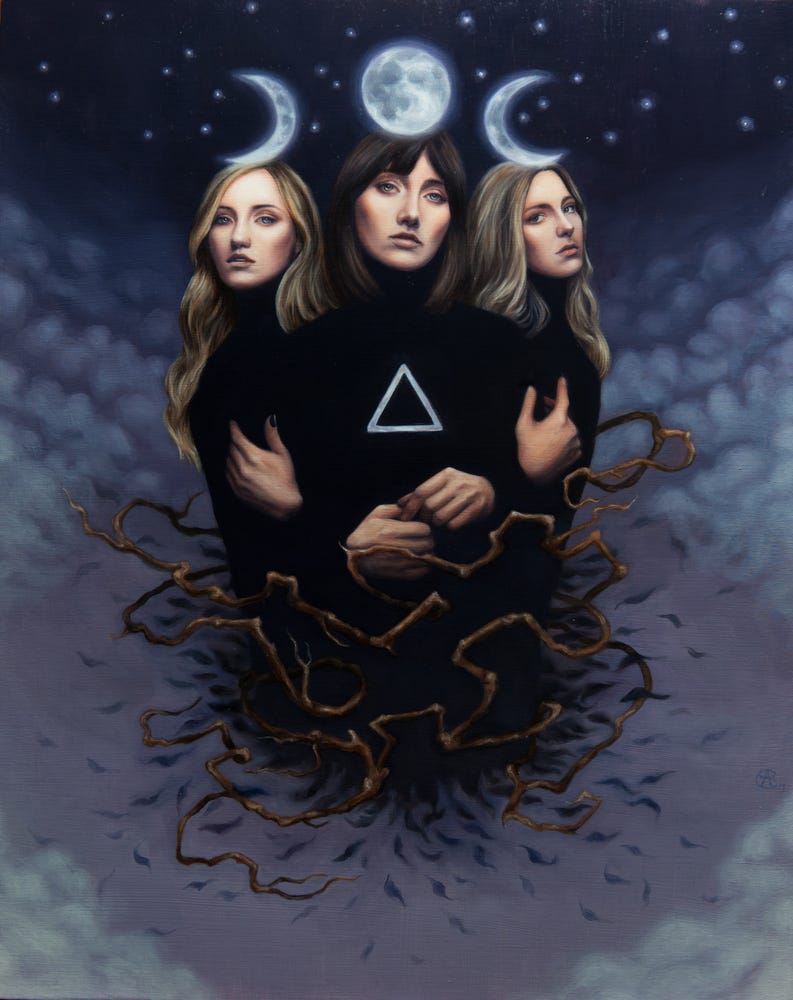
Cast to the margins of art history, the Witch finds resonance with many women artists whose contributions to Modernism were overlooked, erased, or overshadowed by their male counterparts—artists I admire, like Hilma af Klint, Ithell Colquhoun, Agnes Pelton, and Leonora Carrington. Each cultivated a fertile relationship with the hidden side of things, treating art as a means of communication and communion with other realms.
A relentless muse may be calling from beyond the veil, but the artist must cross over and apprehend her mysteries directly to channel and ground her expression here, on this side of things. The creative process becomes a door to the vastness within and without, blurring the line between imaginal and material, summoning visions and thought-forms out of thin air. As a symbol, the Witch embodies the compelling creative power of those who dare cross the threshold and learn to speak the liminal language of the psyche.
The Cyborg: Sterilizing Nature
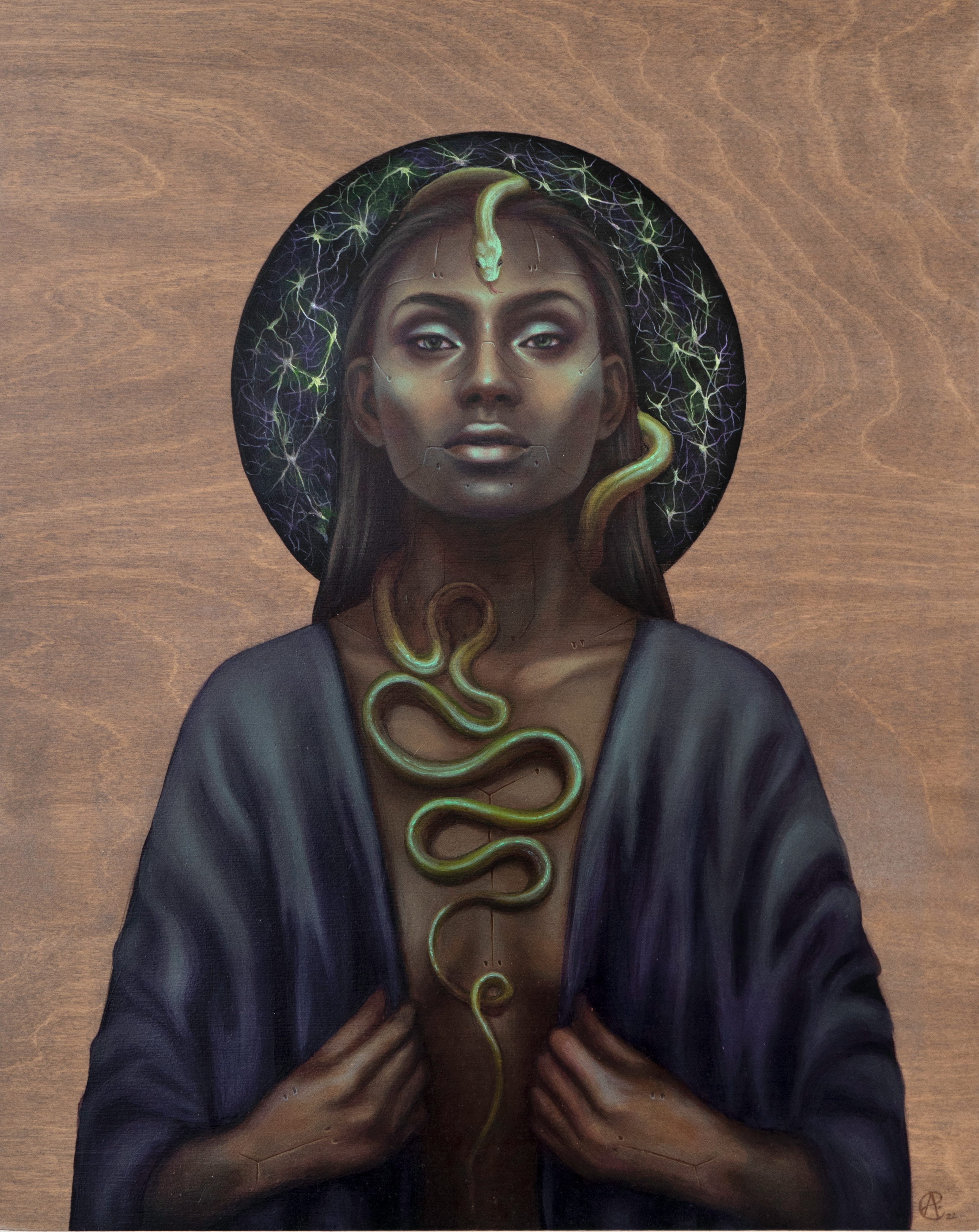
Recently, the Cyborg has surfaced in my work as a new archetype, raising questions as to where the body ends and technology begins. If the Witch dwells at the threshold between seen and unseen realms, the Cyborg emerges at the interface between body and machine.
At this point, I have more questions than answers. I think we are all contending with the Cyborg. I think we should all be asking questions.
What does the wild, embodied, erotic pole of being—the Feminine—mean for Techno-sapiens? How does technology intersect with and transform the procreative and creative process, the wheel of birth, sex, and death? These questions echo an ancient tension between cyclical, embodied existence and our cultural agenda toward linear progress and transcendence.
The Cyborg doesn’t emerge in a vacuum; it is the product of a culture obsessed with overcoming the body and sanitizing matter. It is a creature devoid of eroticism, severed from the web of life, programmed to build its own optimized cocoon, its own silicon womb. Where the Femme Fatale embodies the wild pull of Eros and the messy renewal processes of Nature, the Cyborg represents her sterilization: the erotic flattened into stable efficiency.
The Cyborg sources knowledge not from direct sensory experience but from representational maps abstracted into algorithmic processes. As such, it stands in stark contrast with the Witch’s embodied and relational wisdom. Sensual input does not exist for machines. Is the technological project, then, at odds with the Feminine? Is it a telling fantasy that mirrors back our anxious pursuit of totalizing knowledge—our desire to rip the veil open altogether and invade the Mystery with predictability and mathematical certainty?
Is the Cyborg a dystopian figure, or an admission that our physical, biological reality is equally embedded in stories? We may be animals tethered to earthly processes, but we also exist and evolve within a larger cultural matrix, an ecology encompassing the technologies that continually reshape human perception, social relations, and our malleable sense the real.
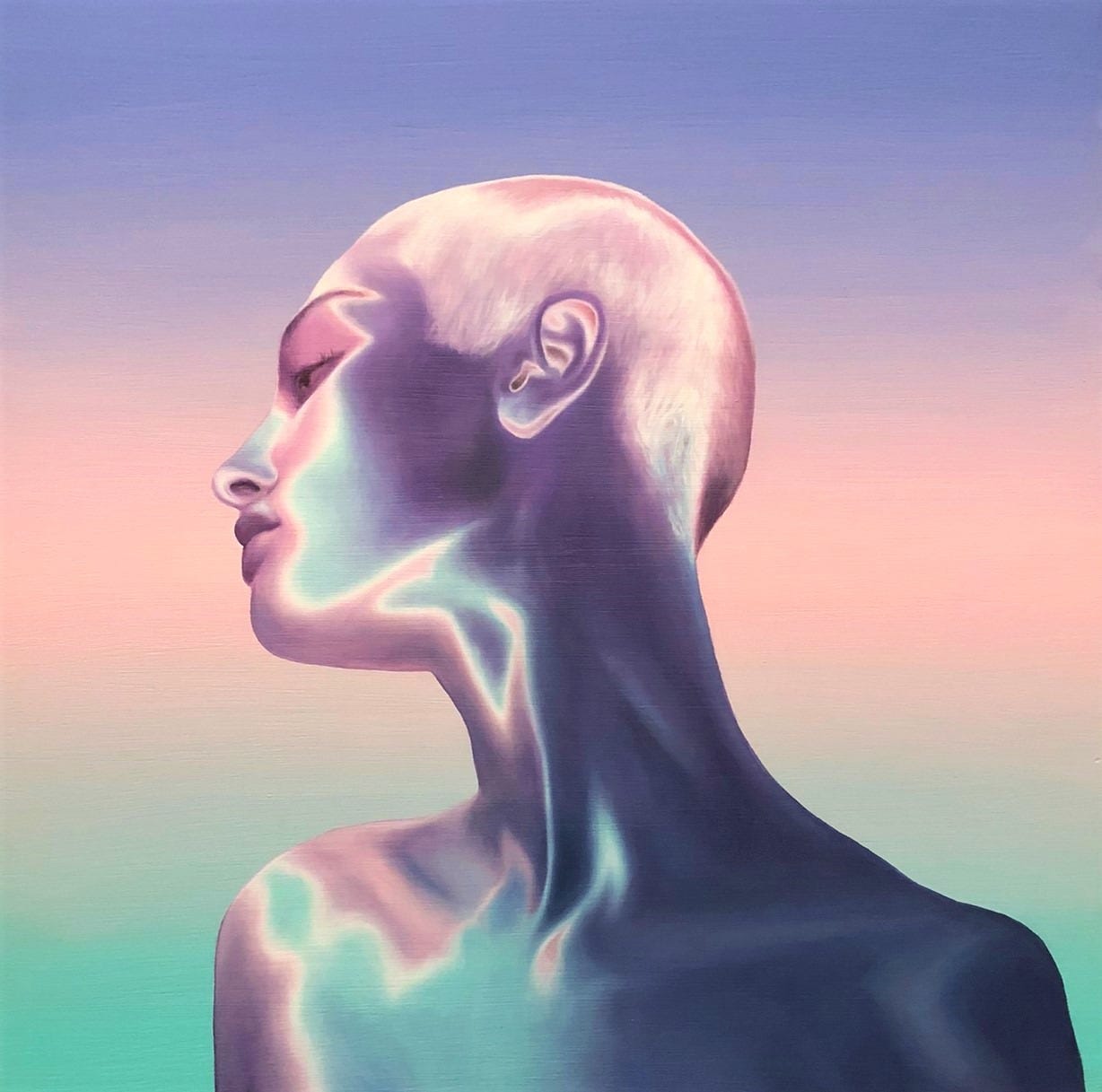
The Cyborg highlights our own predictability and programmability. In a context where maps take precedence over the territory, we lose touch with the ground and float disembodied in a hyperreal construction where everything competes for our attention. The simulacrum feeds on our erotic charge and begins to wear our bodies, our flesh hijacked by irresistible systems designed to capture, predict, and shape our behavior. In this way, the Cyborg asks: Are you a machine?
I could go on and on, but this is starting to feel a bit lengthy for a Studio Notes. My creative practice is a form of inquiry, and exploring the Feminine has been and continues to be central to my artistic journey. The Femme Fatale, the Witch, and the Cyborg are all characters within the larger, ongoing narrative of a culture that, like me, is grappling with the power, mystery, and contradictions of the Feminine.
I would love to hear from you <3
Aethereal Moods is a reader-supported publication. To receive new posts and support my work, consider becoming a free or paid subscriber.
Comments
Nothing yet. Say the first thing.
Sign in to join the conversation.