
A Magical Theory of Art explores the parallels between art and magic, examining how occult practices may be used to unleash one’s daimon and unlock the artistic imagination. Here, I turn to human creativity’s animist roots and explore whether artists have been midwives to spirits all along—possessed by otherworldly things that bestow the fire of inspiration in exchange for expression and influence in the material realm.
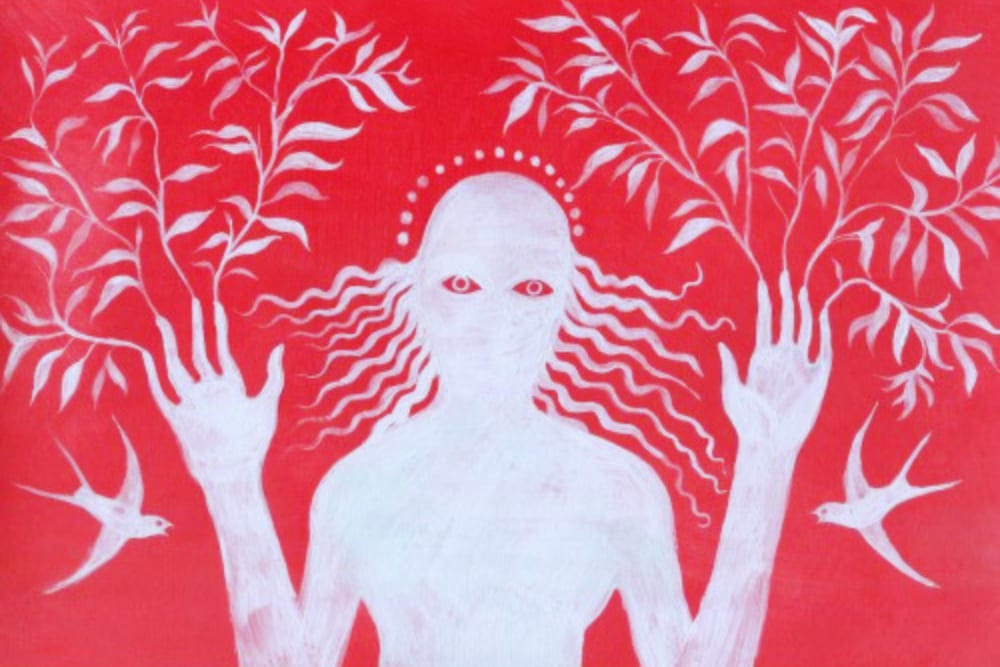
Creation is an act of ensoulment.
This impulse is written into our oldest creation myths. Across cultures, with a consistency that perhaps points to something other than coincidence, a creator god shapes the first human from clay and ensouls it through breath. In Mesopotamia, Enki and Ninhursag fashion humanity from clay mixed with divine essence (the blood of a sacrificed god); in Egypt, the potter-god Khnum shapes body and ka on his potter's wheel using silt from the Nile River while Isis gives Life; in Genesis, God molds Adam from dust and breathes into his nostrils. And so on.
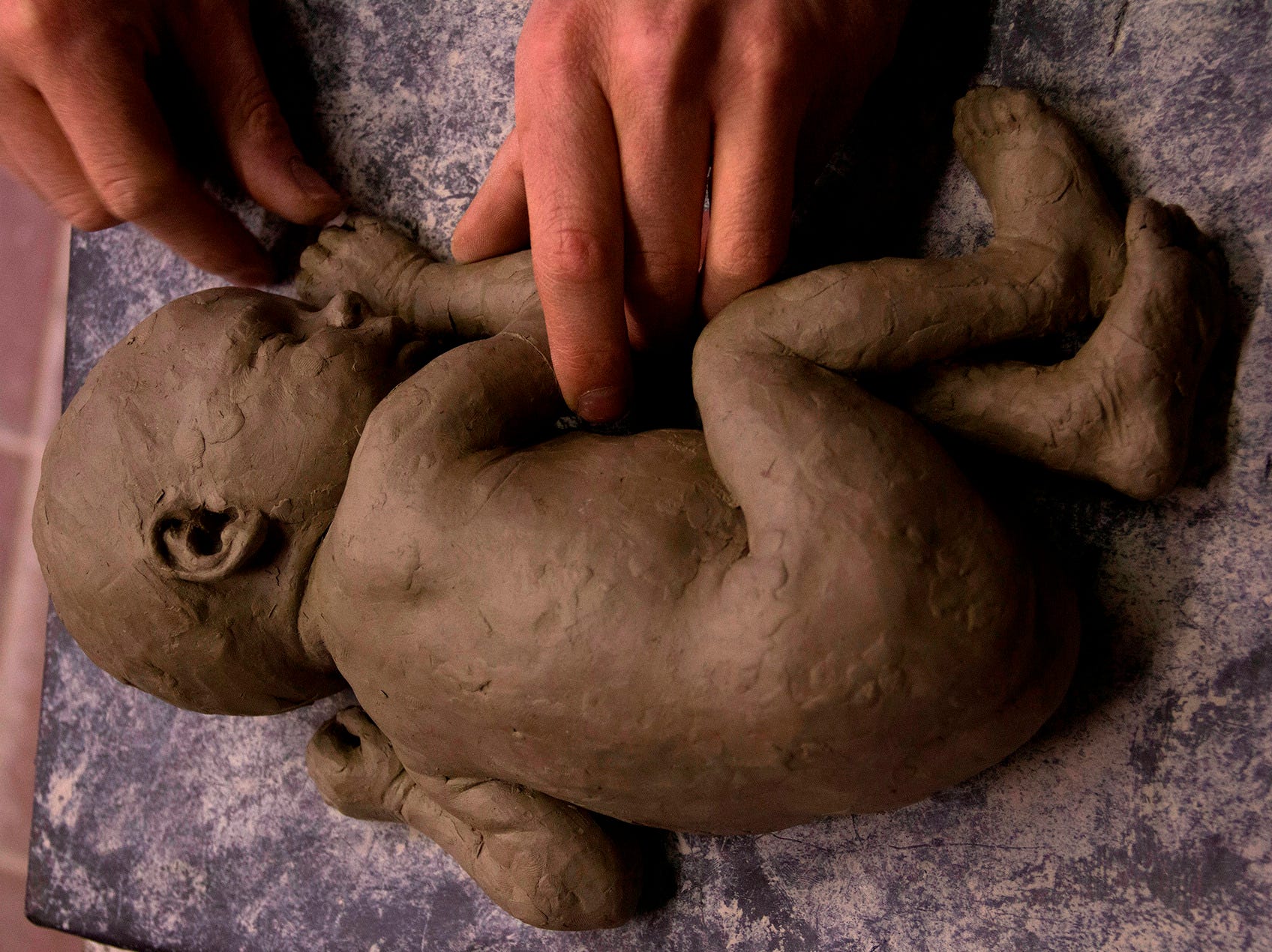
To be made in the image of the Creator is to inherit that same creative urge. As such, the act of crafting a form and calling a spirit into it is among the most ancient things we know how to do, as we shall see. The recurring breath-of-life motif hints at the simultaneous drawing in and drawing forth of inspiration, received and exhaled into form. Thus, humans possess a peculiar capacity to bridge the realms of spirit and matter, transmuting the imaginal, the conceptual, and the emotional into material form.
In this co-creative dance between worlds, art and magic converge.
Making Gods in Our Image
The origin of representation in art is inseparable from the magical imagination. It is well to remember that our species’ creative instincts originate within the animist matrix of our ancestors, in which all things possessed a spirit. In a world permeated with consciousness, the image embodied an aspect of what it represented and offered a direct link to its life force. Through craft, this link was activated, setting its effects in motion in the material realm. Art and magic were not separate disciplines, but twin expressions of our capacity for symbolic thought, nuanced feeling, and the instinct for worship.
Our species’ earliest “marks” on the world are hand stencils from Indonesia, dating back at least 67,800 years, recently found in the Liang Metanduno cave on Muna Island, Indonesia1. The earliest representational art we know of was recently discovered on the island of Sulawesi, also in Indonesia, dated to at least 51,200 years ago2. It depicts what appears to be a hunting scene and is evidence of storytelling and symbolic thought.
While these examples ground early human experience in representation, the earliest example of sculptural art is the Löwenmensch, or Lion Man, discovered in the Hohlenstein-Stadel cave in Germany3. Being the first figurine we know of, it also stands as the first being shaped by human hands, although it’s likely that we’ve lost many others to time. Carved some 40,000 years ago from mammoth ivory, the being is a therianthrope (part human, part animal), a recurring creature throughout early myth.
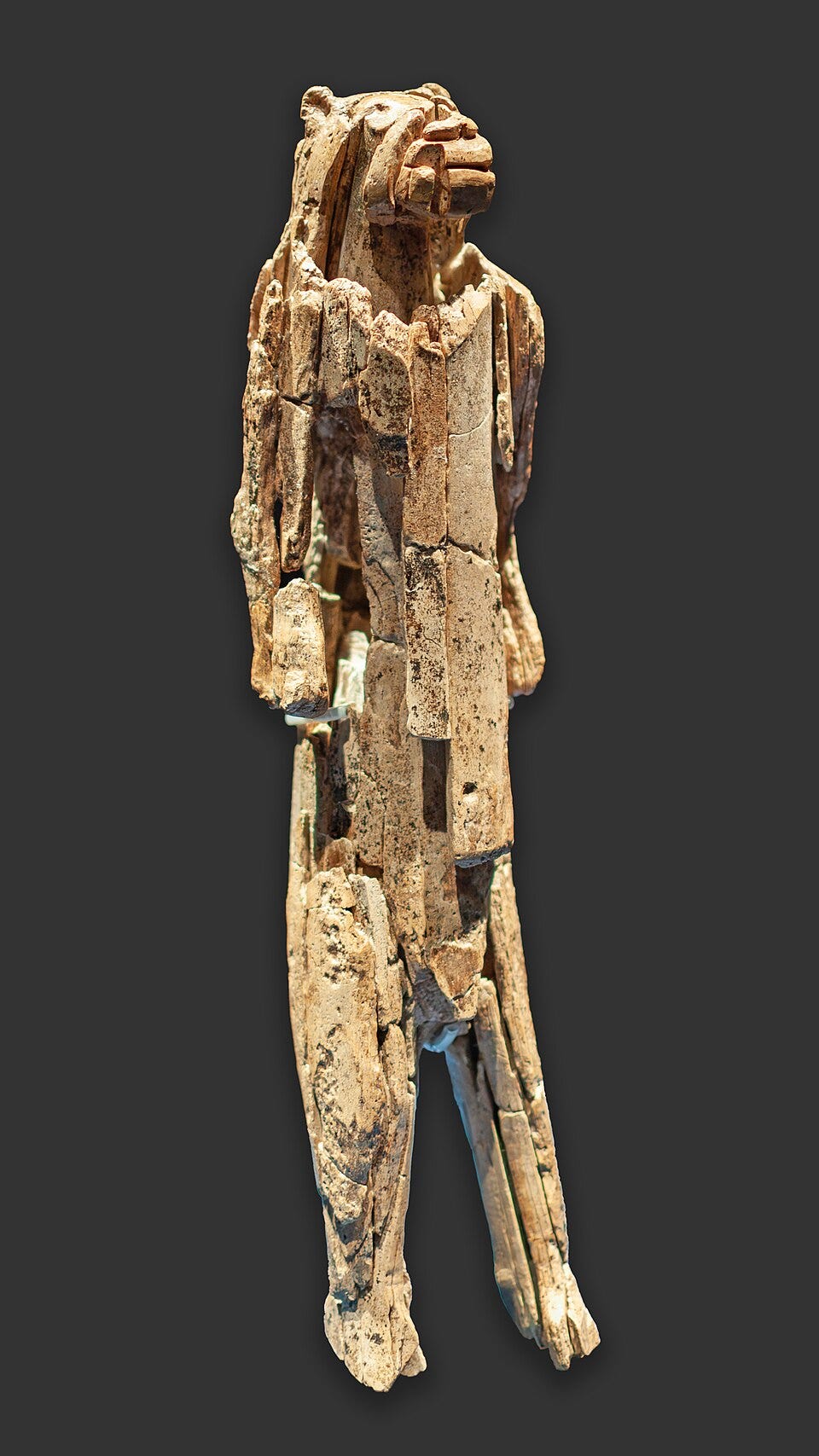
It is estimated that the artifact required around 400 hours to carve, a considerable expenditure of time and energy for an activity not directly tied to physical survival. The carver must have been ignited by a burning inspiration, slowly working the ivory, conjuring the Lion Man out of nothing and giving it a body.
In a world understood as an enspirited web, it is safe to say that Lion Man was no meaningless figure. The object likely functioned as an effigy: a vessel for a particular spirit, an entity alive within the narrative and ritual life of its makers. While the Lion Man’s story is lost to us, it reaches out across time. He is a glimpse into the kind of phantasms that roamed the inner landscapes of our ancestors, and into some of the first stories shared around the fire.
Around the same time, and continuing for tens of thousands of years afterward, humans across vast distances were crafting what we now call Venus figurines4. Over 200 examples survive, dating from 40,000 to 10,000 years ago. The earliest known, the Venus of Hohle Fels, was discovered in 2008 in a cave not so far from where the Lion Man was found. She is the earliest known depiction of a human being in art.
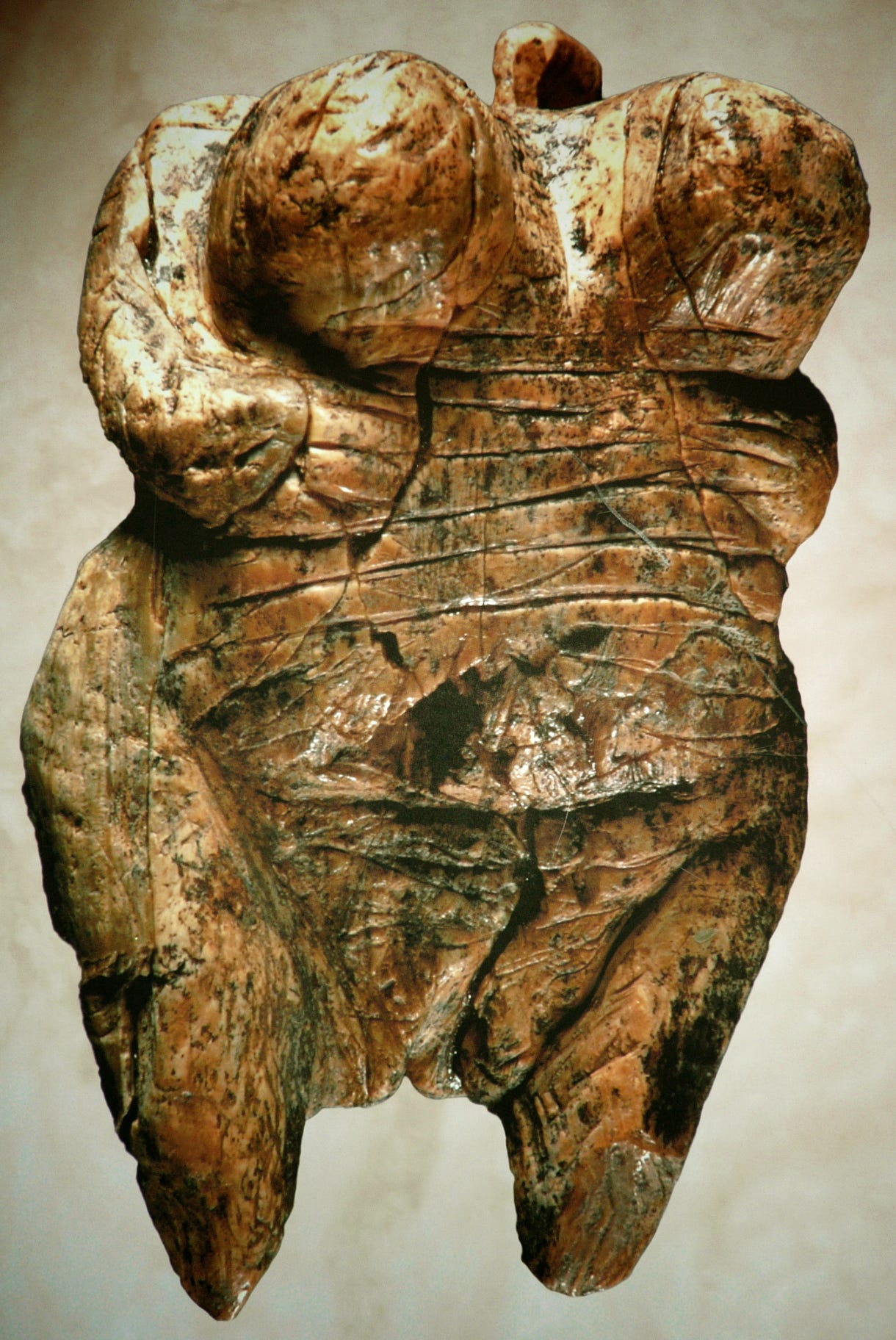
Spanning tens of thousands of years, the Venus figurines attest to our ancestors’ widespread and enduring engagement with a representation of the divine feminine as primeval creatrix, expressed and embodied through a big booty, generous hips, ginormous breasts, and a rounded belly. A potent, sacred figure likely tied to fertility, abundance, and survival narratives. Effigies of the archetypal spirit of a nourishing mother who lived on in the collective imagination of our ancestors across cultures and time.
These two figures, the Lion Man and the Venus of Hohle Fels, are likely among the earliest devotional artifacts our species ever crafted, long-lost gods shaped in our image. Through their anthropomorphic forms, early humans found a way to relate to the otherworldly, giving shape to what would otherwise remain abstract and invisible. In Ensouling the Effigy, Matthew Venus articulates this beautifully:
“The spirit envisioned in a human form offers us eyes to witness us, a face to look upon, ears to hear our prayers and conjurations, hands to bestow blessings and aid us in our burdens, and feet to lay our offerings before […] The gods created us in their image, and we in turn have created them in ours” (p.138).5
While the Lion Man stands just over 30 centimeters and Venus figurines range from 3 to 30 centimeters, it is not until we arrive at one of the world’s earliest known temples, the enigmatic 12,000-year-old Karahan Tepe and the surrounding region of Şanlıurfa, Türkiye, that we encounter the first sculpture at a human scale. The 11,500-year-old statue found at Karahan Tepe, often referred to as the “Corpse Statue,” was unearthed in a ceremonial chamber and stands at 2.3 meters tall6. The 9,000-year-old Urfa Man, discovered in the same region, stands at 1.8 meters.
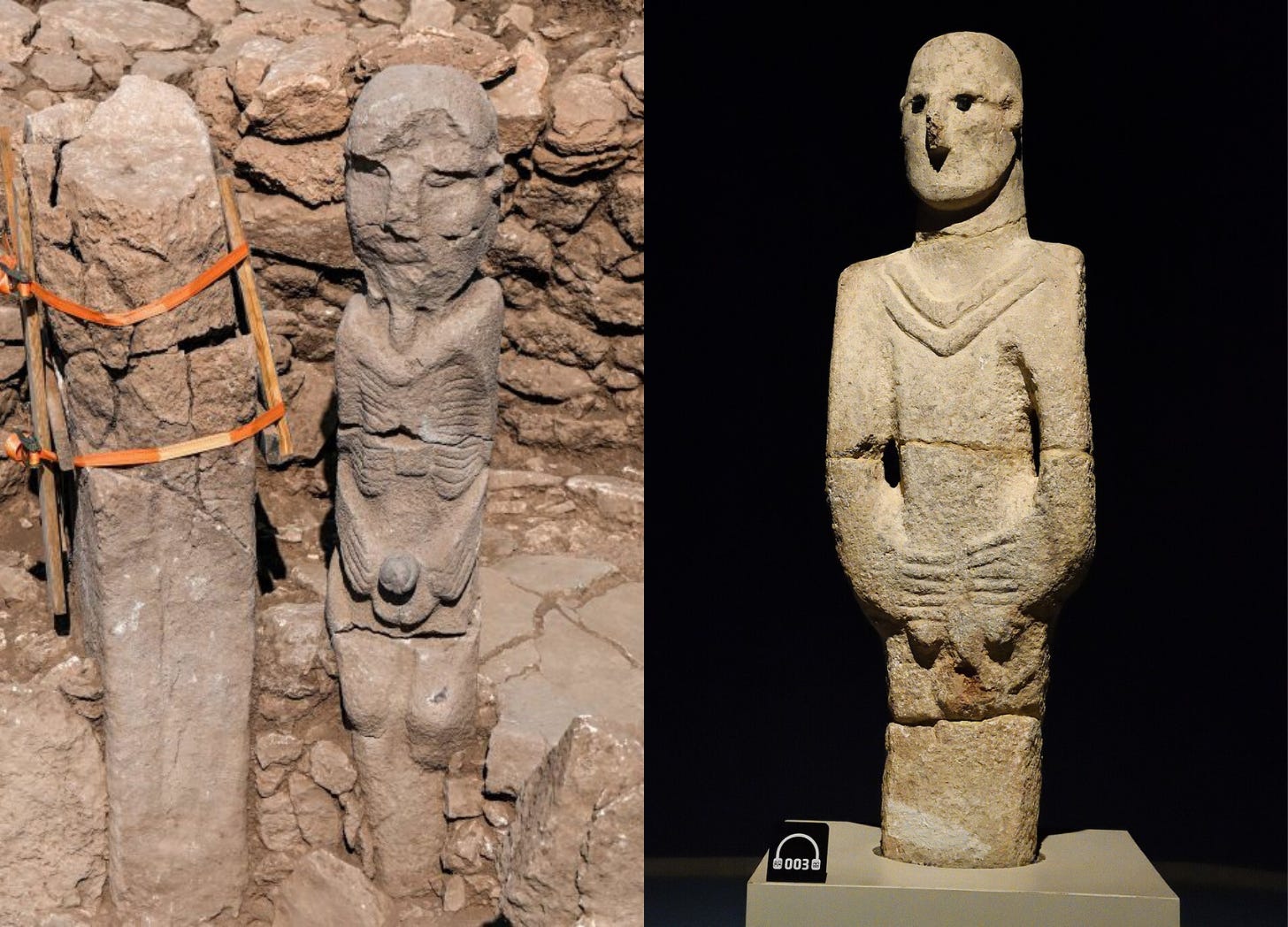
Though both statues share obvious similarities as depictions of a V-necked man holding his erect penis—a consistent iconography among the Taş Tepeler people who sculpted them—the Urfa Man has uncanny obsidian eyes and lacks a mouth. Archeoastronomer Alistair Coombs suggests that “the feature of his absent mouth forms part of a stylistic design that symbolically insinuates the presence of the dead,” and further proposes that he may have been intended as “a communicator from a supernatural world of the dead to the world of the living in a realistically human shape.”7 In this light, both statues raise questions about ideas of divine lineage, ancestor worship, and ritualized communication with the dead.
Through these examples of our creative origins, I have sought to show the evolution of our engagement with spirits and divinity through art, highlighting how the impulse to create was intertwined with the urge to worship and reach out to the Otherworld from the very beginning. I believe that the patterns we see recurring across time and culture point to symbolic motifs not necessarily transmitted via oral traditions alone, but through our ancestors’ direct experience of, and communication with, spirits—forces, entities reified through stories and form. As such, the earliest artists were storytellers and mythmakers, but also midwives to spirits. But what, then, are spirits?
If my art and writing resonate with you, you can support my practice by purchasing a print or becoming a paid subscriber. Thank you for helping me bring more of this work into the world.
What Are Spirits?
“An idea is a being incorporeal, which has no subsistence by itself, but gives figure and form unto shapeless matter, and becomes the cause of manifestation.” — Alice Bailey
Warning: In this section, we ponder big questions that cannot be definitively resolved. Things like the nature of consciousness, the structure of reality, and the flickering boundary between inner and outer remain Mysteries better approached with awe, humility, and a willingness to accept that some things are just ineffable and debatable. Yet, we can treat the unknown as a generative space, a playful field for experimentation and weird, visceral encounters. We can cultivate a direct experience of it. That’s my two cents.
Within an animistic worldview—the soil out of which early human creativity emerged—consciousness is not an isolated, boundaried phenomenon but a fundamental property of Creation. Everything is ensouled, imbued with its own form of intelligence, however foreign and impenetrable it may be to us. Not only animals and plants, but rivers, stones, natural forces, planets, and stars participate in this vast continuum of awareness. Even at scales far removed from human perception, from atoms to galaxies, there is a sense of interiority, of some kind of personhood.
If consciousness permeates all things, then the distinction is not so much between what is conscious and what isn’t, but between what is chaotic and what is organized. From this lens, spirits can be understood as organized patterns of consciousness, an idea I owe to occultist Jason Miller8.
Miller explains that for human beings, consciousness is primarily organized around the physical body. However, there are many more possible configurations. Consciousness may also organize itself around place (a forest, a river, a mountain). It may organize itself around a given tradition as the accumulation of myth, story, ritual, and attention shapes and reifies an entity over time. Spirits can also organize themselves around emotional patterns, behaviours, or ideas.
Additionally, these unique patterns of consciousness can be engaged with, given one has the right sensory and cognitive tools. For our animist ancestors, this was a primary mode of perception—one that, for us, has largely atrophied under the weight of dualistic rational thought. This is where the cultivation of a receptive inner space becomes essential to this wider dialogue with the unseen, along with learning the language of signs and synchronicities.
This leads to a long-standing and often polarizing question within magical and esoteric communities: are spirits autonomous entities existing outside of ourselves, or are they psychological projections arising from within? Perhaps both are not so mutually exclusive, as culture and expectations shape our experience of the liminal.
I was curious to see how Richard Kaczynski would approach this question in his book Mind Over Magick9, which draws on a wealth of peer-reviewed research in psychology and cognitive neuroscience to shed a more empirical light on ritual magic. I was surprised to learn that the experience of a “Third Man”—a sensed presence that offers feelings of hope and guidance during extreme survival situations—is a widely documented phenomenon in psychology, one on which numerous books have been written10.
Whether this sensed presence is interpreted as a guardian angel or the spirit of a deceased loved one watching over the experiencer, some researchers suggest that it may be an adaptive phenomenon. Sensed presence has three fundamental properties: it is apparent and recognizable, localized in space (often behind the experiencer), and intentional. Most importantly, it “may be the common phenomenological base from which experiences of god, spirits, angels, and other entities are derived” (p. 157). Therefore, one might ask whether this innate capacity can be triggered intentionally.
Of course, this is the long-standing claim of the witch and the magician, and also of many artists.
If my art and writing resonate with you, you can support my practice by purchasing a print or becoming a paid subscriber. Thank you for helping me bring more of this work into the world.
Consorting with Spirits
“Magical work generally involves altering one’s consciousness, inhabiting liminal spaces, and seeking inspiration.”—Richard Kackzynski
In 17th-century England and early modern Europe, “consorting with spirits” was an actual criminal charge for which many, often women, were tried, sentenced, and executed for allegedly collaborating with familiars and demons. While many were undoubtedly innocent people swept up in the Church-fueled hysteria of the witch hunts, there is evidence in surviving grimoires, manuals, and testimonies that some were indeed trafficking with spirits. In Consorting with Spirits, the above-mentioned Miller underlines, “spirits were considered so important and powerful that people risked imprisonment and execution to contact them and communicate with them” (p.1).
A witch’s familiar was a companion, a teacher, and an assistant in her magical work, acting as both a protective entity and a guide from which she drew spiritual and divinatory insight—not unlike the Greek concept of the Agathos Daimon (the “Good Spirit”). An intermediary spirit between worlds, it was understood as a guide associated with fate, inspiration, and genius. Daimon, originally a neutral term encompassing a wide range of spirits—from lesser divinities to intermediary beings between gods and mortals—later became the “demon” so feared within the Christian framework11.
Therefore, what was condemned as consorting with spirits was more like our ancestors’ long-standing participation in an animist ecosystem in which communication with non-human intelligences is possible, and relationships are reciprocal. In this context, the familiar or daimon acts as a mediator between worlds, a “third man” that can be called forth for guidance, knowledge, and inspiration.
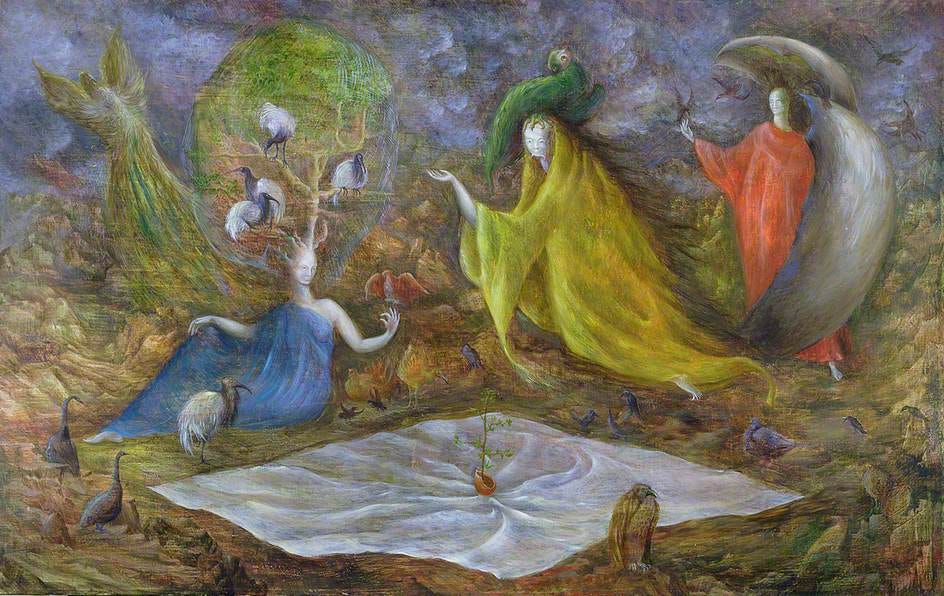
To me, there is great value for artists in engaging our inner genius at the level of personhood, seeing it as a spirit in its own right, while developing the ability to evoke it at will, and becoming a receptive vessel through which its daimonic force can move and create. Re-rooting our creative practice within an animist framework also means engaging with ideas and images as if they possess a life of their own. When we court inspiration, enter into dialogue with it, and birth it forth into being, we too are consorting with spirits. Only through us can their incorporeal nature gain power and influence in the material realm.
Each creative act is a reenactment of the first breath, with spirit exhaled into form again and again. The Lion Man, the Venus figurines, the Corpse Statue, and Urfa Man remind us that art-making has always been bound to the desire to commune with otherworldly forces. From the beginning, the image has always functioned as a site of encounter, ensouled through ritual, story, devotion, and offerings.
Even now, in a world that has largely forgotten its animist roots, this dynamic persists. Our creations open a locus of engagement where unseen, incorporeal forces gather themselves, take form, and enter into relation with the maker, the viewer, and the wider field of meaning in which it circulates.
If my art and writing resonate with you, you can support my practice by purchasing a print or becoming a paid subscriber. Thank you for helping me bring more of this work into the world.
Sample, I. (2026, January 21). Hand shape in Indonesian cave may be world’s oldest known rock art. The Guardian. https://www.theguardian.com/science/2026/jan/21/hand-shape-indonesia-cave-rock-art-67800-years-old
Woodford, J. (2024). 50,000-year-old picture of a pig is the oldest known narrative art. New Scientist. https://www.newscientist.com/article/2438291-50000-year-old-picture-of-a-pig-is-the-oldest-known-narrative-art/
Cook, J. (2017, October 10). The Lion Man: an Ice Age masterpiece. British Museum Blog. https://www.britishmuseum.org/blog/lion-man-ice-age-masterpiece
World History Encyclopedia. (2017). Venus Figurine. World History Encyclopedia. https://www.worldhistory.org/Venus_Figurine
Venus, M. (2025). Ensouling the Effigy: The Witch’s Arte of Enspirited Objects. Crossed Crow Books.
Tas Tepeler Archive Project. (2025, July 27). The strange human statue unearthed at Karahan Tepe. KarahanTepe.net. https://www.karahantepe.net/news/karahan-tepe-human-statue
Jarus, O. (2026, March 23). Urfa Man: An 11,500-year-old life-size statue of a man holding his penis. Live Science. https://www.livescience.com/archaeology/urfa-man-an-11-500-year-old-life-size-statue-of-a-man-holding-his-penis
Miller, J. (2022). Consorting with Spirits: Your Guide to Working with Invisible Allies. Weiser Books.
Kaczynski, R. (2025). Mind Over Magick: The Psychology of Ritual Magick. Inner Traditions/Bear & Company.
Books such as this one: Geiger, J. (2009). The Third Man Factor: Surviving the Impossible. Weinstein Books.
Oracle Hekataios. (2020). Daimon or Demon? The Cave of Oracle. https://oraclehekataios.com/tag/familiar-spirits/
Comments
Nothing yet. Say the first thing.
Sign in to join the conversation.