
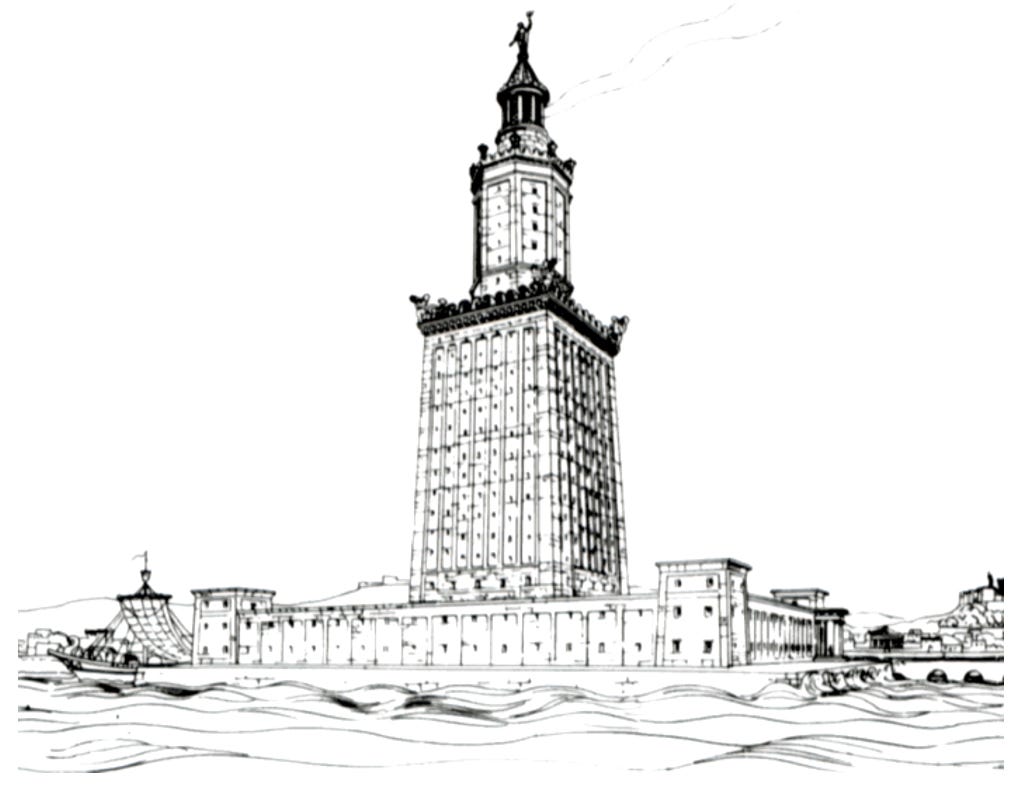
The Pharos or Great Lighthouse towered 100 m over the harbor and was visible to sailors thirty miles out at sea [[ii]]. The details of the neighboring Great Library are far more obscure.
We are told Ptolemy I Soter (c. 369–282 BC), General of Alexander and founder of the Ptolemaic Dynasty founded the Great Library. Or perhaps it was his son Ptolemy II Philadelphus (309–246 BC). It held 400,000 works. Or maybe only 40,000. Are we thinking of the Temple to the Muses, The “Museum” and the associated library? Or are we confusing it with the Temple to Serapis, the “Serapeum,” and its library? “In sum, the ancient figures for the size of the Library or the number of volumes lost in the Alexandrine War do not deserve any credence” [[iii]].
The circumstances of the Great Library’s demise are similarly obscure [[iv]]. It probably burned during the Alexandrine War, the 47–48 BC campaign of Julius Caesar (100–44 BC) [[v]]. Others claim it was in AD 272 when Emperor Aurelian (c. 214–275) retook the city from Queen Septima Zenobia of Palmyra (c. 240–274). Anti-Christians blame a Christian mob that destroyed the Temple of Serapis and its library in AD 391, an event sometimes confused with a later mob that murdered the mathematician and philosopher, Hypatia (c. 350/375–415) in AD 415. Anti-Islamists point to the AD 642 Arab conquest [[vi]].
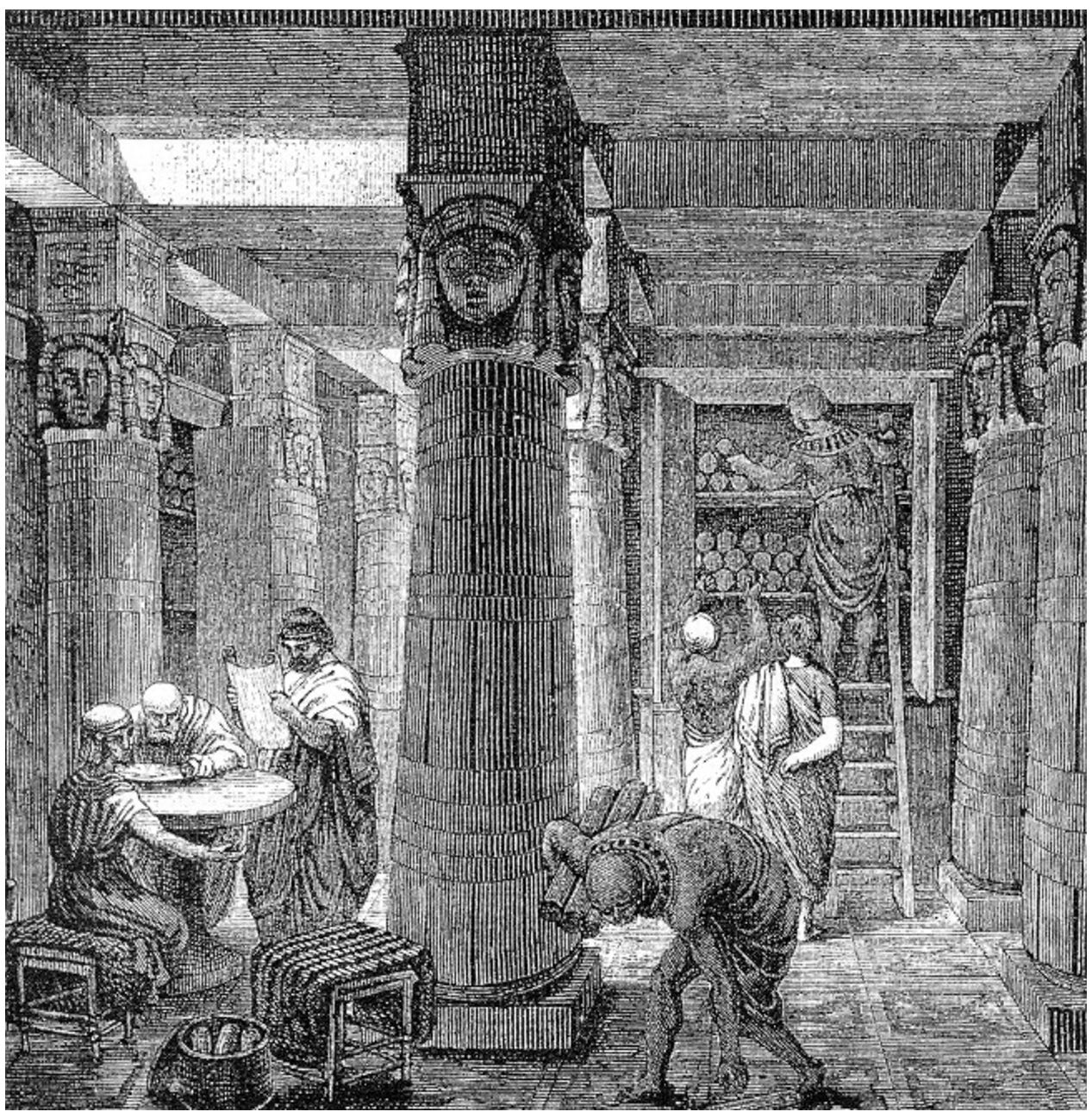
However the end finally came, for several centuries the Great Library of Alexandria was the premiere scientific and scholarly institution of the ancient world. In the Great Library’s Ptolemaic heyday, Roman and Greek physician, surgeon, and philosopher Galen of Pergamon (AD 129–216) reports that customs officials confiscated all books from any ships arriving in Alexandria, keeping the originals and returning copies [[viii]]. Galen further reports that King Ptolemy gave the Athenians fifteen talents of silver (~390 kg ≈ 860 lb) in security for borrowing the collected works of the principal dramatists of classical Greek tragedy, Sophocles (c. 496–406 BC), Euripides (c. 480–406 BC), and Aeschylus (c. 525–456 BC). The King kept the originals, returned the copies, and let the Athenians keep the silver. The library’s goal was to collect all Greek literature and as much knowledge as possible from other cultures.
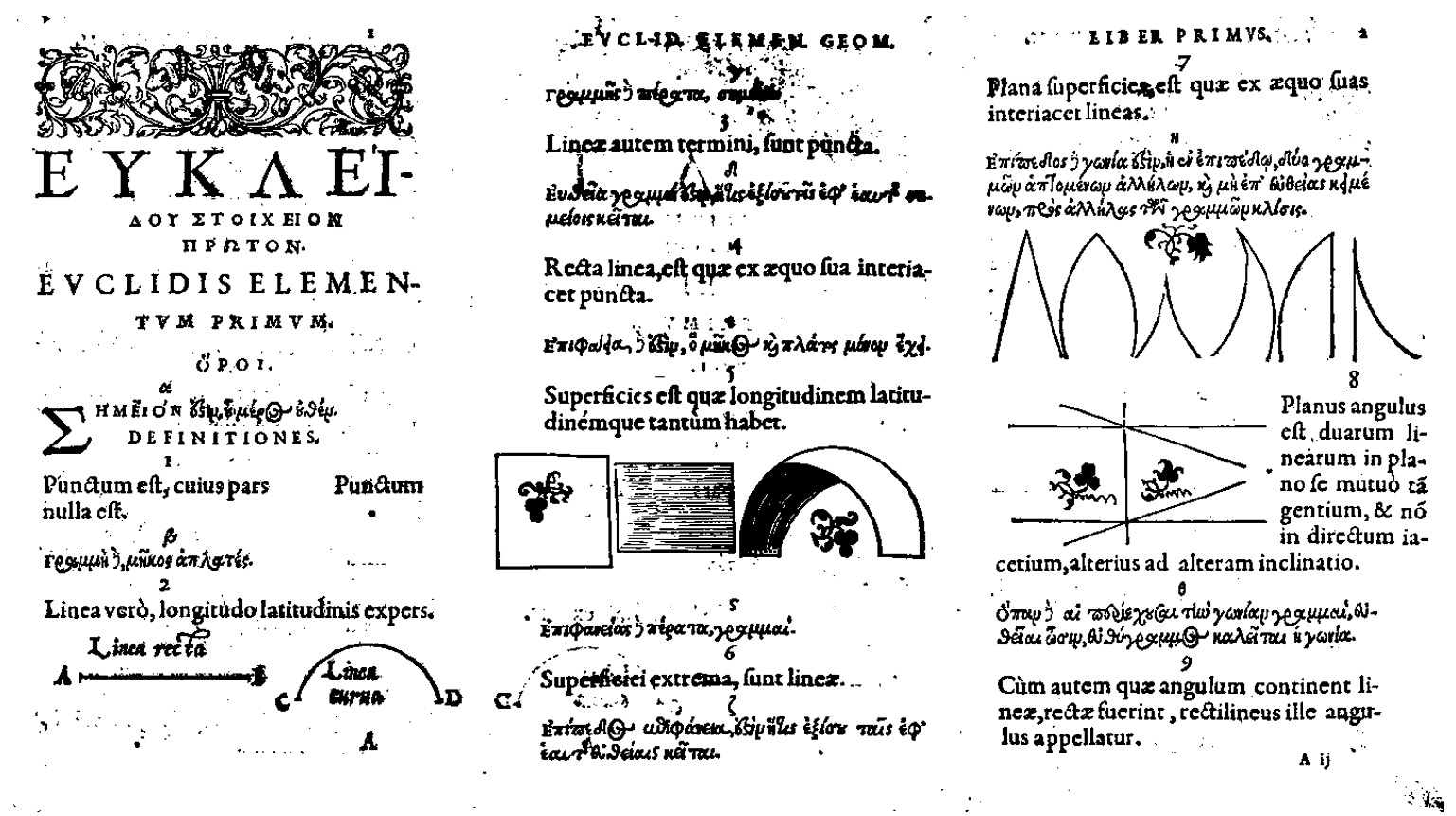
Scholars in residence included Euclid (c. 300 BC), the mathematician whose Elements became the foundational text of geometry: “…the most influential textbook of all times…. Perhaps no book other than the Bible can boast so many editions…” [[x]]. Euclid so standardized geometrical thinking that the predecessors upon whom he built were largely forgotten [[xi]].
Euclid’s Elements became the archetype, “the content of which was fully grapsed only by nineteenth century geometry and mathematics” [[xii]]. “The very concept of mathematics, the notion of proof, and the logical ordering of theorems were learned by studying it, and its contents determined the course of subsequent thinking” [[xiii]]. It organized geometry into a rigorously structured system in which a small set of definitions, axioms, and postulates generated an entire body of propositions through formal proof, establishing a model of knowledge as certain, universal, and deductively necessary. This method reinforced the intellectual pattern, dominant from antiquity through the early modern period, that truth, once grounded in self-evident principles, could be extended by pure reason without recourse to experiment. “The Greeks wanted truths and saw that they could obtain them only by the unquestionable methods of deductive reasoning [[xiv]].”
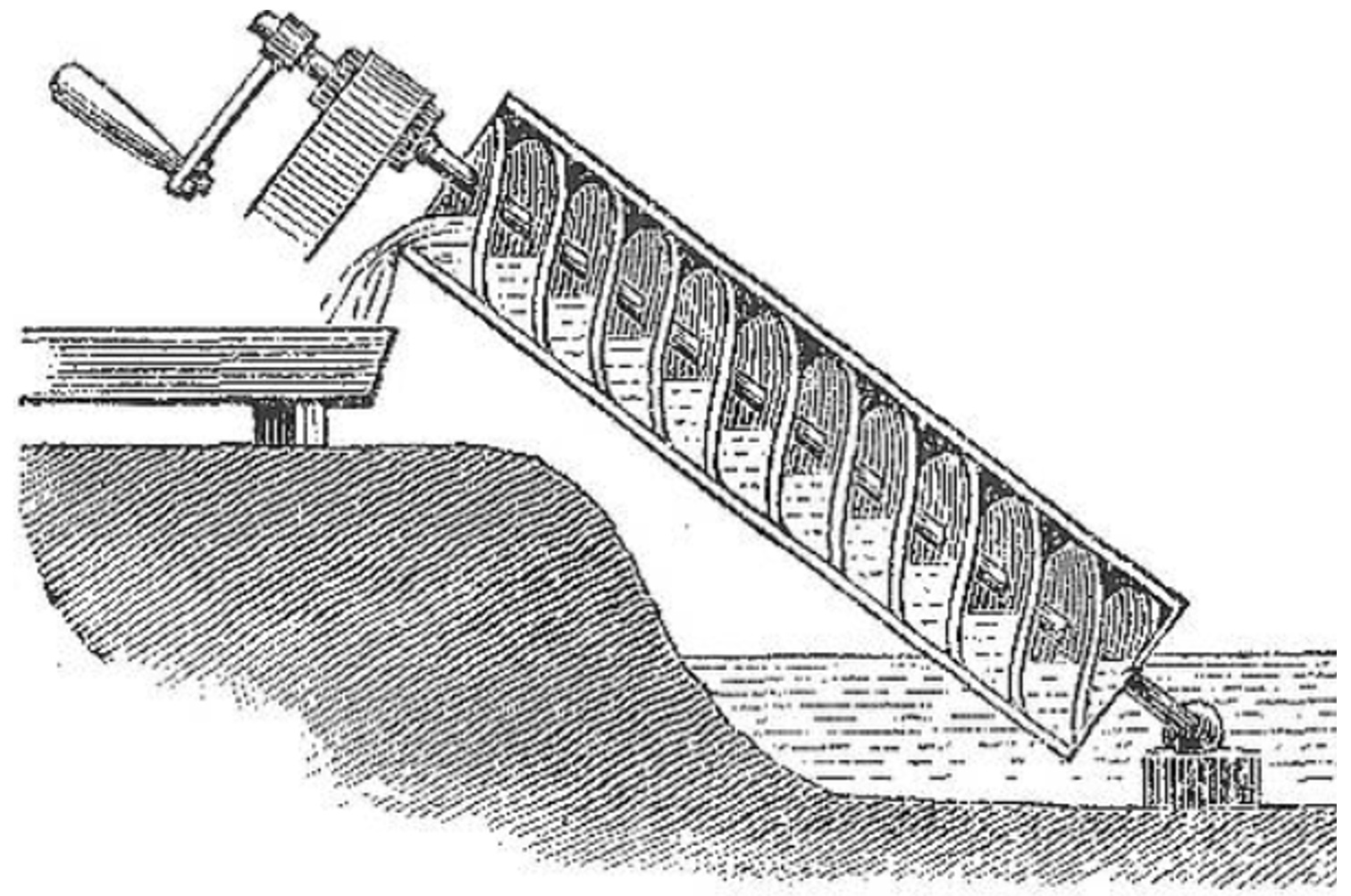
Archimedes (287–212 BC) is said to have visited the Library for a time and invented his famous water screw there [[xvi]]. Aristarchus of Samos (c. 310– c. 230 BC) anticipated Copernicus by 1800 years with his heliocentric model for the solar system [[xvii]]. Eratosthenes of Cyrene (276–195/194 BC) correctly calculated the circumference of the Earth, measured Earth’s axial tilt, pioneered the 365-day calendar with a Leap Day every four years later adopted by Julius Caesar, explored prime numbers, and much more [[xviii]]. A transitional figure between Babylonian and Greek astronomy, Hipparchus of Nicea (c. 190–c. 120 BC) developed early trigonometry, compiled star catalogs, and discovered the precession of the equinoxes (albeit at Rhodes, rather than Alexandria) [[xix]].
Mathematics, geometry, and astronomy were mere adjuncts to the primary mission of collecting and preserving knowledge. The Library and the co-located Museum (literally, a Temple to the Muses) took many different versions of Homer collected from sources across the Greek world and standardized them to today’s accepted version [[xx]] under the direction of Aristarchus [[xxi]].
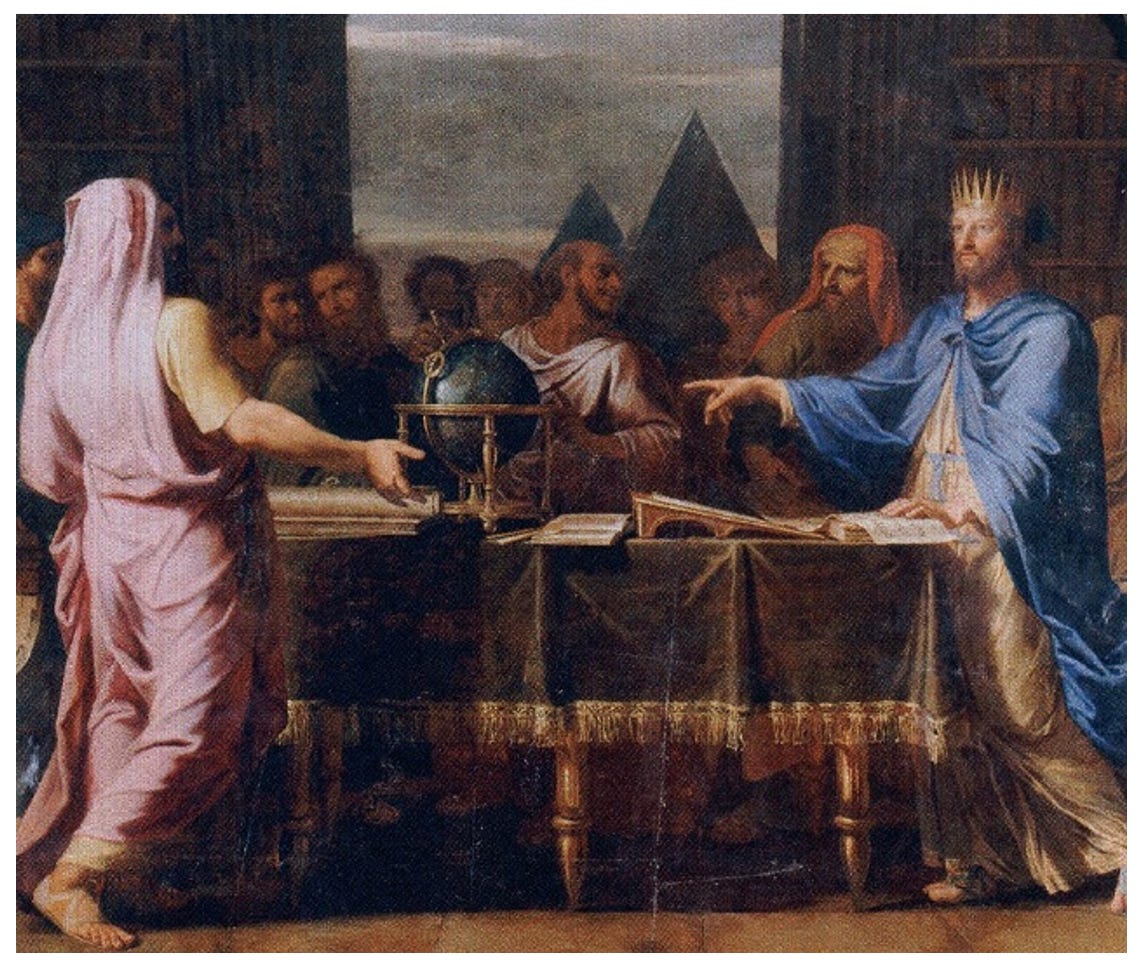
“Egyptian Jews required a Greek translation of their Scriptures, because they no longer understood them in the original language” [[xxiii]]. Ptolemy II Philadelphus (309–246 BC) supposedly sponsored some 72 Jewish scholars to translate their books of wisdom into Greek [[xxiv]]. The “Septuagint” or the “Translation of the Seventy” (LXX) is one of the two primary sources for The Old Testament, the other being the “Masoretic Text” (MT) compiled by Jewish scholars between the 7th and 10th centuries AD. The original LXX was said to be stored in the library of the Temple of Serapis destroyed in AD 391 [[xxv]].
For many years, Christians accepted the MT as the most faithful version of ancient Hebrew Scripture, despite discrepancies in how the New Testament cited passages. Did Isaiah 7:14 prophesy a “young woman” [MT] or a “virgin” [LXX] as cited in Mathew 1:23? Did Psalm 22:16 foretell Christ’s crucifixion, “they pierced my hands and feet” [LXX], or was it “like a lion are my hands and feet” [MT]? In Isaiah 40:3, did a voice cry, “In the wilderness, prepare the way…” [MT], or did a voice cry in the wilderness, “Prepare the way…” [LXX] as cited by John 1:23?
The Masoretic Text is not simply a polemically altered rabbinic recension of an earlier form preserved in the Septuagint. Nor is the Septuagint a mistranslation of the Hebrew reflected in the Masoretic Text. The Dead Sea Scrolls discovery and related manuscript finds suggest the coexistence of distinct textual traditions, each with its own transmission history. These comparisons point to both the durability of the textual record and the constraints on any model that assumes a singular, unvarying original [[xxviii]].
Whatever damage may have occurred to the Library during the Alexandrine War, an active academic community remained into the Roman era. Claudius Ptolemy (~ 100–170) synthesized ancient astronomical observations, the observations of Hipparchus, and his own observations in his thirteen-volume Almagest [[xxix]]. In doing so, he crystalized the Aristotelian cosmology into a comprehensive geocentric model of the solar system that dominated for over a millennium [[xxx]].
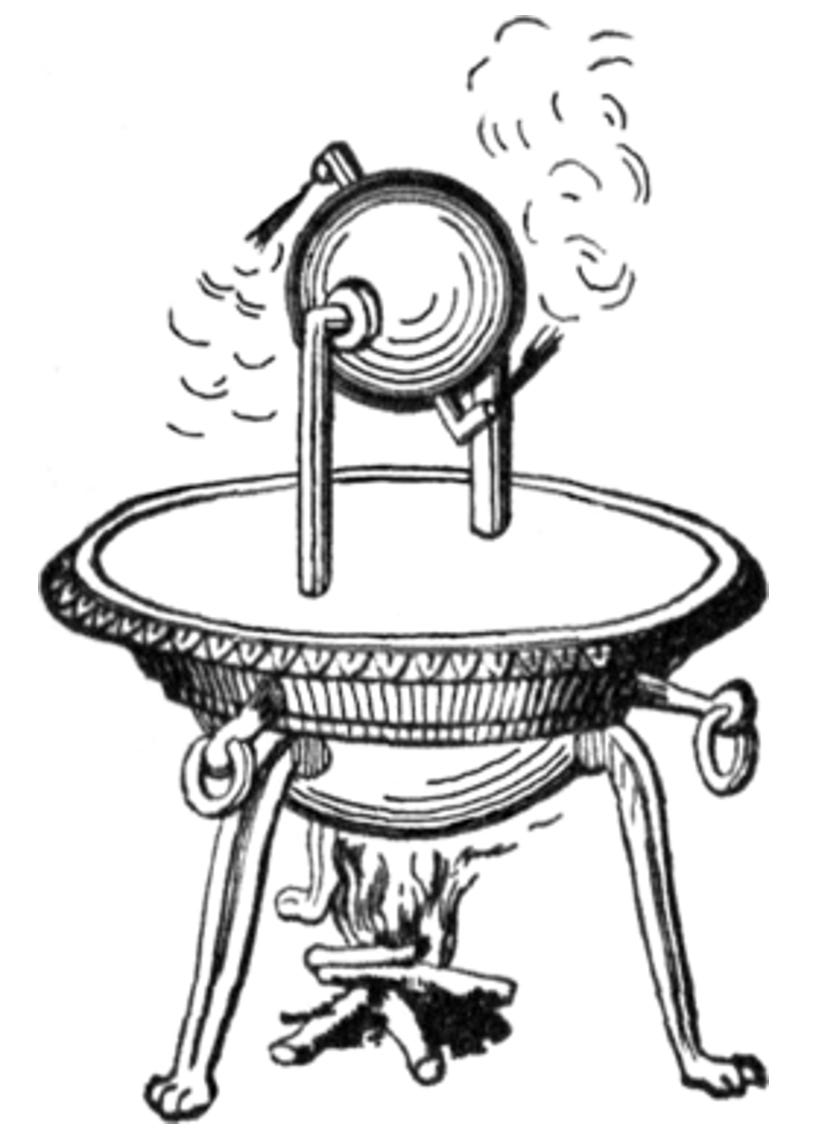
Heron of Alexandria (c. AD 10–70) (alternately “Hero” in Latinized form) was a Greek engineer and mathematician of Roman Alexandria who described early steam-powered devices and automata. In one of Heron’s designs, a fire on an altar heats air in a sealed chamber, increasing pressure and forcing water into a suspended bucket. As the bucket fills and descends, it pulls the doors open via cords and pulleys. When the fire goes out, the air cools, a siphon returns the water to its reservoir, and a counterweight pulls the doors closed again automatically [[xxxii]]. He also reported practical formulas for the area of a triangle and formulated an early version of the principle of least distance in optics, showing that a light ray reflecting from a mirror follows the shortest path between two points. And he is known to have updated Euclid [[xxxiii]].
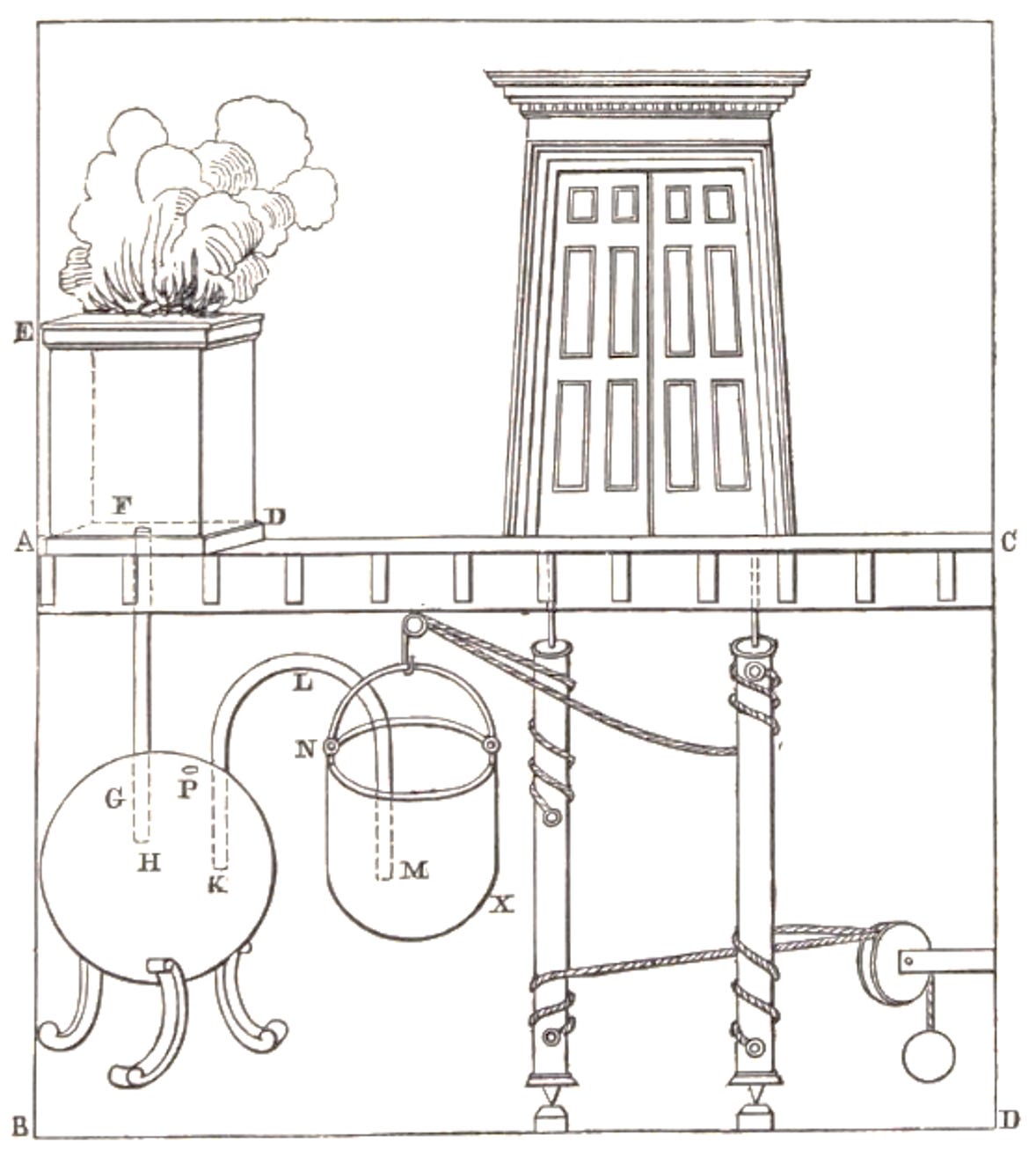
This blend of practical geometry and physical reasoning, alongside his applied works like Pneumatica and Metrica, made his corpus especially valuable to later Greek and Arabic scholars, contributing to its preservation and transmission [[xxxiv]].
Roman Alexandria remained a center of learning, though increasingly shaped by political instability and religious conflict. We already met Clement of Alexandria (c. 150–215) who was active in Alexandria from roughly 180 until about 202–203, when persecution under Septimius Severus (145–211) likely forced his departure. Clement taught at the Catechetical School of Alexandria and helped integrate Greek philosophy with Christian theology [[xxxv]]. We also met Origen (c. 185–253) who was born in Alexandria and taught there from about 203 until 231–232, when disputes with church authorities led him to relocate to Caesarea. One of the most influential Christian intellectuals of late antiquity, he expanded the Alexandrian tradition of biblical scholarship, philosophy, and textual criticism [[xxxvi]]; among his later students at Caesarea was Gregory Thaumaturgus (c. 213–270).
Theon of Alexandria (c. 335–405) was a mathematician and editor best known for his recension of Euclid’s Elements [[xxxvii], [xxxviii]] and commentaries on Ptolemy’s Almagest, helping preserve and standardize key scientific texts in late antiquity. His daughter, Hypatia (c. 355–415), was a leading Neoplatonist philosopher and teacher whose work in mathematics and astronomy continued this tradition, but whose murder in 415 amid civic and religious strife illustrates the fragility of intellectual life in this period [[xxxix]].
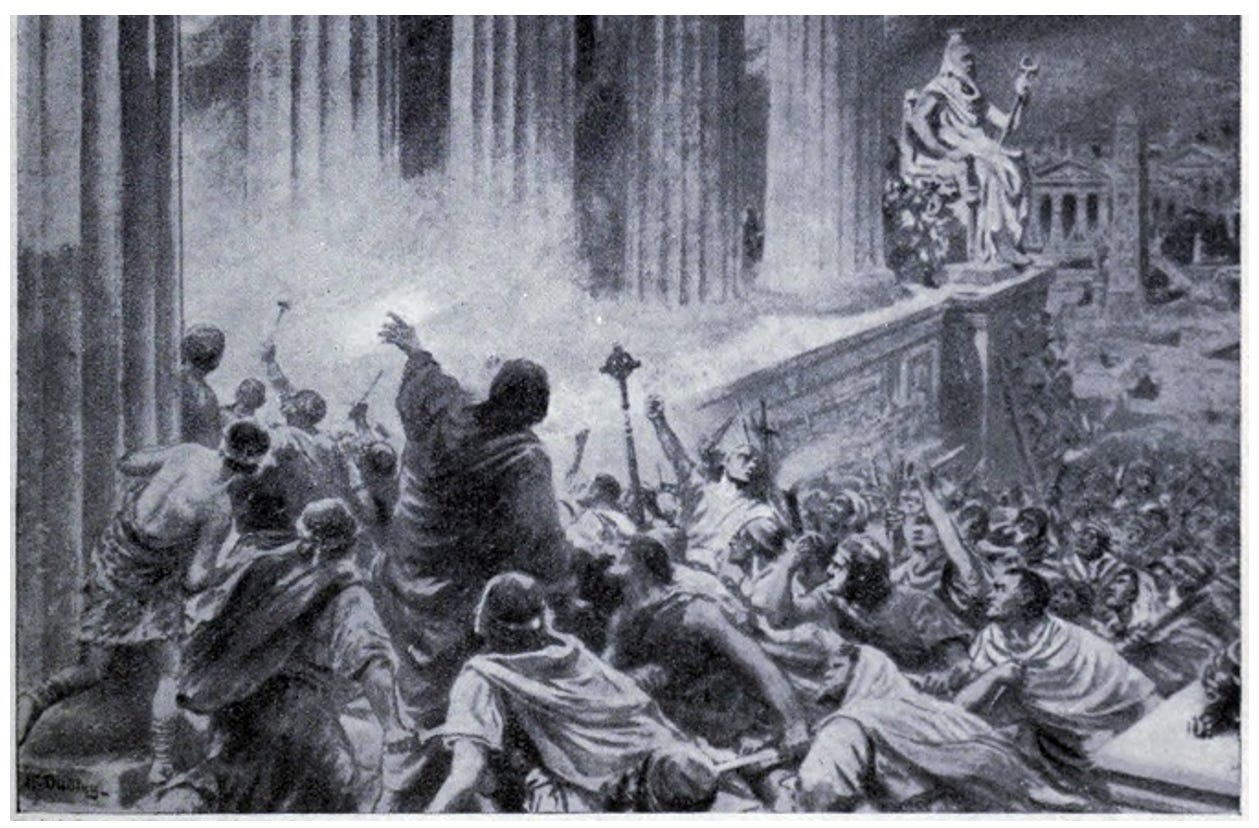
Hypatia’s death was not the end of scholarship in Alexandria, however. A century later, the Christian philosopher and scholar John Philoponus (c. 490–570) challenged Aristotelian physics [[xl], [xli]]. He proposed an impetus account of motion, denied the prohibition of the vacuum and the eternity of the cosmos, and maintained that unequal weights fall equally, anticipating Galileo and his contemporaries [[xlii]]. Pierre Duhem (1861–1916) observed that John Philoponus “deserves to be counted among the great geniuses of Antiquity, and to be celebrated as one of the foremost precursors of modern Science” while acknowledging he may have inherited his ideas from unknown others [[xliii]].
The library may already have been gone, but the Alexandrian academic tradition continued into the seventh century, when Stephanos of Alexandria (c. 580–640) answered a summons from Emperor Heraclius (c. 575–641) in 617 to teach the quadrivium in Constantinople, just a few decades before the Arab conquest of 642 [[xlv], [xlvi], [xlvii]]. And Alexandria was hardly the only seat of learning as classical antiquity yielded to its medieval successors. There was a longstanding center of scholarship in Jundishapur in southwest Persia among the Syriac-speaking Nestorian Christians dating from before the sixth century. Their scholarship was similarly taken up by their Islamic conquerors [[xlviii], [xlix]].
“The story of the Arab burning of the Library is legend; it may also be history” [[l]]. When asked what to do with the books in the Library, it is said that Caliph Omar replied:
If the content of the books is in accordance with the book of Allah, we may do without them, for in that case, the book of Allah more than suffices. If, on the other hand, they contain matter not in accordance with the book of Allah there can be no need to preserve them. Proceed, then, and destroy them [[li]].
Were the books really burned to warm the public baths? Almost certainly not, for the bulk of the collection had likely long since been destroyed or succumbed to humidity and neglect [[lii]].
That’s all for now. Remember always to keep calm, and make physics great again.
See you next week,
Hans
P.S. Pick up your copy of Fields & Energy Book I: Fundamentals and Origins of Electromagnetism, if you haven’t already:
Next time: II 1.7.2.2 Islamic Institutions: Squandering the Inheritance
Enjoyed the article, but maybe not quite enough to spring for a paid subscription?
Then click on the button below to buy me a coffee. Thanks!

Full Table of Contents [click here]
You may follow me online in other places as well:
Telegram: 𝔸𝕖𝕥𝕙𝕖𝕣𝕔𝕫𝕒𝕣’𝕤 𝔸𝕖𝕥𝕙𝕖𝕣𝕤𝕥𝕣𝕖𝕒𝕞
Gab: @aetherczar
Twitter: @aetherczar
Amazon: Hans G. Schantz
[[i]] A drawing of the Pharos of Alexandria by German archaeologist Prof. H. Thiersch (1909). See: https://en.wikipedia.org/wiki/Lighthouse_of_Alexandria#/media/File:Lighthouse_-_Thiersch.png
[[ii]] MacLeod, Roy, “Introduction: Alexandria in History and Myth,” collected in The Library of Alexandria: Centre of Learning in the Ancient World, Roy MacLeod, ed., New York: I.B. Taurus & Co. Ltd., 2004, pp. 1-15. Yes, the mixed units are in the original source. See: https://archive.org/details/LibraryOfAlexandriaBYSamy/page/n13/mode/2up
[[iii]] Bagnall, Roger S., “Alexandria: Library of Dreams,” Proceedings of the American Philosophical Society 146, no. 4, Dec. 2002, pp. 348–362. doi: 10.2307/1558311.
[[iv]] Barnes, Robert, “Cloistered Bookworms in the Chicken-Coop of the Muses: The Ancient Library of Alexandria,” collected in The Library of Alexandria: Centre of Learning in the Ancient World, Roy MacLeod, ed., New York: I.B. Taurus & Co. Ltd., 2004, pp. 61-77. See: https://archive.org/details/LibraryOfAlexandriaBYSamy/page/61/mode/2up .
[[v]] Rico, Christophe, “The Destruction of the Library of Alexandria: A Reassessment,” collected in The Library of Alexandria: A Cultural Crossroads of the Ancient World, Series Polis Institute Conference Proceedings, Editors Christophe Rico and Anca Dan, Jerusalem: Polis Institute Press, 2017. ISBN 9789657698105. See: https://www.academia.edu/35442697/THE_DESTRUCTION_OF_THE_LIBRARY_OF_ALEXANDRIA_A_REASSESSMENT_published_paper_
[[vi]] Previté-Orton, C.W. (1877–1947), The Cambridge Medieval History, vol. 1, Switzerland: Castalia Library, 2023, p. 233. Originally published as The Shorter Cambridge Medieval History, 1952.
[[vii]] Artistic Rendering of the Library of Alexandria, based on some archaeological evidence, 1850. O. Von Corven - Tolzmann, Don Heinrich; Alfred Hessel and Reuben Peiss. The Memory of Mankind. New Castle, DE: Oak Knoll Press, 2001. See: https://en.wikipedia.org/wiki/Library_of_Alexandria#/media/File:Ancientlibraryalex.jpg
[[viii]] Galen of Pergamon (AD 129–216), Commentary on Hippocrates’ Epidemics, in Claudii Galena Opera Omni vol. XVII, trans, Assmann, Friedrich Wilhelm, 1800-; Kühn, Karl Gottlob, (1754-1840), pp. 606-607. See: https://archive.org/details/b29339339_0017/page/606/mode/2up
Ptolemy the king of Egypt was so eager to collect books, that he ordered the books of everyone who sailed there to be brought to him. The books were then copied into new manuscripts. He gave the new copy to the owners, whose books had been brought to him after they sailed there, but he put the original copy in the library with the inscription “a [book] from the ships”. See: https://www.attalus.org/translate/extracts.html [17a.605]
Also: “…having given them [the Athenians] a deposit of fifteen talents of silver, he [King Ptolemy] received the books of Sophocles (c. 496–406 BC), Euripides (c. 480–406 BC), and Aeschylus (c. 525–456 BC), in order only to copy them and then immediately return them unharmed. But when he had splendidly prepared copies on the finest papyrus of those he had received from the Athenians, he kept the originals for himself; and the copies which he had prepared he sent to them, asking that they keep the fifteen talents and accept the new copies in place of the old books they had given.”
[[ix]] Archimedes’ screw. Public domain, from Chambers’s Encyclopedia (Philadelphia: J. B. Lippincott Company, 1875). See: https://commons.wikimedia.org/wiki/File:Archimedes_screw.JPG or https://picryl.com/media/chambers-1908-archimedean-screw-2cf835.
[[x]] Boyer, Carl B., and Uta C. Merzbach, A History of Mathematics, 2nd ed. New York: John Wiley & Sons, Inc., 1991, p. 119. See: https://amzn.to/4n3Du8E
[[xi]] Kline, Morris, Mathematical Thought from Ancient to Modern Times, New York, Oxford: Oxford University Press, 1972, vol. 1, p. 26.
The Greeks wrote some histories of mathematics and science. Eudemus (4th cent. B.C.), a member of Aristotle’s school, wrote a history of arithmetic, a history of geometry, and a history of astronomy. Except for fragments quoted by later writers, these histories are lost. The history of geometry dealt with the period preceding Euclid’s and would be invaluable were it available. Theophrastus (c. 372-c. 287 B.C.), another disciple of Aristotle, wrote a history of physics, and this, too, except for a few fragments, is lost.
See: https://amzn.to/3QHhcNS.
[[xii]] Jaki, Stanley L. (1924–2009), Science & Creation, New Hope, KY: Real View Books, 2016, p. 102. See: https://amzn.to/4dkoGiy.
[[xiii]] Kline, Morris, Mathematical Thought from Ancient to Modern Times, New York, Oxford: Oxford University Press, 1972, vol. 1, p. 171. See: https://amzn.to/3QHhcNS.
[[xiv]] Kline, Morris, Mathematical Thought from Ancient to Modern Times, New York, Oxford: Oxford University Press, 1972, vol. 1, p. 171. See: https://amzn.to/3QHhcNS.
[[xv]] Archimedes’ screw. Public domain, from Chambers’s Encyclopedia (Philadelphia: J. B. Lippincott Company, 1875). See: https://commons.wikimedia.org/wiki/File:Archimedes_screw.JPG or https://picryl.com/media/chambers-1908-archimedean-screw-2cf835.
[[xvi]] MacLeod, Roy, “Introduction: Alexandria in History and Myth,” collected in The Library of Alexandria: Centre of Learning in the Ancient World, Roy MacLeod, ed., New York: I.B. Taurus & Co. Ltd., 2004, pp. 1-15. See: https://archive.org/details/LibraryOfAlexandriaBYSamy/page/n13/mode/2up
[[xvii]] Boyer, Carl B., and Uta C. Merzbach, A History of Mathematics, 2nd ed. New York: John Wiley & Sons, Inc., 1991, pp. 159-160. See: https://amzn.to/4n3Du8E
[[xviii]] Boyer, Carl B., and Uta C. Merzbach, A History of Mathematics, 2nd ed. New York: John Wiley & Sons, Inc., 1991, pp. 160-161. See: https://amzn.to/4n3Du8E
[[xix]] Boyer, Carl B., and Uta C. Merzbach, A History of Mathematics, 2nd ed. New York: John Wiley & Sons, Inc., 1991, pp. 162. See: https://amzn.to/4n3Du8E
[[xx]] Barnes, Robert, “Cloistered Bookworms in the Chicken-Coop of the Muses: The Ancient Library of Alexandria,” collected in The Library of Alexandria: Centre of Learning in the Ancient World, Roy MacLeod, ed., New York: I.B. Taurus & Co. Ltd., 2004, pp. 61-77. See: https://archive.org/details/LibraryOfAlexandriaBYSamy/page/61/mode/2up .
[[xxi]] Bagnall, Roger S., “Alexandria: Library of Dreams,” Proceedings of the American Philosophical Society 146, no. 4, Dec. 2002, pp. 348–362. doi: 10.2307/1558311.
[[xxii]] de Champaigne, Jean Baptiste (1631–1681), “Ptolemy II Philadelphus talking with some of the 72 Jewish savants who translated the Bible for the great library of Alexandria,” 1672, Accession number: INV.1850 2229 (Palace of Versailles); References: Joconde work ID: 000PE011856; Salons ID: 29770. See: https://commons.wikimedia.org/wiki/File:Ptoleme_2_by_Jean-Baptiste_de_Champaigne.jpg
[[xxiii]] Zeller, Eduard (1814-1908), Outlines of the history of Greek philosophy, London: Longmans, Green, and Co., 1886, pp. 318-319. “This Jewish Peripatetic assured King Ptolemy Philometor that the oldest Greek poets and philosophers, and especially Pythagoras and Plato, had used our Old Testament, and in order to procure evidence for this assertion, he appeals to a series of verses supposed to be the work of Orpheus and Linus, Homer and Hesiod, which are, however, shameless forgeries, though neither Clemens nor Eusebius detected them.” See: https://archive.org/details/outlinesofhistor00zell_0/page/318/mode/2up
[[xxiv]] MacLeod, Roy, “Introduction: Alexandria in History and Myth,” collected in The Library of Alexandria: Centre of Learning in the Ancient World, Roy MacLeod, ed., New York: I.B. Taurus & Co. Ltd., 2004, pp. 1-15.
“The first extended discussion of the Library that survives is the Letter of Aristeas (cl 80-145 BC), by legend written by a Jewish scholar employed at the Library, which chronicles the history of a project to translate the Hebrew scriptures known as the Septuagint into Greek. The name survives from the belief that seventy Jewish scholars were assembled and secluded by the king until the translation was complete. Whilst the story is now not widely believed, this letter and other fragments lend support to the theory that the Library was commissioned by Ptolemy I (Soter), one of Alexander’s successful generals, who after Alexander’s death secured the kingship of conquered Egypt.”
See: https://archive.org/details/LibraryOfAlexandriaBYSamy/page/n13/mode/2up
[[xxv]] Rico, Christophe, “The Destruction of the Library of Alexandria: A Reassessment,” collected in The Library of Alexandria: A Cultural Crossroads of the Ancient World, Series Polis Institute Conference Proceedings, Editors Christophe Rico and Anca Dan, Jerusalem: Polis Institute Press, 2017. ISBN 9789657698105. See: https://www.academia.edu/35442697/THE_DESTRUCTION_OF_THE_LIBRARY_OF_ALEXANDRIA_A_REASSESSMENT_published_paper_
[[xxvi]] Hero, of Alexandria, The pneumatics of Hero of Alexandria, London, Macdonald & Co.; New York, American Elsevier, 1971, p.72. Greenwood, Joseph George, (1821-1894); Woodcroft, Bennet, (1803-1879), translators. See: https://archive.org/details/pneumaticsofhero0000hero/page/72/mode/1up
See: https://en.wikipedia.org/wiki/Aeolipile#/media/File:Aeolipile_illustration.png
[[xxvii]] Hero, of Alexandria, The pneumatics of Hero of Alexandria, London, Macdonald & Co.; New York, American Elsevier, 1971, p.72. Greenwood, Joseph George, (1821-1894); Woodcroft, Bennet, (1803-1879), translators. See: https://archive.org/details/pneumaticsofhero0000hero/page/72/mode/1up
See: https://en.wikipedia.org/wiki/Aeolipile#/media/File:Aeolipile_illustration.png
[[xxviii]] Law, Timothy Michael (b. 1979), When God Spoke Greek: The Septuagint and the Making of the Christian Bible, New York: Oxford University Press, 2013.
[[xxix]] Boyer, Carl B., and Uta C. Merzbach, A History of Mathematics, 2nd ed. New York: John Wiley & Sons, Inc., 1991, pp. 164-172. See: https://amzn.to/4n3Du8E
[[xxx]] MacLeod, Roy, “Introduction: Alexandria in History and Myth,” collected in The Library of Alexandria: Centre of Learning in the Ancient World, Roy MacLeod, ed., New York: I.B. Taurus & Co. Ltd., 2004, pp. 1-15. See: https://archive.org/details/LibraryOfAlexandriaBYSamy/page/n13/mode/2up
[[xxxi]] Hero, of Alexandria, The pneumatics of Hero of Alexandria, London, Macdonald & Co.; New York, American Elsevier, 1971, p.57. Greenwood, Joseph George, (1821-1894); Woodcroft, Bennet, (1803-1879), translators. See: https://archive.org/details/pneumaticsofhero0000hero/page/57/mode/1up
[[xxxii]] Hero, of Alexandria, The pneumatics of Hero of Alexandria, London, Macdonald & Co.; New York, American Elsevier, 1971, p.57. Greenwood, Joseph George, (1821-1894); Woodcroft, Bennet, (1803-1879), translators. See: https://archive.org/details/pneumaticsofhero0000hero/page/57/mode/1up
[[xxxiii]] Kline, Morris, Mathematical Thought from Ancient to Modern Times, New York, Oxford: Oxford University Press, 1972, vol. 1, p. 25. See: https://amzn.to/3QHhcNS.
[[xxxiv]] Boyer, Carl B., and Uta C. Merzbach, A History of Mathematics, 2nd ed. New York: John Wiley & Sons, Inc., 1991, pp. 172-174. See: https://amzn.to/4n3Du8E
[[xxxv]] Jaki, Stanley L. (1924–2009), Science & Creation, New Hope, KY: Real View Books, 2016, pp. 167-169. See: https://amzn.to/4dkoGiy.
[[xxxvi]] Jaki, Stanley L. (1924–2009), Science & Creation, New Hope, KY: Real View Books, 2016, pp. 116-117. See: https://amzn.to/4dkoGiy.
[[xxxvii]] Boyer, Carl B., and Uta C. Merzbach, A History of Mathematics, 2nd ed. New York: John Wiley & Sons, Inc., 1991, p. 119, 162. See: https://amzn.to/4n3Du8E
[[xxxviii]] Lloyd, G.E.R., Greek Science After Aristotle, New York: W.W. Norton & Company, 1973, p. 162. https://amzn.to/4tBi5Gl
[[xxxix]] Scholasticus, Socrates (c. 380–450 AD), Ecclesiastical History, Book VII, Chapter 15. Collected in Christian Literature Pub. Co., 1890. Select library of Nicene and post-Nicene Fathers, second series, v. 2. The ecclesiastical history of Socrates Scholasticus / revised with notes by A.C. Zenos -- The ecclesiastical history of Sozomen, comprising a history of the church from A.D. 323 to A.D. 425 / translated from the Greek ; revised by Chester D. Hartranft (1839-1914).
THERE was a woman at Alexandria named Hypatia, daughter of the philosopher Theon, who made such attainments in literature and science, as to far surpass all the philosophers of her own time. Having succeeded to the school of Plato and Plotinus, she explained the principles of philosophy to her auditors, many of whom came from a distance to receive her instructions. On account of the self-possession and ease of manner, which she had acquired in consequence of the cultivation of her mind, she not unfrequently appeared in public in presence of the magistrates. Neither did she feel abashed in coming to an assembly of men. For all men on account of her extraordinary dignity and virtue admired her the more. Yet even she fell a victim to the political jealousy which at that time prevailed. For as she had frequent interviews with Orestes [Roman Prefect of Egypt], it was calumniously reported among the Christian populace, that it was she who prevented Orestes from being reconciled to the bishop [Cyril, who was in conflict with Orestes]. Some of them therefore, hurried away by a fierce and bigoted zeal, whose ringleader was a reader named Peter, waylaid her returning home, and dragging her from her carriage, they took her to the church called Cesareum, where they completely stripped her, and then murdered her with tiles [?]. After tearing her body in pieces, they took her mangled limbs to a place called Cinaron, and there burnt them. This affair brought not the least opprobrium, not only upon Cyril, but also upon the whole Alexandrian church. And surely nothing can be farther from the spirit of Christianity than the allowance of massacres, fights, and transactions of that sort. This happened in the month of March during Lent, in the fourth year of Cyril’s episcopate, under the tenth consulate of Honorius, and the sixth of Theodosius [i.e. AD 415]. This is the only known first-hand account. See: https://archive.org/details/socratessozomenu0002socr_2ndseries/page/160/mode/2up?q=hypatia
[[xl]] Jaki, Stanley L. (1924–2009), Science & Creation, New Hope, KY: Real View Books, 2016, pp. 187-190. See: https://amzn.to/4dkoGiy.
[[xli]] Lloyd, G.E.R., Greek Science After Aristotle, New York: W.W. Norton & Company, 1973, pp. 157-168. https://amzn.to/4tBi5Gl
[[xlii]] Boyer, Carl B., and Uta C. Merzbach, A History of Mathematics, 2nd ed. New York: John Wiley & Sons, Inc., 1991, pp. 247-248. See: https://amzn.to/4n3Du8E
[[xliii]] Duhem, Pierre Maurice Marie, (1861-1916), Le système du monde; histoire des doctrines cosmologiques de Platon à Copernic, Paris, A. Hermann, 1913, p. 397.
“Was Philopon the originator of these principles? If so, John of Alexandria—known as ‘the Christian’—would deserve to be counted among the great geniuses of Antiquity, and to be celebrated as one of the foremost precursors of modern Science. It is more probable, however, that the Grammarian did not create the Dynamics he professes, but rather received it through the teachings of others—that he continued the tradition of the Alexandrian mechanicians. Nevertheless, he retains the merit—unique among all commentators on Aristotle’s *Physics*—of having grasped just how much sound insight this Dynamics contained, and how erroneous that of the Peripatetics was; and of having defended the former just as firmly and sensibly as he combated the latter. Such a merit is by no means slight [Google Translate]. See: https://archive.org/details/lesystmedumond01duhe/page/398/mode/2up
[[xliv]] The Burning of the Library at Alexandria in 391 AD, illustration from ‘Hutchinsons History of the Nations’, c.1910 (litho), Dudley, Ambrose (fl. 1920s) / Private Collection / The Stapleton Collection / The Bridgeman Art Library. See: https://commons.wikimedia.org/wiki/File:The_Burning_of_the_Library_at_Alexandria_in_391_AD.jpg.
[[xlv]] Papathanassiou, Maria, “Stephanos of Alexandria: A Famous Byzantine Scholar, Alchemist and Astrologer,” collected in The occult sciences in Byzantium, Editors: Paul Magdalino, Maria Mavroudi, Geneva : La Pomme d’or, January 2006, pp. 163-203. See: https://www.researchgate.net/publication/304215429_Stephanos_of_Alexandria_A_Famous_Byzantine_Scholar_Alchemist_and_Astrologer
[[xlvi]] Shepard, Jonathan, ed., The Cambridge History of the Byzantine Empire, vol. 1, Switzerland: Castalia Library, 2024, pp. 229-230.
[[xlvii]] Previté-Orton, Charles William (1877-1947), Cambridge Medieval History, vol. 1, Switzerland: Castalia Library, 2024, pp. 233-234.
[[xlviii]] Jaki, Stanley L. (1924–2009), Science & Creation, New Hope, KY: Real View Books, 2016, p. 191. See: https://amzn.to/4dkoGiy.
[[xlix]] Crombie, A.C., Augustine to Galileo, vol. I, Cambridge, Massachusetts: Harvard University Press, 1961, p. 350.
[[l]] MacLeod, Roy, “Introduction: Alexandria in History and Myth,” collected in The Library of Alexandria: Centre of Learning in the Ancient World, Roy MacLeod, ed., New York: I.B. Taurus & Co. Ltd., 2004, pp. 1-15. See: https://archive.org/details/LibraryOfAlexandriaBYSamy/page/n13/mode/2up
[[li]] MacLeod, Roy, “Introduction: Alexandria in History and Myth,” collected in The Library of Alexandria: Centre of Learning in the Ancient World, Roy MacLeod, ed., New York: I.B. Taurus & Co. Ltd., 2004, pp. 1-15. See: https://archive.org/details/LibraryOfAlexandriaBYSamy/page/n13/mode/2up
[[lii]] Rico, Christophe, “The Destruction of the Library of Alexandria: A Reassessment,” collected in The Library of Alexandria: A Cultural Crossroads of the Ancient World, Series Polis Institute Conference Proceedings, Editors Christophe Rico and Anca Dan, Jerusalem: Polis Institute Press, 2017. ISBN 9789657698105. See: https://www.academia.edu/35442697/THE_DESTRUCTION_OF_THE_LIBRARY_OF_ALEXANDRIA_A_REASSESSMENT_published_paper_
Comments
Nothing yet. Say the first thing.
Sign in to join the conversation.