
The Goths sacked Rome in 410 [[iii]], but the seeds of the Roman downfall were planted much earlier. As the existential threat of Carthage waned and as the riches of Greece flowed into Rome, moral laxity reined. Cato (234–149 BC) declared it “the surest sign of deterioration in the republic when pretty boys fetch more than fields, and jars of caviar more than ploughmen” [[iv], [v]]. Wealthy men bought up farmland, replaced tenant farmers with slaves, and drove the poor from their lands.
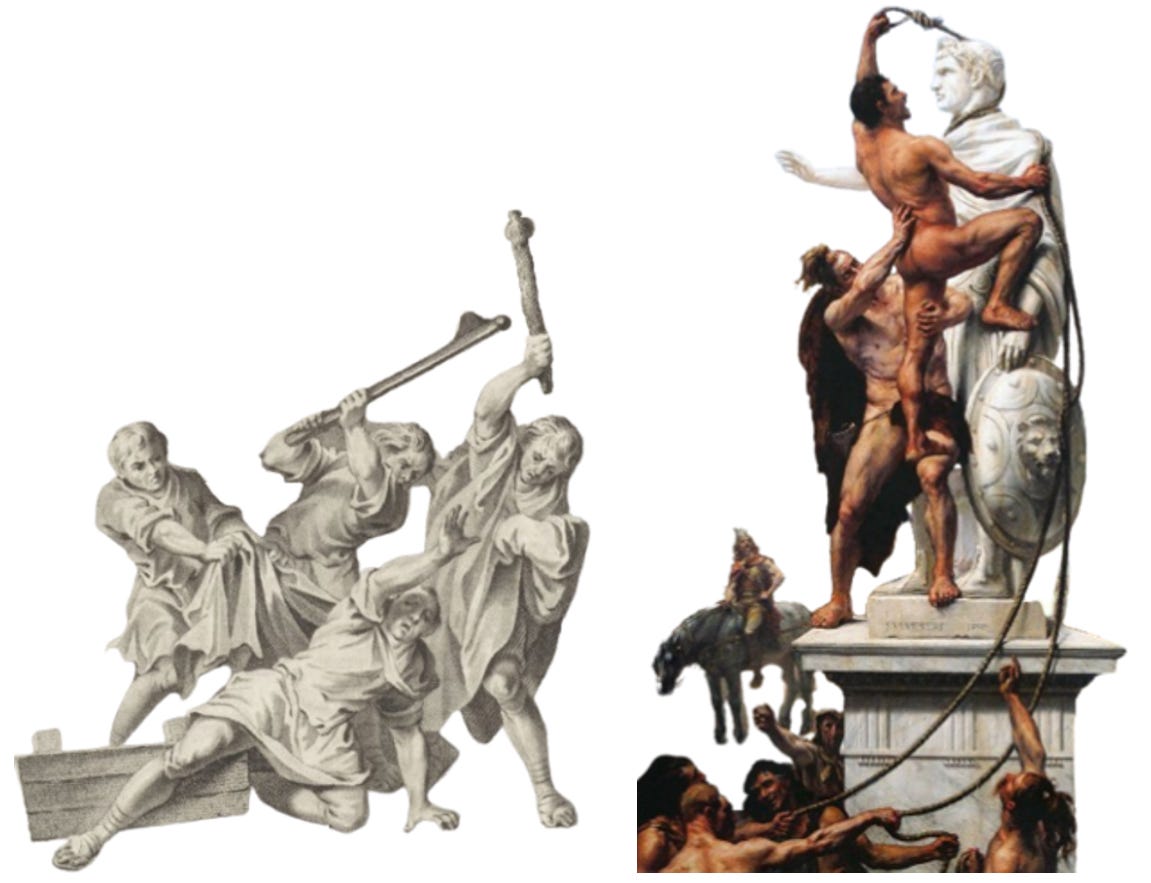
Tiberius Gracchus (c. 163–133 BC), Tribune of the Plebs, sought land reform. He broke with established conventions by deposing a fellow tribune and circumventing traditional Senate authority. His rivals murdered him and many of his supporters in mob violence [[vi]]. Within decades the Republican tradition that military service was tied to land ownership was undone. Landless soldiers’ loyalties lay with their generals rather than the Senate. Rome managed popular discontent though what satirist Juvenal (c. 55–127), would later dub “bread and circuses” [[vii], [viii]].
Despite corruption and moral decline, the traditions of Roman Law continued into the Empire, as we saw from the example of the Apostle Paul’s successful appeal to the Emperor. From the third century AD onward, the Empire had to rely more heavily on non-Italian and then openly “barbarian” troops.
The turning point came in 376, when large numbers of Goths were admitted across the Danube under Emperor Valens (328–378) to escape the Huns. Roman corruption and abuse led to revolt; two years later in 378 the Goths defeated and killed Valens at the Battle of Adrianople [[ix]]. Though later incorporated into imperial service, Gothic forces under Alaric (c. 370–410) eventually sacked Rome in 410. Notwithstanding the unrest and ultimate fall, Rome had long periods of stability and prosperity.
However, Rome’s strengths were in law, engineering, and administration rather than speculative natural philosophy. Pliny the Elder (~23–79), in his Naturalis Historia, compiled reports on astronomy, geography, zoology, botany, and mineralogy: collections of Greek learning and travelers’ lore rather than critical investigations [[x]]. His work preserves much information yet reflects little mathematical or experimental method.
Likewise, Boethius (~480–524) did not advance new natural science. Instead, he transmitted late Greek mathematical, philosophical, and cosmological wisdom to the medieval West [[xi], [xii]]. “Boethius’ labours gave logic half a millennium of life: what logician could say as much as that for his work?” [[xiii]]. Pliny and Boethius were exceptions, not the rule, however. “Throughout its long history, ancient Rome contributed little to science or philosophy and less to mathematics” [[xiv], [xv]].
The eventual collapse of the Western Roman Empire in the late fifth century made survival rather than natural inquiry the priority in Western Europe. By the mid-sixth century, “Education, wealth, habits of life and thought sank to a lower level” [[xvii]]. Systematic inquiry requires stability and surplus. Both were scarce as the Dark Ages began and the Eastern and Western halves of the Empire carved out their independent destinies.
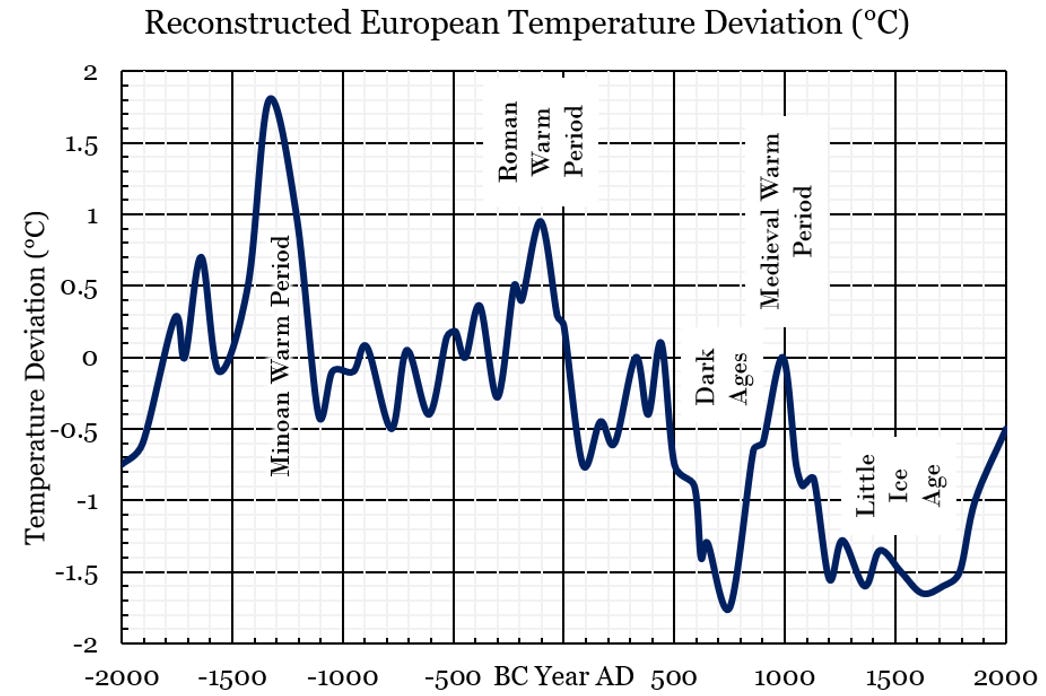
Climatic deterioration including volcanic eruptions and brutally cold weather in the later fifth and especially the mid-sixth century is an important background factor in the instability affecting both the Western and Eastern Roman Empire and much of Eurasia [[xviii]]. Crop failure, famine, and plague afflicting the malnourished were commonplace; ruinous taxation and ill-advised military campaigns compounded the misery [[xix]].
The long and destructive Byzantine–Sasanian War of 602–628 exhausted both the Eastern Roman (Byzantine) Empire and the Sasanian Persian state, leaving the eastern Mediterranean and Near East politically and militarily weakened. When Islamic armies emerged from Arabia in the 630s, they rapidly defeated the Persians, ending the Sasanian Empire by 651. They also seized some of Byzantium’s wealthiest provinces, including Syria and Egypt, with major cultural centers such as Alexandria passing into the new Islamic sphere [[xx]].
Meanwhile in the west, long-distance trade declined, urban populations shrank, and the tax revenues that had supported large public institutions disappeared. Libraries deteriorated, schools closed or became localized ecclesiastical centers, and manuscript production contracted sharply.
Intellectual activity did not vanish, however. Monasteries and cathedral schools preserved classical and Christian texts, but scholarship became fragmented and largely oriented toward preservation rather than innovation. More about the influence of those institutions in a moment. In this environment of political instability and economic contraction, sustained patronage and institutional continuity were difficult to maintain.
A partial recovery began in the late eighth and ninth centuries under the Carolingian rulers. Building on the accomplishments of his father, Pépin le Bref (714–768) [[xxi]], Charlemagne (742–814) consolidated political authority across much of western Europe restoring a degree of stability that encouraged administrative reform, economic revival, and renewed investment in education. Charlemagne promoted a program of educational reform that standardized Latin learning, expanded monastic and cathedral schools, and improved the copying and preservation of texts [[xxii], [xxiii]]. The development of the clear and efficient Carolingian minuscule script facilitated manuscript production and transmission. Although the Carolingian Renaissance did not produce a scientific revolution, it reestablished the institutional and cultural infrastructure on which later medieval intellectual life, including the revival of natural philosophy in the twelfth and thirteenth centuries, would build.
The intellectual inheritance of Greek philosophy and science passed to Byzantines, Muslims, and Western Europeans alike. In Byzantium and the Islamic world that inheritance was preserved and occasionally extended, most strikingly during the Islamic Golden Age, which produced important work in mathematics, astronomy, and optics before being disrupted by the Mongol conquests. Western Europe, meanwhile, lagged behind for centuries as political fragmentation and economic contraction followed the fall of Rome.
That’s all for now. Remember always to keep calm, and make physics great again.
See you next week,
Hans
P.S. Pick up your copy of Fields & Energy Book I: Fundamentals and Origins of Electromagnetism, if you haven’t already:
Next time: II 1.7.2 Institutional Support: Another Catalyst of Science
Enjoyed the article, but maybe not quite enough to spring for a paid subscription?
Then click on the button below to buy me a coffee. Thanks!

Full Table of Contents [click here]
You may follow me online in other places as well:
Telegram: 𝔸𝕖𝕥𝕙𝕖𝕣𝕔𝕫𝕒𝕣’𝕤 𝔸𝕖𝕥𝕙𝕖𝕣𝕤𝕥𝕣𝕖𝕒𝕞
Gab: @aetherczar
Twitter: @aetherczar
Amazon: Hans G. Schantz
[[i]] Portman, Ludwig Gottlieb (printmaker), after a drawing by: Jacobus Buys, 1797 Amsterdam. Illustration from: Stuart, Martinus. *Romeinsche geschiedenissen* [Roman Histories], Vol. XI, p. 266. Amsterdam: Johannes Allart, 1797. Source: http://hdl.handle.net/10934/RM0001.COLLECT.329965 Rijksmuseum. See: https://commons.wikimedia.org/wiki/File:Moord_op_Tiberius_Gracchus,_RP-P-1905-2184.jpg
[[ii]] The Sack of Rome in 410 by the Barbarians by Joseph-Noël Sylvestre, 1890. See: https://en.wikipedia.org/wiki/Sack_of_Rome_(410)
[[iii]] Previté-Orton, C.W. (1877–1947), The Cambridge Medieval History, vol. 1, Switzerland: Castalia Library, 2023, p. 85. Originally published as The Shorter Cambridge Medieval History, 1952.
[[iv]] Polybius (~200–~118 BC), The Histories, Book XXXI, 25:5-7, published in Vol. III of the Loeb Classical Library edition, 1923. “So great in fact was the incontinence that had broken out among the young men in such matters, that many paid a talent [~75lb of gold or about $6M in 2026] for a male favourite and many three hundred drachmas [about 1 kg of silver or about $2600 in 2026] for a jar of caviar…. It was just at the period we are treating of that this present tendency to extravagance declared itself, first of all because they thought that now after the fall of the Macedonian kingdom their universal dominion was undisputed, and next because after the riches of Macedonia had been transported to Rome there was a great display of wealth both in public and in private.” See: https://penelope.uchicago.edu/Thayer/E/Roman/Texts/Polybius/31*.html
[[v]] Polybius (~200–~118 BC), The Histories of Polybius, Book XXXI, 25:5-7, published in Vol. VI of The Histories, with an English translation by W.R. Paton (1857-1921), 1922. https://archive.org/details/historieswitheng06poly/page/212/mode/2up
[[vi]] Plutarch (46–119), Plutarch’s Lives, vol. 2, “The Life of Tiberius Gracchus,” Switzerland: Castalia Library, 2020, p. 643.
[[vii]] Juvenal (~55 – 127), Satires, “Satire X: On Aspirations,” Translated by Jerome Mazzaro. With an introduction and notes by Richard E. Braun. Ann Arbor: University of Michigan Press, 1965, p. 122. Braun translates “panem et circenses” as “food and the circus games.” See: https://archive.org/details/juvenalsatires0000unse/page/122/mode/2up
[[viii]] We may have Tertullian to thank for preserving Juvenal. “His [Juvenal’s] work was forgotten for a time after his death. Later it began to be read and quoted, first by the Christian propagandist Tertullian—who lived and wrote about [AD] 200 and was as full of passionate indignation as Juvenal — then by other Christian authors and also by pagan students of literature.” See: https://www.britannica.com/biography/Juvenal
[[ix]] Previté-Orton, C.W. (1877–1947), The Cambridge Medieval History, vol. 1, Switzerland: Castalia Library, 2023, pp. 56-59. Originally published as The Shorter Cambridge Medieval History, 1952.
[[x]] Crombie, A.C., Augustine to Galileo, vol. II, Cambridge, Massachusetts: Harvard University Press, 1961, pp. 10-11.
[[xi]] Crombie, A.C., Augustine to Galileo, vol. II, Cambridge, Massachusetts: Harvard University Press, 1961, pp. 10-11.
[[xii]] Jaki, Stanley L. (1924–2009), Science & Creation, New Hope, KY: Real View Books, 2016, pp. 185-187. See: https://amzn.to/4dkoGiy.
[[xiii]] Grant, Edward, God & Reason in the Middle Ages, Cambridge University Press, 2004, p. 41. See: https://amzn.to/3Pc20rv. Quoting Jonathan Barnes, “Boethius and the Study of Logic,” p. 85.
[[xiv]] Boyer, Carl B., and Uta C. Merzbach, A History of Mathematics, 2nd ed. New York: John Wiley & Sons, Inc., 1991, p. 177. See: https://amzn.to/4n3Du8E
[[xv]] Kline, Morris, Mathematical Thought from Ancient to Modern Times, New York, Oxford: Oxford University Press, 1972, vol. 1, p. 171.
“The Roman emperors did not support mathematics as did the Ptolemys of Egypt. Nor did the Romans understand pure science.”
See: https://amzn.to/3QHhcNS.
[[xvi]] After a chart I found here:

Robert Fagan@fagandr1
@zakmckrakken What is your evidence that humans would be at risk, particularly when we were at no risk during the Roman Warm Period & the Medieval warm Period?

6:54 AM · Sep 7, 2019
3 Replies · 4 Reposts · 8 Likes
Quoting source temperature data from Alley R8 (2004) GISP2 Ice Core Temperature and Accumulation Data IGBP PAGES/World Data Center for Paleoclimatology Data Contribution Series #2004-013. NOAANGDC Paleoclimatology Program, Boulder CO, USA, and quoting current temperature from: Box JE, Yang L, Bromwich DH, Bai L (2009) Greenland Ice Sheet Surface Air Temperature Variability, 1840 - 2007 American Meteorological Soc, Journal of Climate Vol 22, pp. 4029-4049. Note, these data are inherently time averaged, and don’t show the deep spike of AD 536-540.
[[xvii]] Previté-Orton, C.W. (1877–1947), The Cambridge Medieval History, vol. 1, Switzerland: Castalia Library, 2023, p. 192. Originally published as The Shorter Cambridge Medieval History, 1952.
[[xviii]] Büntgen, Ulf; Myglan, Vladimir S.; Ljungqvist, Fredrik Charpentier; McCormick, Michael; Di Cosmo, Nicola; Sigl, Michael; Jungclaus, Johann; Wagner, Sebastian; Krusic, Paul J.; Esper, Jan; Kaplan, Jed O.; de Vaan, Michiel A. C.; Luterbacher, Jürg; Wacker, Lukas; Tegel, Willy; Kirdyanov, Alexander V., “Cooling and societal change during the Late Antique Little Ice Age from 536 to around 660 AD,” Nature Geoscience, vol. 9, 2016, pp. 231–236. doi:10.1038/ngeo2652
[[xix]] Previté-Orton, C.W. (1877–1947), The Cambridge Medieval History, vol. 1, Switzerland: Castalia Library, 2023, p. 192. Originally published as The Shorter Cambridge Medieval History, 1952.
[[xx]] Shepard, Jonathan, ed., The Cambridge History of the Byzantine Empire, vol. 1, Switzerland: Castalia Library, 2024, pp. 228-230.
[[xxi]] Shepard, Jonathan, ed., The Cambridge History of the Byzantine Empire, vol. 1, Switzerland: Castalia Library, 2024, pp. 297-303. “Le Bref” means “the brief” or “the short.”
[[xxii]] Previté-Orton, C.W. (1877–1947), The Cambridge Medieval History, vol. 1, Switzerland: Castalia Library, 2023, p. 312 – 318. Originally published as The Shorter Cambridge Medieval History, 1952.
[[xxiii]] Grant, Edward, God & Reason in the Middle Ages, Cambridge University Press, 2004, pp. 25-29. See: https://amzn.to/3Pc20rv.
Comments
Nothing yet. Say the first thing.
Sign in to join the conversation.