
Signals & Switches | Assets & Orchestration
by Paul Tonsager
(This article was written with the help of AI, but all editing, analysis, commentary, & opinion are mine.)
At CN Worldwide (CN Rail’s international freight forwarding arm), my team kept a spreadsheet we called A+B+C.
Each letter stood for a piece of a customer’s supply chain we handled. Ocean. Customs. Drayage. Warehousing. Rail. We tracked the margin on each piece, added them up, and then asked the only question that really mattered to us: what did this relationship produce for the railroad?
There was no AI in it. No digital twin, no orchestration engine, no optimizer. It was a spreadsheet, and it worked fine.
The innovation was not the technology. It was the decision that a customer could not be evaluated one transaction or one P&L at a time.
I thought about that spreadsheet again when Maersk announced a change in Global Head of Solutions on November 1, 2026. Normally an executive move would not send me very far down the rabbit hole. This one did, because of what sits underneath it.
If you do not work in ocean shipping, stay with me anyway. The company here is Maersk, but the question underneath belongs to anyone assembling a portfolio of related businesses, and it is a question management has to keep answering long after the acquisitions close.
Some background on why this is personal. Maersk was my last full-time operating role before I started my advisory business, and I spent it integrating procurement across landside activities. Before that I was at CN, building an NVOCC and international logistics business inside an asset-heavy railroad. Two vantage points on the same question: if you are an asset-heavy company expanding into logistics, what are you actually trying to accomplish?
At CN, the answer was clear. Fill the train. Fill it in both directions, to be precise. A loaded car moving in the strong direction is worth less than one that fixes an imbalance, because the second one pays twice: once for the freight and once for the equipment it repositions. Balanced cargo was the real objective, and A+B+C was how we saw it.
CN Worldwide was not created because CN wanted to be a global freight forwarder. By 2018 it was moving over 60,000 TEU a year and ranked among the top five international freight forwarders in Canada. We were building capabilities that got us closer to international cargo owners, let us influence routing decisions, and generated incremental freight for the railroad. The logistics business existed to support the economics of the core asset. A+B+C was how we proved it was working.
At Maersk, the question ran the other way: how do you use enormous scale to create value across landside businesses that had always operated separately?
Which brings me to what caught my eye in Maersk’s latest results and the reorganization of Logistics & Services into Forwarding, Landside and Solutions.
Maersk’s ships are running essentially full, at 96 percent Ocean utilization in the second quarter of 2026. Yet Maersk is talking about warehouse whitespace inside Solutions.
That is a more interesting question than who occupies a box on the org chart. If you have the cargo, the customers, the data and the assets, and you call yourself an integrator, why is the network not helping fill the available capacity?
At CN, logistics helped fill the train. At Maersk, the flywheel should be capable of running in both directions.
Which raises the real question. Has Maersk built an integrated logistics company, or has it built all the pieces and now arrived at the much harder job of integrating them?
If logistics exists primarily to generate ocean cargo, then strong vessel utilization is good news and the story ends there.
But Maersk has built far more than a cargo-generation engine. There is an entire landside enterprise sitting alongside the ocean network now, and it has its own assets to fill.
Integration should therefore work in both directions. When ships have open capacity, logistics should help fill the ships. When ships are full and warehouses have space, Ocean should help fill the warehouses. When cold storage sits idle, the reefer franchise should be feeding it. When trucking capacity is available, Ocean and warehousing should be generating loads. And when the network tightens, the objective should shift from maximizing utilization to maximizing total network yield.
Every part of the organization becomes a provider of capacity and a source of demand for the rest of the system. That is the flywheel.
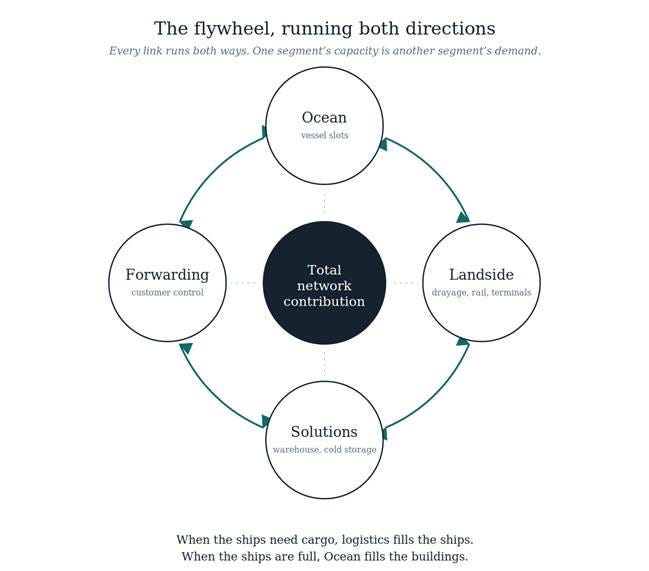
The flywheel, running both directions. Easy to draw. Harder to run.
Maersk knows an extraordinary amount about global cargo long before it reaches a warehouse: the customer, the booking, origin and destination, the vessel, estimated arrival, equipment type, frequency, historical movement patterns. Call that what it is. A demand signal.
Imagine a Maersk warehouse near a major gateway running at 70 or 75 percent utilization. A traditional warehouse organization hands the sales force a target and tells them to go sell more space.
Why start there?
Maersk’s own Ocean organization may already be carrying thousands of containers for customers whose cargo moves within an economically viable radius of that building.
The better question runs the other way. How much Maersk-controlled cargo passes within 50, 100 or 200 miles of every underutilized Maersk facility? How much of it could physically use the building? How much belongs to customers with a logical warehousing requirement? How much has Maersk actually proposed moving through the facility? How much did it win, and why did it lose the rest?
The answers tell management whether the problem is location, pricing, capability, sales execution, customer preference, or integration itself.
Before going further, the argument deserves its strongest counter, because there is one.
Warehouse vacancy is often planned. Contract logistics facilities get built to a customer’s ramp curve, and the empty space in year one is priced into the deal. A building at 70 percent may be sitting exactly where the pro forma said it would be.
Warehouse siting also follows the customer’s distribution network rather than the port. A box landing in Los Angeles for a retailer whose DC network runs through Dallas and Atlanta is not a candidate for a gateway building, no matter who controls the container.
The buyer is different, too. Ocean procurement is annual and run by a transportation team. Warehousing is a three-to-five-year commitment run by network planners and finance, on a completely different cycle. Winning the box tells you very little about who will win the building.
And some shippers simply will not put their inventory with their carrier. Concentration risk is real, and a procurement group that spent the last few years diversifying its ocean panel is in no hurry to hand the same provider custody of its stock.
All of that is true, and it explains why the connection is hard. It does not explain why the connection would be invisible.
Running commercial for a private-equity-owned shortline taught me the rule I still use. Monetize everything, or have a plan to do it. Not every asset earns today, but every asset has an answer attached: a ramp curve, a customer coming, a lease, a sale, a date. Private equity does not take excuses. It takes plans, with dates on them. Whitespace with an answer is a plan. Whitespace without one is a question nobody has asked.
A forty-mile railroad cannot afford much of the second kind. Every siding, every car spot, every acre of ground either earns or gets sold, leased or lifted, because there is no other P&L to hide it in and the owner is asking every quarter. A company the size of Maersk can carry unmonetized assets for years without anyone feeling it. Scale is what lets whitespace persist, and that is a better explanation of the 1.7 percent than any failure of intent.
The claim here is narrower than “Maersk should be full.” It is that Maersk should be able to say, facility by facility, how much of its own controlled cargo was addressable, how much it quoted, how much it won, and why it lost the rest. If that analysis does not exist, the whitespace is not being managed. It is being explained.
Cold chain is the clearest case.
Maersk moves roughly one in four refrigerated containers worldwide. That means relationships with an enormous number of exporters and importers moving temperature-sensitive product. Maersk knows where refrigerated cargo originates, where it is going, when it will arrive, the seasonality and the equipment involved. It physically controls the reefer carrying the product.
Now put an underutilized Maersk cold store downstream of that flow.
Maersk knows this. In July it launched an integrated cold-chain product from Chile to the U.S. East Coast covering origin services, ocean transport, port handling, fumigation, inland movement and cold storage. Its Rotterdam cold store sits beside APM Terminals Maasvlakte II, and Maersk says the proximity is precisely the point. The capability is real and the strategic logic is the company’s own.
Which sharpens the question rather than answering it. If this is the model, why does it arrive as a product launch in one trade lane instead of operating as the default across the network?
The integrated proposition writes itself: origin, reefer container, vessel, terminal, cold storage, inland distribution, customer. One provider, one visibility environment, fewer handoffs, better exception management, clearer accountability.
Cold storage is stickier than dry warehousing and harder to switch, which cuts in both directions. Incumbents are entrenched, and the commodity, the temperature regime and the facility’s certifications all have to line up. Plenty of that cargo will never be a candidate.
But if the model cannot connect one of the world’s largest reefer networks to its own available cold storage, the constraint sits in the operating model rather than the sales plan.
The reorganization into Landside, Forwarding and Solutions matters because investors can now see more clearly where the economics are being generated.
In the second quarter of 2026, Forwarding produced an EBIT margin of 6.4 percent and Landside 6.3 percent. Solutions, which includes contract logistics, lead logistics and e-commerce, with cold-chain activity forming part of the broader integrated offering, came in at 1.7 percent.
Solutions has improved materially, and Maersk is direct about the gap. It attributes the lower margin to whitespace and says it is focused on pipeline conversion and reducing it.
The question is not whether Solutions can improve its margin. It is why meaningful whitespace exists inside an integrated company that already controls enormous cargo flows.
The margin is the financial symptom. The whitespace tells you something about the operating model underneath it.
The vessels are full in part because the carriers have decided they will be.
Sea-Intelligence’s blank sailings tracker, published July 24, shows scheduled capacity in the Asia to U.S. East Coast trade growing 46 percent in the first half of 2026 against the first half of 2019, while blank sailings over the same comparison grew 215 percent. On the West Coast, capacity grew 16 percent and blanked sailings rose 62 percent. In some trades, blanking is running as much as 4.6 times 2019 levels. Read at least part of that as deliberate supply management rather than simply a demand story.
And read it as railroad behavior.
Railroads spent the last two decades learning that holding price and managing the resource base produces better returns than chasing volume. Ocean spent forty years learning the opposite lesson the expensive way, buying share and giving away rate through every down cycle. Blanking at this scale is the industry finally applying the discipline its economics always required. Frankly, about time.
I have said for years that a railroad could use a steamship line CEO for a while, because the lines manage revenue better than anyone in rail, and that a line could use a railroad executive, because railroads manage cost better than anyone in shipping. Blanking is ocean borrowing the instrument it lacked.
The ocean version has limits the rail version does not. Nobody builds a competing railroad, and capacity that comes out of a rail network largely stays out. Blanking withholds capacity without retiring it, and the ships are still there next quarter. Rail discipline is structural. Ocean discipline is behavioral, and it lasts only as long as carriers remain willing to manage capacity rather than chase share.
Ocean carriers also operate under regulatory constraints that railroads do not share in quite the same form. The FMC now has explicit rules governing unreasonable refusal to deal over vessel space and continues to scrutinize carrier practices affecting shipper access and choice. Capacity discipline has a ceiling.
But here is the part that matters for an integrator.
When a railroad pulls train starts, it does not damage a warehouse the railroad owns, because the railroad does not own one. When Maersk blanks a sailing, the cargo does not disappear along with the sailing. Pete Mento, a director with Baker Tilly’s Global Trade Management Services, put it well in Supply Chain Dive: the freight “gets pushed onto the next available vessels, so you can suddenly have several weeks of demand fighting over one week’s worth of space.” That surge lands on terminals, drayage capacity, warehouses and cold storage. Inside Maersk, those are Landside and Solutions.
So an integrator running rail-style capacity discipline takes the benefit in one segment and pays for it in the others. Ocean books the margin. Landside absorbs the peak. Solutions absorbs the volatility in labor planning, dock scheduling, storage and inventory flow. Every one of those consequences stays invisible unless somebody is measuring the network rather than the segment.
The new reporting structure creates real transparency, and it carries a risk.
Ocean has a P&L. Forwarding has a P&L. Solutions has a P&L. Landside has a P&L.
If each leader is rewarded primarily for maximizing his or her own segment, everyone can make entirely rational decisions that add up to a worse outcome for Maersk. Ocean protects Ocean margin. Forwarding protects Forwarding margin. Solutions protects Solutions margin. Landside protects Landside margin.
Everyone hits the target, and nobody optimizes Maersk.
Integration requires an economic layer above the business units. The question cannot only be what Ocean made. It has to be what this customer relationship generated across Maersk.
Take a hypothetical movement. Ocean contribution: $2,000. Drayage: $200. Customs: $75. Cold storage: $500. Forwarding and management: $100.
The traditional organization sees five transactions. The integrator should see one $2,875 customer movement.
That changes commercial decisions. Suppose Customer A produces $2,000 of Ocean contribution and buys nothing else. Customer B produces $1,850 of Ocean contribution but generates another $875 elsewhere in the network. A siloed Ocean organization prefers Customer A. The integrated enterprise should see $2,725 from Customer B against $2,000 from Customer A.
Enterprise contribution is not only margin, either. Take Customer B again. If that $1,850 of Ocean contribution is Chilean fruit moving north in a reefer that would otherwise reposition empty, and the return leg gives Maersk a paid move on a box it was going to move anyway, B is worth more than $2,725. Customer A’s $2,000 buys a slot on the strong leg, which Maersk can sell to anyone. Ocean has priced this into its own network for decades. The question is whether it prices it into the buildings.
Simplified, but the principle holds. If Maersk cannot see total network contribution at the customer, lane and shipment level, it cannot optimize an integrated network. It can cross-sell. Cross-selling and integration are different things.
This is A+B+C at a scale we never contemplated. For Maersk the equation is Ocean + Landside + Forwarding + Solutions = total customer and network contribution. If those businesses are measured independently, without a common view of the customer, no amount of capability on the landside adds up to an integrated company.
Which points at a commercial answer, not only an analytical one.
Vessel space is the scarcest asset in the portfolio. Warehouses can be leased, trucks can be hired, cold storage can be built. A sailing has a fixed number of slots and they are worth something to the customer. Yet the traditional Ocean decision prices that space on the economics and commitments of the Ocean relationship, not on what the customer contributes across everything else the enterprise owns.
Turn that around. Give the customer good space, good rates and reliable allocation, and ask the customer to fill the cold store for a year in return. That is the Customer A and Customer B math turned into a commercial policy rather than a reporting exercise. Customer B is worth $2,725 to the enterprise and should be loaded first. Customer A is worth $2,000, pays the published rate, and takes what is left after B is on board.
With one discipline attached. The leverage goes only where the addressable-cargo analysis says the fit is real. Spend scarce vessel space pushing freight into a building that sits in the wrong place for the customer’s distribution network and you have subsidized a bad site decision with your most valuable asset. That is the same failure this article is arguing against, running in the other direction. Fill the buildings the cargo can actually use, and fix or exit the ones it cannot.
Shippers will call that bundling, and some will complain loudly. Airlines and railroads have priced relationship value for decades and nobody calls it anything but revenue management when they do it. Procurement organizations game allocation as a matter of professional practice. They resist bundling because it changes their leverage, and because a good bundle works. If the cold storage product is good enough to win on its merits, stop apologizing for asking the customer to use it. If it is not good enough, that is a product problem, and no amount of clever allocation will hide it.
The serious objection is not fairness. It is term. You are asking for a year of cold storage against an ocean contract you reprice every twelve months, and any competent procurement group will price that asymmetry, most likely by taking it out of the ocean rate and eating the landside margin you were trying to capture. So match the terms. A multi-year landside commitment earns a multi-year space commitment, with the rate mechanism to go with it. If the enterprise will not commit its own capacity that far out, it has no standing to ask the customer to.
The regulatory boundary described earlier applies here, and any network-based commercial strategy has to be built inside it. It does not touch the economic question underneath. If two customers consume the same scarce capacity and one generates materially greater enterprise contribution, that difference belongs in how the relationship is priced, structured and negotiated. The customer who will not commit still gets a quote. It is a worse quote. That is life.
Back-row treatment only bites when space is worth something. It is worth something now, and it will stay that way as long as the carriers keep managing supply the way they currently do. The blank sailings that protect Ocean margin also manufacture the scarcity that makes network-based allocation enforceable. The same discipline that pushes cost onto the landside businesses creates the leverage to fill them.
A fair objection at this point: Maersk may already be doing exactly this. The entire integrator strategy is built on selling more of the chain to the same customer, and the company has said so for years. Touche.
But cross-selling and allocation are different decisions, made by different people, on different timelines. Cross-selling changes what the salesperson puts in front of the customer. Allocation changes who gets loaded when the vessel is tight, and that call sits with people whose numbers are measured in Ocean. Until the landside relationship changes the economics of the Ocean decision, the enterprise is selling the bundle without fully pricing the relationship.
What the published numbers can settle is narrower than I would like, and still enough. Solutions remains well behind Forwarding and Landside, and Maersk itself identifies whitespace as something it needs to reduce. Margin does not tell us what is missing inside the operating model. It tells us the work is not finished.
Over the last decade Maersk assembled an extraordinary collection of capabilities through acquisition and organic investment. Warehousing, e-commerce, last mile, air freight, contract logistics, cold chain, inland transportation, terminals, and Ocean.
Acquisitions give you capabilities. They do not give you integration. That takes a common operating system, and the architecture worth borrowing thinks in capacity, demand, data and orchestration rather than in owned boxes.
A customer does not fundamentally care whether the optimal warehouse belongs to Maersk, GXO, DHL, Lineage or Americold. The customer cares about location, availability, capability, price, service, reliability and the total supply-chain outcome. The same is true of trucks, rail, chassis, terminals and even ocean capacity.
For most of transportation history, integration was achieved through ownership. Want more control? Buy the asset. Want another capability? Buy the company. Technology changes that equation. An orchestration layer that can see capacity across hundreds or thousands of providers, owned and not, makes integration an information problem as much as an ownership problem. That is a different definition than the one this industry has used for a century.
Ownership provides control, and it also creates an obligation. If Maersk owns a warehouse, Maersk has to fill it. Own cold storage, you need throughput. Own trucks, you need loads. Operate terminals, you need lifts.
An asset-neutral orchestrator carries no such obligation. It asks what combination of available assets produces the best customer outcome. Today that might be a Maersk vessel, an independent dray carrier, a Lineage cold store, a railroad and a third-party warehouse. Tomorrow it could be an entirely different set.
Picture a network engine continuously ingesting Ocean bookings, historical customer flows, vessel and terminal capacity, warehouse and cold-storage utilization, drayage and rail availability, equipment positioning, customer contracts, commodity requirements, transit commitments, congestion, rates, margins and third-party capacity. The system does not stop at forecasting. It asks what combination of assets maximizes the desired network outcome, given what is known about demand and capacity.
Sometimes the objective is utilization. Sometimes margin, velocity, service, asset turns or total network contribution. As constraints change, the objective changes.
The concept is not new. A+B+C was a crude version of the same idea. What has changed is the ability to run it at a speed and level of granularity a spreadsheet could never reach.
Which is the distinction worth holding onto. AI is not the strategy here. The strategy is measuring the network instead of the segment, and that decision belongs to management. AI is what makes the measurement possible at the speed the network actually runs at. Buy the technology without making the decision and you will mostly automate the silos faster.
It is tempting to treat the major ocean carriers as moving toward the same integrated future. They are not.
MSC has extended deeply inland through MEDLOG, terminals, rail, depots and related infrastructure, and much of that investment stays close to the physical container.
Hapag-Lloyd calls its approach “Pure Play Plus.” Ocean remains at the center, supplemented mainly by terminals and inland transportation.
CMA CGM, through CEVA and other investments, has made an enormous commitment to a broad logistics enterprise spanning forwarding, contract logistics, air cargo and other capabilities.
Hapag and MSC have stayed relatively close to the container. Maersk and CMA CGM have bet that controlling more of the end-to-end supply chain produces a differentiated proposition and steadier economics, which means testing whether the ocean franchise can become the foundation for something much broader.
There is a fourth competitor in this, and it does not own ships.
The thesis is simple. I do not have to own the supply chain to integrate it. I need access, data, connectivity, capacity, and the intelligence to sequence those resources better than anyone else.
This is not hypothetical. Flexport offers visibility across freight moving through Flexport, through another forwarder, or booked directly with an ocean carrier. project44 connects carriers, forwarders and facilities across modes into a common data layer. FourKites now supports carrier selection and booking against cost, speed, reliability and routing rules.
And in May 2026, Amazon launched Amazon Supply Chain Services, opening its freight, distribution, fulfillment and parcel capabilities to businesses well beyond its own sellers, built on the infrastructure and the operating intelligence it developed running its own network. The parallel to AWS is hard to miss. Amazon spent years building infrastructure for itself and then turned that infrastructure into a platform other companies could consume. Supply Chain Services raises the possibility of the same architecture in physical logistics.
None of them is Maersk’s equal in ocean today, and that is beside the point. A platform combining Maersk capacity, MSC capacity, CMA CGM capacity, railroads, independent truckers, Lineage, Americold, GXO, DHL and thousands of specialized providers has a virtual network larger than any physical network a single transportation company could afford to build.
Maersk has to fill the assets it bought. The orchestrator only has to fill the customer’s need.
My CN Worldwide experience taught me something else that A+B+C could not fix. Integration has limits, and the binding one is usually channel conflict.
CN depended on the steamship lines to feed international containers onto the railroad. CN Worldwide, meanwhile, was moving closer to the cargo owner and competing with those same lines for control of the freight. The better we got at one objective, the more it cost us on the other. Eventually those goals collide. At CN, the importance of the steamship lines to the railroad put a natural limit on how far we could push the NVOCC model, and the ecosystem feeding the core asset mattered more than proving CN could become a global forwarder.
Maersk made the opposite choice, deliberately and a long time ago.
The wholesale model, selling ocean capacity to forwarders and NVOCCs who own the customer relationship, is the natural counterpart to what CN Worldwide was doing. Maersk stopped organizing its growth strategy around protecting it. Forwarder cargo still moves on Maersk ships, and forwarders remain significant customers. What changed is that Maersk accepted the channel conflict rather than managing the business to avoid it, because moving closer to beneficial cargo owners necessarily puts it in competition with the forwarding community. In 2020, folding Damco into the Maersk brand, it stopped pursuing Damco’s multi-carrier FCL NVOCC offering as a general product and said it would use its own Ocean product to build the integrated proposition. One Maersk sales force, one customer-service organization, one platform, one owner of the customer relationship. Strategically it was something of a damn-the-torpedoes decision: accept the conflict and pursue the model.
Different companies. Different core assets. Different channels. Different destinations.
Neither outcome says integration is right or wrong. Both say that management has to know what it is optimizing and which conflicts it is prepared to accept. CN needed the ocean carriers as customers of the railroad, so protecting that channel mattered more than the forwarding P&L. Maersk wanted a larger share of the cargo owner’s total logistics spend, and that meant accepting competition with the forwarding community it had spent decades selling to.
Which sharpens the whitespace question rather than softening it. Maersk paid a real price to get closer to the beneficial cargo owner. It accepted real conflict with a wholesale channel that remained important to Ocean, and took on competitors who were also customers. Having paid that price for the direct relationship, the company should be able to see what the relationship is worth across every segment that touches it.
And for anyone drawing boxes around adjacent businesses, the question underneath is this. Who becomes my competitor tomorrow, and which relationship am I willing to disrupt to build the company I want to become?
Here is where this stops being about Maersk.
There is a temptation to look at a decade-long journey and grade every decision with hindsight. That misses the lesson. Maersk had to build capabilities, acquire businesses, integrate them, measure the results, find out what worked and what did not, reorganize, and keep learning. Some things can only be learned by operating them.
The lesson extends well beyond one company. If you are assembling a portfolio of related businesses, ask yourself why you are putting these businesses together.
“Because they are adjacent” is not enough. “Because we can cross-sell” is not enough. “Because we will have procurement synergies” is not enough. “Because we will be bigger” is certainly not enough.
Ask instead what the combination is supposed to produce. Can Business A systematically create demand for Business B? Can B improve utilization of an asset in C? Does combining their data create information none of them possessed independently? Does the portfolio improve the customer proposition? Does ownership create an advantage, or could the same outcome come from partnering with somebody else’s asset?
And can you draw that flywheel on a single sheet of paper?
Buying businesses happens quickly. Integrating them takes years. Orchestrating them takes longer still.
Systems have to connect. Commercial organizations have to change. Incentives have to change. People have to stop treating customers as the property of individual business units. Data has to move.
Along the way, management discovers things that were not visible when the original strategy was conceived. Maybe a capability you thought you had to own does not need to be owned. Maybe something that looked peripheral turns out to be essential. Maybe the real advantage is not cross-selling at all, but data, or capacity visibility, or orchestration. You learn, and the strategy should change because of what you learn.
That is why I would not read Maersk's decade of financial pain as a decade of getting it wrong. The company was working out what it wanted to become when it grew up, and that is what the process costs. Call it transformation.
That may be where this ultimately leads, and it is the part worth borrowing.
Do not ask how many adjacent businesses you can own. Ask where ownership creates a structural advantage. Own those assets. Then build the capability to orchestrate everything else. The portfolio that results looks less like a collection of wholly owned businesses and more like owned assets, strategic partners, third-party capacity, and one orchestration layer over the top.
The advantage does not come from owning every box on the organizational chart. It comes from understanding which boxes matter and making all of them work together.
Which brings me back to the organizational change that started this.
Maersk has the cargo, the customers, the ships, the containers, the terminals, the warehouses, the cold storage, the inland transportation, the forwarding operation and enormous amounts of data.
When ships are full and warehouses have whitespace, the answer cannot only be to sell harder. When one of the world’s largest refrigerated-container operations coexists with available cold-storage capacity, the answer cannot only be to find more cold-storage customers. The customers may already be inside the building. The cargo may already be on the water. The demand signal may already be sitting in Maersk’s own systems.
If you are an integrator, integrate.
Integration is a set of decisions about what you are optimizing, what you need to own, what you can orchestrate, and which existing relationships you are willing to disrupt to get there.
And if you are building a portfolio of your own, you do not have to repeat every step. You can start with the question Maersk has spent a decade learning how to answer: why do these businesses belong together, and what can they accomplish together that they could never accomplish apart?
If you cannot answer that, you do not have an integration strategy. You have a portfolio.
Paul D Tonsager is Founder and Principal of IMS Advisory. He writes Signals & Switches on freight strategy, railroad consolidation, and the AI layer reshaping logistics. He is also a contributor to the Journal of Commerce. Prior roles include Vice President, North American Procurement at Maersk; MD Asia CN Rail, Founder of CN Worldwide; and Chief Commercial Officer at Patriot Rail.
No posts
Comments
Nothing yet. Say the first thing.
Sign in to join the conversation.