
If you walk into a business and ask who owns it, that is not an entirely strange question, especially for small businesses. And the answer may be straightforward. Imagine asking instead: Who is responsible for leaving it in a better condition than they found it? This question will likely challenge them to think and is less obvious. A business is more like a theater production, where no one person ‘owns’ the entire thing.
Stewardship manifests as a particular kind of attending. It’s not only about the results, productivity, or money. A good steward will care about how even small things are presented and perceived. For example, they will notice that a meeting, while covering the key issues, still felt off. That’s not to say that to be a good steward one must always notice everything, but that everything is important as it all works together for a larger purpose. And each person in an organization matters, no matter what their role is. As Einstein said: “I speak to everyone in the same way, whether he is the garbage man or the president of the university.” The aesthetic conditions of a business can indicate a problem in an organization before any data shows up.
Society (and Business) as a Contract
In “Reflections on the French Revolution,” Edmund Burke describes that society should not be considered a partnership only for the trading of goods, like pepper, coffee, and tobacco. But, he asserts, society is a partnership for science, art, and virtue. A leader cultivates more than just the transactions of external goods. A leader ought to be a steward of what has been put in their care. They inherit more than just data and spreadsheets; they inherit tradition, trust, and unfinished work.
Every leader who follows the founder needs to understand the culture and situation that they have inherited. Stewardship involves preserving what is good and moving forward in other ways to overcome what isn’t working or is bad for the organization. When we see leadership make short-sighted decisions, we can likely find some way in which they were not trying to practice good stewardship. They might have been too hasty, too reactionary, too self-absorbed. Applying Burke’s idea of partnership to business, we can conclude that a leader is a temporary custodian rather than a permanent owner. Their charge is not just to achieve immediate benefit, but the overall health of the organization, to preserve it and help it continue to flourish tomorrow.
It’s not merely conservation of the business; we know businesses, for example, have different stages as they begin and mature, which is also true of people. Parents know they need to treat their children differently as they grow up and their needs change. The goal of the leader should be to allow the organization to grow and change, but also to be able to hand it off in a better place than it was when they began.
MacIntyre and the Corruption of Practices
In his famous book After Virtue, Alasdair MacIntyre brings up a distinction between practices and institutions. We can paraphrase his definition of a practice as any coherent, complex, socially established, and cooperative human activity. But most importantly, a practice is concerned with internal goods, such as excellence, enjoyment, and the creation of beauty. Institutions provide the structure for practices, but the institutions pursue external goods, such as money, status, and scale. MacIntyre claims that institutions are necessary to sustain practices, but they also corrupt those very practices, which is why he says we need virtues to resist that corruption.
Leaders are those who need to protect the practice from becoming corrupted by the institution that supports it. This is very demanding as leaders are constantly pulled in different directions by people with competing interests. A lot of the pressures that can corrupt practices are not bad things for organizations, such as efficiency, scale, and productivity. The leader may not be able to resolve everything, but they move with the tension in place. Aesthetics are often the first place where corruption can become visible. Meetings become only transactional. Employees stop speaking at meetings. The waiting room appears less inviting. Curiosity quietly disappears. This is why it can be vital to notice the aesthetic conditions because they can communicate that an organization is healthy or not doing well.
Stewardship as an Aesthetic Capacity
We might think of stewardship as a moral category or orientation. But it is an aesthetic capacity. Those with this capacity are better equipped to notice small changes in conditions or environments, and then they will also respond before these become bigger problems.
While leaders ought to have certain kinds or levels of knowledge, being a leader requires more than that. Being perceptive enough to sense issues in their earliest phases, before the numbers announce them is a worthy capacity to develop. It is not about magic or prediction; it involves training yourself to be sensitive to slow changes. This develops in part through acts of care.
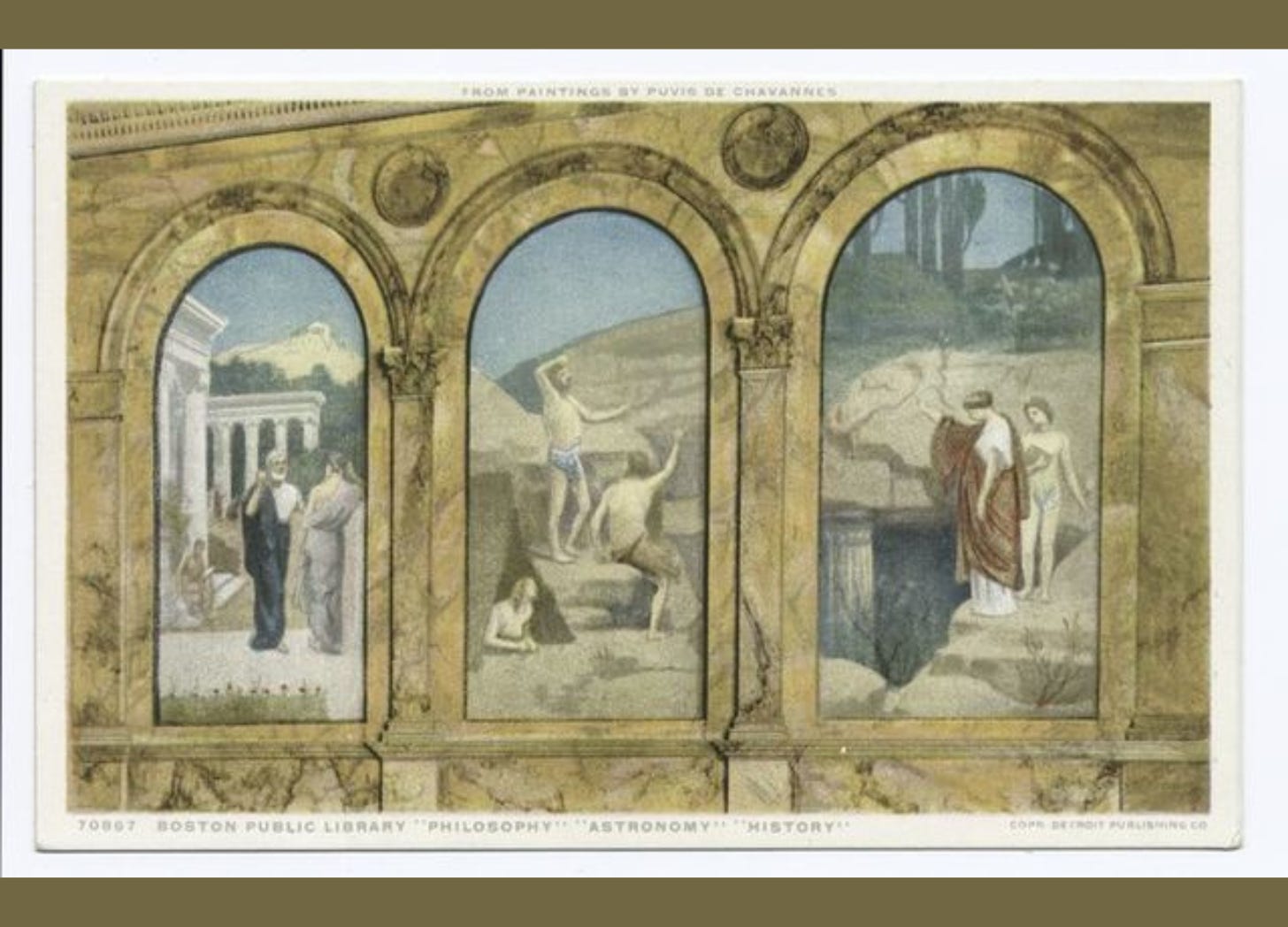
A good steward notices deterioration before it’s too big to fix. For example, there’s a series of eight paintings by Pierre Puvis de Chavannes (1824-1898) that surround the grand staircase at the Boston Public Library. An employee whose official responsibilities had nothing to do with these paintings noticed some moisture buildup on the one called Philosophy. They were able to save this painting through innovative techniques, but someone had to be attentive enough to notice the problem before it became unsalvageable. In other words, beautiful things endure because someone noticed before it was too late.
Reflection
What are you treating as if you owned it, even though you are only its steward?
What have you stopped noticing that actually needs your attention?
What will you pass on to those who follow you?
Aesthetics Research Lab is a reader-supported publication. To receive new posts and support my work, consider becoming a free or paid subscriber.
Work with me
I work with organizations and individuals who want to think more carefully about judgment, meaning, and the conditions that shape everyday decisions.
If that sounds like your situation, you can reach me at michaelrspicher@gmail.com or learn more at michaelrspicher.com.
Relevant ARL Articles
Reorienting through Aesthetics
Aesthetics are Intangible Assets
ARL News & Events
My recent article for BeautyMatter: Does Beauty Diminish or Expand?
My latest for Fast Company: Are You Part of the ‘Distraction Economy’?
“The Aesthetic Edge” is a free ebook, co-written by myself and Hannah Spicher. Download your copy today!
Michael’s interview with NeuroArts Resource Center.
Digital Fashion: Theory, Practice, Implications, edited by Michael R. Spicher, Sara Emilia Bernat, and Doris Domoszlai-Lantner, is available for purchase! (Our book was featured in a BeautyMatter article.)
Comments
Nothing yet. Say the first thing.
Sign in to join the conversation.