
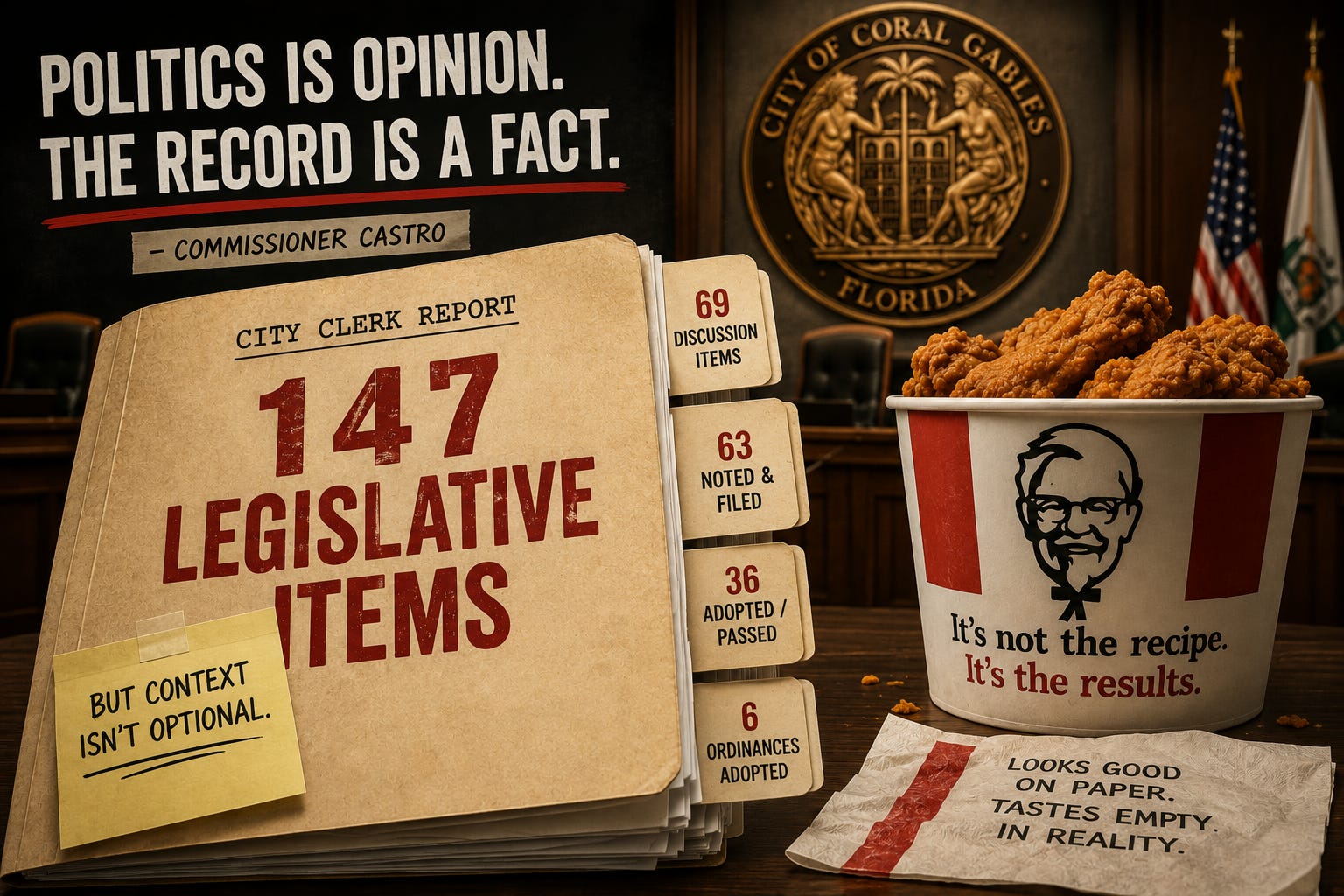
Note: This post is for anyone weighing whether to vote for Commissioner Melissa Castro in her re-election bid. Castro points to her first-term record as evidence of what she's accomplished — but that record, pulled directly from the City Clerk, tells a different story than the one she's telling. Because this is a long read, I've included a summary of the findings below. And a note on length. Yes, this is long. It has to be. A sixty-second reel can make a claim; it takes more than sixty seconds to check one. Castro’s whole case fit in a number — in her case “147” — precisely because a number doesn’t have to show its work. The record does, and the record is where accountability actually lives. If you want the short version, it’s in the summary below. If you want to know whether your commissioner earned your vote, that takes reading. These are the facts that decide how people vote and whether the people we elect answer for what they do. Those facts are worth more than your patience for a scroll.
Summary:
In a July 17th Instagram reel, Commissioner Melissa Castro responded to criticism of her first-term record by citing “147 legislative items” and the line “politics is opinion; the record is fact.”
I submitted a public records request for the document Castro refers to in her July 17th Instagram reel and dissected it.
The number is real — but it measures activity, not accomplishment.
69 of the 147 were never legislation at all: discussion or protocol items.
By outcome: 63 were simply noted and filed, 29 remain pending with no action taken, and 19 were drafted, deferred, failed, or dismissed.
Only 36 were ever adopted or passed.
Of those, just six were ordinances that became binding city law — all adopted in a single year (2024), most narrow, procedural, or ceremonial, and two co-sponsored rather than hers alone.
Five days after I filed the records request that produced these findings, Castro posted a second reel — holding up a folder she called a filing cabinet, reciting a series of items while again omitting what became of them.
That omission is the point: a file count is not a record, and motion is not accomplishment.
Politics is opinion. The record is fact. Believe it or not, those words aren’t mine. They belong to Commissioner Melissa Castro.
On July 17th, Castro posted a reel on Instagram in response to criticism about her legislative record in her first term. In the video, Castro stated she had “147 legislative items” in the last three and a half years. To her credit, that’s an impressive number, but it got me thinking… How many of those items resulted in enacted law? How many were just discussion items? Before I get into it, here’s the Instagram reel:
Ok, so she had 147 agenda items since 2023. Broken down, those agenda items fall into one of three categories: Ordinances, Resolutions, and Discussion items. If we were to itemize each under one of the three categories, it would look like this:
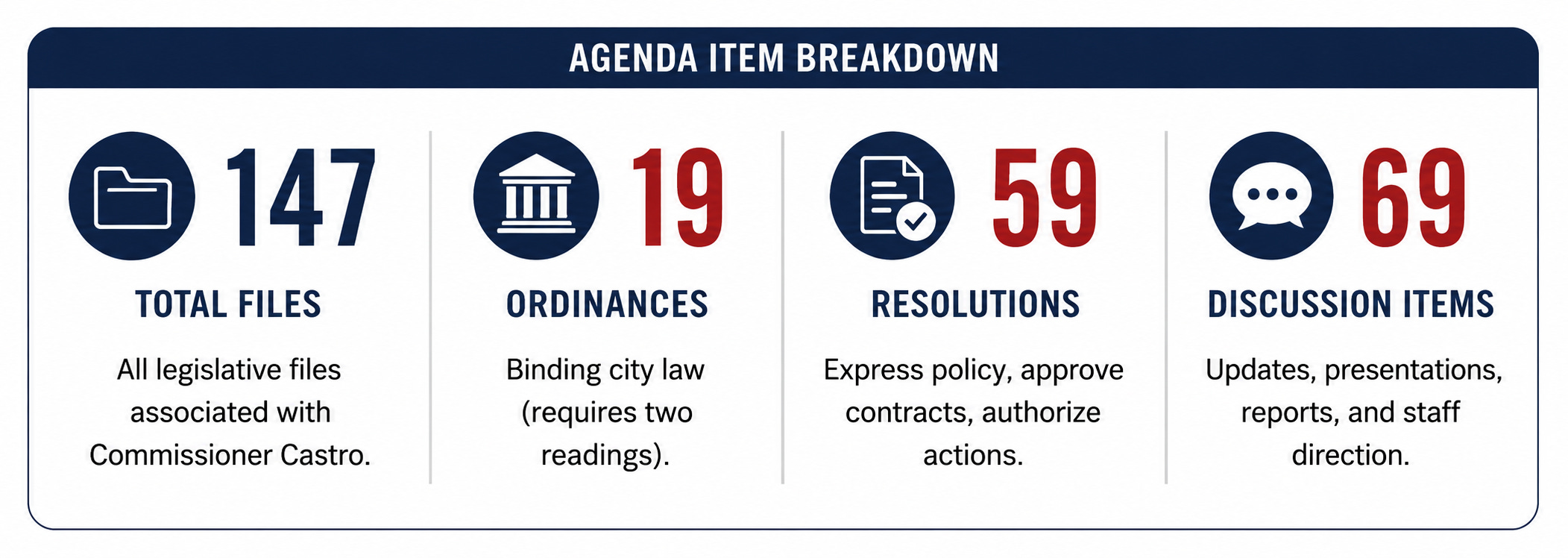
Ok, I’ll concede that at first glance this appears to be pretty impressive. In three and a half years, 147 agenda items is a lot. But understanding the difference between each of these agenda item types is really, really important.
For starters, an ordinance is the city’s strongest legislative tool. It creates or amends binding municipal law, requires two readings, and can permanently change the City Code. A resolution, on the other hand, expresses policy. It approves contracts, authorizes spending, makes appointments, and creates direction. Generally, it does not amend city law, but still plays a valuable role in legislation. And then there is the discussion item, which simply places an issue before the Commission. Although it does not itself enact law, it is a useful tool for generating conversation and giving staff general direction. These distinctions matter because not every file carries the same legislative weight.
What’s within those 69 discussion items, which almost make up half of all 147 agenda items, is also an important distinction. From Burger Bobs, to FreeBee, to a Compensation Study, to Telephone Systems, a discussion item is demonstrably and fundamentally different from legally binding legislation. This is why context matters and it’s why Castro left this detail out. It’s easy to say “look at all that I did!” but not tell residents that most of it never manifested into law. Even more telling is the outcome….
Here’s the part Castro’s presentation quietly depends on: how you sort the record decides what it looks like. She sorted by type — 19 ordinances, 59 resolutions, 69 discussion items — because type sounds like substance. “Ordinance” and “resolution” are weighty words; a list of them reads like a body of lawmaking.
But every one of those 147 files carries a second label the reel never mentioned: its status — what actually happened to it. And status doesn’t care what type a file is. An ordinance can be noted and filed; four of hers were. A resolution can fail; six of hers did. A discussion item can sit “agenda ready” indefinitely. The same nine status categories apply to all 147 files equally — which makes status, not type, the axis that measures outcome.
So take the identical record Castro cited and sort it by status instead of type:
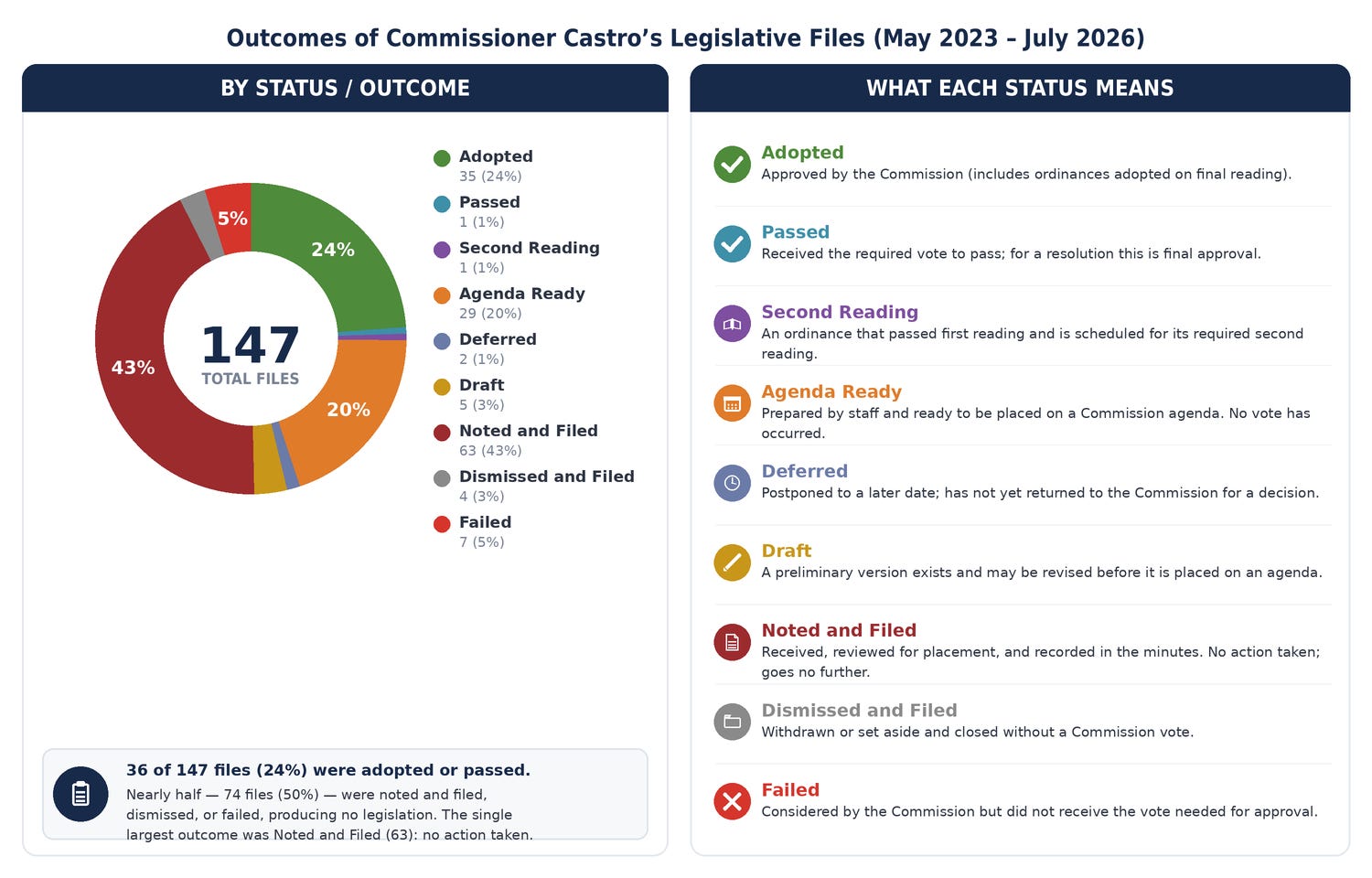
The impressive-sounding type buckets dissolve into what the files became: 36 adopted or passed, 37 still pending or unresolved, and 74 — more than half — filed away or rejected without ever producing legislation. Same 147 files. Same official record. The only thing that changed is which column you sort by — and that single choice is the difference between a record that looks full and one that shows what was accomplished.
To be fair, much of that 74 is discussion items doing exactly what discussion items are supposed to do — get noted and filed. But that is the point: half the record was never the kind of thing that could become law in the first place. With that in mind, let’s walk through what actually happened to all 147.
Let’s start with “Noted and Filed.” There are 63 items that fall under this category, making it the single largest outcome category out of the 147 items Castro is associated with. The largest category in Castro’s “official record” isn’t adopted, it isn’t passed, it’s simply listed as “noted and filed.” Apparently, the road from 147 to accomplishments gets considerably narrower once we start asking what happened to all those files. No action was taken on the 63 items and the item went no further aside from simply being recorded in the minutes.
There is nothing inherently wrong with that. Commission meetings should include updates, reports, and discussions that are filed in the public record and made readily available for voters to review. But if those files are going to be counted towards Castro’s record, residents should understand that being discussed and filed is fundamentally different from being enacted, and is not necessarily reflective of substantive legislation. Sixty-three files — roughly 43% of the entire 147 item record Castro has highlighted — fall into this category. In other words, the single largest component of the “official record” she presented as evidence of productivity consists of matters that were noted and filed. That context didn’t make the Instagram reel.
Then we have the 29 “Agenda Ready” items, meaning some of the items haven’t reached an outcome at all. That fact alone means they should not be counted in the official record because they demonstrate, well, nothing. “Agenda ready” isn’t an adverse outcome… it isn’t an outcome at all. Yes, a pending item may eventually become an accomplishment, but until it does there is a reasonable expectation that an elected official would not count the possibility of future action as proof of past accomplishment. Castro should have made that clear. If we are measuring activity, sure, go ahead and include these items. If we’re measuring outcome, which is truly reflective of an accomplished record, well then the jury is still out.
Then there are the files that never reached successful final action for one reason or another: five remain in draft form, two were deferred, seven failed, four were dismissed and filed, and one is still pending a second reading. Those statuses aren’t interchangeable — a deferred item is obviously different from one that failed a Commission vote — but none should be confused with an adopted legislative accomplishment. Again, this doesn’t mean introducing them was meaningless. It means the outcome matters when a politician asks voters to judge a record by its size.
Finally, we arrive at the categories most people probably assumed Castro was talking about when she invoked her legislative record: adopted and passed. Thirty-six of the 147 items are classified as such; that’s approximately one-quarter of the record Castro boasted. In three and a half years. That’s less than twelve items a year. That does not mean the other 111 served no purpose. Discussion itself can produce direction. Reports can inform policy. Pending items may eventually pass. But it does mean that 147 and 36 describe two very different things. One measures the size of the file record while the other measures files that reached an adopted or passed disposition.
To be perfectly fair to Castro, she didn’t say she “passed” 147 laws. Actually, I don’t need to be fair to her. She conveniently left that distinction out. I’m holding her accountable for the things she didn’t say. She said she had 147 legislative items but didn’t get specific about any of them. Taken literally, the Clerk’s records support the existence of those items, but that technical defense misses the point and gives Castro permission to misinform the public (which she did). Castro wasn’t giving residents a lesson in municipal records management, she was responding to valid criticisms that she hasn’t accomplished enough in office. The 147 was offered as evidence of accomplishment. Once that’s the purpose for which the number is being used, outcomes become relevant.
147 existed. Sixty-nine were discussion or protocol files to begin with. By outcome: 63 were noted and filed, 29 remain agenda-ready, 19 were drafted, deferred, failed, dismissed, or pending a second reading, and only 36 show adopted or passed outcomes.
But even 36 doesn’t answer the question I started with because “adopted or passed” includes different kinds of Commission action. If we’re going to talk specifically about legislation that actually changed Coral Gables law, we have to narrow the record one more time.
We’ve separated activity from outcome. The next question is the obvious one: how much of Castro’s 147-item “official record” actually resulted in something that permanently changed the city code? Are you ready for this? Only 6 of the 19 ordinances were adopted as binding law.
Just. Six.
Let me repeat Castro’s line from her Instagram reel: “Politics is opinion. The record is fact.” Ok, sure. But if we’re going to invoke the record, let’s read the whole thing. I stated that 36 of the items were adopted or passed, of which six are ordinances. Only six became binding city law. In three and a half years. That is not much of a record. However, if Castro introduced legislation that earned the support necessary to become law, she deserves credit for it. I’m not interested in taking accomplishments away from her merely because I’m examining the way she presented her record. But giving her credit for six adopted ordinances does not require pretending that 147 files represent 147 equivalent legislative accomplishments. They don’t. The Clerk’s own records make that clear. So let’s look at the six ordinances themselves.
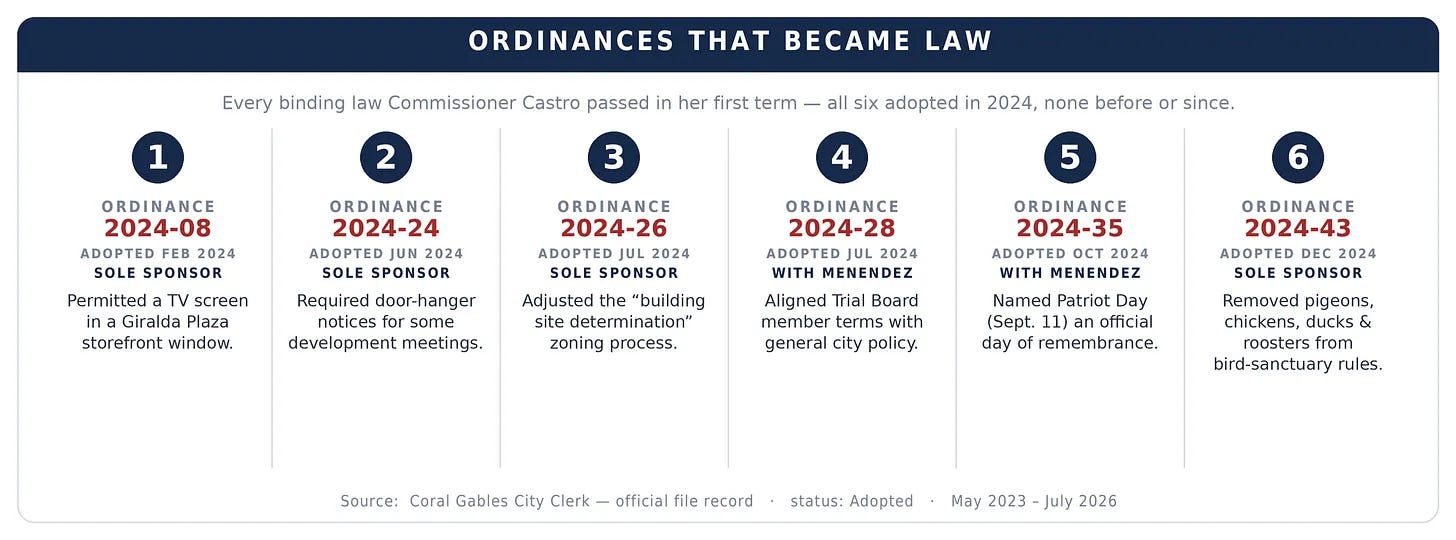
Ok, so six is the number. Wow, amazing, great! Six ordinances in over three and a half years. Which is why, naturally, substance is the next question. If the record is fact, then Castro deserves to have all six examined on their merits. Sure, passing an ordinance is unquestionably a legislative accomplishment. But the ordinance number stamped at the bottom of the page tells us that something became law; it does not tell us how consequential that law was. I’d like to be sensitive to the fact that some of these may be significant to some voters. I don’t want to disqualify how, subjectively, any of these may be consequential to one person or the other. But objectively, these ordinances are narrow, procedural, ceremonial, and all landed in a single year. For reference, here’s a little bit about each ordinance so you can judge the substance for yourself:
A television screen on Giralda Plaza (Ord. 2024-08 · Feb. 2024 · sole sponsor) This changed the zoning rules for the Giralda Plaza pedestrian strip so a business could put a television screen on the inside of a window facing the street. That is the whole of it — one type of display, one window orientation, one block. It’s the kind of item that helps a specific merchant; as a headline accomplishment, it’s a signage tweak.
Door-hanger notices (Ord. 2024-24 · Jun. 2024 · sole sponsor) This added door hangers as one more required way to notify neighbors before the public meetings developers hold for multi-family and mixed-use projects. It’s a modest transparency measure — but it changes notification, not what gets built. And it wasn’t a consensus fix: the city’s own Planning & Zoning Board recommended denying it, 5–1, and the Commission passed it anyway.
Building-site determination (Ord. 2024-26 · Jul. 2024 · sole sponsor) This amended a single zoning-code section to streamline how one type of application — “building site determination” — is processed. This is administrative plumbing, a procedural change almost no resident will ever encounter. Here too the Planning & Zoning Board recommended denial, 6–1, before the Commission adopted it.
Trial Board terms (Ord. 2024-28 · Jul. 2024 · co-sponsored with Commissioner Menendez) This made the term lengths of the city’s Trial Board members consistent with general city policy — internal housekeeping that harmonizes one board’s rules with the rest. It sets no policy and touches no resident’s life, and it was co-sponsored, not solely hers.
Patriot Day (Ord. 2024-35 · Oct. 2024 · co-sponsored with Commissioner Menendez) This designated Patriot Day, September 11, an official city day of remembrance and holiday. It’s a meaningful gesture — and a ceremonial one. Commemorative designations govern nothing and deliver no service; they’re among the lowest-lift items a commission handles. I commend her and the Commission for enacting this ordinance and honoring those we lost.
The bird sanctuary and the fowl (Ord. 2024-43 · Dec. 2024 · sole sponsor) This amended the animal code to remove pigeons, chickens, ducks, roosters, and other domestic fowl from bird-sanctuary protection. It doesn’t create a policy so much as trim an existing one. The specificity tells the story: this is a tidy-up that resolves a particular nuisance question, not a measure with broad reach.
That is the complete legislative record behind “147.” Not one of these did nothing — each changed something real. But each one is either narrow, procedural, or ceremonial; two of the six were co-sponsored rather than hers alone; two passed over the objection of the city’s own advisory board; and all six were adopted in a single year. This is what the file count was hiding: not a body of work, but a handful of small-bore items and a great deal of motion that never became anything.
A word on sponsorship, in fairness. Legislation is rarely a solo act — items get co-sponsored all the time. Two of these six ordinances were co-sponsored with Commissioner Menendez, not carried by Castro alone, and at least one began as another commissioner's item before she took it up. All of this information is available in the full record I am posting below for everyone to download and sift through, just as I have. None of that is a knock: co-sponsoring and advancing others’ work is a normal, legitimate part of the job. But it's worth stating plainly, because a "147 items, all mine" impression doesn't survive contact with the record either. Where she was the sole sponsor, I've said so; where she wasn't, that belongs on the page too. That's not a knock on the work. It's a knock on the framing: a record offered as "look what I did" should be clear about what was done with others, and hers wasn't. The distinction didn't make the reel, the same way the outcomes didn't.
Before I move on, I want to reiterate something I said above, particularly because I know how some of you readers work and you’ll jump to critique me for my comments regarding Patriot Day as a deflection of my arguments rather than analyzing the weight of this post for its substance.
Measuring these items as legislative accomplishments is not the same as measuring what they mean. The Patriot Day designation, in particular, carries real weight for many in our community — it honors neighbors we lost and the people who answered that day, and I don’t diminish that for a moment. The same goes for anyone who benefited from any of these ordinances; each one mattered to someone. My point is narrower and it is about the office, not the cause: recognizing a day of remembrance, however meaningful, is not the heavy legislative lifting a commissioner is elected to do — and it cannot carry the weight of a claim like “147 items.” Honoring the fallen and building a legislative record are both worth doing. They are not the same thing, and one cannot stand in for the other.
The day Castro posted the reel about her record, I made a public records request. I wanted to see this document for myself. That's how I got all the information above. If you want that document, here it is. Take a look for yourself.

The full record: all 147 items Castro cites, straight from the City Clerk, nothing trimmed. Sort it by type and it looks like a mountain; sort it by outcome and you find the hill. Don't take my word for it — the whole thing's here.
What's really, really funny is that less than a week after this she posted a second reel. Here's that video:
I don’t know what world Castro is living in, but that didn’t look like a filing cabinet. That was a single filing folder. Big, big difference… Now, if you want to see a filing cabinet, feel free to make a public records request for Lago’s legislative record. If we’re talking metaphorically, which I’m not sure Castro understands the concept of given she just called a folder a cabinet, Lago’s record would fit into multiple filing cabinets. If it isn’t already obvious, I’m the one that made the public records request. This is why the public records request system exists. If a pubic official says one thing, a system is in place to verify that information. So get over yourself Dr. Castro, you’re in public office and we the residents get to make public records requests whenever we’d like. Just ask your pal Maria Cruz, she specializes in it.
I’m not going to walk through what was in the folder or the agenda items she referenced in her second reel. Going item by item (again) would mean playing the game she’s inviting — measuring a career by whether a folder can be made to look full. That was never the question. The question is why a folder is being presented as a filing cabinet, and why a handful of items is being presented as a body of work. And why that body of work supposedly demonstrates a substantive, accomplished, and successful three-and-a-half-year political career. Declining to litigate the contents isn’t ducking the argument. It is the argument.
The second reel gives away the whole method. In it, she recites her record as three numbers: nineteen ordinances, fifty-nine resolutions, sixty-nine discussion items. It sounds like an accounting. It has the cadence of substance. And it leaves out the only column that matters — what happened to any of it.
So let me finish the sentences she started.
Nineteen ordinances — of which six became law. The other thirteen were left sitting, filed away, dismissed, voted down, or still waiting on a second reading.
Fifty-nine resolutions — of which thirty were adopted or passed. The rest stalled, failed, or were never taken up.
And sixty-nine discussion items — of which none became anything, because discussion items can’t. They aren’t votes. They’re conversations. They get noted and filed. Listing sixty-nine of them alongside laws and resolutions, as if they’re the same kind of work, is how you turn the transcript of people talking into a résumé.
Add it up and the completed sentence reads like this: of the 147, thirty-six ever reached a final result — six ordinances and thirty resolutions — and sixty-nine of them were never capable of one to begin with.
That’s not a filing cabinet. It never was.
A filing cabinet is not a folder. And a performance is not a record. Castro’s whole term is purely performative. It’s not even Oscar worthy.
Comments
Nothing yet. Say the first thing.
Sign in to join the conversation.