
Perhaps the most annoying thing in movies lately is Quentin Tarantino’s self-imposed limit of directing 10 movies. The cinema great and frequently very annoying person has decided that he’s only allowing himself to make 10 movies in his lifetime … and he’s at nine right now. Well, kind of.
I guess it depends on how you classify the Kill Bill(s), but at least in Tarantino’s view, he only has one movie left to make. Looking back, he probably should have found a way to end on Once Upon a Time... in Hollywood, a beautiful (and brutal) summation of his entire aesthetic, but instead he saved that for No. 9.
Now we have to have a new tabloid-y story every few months about what he’s working on next and how it’s not good enough to be his final movie and how he needs to start over. It’s also why he won’t be directing the standalone sequel to OUATIH, the untitled Cliff Booth film, and the entire thing is just pretty confusing and vexing.
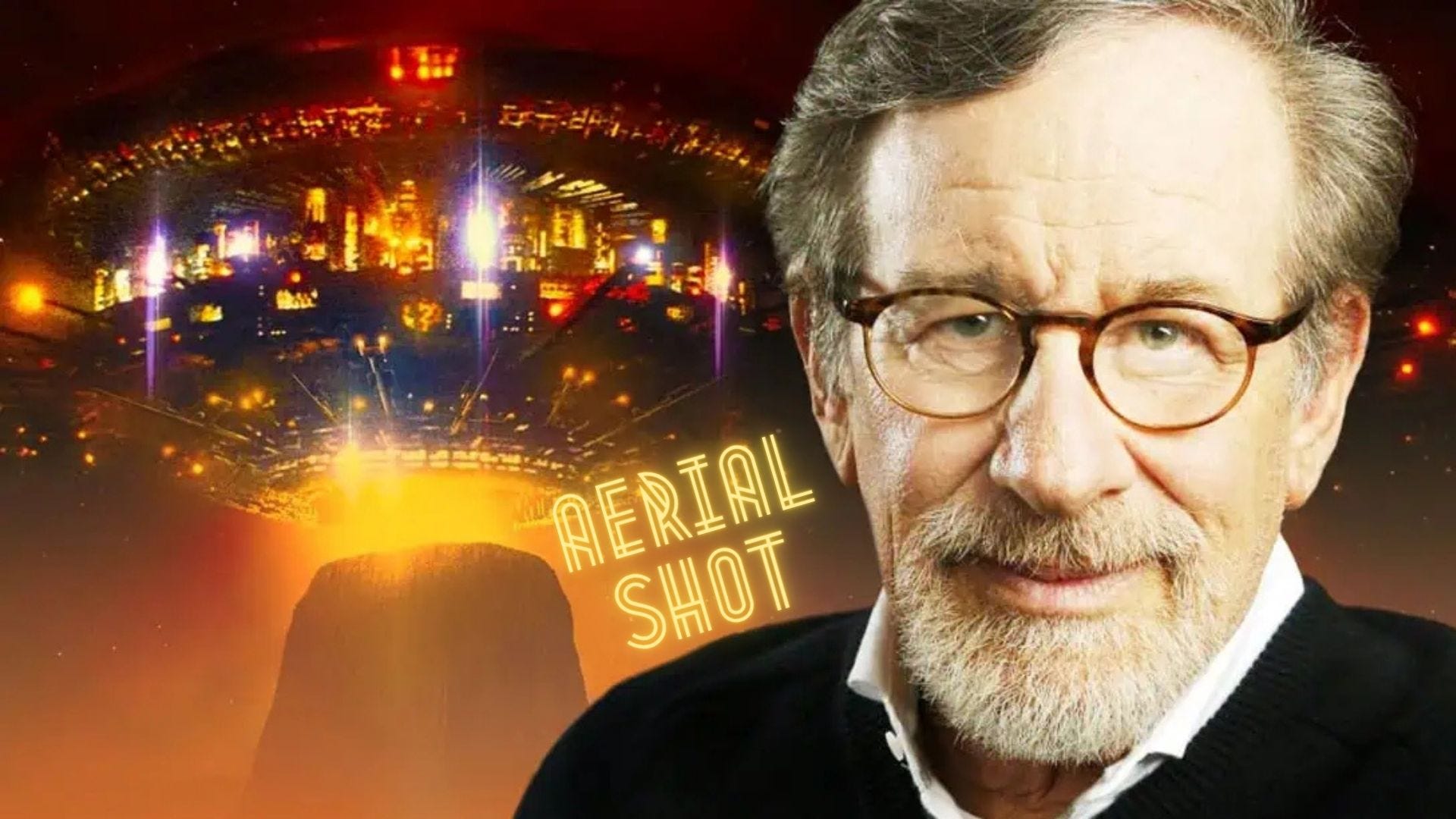
Steven Spielberg, on the other hand, has directed over 30 films, starting with Duel in 1971 and culminating (for now) in the brand-new Disclosure Day. Thankfully, Spielberg doesn’t have a planned capper, à la Tarantino, but there’s a part of me (and probably a part of Spielberg) that thinks he should have ended his career with The Fabelmans four years ago.
Now, I’m glad to be getting more Spielberg movies. Don’t get me wrong. It’s just that The Fabelmans (2022) is almost a decoder ring of sorts for the rest of his entire catalog. Everything he’s ever made has a slightly different sheen to it after watching The Fabelmans, a coming-of-age story loosely based on Spielberg’s life. With the help of Pulitzer Prize winner Tony Kushner, almost acting as Spielberg’s therapist, this movie almost feels like Spielberg’s final bow before hanging up the camera.
The Fabelmans shows a young Spielberg watching as his family falls apart. Spoilers, but the gist is that his mom leaves his father after falling in love with his father’s friend, and she partially figures this out after watching her son’s short film. It also looks at how Spielberg can sometimes see himself as a filmmaker first instead of a person, and ends on perhaps the best final note of any of his movies.
Spielberg’s best movies, from E.T. the Extra-Terrestrial to Close Encounters of the Third Kind to Jurassic Park, all have a different gravity to them through The Fabelmans, which is what makes his follow-up (four years later) so interesting.
Just recently, I rewatched War of the Worlds, which is an obvious 9/11 parallel as well as Spielberg’s reckoning on what it’s like to be a father during tumultuous times. It’s about him as a parent and also his parents’ respective roles in raising him amid chaos. Cruise’s in-and-out nature and relationship to his own children in the movie aren’t dissimilar to what’s happening in The Fabelmans. There are just more UFOs and fewer Seth Rogens.
Disclosure Day, Spielberg’s latest deep dive into aliens, is more of an interesting document than it is a good movie. It picks up where his others left off1 and takes the age-old extraterrestrial dilemma and turns it into a rebuke of Trump-ism and the general lack of empathy prevalent in … well, everywhere.
It’s a perfect encapsulation of boomerism, hopecore and blinding sincerity, while also being kind of a genre mish-mash, or more simply a mess. There’s really good stuff, especially in the first hour, but there’s nothing really new or inventive when it comes to the worldwide alien conspiracy. It’s a Greatest Hits album, but of someone trying to replicate their best work, instead of just playing their best stuff.
It also makes sense that this is the successor to The Fabelmans, as at its core, this is a movie about someone recreating their childhood home to look into the past and see what happened to make them into this person. It also brings to mind, maybe the most illuminating Spielberg question-answer, when he was interviewed by James Lipton.
While discussing his 1977 sci-fi epic, “Close Encounters of the Third Kind,” Lipton stunned Spielberg with a thoughtful inquiry about the filmmaker’s parents. In the film, aliens and humans communicate via a sequence of musical tones generated by a computer.
“Your father was a computer scientist; your mother was a musician,” Lipton ventured. “When the spaceship lands, how do they communicate?”
“That’s a very good question; I like that,” Spielberg said with a grin, before replying, “I’d love to say I intended that, and I realized that was my mother and father, but not until this moment. … Thank you for that.”
It’s a very clear 1:1 with Emily Blunt and Josh O’Connor. Blunt is a (sometimes eccentric) TV meteorologist, looking to become slightly more famous, given the gift of empathy, while O’Connor is the hard-nosed mathematician who helps translate languages. It’s the same archetypes over and over again with Spielberg, and it unfortunately just doesn’t work in the same way many of his past films have come together.
The other big problem with Disclosure Day, other than its emphasis on psychotherapy instead of plot/character development, is that it’s just kind of a wet blanket. This has some of the trappings of the worst SNL political sketches or even something like the recent Adam McKay films, like Don’t Look Up or Vice, where it wants to show you how bad things are and how they can get better, in a way that feels malinformed and kind of dishonest.
The power and importance of a press that show us the truth is central to the movie in ways very close to The Post, Spielberg’s rashly assembled public intervention on the early Trump presidency about the same idea. Disclosure Day does leave narrative fully behind by the end; the spectacle on TV puts the world in a spell, those images and their truth supposedly impossible to shake. In an early scene, O’Connor’s girlfriend, a former novitiate, discusses the alien presence in theological terms with the nun she used to be under and gets admonished that she didn’t lose her faith in God, but in people. There are no cynics allowed in Spielberg’s temple.
—Filipe Furtado, Mubi
If everyone were to just come together and accept one another, things would be great. Which is obviously true, but also contains some of that uber-sincerity that I find a bit exhausting. To be fair, I made sure to ask friends who saw the movie if I was being too harsh on it because of that immediate reflex, and I was told, “it was very sincere but that didn’t mean it was good.” So … phew.
I'm very curious to see where Spielberg goes from here. He’s playing with the house money of house money at this point. He’s made his “final” film and then another film about what it was like to make that “final” film. There’s talk of a Western, which would be a delightful and much-needed pivot, and maybe what he needs is to shift to a different part of the world and get out of his own head2.
This one’s a miss, which is fine. It happens. Every Spielberg movie is still a treat, even if it doesn’t hit the mark. The man made Jaws and Jurassic Park and Indiana Jones. He gets a lifetime of free passes.
Indiana Jones And The Kingdom Of The Crystal Skull, War Of The Worlds, Close Encounters Of The Third Kind, E.T.: The Extra-Terrestrial
very relatable to me perusing jobs in London, just to see
Comments
Nothing yet. Say the first thing.
Sign in to join the conversation.