
I have been invited to expand on a substack post I responded to regarding “Three Curricular Concerns and a Strategy” by Rosemary Hipkins that provided an interesting insight, and very relevant concern regarding the “knowledge-rich” curriculum currently being rolled out. She highlights the dilution of curriculum in the face of ever growing knowledge, addressing misinformation and disinformation in the learning environment, and the walking back of bicultural elements. These concerns she raises are real and highlight a fundamental flaw in how our modern education system is coping with the complexities of our society. Rosemary offers a strategy to address these concerns by asking the question “Where does knowledge come from?” and “How do we know the knowledge is trustworthy?” She suggests a practical strategy that can be readily understood and applied, the idea of knowledge systems could help.
My area of educational expertise is in Technology curriculum. The knowledge system is something we utilise in the Technology curriculum, although I usually refer to it as Knowledge Architecture. This is an essential part of the technological process to solve problems, defining the boundaries and gathering information that will contribute to a solution. The knowledge used has to be useful, it has to have utility to solve the problem. This is how we screen out the misinformation, the disinformation, by focusing on the knowledge that gives us answers to the questions that the problem is presenting. Its integrity.
Rosemary expands on the idea of knowledge systems by recognising three aspects of the mainstream knowledge architecture we currently use: It is very Eurocentric and supports the status quo of Western Imperialism and capitalism; Indigenous knowledge is acknowledged, but viewed as traditional knowledge, and thirdly there is a dilution of local knowledge. Each of these areas provide context to how the knowledge can be seen, evaluated and utilised.
MEANINGFUL & PURPOSEFUL
Context has always been a challenging issue in modern education, as a way to give literacy and numeracy purpose and meaning. When learning is not rooted into a meaningful problem solving context, the quality of the knowledge and information deteriorates into the knowledge system that 21st century education is navigating. Public education is just over one hundred years old. It was designed for a world that no longer exists. Prior to this era of education, an education was process based learning. Look at what I do and copy me. Experiential learning. Developing the skills on the job, the apprentice learning from the master. The learning followed the gaps in the community. Farming was responsible for a large part of the work force, the skills were diverse, focusing on solving the problems of food production. Cottage industries created clothing, boots, bakeries, carpentry, candlemakers for the community. Apprentices were usually family members taking on the craft, learning the process of knowledge and skill acquisition in order to solve a problem and provide a service. It is important to recognise here that the community had agency over what they saw as important learning for their community. With the advent of industrialisation and the establishment of factories, this was all about to change.
There was a specific need to train and upskill a large number of people to work the factories of the industrial era. To achieve this goal they looked to a model of learning where an instructor would teach the necessary knowledge and skills to complete a specific task. The “content” of this task would be broken down into a series of steps (a “process”) for the worker to follow. All that was required was for the worker to follow the step by step process, mimic the actions, learn the knowledge and the task would be completed. They would repeat this process until they were competent. Then they would take their place in the production line. In a factory there would be many production lines, many specific tasks, many step by step processes to learn, so much so that it would be impossible for all workers to know all the steps.
It is at this point three things happened which impacted the future of learning, firstly meaning was stripped from their learning, the big picture, the context, their purpose had been removed. Secondly, the knowledge, the skills, the tasks and processes were siloed and compartmentalised. The holistic approach to learning in their community has been dissected into bite sized, step by step tasks for use in an industrial setting. Thirdly, their agency over learning was removed. No longer did they decide what had to be done for their work day, the decision was made for them. This system of task focused mass learning technique became the precursor of modern education. It was the solution to a problem that 19th century western society was facing. In the 21st century content-based learning presents more problems for our society as it tries to adapt to the fast paced changes we are currently experiencing. The merits of a process-based learning framework when society is confronted with uncertainty and fast paced change will be discussed at a later time, as it has value when confronting issues such as the one being discussed here.
KNOWLEDGE ARCHITECTURE
Knowledge and the architecture that it inhabits is inherently unstable, by this I mean it changes, as new discoveries are made, new insights are formed, the knowledge architecture accommodates it, building on it in a manner that can be seamless or ad hoc. Planning curriculum under these conditions using the content-based curriculum model leaves it prone to abuse by ruling parties by giving undue attention to and learning around literacy and numeracy, whitewashing colonial history, creationism versus evolution are a few examples where curriculum content shaped by politicians and think tanks (New Zealand Institute) with their own agenda, will influence social outcomes. Whereas critical thinking, problem-solving, creativity and innovation, as well as entrepreneurship are all sidelined by politicians as “nice to have” and “we want them to happen”, but are resistant, perhaps even ignorant as to how to go about it. This is a big part of the systemic problem that education faces. It’s very hard to create a better system, when our politicians’ only experience of it is the one we all went through.
Einstein said that “You cannot solve the problems of today with the same level of thinking that created them”. Hence we are caught in an education loop of sorts (like when movie studios run out of ideas, they remake old movies). Politicians don’t know, so they rehash the same political rhetoric: failing school grades, more literacy and numeracy. It’s been done this way since I was at school, nigh on 50 years ago, and yet we have Education Minister Erica Stanford delivering her Knowledge-rich, back to grades A-E on the claims that employers and parents don’t understand the NCEA grading system.
I’ve been teaching technology curriculum for almost 40 years in all education sectors across Aotearoa and Australia. One thing I have experienced is that all national curriculums are not the same. Technology in school curriculum around the world comes in many forms, such as wood work, metal work, cooking, home science, sewing, industrial arts, technical drawing, material science, mechanics, design, computer science are interpretations that governments make in order to meet social and vocational needs. However in Aotearoa/New Zealand they interpreted technology as “Knowledge of Process”. As such the technological process, as applied to problem solving and the design of a solution, shifted the focus from learning content to learning a process. The process remains unchanged, whether you are in year 1, or year 4, or in year 7 or in year 13. It is the depth of knowledge, application of competent skills and the management of resources to design a solution. Therefore technological practice is a good place to learn about knowledge integrity. Understanding this relationship is the reason technology curriculum is resilient to the turmoil and upheaval that society faces, because problem solving has always been the solution to our survival and growth.
Historically, technology was the first curriculum, it was around long before languages, mathematics and contributed to the establishment of scientific, geological and geographical knowledge, as well as the development of skills to shape, form and join materials. The Architecture of Knowledge, its epistemology has its roots in a world shaped by technological process, a process aimed at survival, problem solving and incremental improvements in the quality of life.
Consider the implications of the historical development of technological solutions and its contribution to knowledge architecture. The development of the first stone tools which took place over hundreds and thousands of years developed knowledge about the type of stones to use, their location and the process (skills) to shape and form them. This answers the first question “Where does knowledge come from?” Within this context the knowledge has to have utility. In regard to the second question “How do we know the knowledge is trustworthy?”. The answer is in the solution. Did the knowledge contribute towards solving the problem? For those that know their prehistory, the stone they used was obsidian, a volcanic glass-like rock that when knapped, creates razor sharp edges. This knowledge was essential to preserve. Remember it took hundreds and thousands of years and countless trial and error processes in order for the knowledge to be tested and trustworthy. Not all rocks and stones would be suitable. It had to be obsidian. Once the knowledge was deemed trustworthy it had to be stored for future generations. How would this take place?
TRADITIONAL KNOWLEDGE & CREATION MYTHS
As technological development evolved and the knowledge architecture increased. With each new insight, new knowledge would be required to be communicated. Language would have evolved alongside as the need to store and transmit this knowledge would be essential. This brings us to the idea of traditional knowledge and its value in modern education and society.
When I teach design with my senior students, we explore creation myths with a focus on the Māori myth of creation. Embedded in this story, and all creation stories is traditional knowledge that serves to retain and pass down essential knowledge to the next generations. These stories were the analogue version of hard drives for an analogue society. By exploring creation stories we can thread together the essential, trustworthy knowledge of ancient societies. One of the key insights I have come to understand is that creation stories follow the same path, chaos to order, the void to light. They all address shared understanding of the problem solving process, the technological literacy that modern technology curriculum teaches. This problem solving process was personified through the Gods and the stories of the culture. It was only in the 1980s that this problem solving process was given a name: Design Thinking. This process identified six key steps: Empathy, Define, Ideation, Prototype & Testing, Iteration, Implementation and Ripples. This is what I teach students of Design and Technology. However, all creation stories embody these exact steps.
Consider the graphic below of the Māori Creation story. Each stage of the myth aligns with the design thinking process. The Void is the chaos arising from the problem. To sit with the problem and consider its impact on the world requires empathy. The Night is defining the problem, recognising the root cause and boundaries of the problem. Ideation is where the children all present possible solutions. Prototyping and testing is to create a working model of the solution, Iteration is changing and modifying the solution weathering the storms of trial and error, and Implementation is its short term and long term effect and impact on the world.
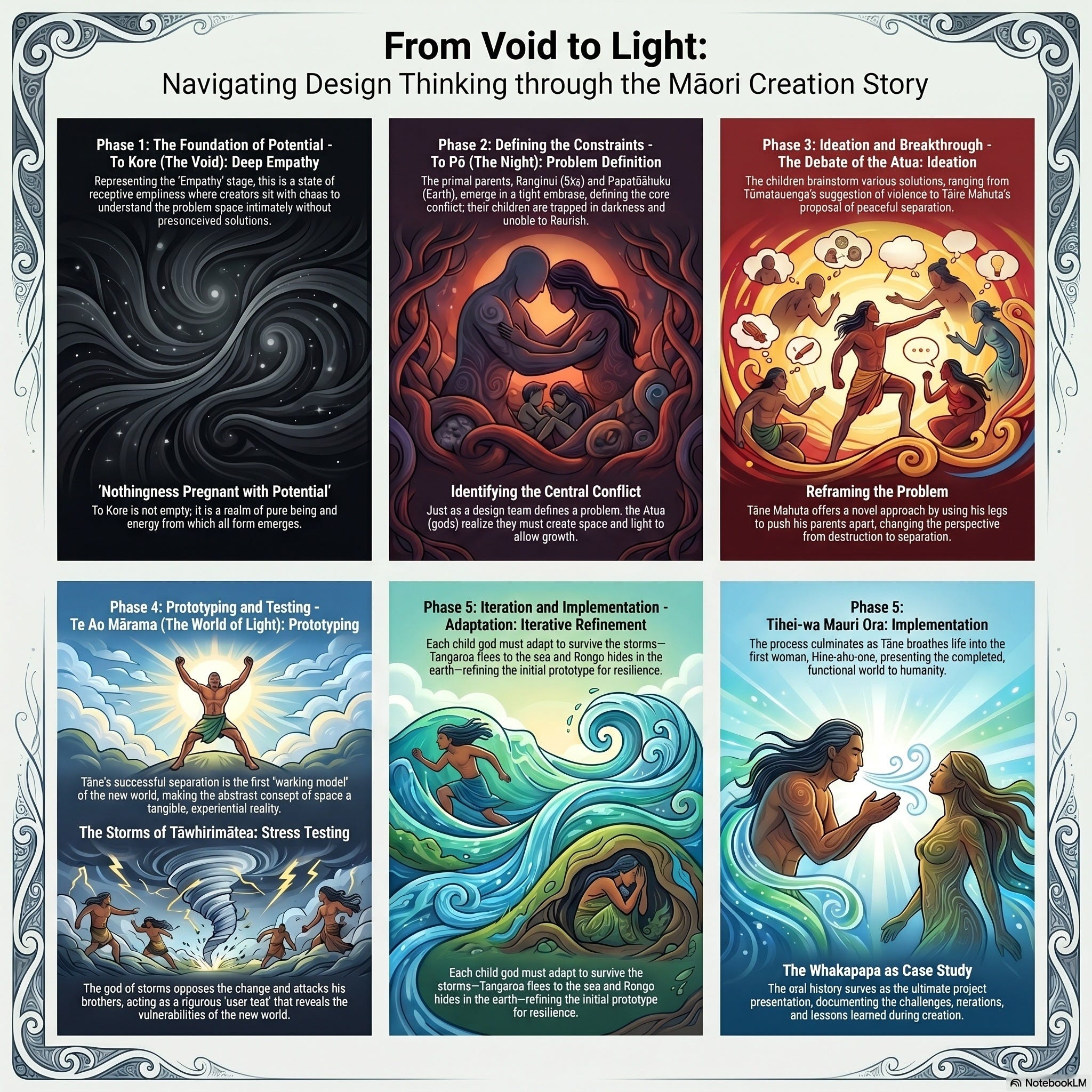
At each stage knowledge and skills are applied to develop the solution. If the knowledge is trustworthy, authentic to the problem, the solution will be revealed. For this process to be embodied into a creation myth narrative, across all cultures illustrates how valuable this problem solving process was for societies. The nature of the creation myths across cultures show diversity of characters, environments and events used to convey the narrative of problem solving. The traditional knowledge these myths offer us is that history shows technological practice and problem solving are essential to our survival and growth. If an argument was to be made for how our education system should work for the 21st century, then the elements of the creation myths serve as a traditional foundational starting point to build from.
INDUSTRIALISATION OF LEARNING
Industrialisation and Western Imperialism established the modern education system at the end of the 19th and beginning of the 20th century. It is a little over 100 years old. The industrialists wanted workers for their factories. They did not want a nation of thinkers, they wanted a nation of workers. Imperialism, by its very nature, would dismiss creation stories and traditional knowledge for specialist knowledge and skills. From these values, the factory monitorial system of education came into being, and shaped modern western education. This became known as content-based learning and drives modern education as we know it today. Timetables, bells, exams, streamed classes, teacher as the knowledge wielder, sage on the stage all shape the learning environment. Our capacity to navigate a complex world with increasing problems using this model of learning will indiscriminately limit our society’s ability to survive and grow.
Content based learning works well when society is stable, clear employment pathways and predictable outcomes. This was evident in western culture after the second world war into the early 1980’s. The prosperity of the age was a combined result of the education system and how it contributed to the industrial and economic system of the time. It focused on, and was effective in, delivering knowledge and skill capabilities for employment in society. Preservation of the status quo controls and shapes breadth and depth of learning and what is being taught.
When society is in a state of flux, where the status quo starts to break apart, becomes unstable, unpredictable and under constant pressure to change, navigating a sea of problems requires a different set of knowledge and skills, including competent problem solving, critical thinking and decision making. Understanding our motivations and ”Why?”, through the lens of empathy (another overlooked attribute that is sorely lacking in our western culture), is essential for a society’s survival. Societies have always been under threat of succumbing to the slow chaos of constant change. Modern society is no different. It may be more interconnected, more complex, creating more problems, but historically every society had a choice between renewal and growth or decline and death.
Those cultures who used creation stories to store the essential learning, authentic knowledge and the capabilities to survive and thrive are still around. Those societies that no longer exist, the creation stories that preserved their essential learning and authentic knowledge are unknown, lost in the analogue time of history. Easter Island is an example of this. There was a society living on the island. They built statues. Then they disappeared. The environment was left barren. Their creation myth may see the land and its resources as forever abundant. They eat, build, and keep warm without considering the slow depletion of their food and resources. Populations dwindle. Eventually the society is gone. Their knowledge architecture was incomplete or suffered at the hands of misinformation.
Unfortunately Western society suffers at the hands of a myth of an industrialised society and growth model economy that strives to deliver democracy, freedom and private ownership as the ideal outcome. It is sold as equal opportunity for all, but decision making is firmly in the hands of a powerful few. There is no desire from politicians to overhaul a system of learning that has placed them where they are today. The system of education that preserves the status quo is what we have at the moment, content based learning.
As I’ve stated earlier, content based learning is prone to manipulation and control. We are seeing this with our current NZ government introducing a “knowledge-rich” curriculum, with an emphasis in the senior school on vocational training and skill development for industry. In the 1950’s the job market and economy was growing. In 2026, the job market is shrinking, as are manufacturing and traditional vocational pathways. This has created bottlenecks of students trying to enter the workforce. The education system, by not acknowledging its role in creating this problem, makes it difficult to initiate change. Students have no agency over their learning, communities have little influence.
KNOWLEDGE OF PROCESS
This is why having a process based learning, design thinking, technological literacy and problem solving as an educational framework is effective in resolving social problems. This is what the creation stories tell us. The story is the process, and when you have a problem it is the knowledge of ‘process’ that gives you a solution. It is the reason societies evolved and survived, it empowers, increases capability, cuts through misinformation, learning about processes and systems, the very architecture that keeps powerful people in control, is perhaps a key reason why it’s such a threat to the status quo and the class of people in control. A problem solving process based educational framework would create a generation of students who would use this knowledge against them, giving them the agency and means to overthrow their oppressors and create a truly good world for their communities.
Can education be revolutionary at a personal level? Absolutely. Can it be revolutionary at a societal level? Absolutely, but it requires systemic change. For this to happen requires politicians who truly want to empower their citizens, which requires giving away more control. The actions of current government leaders would suggest they would rather not concede more control to the people, so education policy timetravels back to the post war society with grades A-E, vocational emphasis, whitewashing of colonialism and exam based outcomes, back to a time in the good ol’ days of education where all information and knowledge was screened by gatekeepers. This brings to mind a quote you may have already know:
“In times of change learners inherit the earth; while the learned find themselves beautifully equipped to deal with a world that no longer exists.” Eric Hoffer.
Creation myths, stories and the design thinking process has been the dominant learning narrative for the past two million years. They were passed down by word of mouth. From person to person. The meaning was still embedded into the story, keeping it rich and alive. As such, it has shaped and formed the knowledge architecture that we know today. The irony about modern education and its emphasis on literacy is to recognise that at one point in history, with the invention of writing, there became a disconnect to the knowledge of process being experienced and learned, the story being told with the knowledge of “the process” being written down for later learning. The purpose and meaning had been stripped away from knowledge and practice, becoming just written content, dead on a page. Is it knowledge-rich? Is it useful? Does it have utility? Is it relevant? We will not know until it is applied to a real world authentic problem to be solved. Eight thousand years later, we still stand at this place today, as educators.
In this time society has progressed, western society chooses the untested path of a content based knowledge rich learning system, and in the space of just over one hundred years, cracks appear, problems are being revealed, social progress is stagnating and delivering education for a world that no longer exists.
We can continue trying to tick all the boxes, shuffle around the timetable, try different approaches and contexts to literacy and numeracy, again, manage plagiarism, the use of A.I., misinformation, set and mark exams to regurgitate our understanding that is required of a content-based learning framework, or we could problem solve our way forward with a process based learning framework that has students collaborate, build utilitarian knowledge architecture through integrated learning across curricula, fail, build resilience and work at solving real world problems within their own communities with an entrepreneurial spirit that takes ownership over their own learning.
Traditional knowledge of the creation myths shines a light on the narrative path of what is required of education for a society to survive and grow. Technological literacy requires us to understand systems, and when they are not working efficiently and effectively, prototyping better systems is required. When our education system is capable of the erasure of culture, delivering mis or dis information, or restricting access to local knowledge, it is a reflection of the political system responsible for managing it.
The educational framework that we choose to develop will influence and shape the society that we want. Leaders of western society will be required to “check their mindset” and recognise the value of traditional knowledge in education, or suffer its demise.
THE TENSION BETWEEN TWO WORLDS
I tell a story to all my students, one where we live in two worlds. The first world is the Real world, the one we all wake to and experience every day. In this world is the Sea of Problems. As Solutionaries, we need to be able to navigate this sea with its social, environmental, economic and technical problems. This is the world “as it is.” Then there is the Quality world, where all the good things are, the people we love and connect to, the places we visit, the interests we engage in and the values we hold close. This is the world “as you want it to be”, the Sea of Solutions. A problem is the tension that occurs between these two worlds. Everyone has different tensions in their worlds, different problems. The solution is to act. However the key question here is “When do I act?” The answer is simple, as soon as it starts to impact your Quality world. As students or ākonga of technology, they are learning how to develop their locus of control to act. This is the effect of what technological literacy can do in my classroom. I see the success of my students. I see their confidence grow. I see how they step up to solving problems. How they see themselves as “Solutionaries”. I can see and extrapolate how it would look across the school, the community and greater society.
It’s not just resolving the dilution of knowledge, knowledge integrity or bicultural elements within the current educational framework. Because then there is A.I., a changing work force, economic and social inequality, climate change all converging towards this crux point in the future. If a society’s knowledge architecture (education) is not resilient in how it is structured and applied to social and environmental change, then history has few pages on those civilisations that failed in their ability to respond to the change around them. They failed in the response-ability.
If we are going to resolve these problems, we have to ask some serious questions such as “Is the current educational framework ‘fit for purpose.’ in navigating an uncertain future?” In other words, is our Quality world being negatively impacted by our education system? If so then the bigger question for all of us, as a community of learners and educators, is “What does education look like in our Quality world?”. For this answer I would look to the traditional knowledge of indigenous creation myths and legends as applied to solving problems.
By Andrew R. Bowen
HoD Technology
Kings High School - Dunedi
n
No posts
Comments
Nothing yet. Say the first thing.
Sign in to join the conversation.