
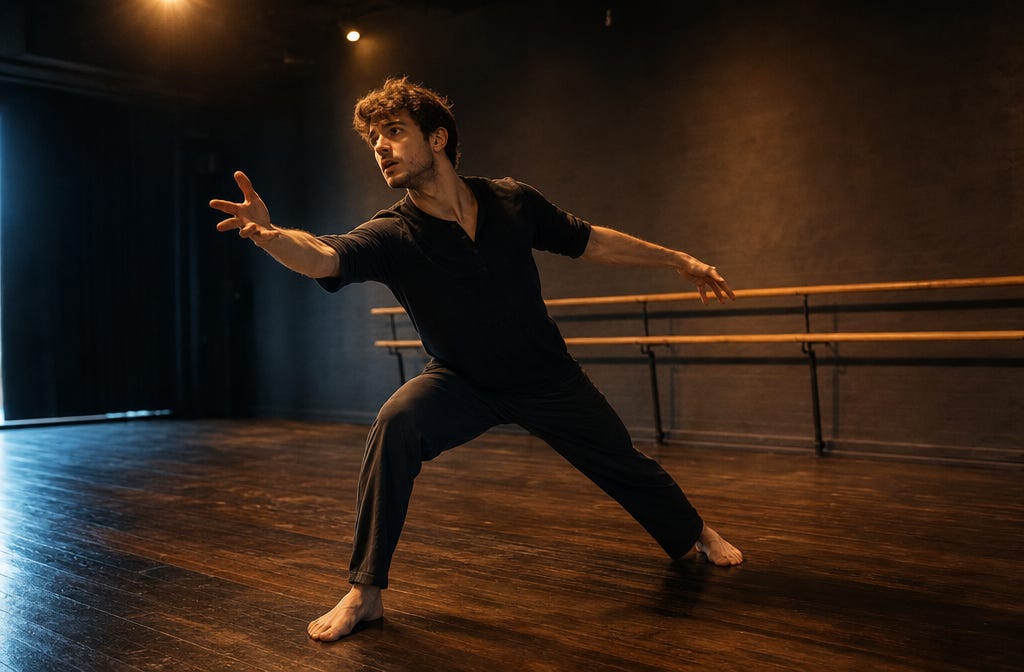
I once directed an actor who had every line letter-perfect, every intention mapped, every beat justified on paper. And the performance was dead. We sat in the house after a run and I couldn’t name the problem — until I asked him to play the whole scene as if his character were carrying a heavy, invisible suitcase he refused to set down. Same words. Same blocking. Suddenly the he was “struggling” (in a good way). Nothing in his script analysis or line delivery had changed. His body had.
That’s the secret hiding in plain sight. Your body isn’t the delivery van for the story — IT IS THE STORY! And the science finally agrees with what great actors have always felt in their bones.
For generations, Western training treated mind and body as separate departments: figure out the feeling upstairs, then send it down to the limbs for delivery. Cognitive science has dismantled that wall.
The field calls it embodied cognition. The concept holds that body and psyche are intertwined, with effects running in both directions, and that cognitive processes aren’t possible without the direct participation of the body[1]. Translation for actors: posture, movement, and breath don’t follow your emotional choices — they help generate them.
It goes deeper. Neuroscientists working in this area describe a startling reframe of what feeling even is. Emotions are understood as brain representations of body states — nerve activation patterns that correspond to the condition of your internal world[2]. The body shifts first; the feeling is the brain reading that shift.
Not only is character expressed by action — actions create character.
That line, drawn from scholar Rick Kemp’s work on embodied acting, is the whole argument in eight words[2]. It also explains my suitcase actor. Change the physical life and the inner life reorganizes to match.
🎯 The practical upshot: when you’re stuck in a scene, stop interrogating the feeling and change the body. Proprioception — the input from muscles and joints that tells the brain about posture and movement — is a door into emotion you can open from the outside[1].
Here’s the myth I most want to kill: that movement training belongs to dancers, mime artists, and physical-theatre specialists, while “real” actors just need text and truth.
Movement systems built for the stage are now used everywhere precisely because they make any performance more specific. Laban and other mind-body techniques are increasingly used by actors to make expressive choices for their characters through physical movement, and the principles have spread into psychotherapy and even gesture recognition for computers[3]. You don’t need to plié. You need to notice.
And this matters on camera as much as on stage. A lens magnifies the smallest physical truth — a held breath, a weight shift, a hand that doesn’t quite commit. The training that makes a stage actor bigger is the same training that makes a screen actor truer, because both start from the same root: knowing exactly what your body is doing and why.
You don’t have to master all of these. Think of them as different lenses for the same question — how does this person move? Sample widely, then go deep on what speaks to you.
Laban Movement Analysis. A vocabulary for how a movement happens, not just what it is. Laban broke movement into the motion factors of space, time, weight, and flow — direct or indirect, quick or sustained, heavy or light, bound or free — and asserted that each Effort carries its own emotive quality[4]. A character who moves with “heavy, sustained, bound” energy is a different soul than one who’s “light, quick, free,” before either says a word.
Michael Chekhov’s psychological gesture. A single large, full-body gesture that captures a character’s whole inner drive. Chekhov had actors enact a character’s state of mind through large gestures involving the entire body, then concentrate on the proprioceptive sensations of that pose to reach the character’s emotional landscape[5]. My invisible suitcase was a rough cousin of this.
Viewpoints. A system for ensemble and space developed by Anne Bogart and Tina Landau. It creates story onstage through time — tempo, duration, kinesthetic response, repetition — and space — spatial relationship, architecture, shape, and gesture[6]. Brilliant for waking up your instincts about where you are relative to everything around you.
Suzuki Method. Born at the Suzuki Company of Toga in Japan, this is rigorous, grounded, stamp-the-floor work that builds a powerful, centered physical presence[6].
Alexander Technique. Less about adding and more about subtracting. Its originator discovered that unlearning certain breathing and posture habits was the key to maximizing physical functionality[6]. It clears the unconscious tension that muddies everything else. This, as a singer, has been one of my best go-to techniques.
Animal work and character walks. The oldest tricks in the book, and they still work. You borrow the rhythm and weight of a cat, a bear, a heron, and let it reshape how your character occupies space. Yes, it can feel silly but it works.
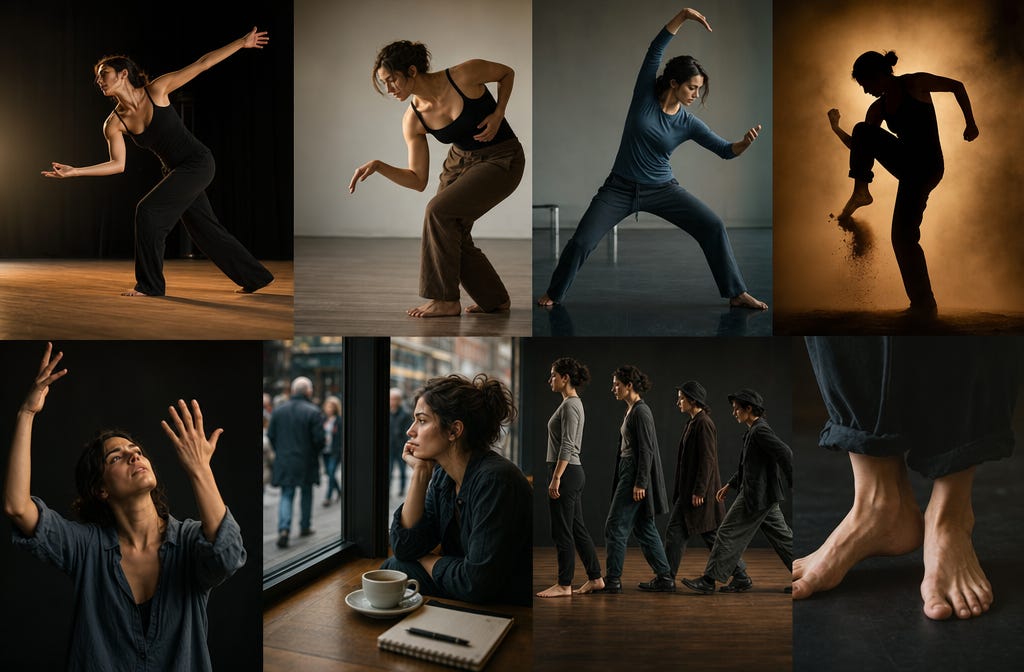
You don’t need a studio or a teacher to begin. You need attention and a willingness to feel a little ridiculous.
Become a watcher of walks. This is the foundational exercise across nearly every system. Observing how other people walk — their weight placement, and how that begins the bodily narrative through movement — is a useful place to begin[4]. Sit in a café and catalog how strangers carry themselves. The defeated shuffle, the cocky bounce, the careful tiptoe of someone hiding something. Steal all of it.
Run the neutral-to-character experiment. Stand in a relaxed, neutral position. Then change one thing — drop your weight into your heels, lead with your chest, let your hands go heavy. Hold it, breathe, and notice what mood arrives uninvited. Laban work lets you find a baseline within yourself versus that of a character, and this is how you locate the gap[7].
Apply one Effort to a scene you already know. Take a monologue and play it “direct and sudden.” Then play it “indirect and sustained.” Same text, two completely different humans. This embodied work helps the actor understand internal impulse and develop an expressive body that makes clean, precise choices[8].
The point of all three isn’t to perform — it’s to discover. You’re collecting physical information your analytical brain can’t reach on its own.
When you train the body as an instrument of discovery rather than a megaphone for decisions already made, the work gets braver. Physical training attunes actors to their bodies so they can expand their range of expression and deepen a character’s authenticity[9]. You stop pre-deciding every moment in your head and start letting impulses rise from the floor up.
It also feeds ensemble work. Shared physical training builds a mutual understanding of physicality, space, and rhythm that creates a cohesive, synchronized ensemble[9]. A cast that has moved together listens together.
And it future-proofs your craft. A movement framework gives performers a way to keep their education going through the simple act of observation[4] — every crowded train platform becomes a free masterclass.
That actor with the dead-perfect scene wasn’t lacking talent or intelligence. He was living entirely above the neck, in a profession that lives in the whole body. The fix wasn’t more thinking. It was a suitcase he couldn’t put down.
So before your next rehearsal or self-tape, try the inversion. Don’t ask what your character feels and then move accordingly. Move first — change the weight, the rhythm, the lead — and listen for what feeling shows up. You might meet a person you’d never have reasoned your way to.
What’s the most surprising thing your body has taught you about a character you thought you already understood? Tell me your suitcase story in the comments — I read every one, and the best ones tend to teach the rest of us something new.
Comments
Nothing yet. Say the first thing.
Sign in to join the conversation.