

My first day on a set, a director gave me two notes. The first was “smaller, much smaller.” The second, about forty seconds later, was “you drifted off your mark again.” I had spent fifteen years on stages where the floor was mine to roam, and now my entire performance had to land inside a two-inch piece of tape. Welcome to the movies.
If you came up through theatre, this is the wall you hit. Nobody warns you about it. Your monologues are sharp, your emotional life is rich, and then a focus puller you have never met quietly informs the crew that your close-up is soft because your chin floated four inches past where it was supposed to be. The work was beautiful. The shot is garbage. Both things are true at once.
Hitting your mark is one of those craft skills that sits in the same drawer as close-up technique and boom-mic awareness — the unglamorous stuff that separates the actor who gets hired again from the one who books once and confuses everyone. So let’s pull it out of the drawer and look at it properly.
A mark is a small piece of gaffer tape, usually shaped like a T or an X, stuck to the floor to tell you exactly where your feet need to land at a given beat in the scene. On location it might be chalk, a sandbag, a pebble, or a scuff someone made with their heel. The material changes. The job never does.
Marks get placed by the camera team after the shot is designed, and they exist because the camera has already been told where to look [2]. Tape on the floor keeps you inside the frame and inside focus across every take, so the wide shot and the close-up actually cut together later [1]. On stage, the lighting washes a big area and the audience watches from a fixed seat thirty feet back. Film is a different beast entirely. A fast lens wide open for a close-up can hold focus across a sliver of space barely wider than your hand. Step forward and your eyes go soft. Step back and your face slides into a shadow the gaffer never meant for you to find.
Here’s an analogy that tends to land with stage folks. Picture a fight sequence you have drilled a hundred times — every parry, every beat, clean. Then on the take you finish the whole thing standing two feet stage-left of where the choreography put you. Doesn’t matter how good the swordplay was. The picture is wrong. Marks work the same way, except it isn’t only your scene partner depending on your position. It’s a dozen people.
Start with the focus puller, the most quietly heroic person on any set. Their entire job is keeping the image sharp while bodies move through space, riding a focus wheel by feel off distances they measured during rehearsal [4]. Land on your mark and their job is hard but doable. Drift, and they are guessing — and guesses show up enormous on a thirty-foot screen.
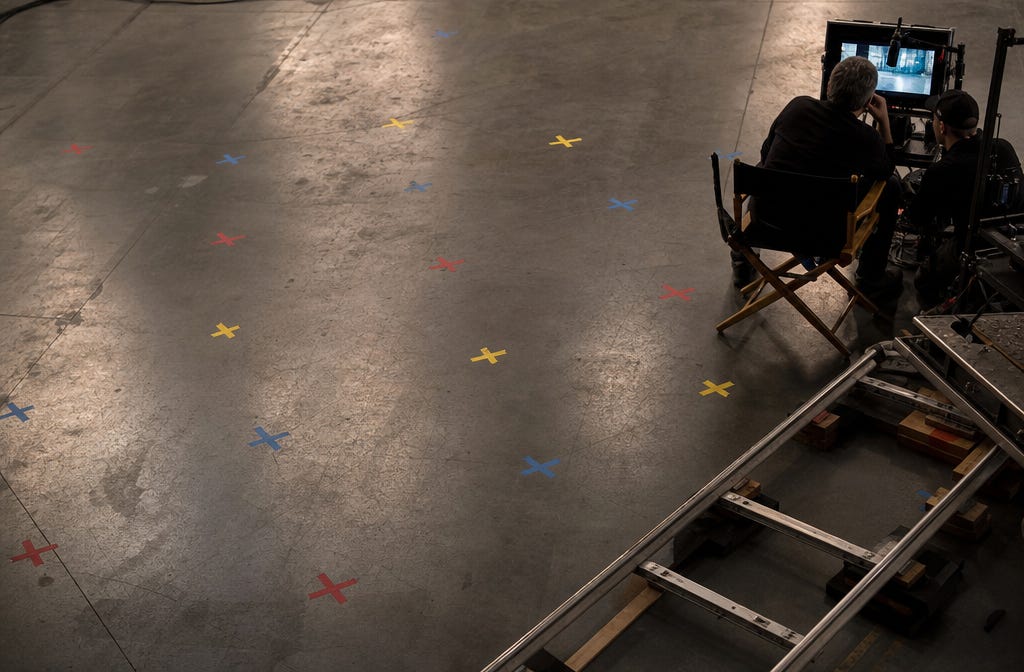
The lighting team built a specific look for a specific patch of floor. Wander two feet left and you walk into dark the gaffer never lit. Wander forward into a hard backlight and you become a silhouette. The director and the editor are counting on continuity, too — if your body lives in a different spot on every take, cutting between angles turns into a jigsaw puzzle with half the pieces missing. So hitting your mark is not some bureaucratic hoop. It’s a quiet act of respect for everyone who did their job so yours could shine.
Looking down at your feet to find the tape is the on-camera equivalent of a dancer staring at the floor mid-performance. It reads. It pulls the audience out of the moment and announces to the room that the technical side rattles you. The good news: working actors almost never look down, because they use better tools.
The first is peripheral vision. During the walk-through, find a fixed object that sits at your eye level when you’re parked on the mark — the corner of a table, the edge of a doorframe, the base of a lamp. You aren’t staring at it. You’re letting the edge of your sightline register it, so when that shape clicks into the right spot, your body knows it has arrived [3]. Your eyes stay locked on your scene partner the whole time.
The second is counting your steps. Walk the path from your start position to your mark and count the steps. Walk it again. Then walk it a third time with your eyes shut. Most actors are surprised how repeatable their own stride is — a five-step walk stays a five-step walk every single time, as long as nerves don’t make you rush or stall. Rehearse it until your feet could do it while your brain is busy acting [3].
Third is plain texture and distance memory. A seam in the carpet, a grout line, the lip of a rug — your soles can learn these. And when the tape is a T, the top bar is where your toes stop and the stem points back toward the lens, giving you a built-in heading on the way in. Your feet find the top of that T the way a gymnast’s feet find the end of the beam.
And if you genuinely must glance down? Do it early, and make it the character’s idea. Someone who looks at the ground thoughtfully three steps before they stop is acting. Someone who checks their feet the instant they halt is an actor looking for tape. The audience can always tell the difference.
Here’s a secret that takes new actors too long to learn: the camera operator and the first AD are your collaborators, not your wardens. Treat them that way and set gets a lot less scary.
Ask the operator during rehearsal whether there’s any play in the mark. Sometimes you’ve got a couple of inches of wiggle room, sometimes you’ve got none, and knowing which lifts a real weight off your shoulders. Operators respect an actor who asks a smart technical question — it tells them you take the whole machine seriously. If a piece of blocking fights you and keeps throwing your mark off, say so to the AD in rehearsal, not on take seven after the director has already called action four times. ADs solve problems for a living. They would much rather move a mark early than burn twenty minutes of shoot time later. And it is completely normal to ask for one full-speed walk-through so the focus puller can check distances before the first take. Nobody will think less of you. They’ll think the opposite.
The most common miss is looking down on arrival, almost always from nerves and too little rehearsal — landmarks and step counts fix it. Next is stopping short, where you sense the mark coming and brake too early; commit to the full distance and trust your count. Its twin is overshooting, usually adrenaline carrying you a beat past the tape, which is why you rehearse the stop, not just the walk. Then there’s abandoning the mark the second a scene gets emotional, as though precision and feeling can’t coexist — they can, and the actors you admire prove it every week. And a sneaky one: nailing the foot position but facing slightly wrong, so rehearse the whole shape of the body and the eyeline, not just where your shoes go.
Precision is a muscle, and muscles answer to reps. Put a piece of tape on your living-room floor and walk to it from ten feet out with your eyes closed. Open them, check how close you got, adjust, repeat until you’re landing within an inch. Then make it harder: walk to the mark while running your lines out loud, so you’re landing accurately with your attention somewhere else entirely — which is the actual job. Finally, approach the same mark from three different angles and start positions, because real setups rarely send you in from the same door twice. Build the flexibility in now, where the stakes are a stubbed toe instead of a blown take.
The mark is not your enemy. It’s the thing that lets the camera find your eyes when the moment matters most. Master it and you stop thinking about your feet forever, which frees you up to do the only job that was ever really yours: living truthfully in front of the lens.
So here’s my question for you: what’s the technical skill that’s quietly holding your screen work back — and what would change if you drilled it this week until it disappeared? Hit reply and tell me. I read every one.
Comments
Nothing yet. Say the first thing.
Sign in to join the conversation.