
We’re kicking off a new series that takes you behind the scenes of the conversations we’re having with founders and operators in the Adverb community. Each article will bring a practical, candid perspective from the people building, scaling, and learning in real time.
For this first installment, we’re revisiting a session from Adverb’s recent San Francisco Founder Summit where Mike, former head of hardware at Square and current founder of an early-stage AI startup, spoke on one of the most misunderstood growth levers in early-stage startups: pricing.
Mike has spent the better part of his career thinking about how price shapes customer behavior—from reworking Square’s transaction model to designing his current startup’s revenue-sharing structure.
Drawing from hard-won experience and missteps, Mike walked through what founders should know about experimenting, user psychology, and the reality of setting prices when you’re still finding product-market fit.
Here are our biggest takeaways.
Pricing doesn’t just shape revenue—it defines your margin, customer mix, and market perception. “Pricing should always be top of mind,” Mike said. “I know it’s exciting to think about a roadmap and hiring and who you’re going to close next. But the single biggest lever that you have for how your business is going to perform is pricing.”
At Square, Mike learned that a one-time price adjustment could outperform years of new customer acquisition. When Square moved its transaction fee from 2.75% to 2.65% + 10¢, the change lifted profit substantially.
Founders tend to obsess over new features and funnel metrics—but price affects every customer, immediately. As Mike put it, “A dollar from price growth can be worth three to ten dollars of new revenue.”
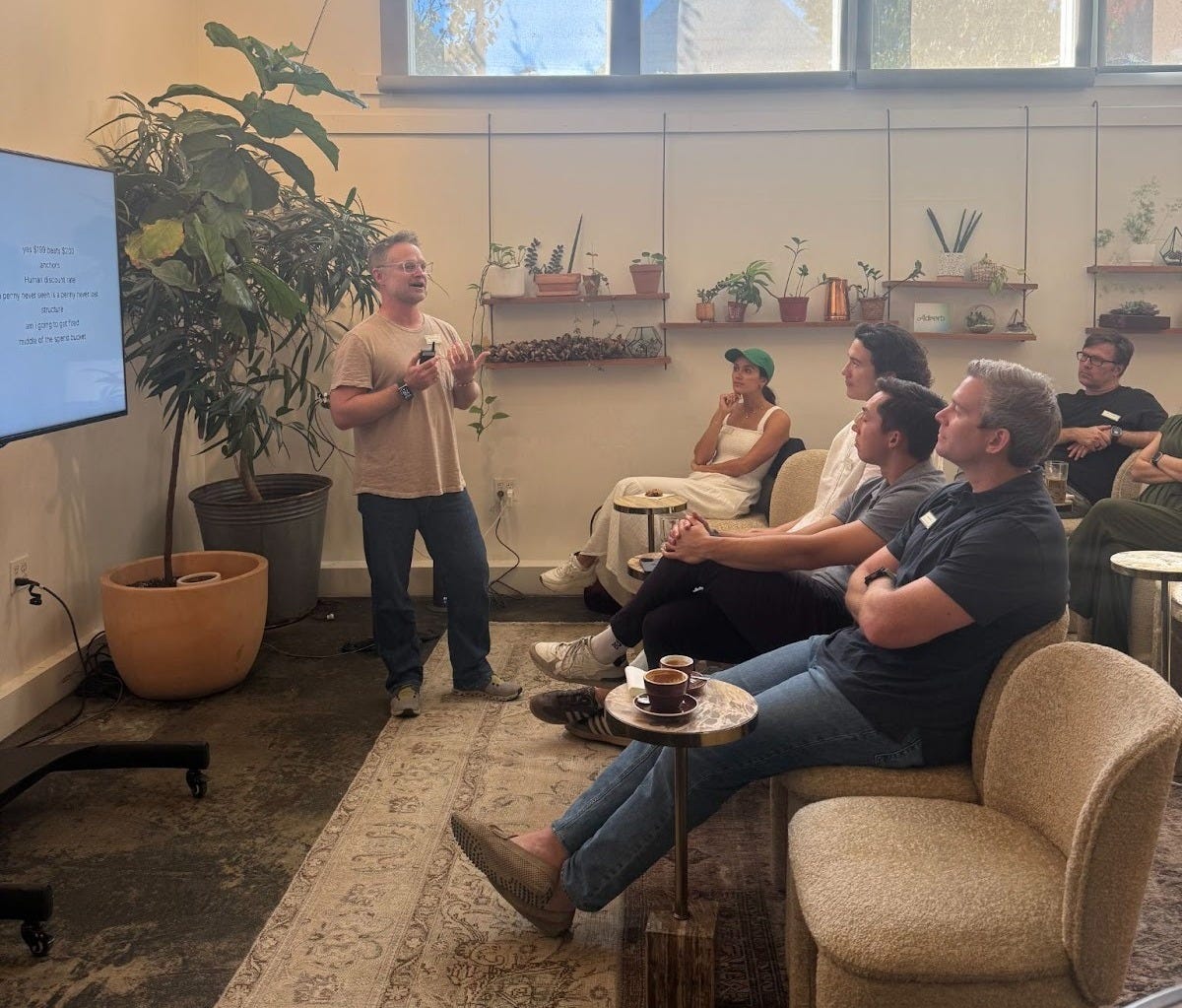
There’s no perfect formula for pricing. Elasticity shifts by segment, time, and context, but Mike emphasized the importance of small, continuous experimentation.
“There is nothing static about pricing. You should be thinking about every new customer coming to your website and seeing your pricing as a testing opportunity where you can get a sense of maximum willingness to pay. As soon as you stop testing, your data gets stale.”
Even in B2B, where volume is lower, every negotiation can be a test. “A single buyer conversation has three or four test occasions,” he explained. Each turn of a contract or quote provides data about where customers perceive value that can help you build conviction around your pricing strategy.
The best pricing models mirror how your product delivers value. “If your customers are very familiar with paying for your type of product in a certain way, it’s going to be an uphill battle to change,” Mike said. “But if you ground your pricing in the value you deliver, that makes the ROI conversation easier for your customer.”
At Mike’s current startup, that meant tying pricing to measurable business outcomes, not vague productivity promises. Early on, Mike tried selling on labor savings, but customers didn’t believe the math: “The believability of pulling out labor costs was very low.”
Instead, they reframed the value around revenue upside: how much faster drive-thru lines moved and how that lifted average ticket size. Once they could show a 4-15% increase in sales, pricing conversations changed completely.
Today, Mike’s startup offers two plans: a straightforward monthly fee and a model that puts their fees at risk, tied to customer upside. Most customers opt for the fixed plan, but they love that there’s an option built around shared incentives.
Founders often approach pricing as an analytical exercise. But the decision to buy is emotional first, logical second. “Even when you’re selling to businesses, it’s a human writing the check,” Mike said.
In consumer terms, grocery stores know shoppers only track the price of milk, eggs, and bread—so they price everything else freely.
Your customers have their own “price of milk.” Learn what that is—maybe it’s percentage of headcount cost, a monthly subscription fee, or a comparable SaaS spend—and position yourself relative to that.
Mike’s favorite example: Square’s transaction fee model subtly reduced friction by taking out Square’s fees before merchants saw the funds. “A penny never seen is a penny never lost,” he said. If they’d billed merchants after the fact, the same fee would’ve felt much more painful.
When Square expanded to Europe, the U.S. playbook needed to be re-thought. The company bundled software and payments into one rate—common in the States, confusing overseas. “They were used to buying POS software and payments separately,” Mike said. European merchants compared only the payments rate and assumed Square was expensive.
Lesson learned: pricing is cultural. Before you scale your model across markets or segments, understand how your buyers are used to purchasing similar tools. Sometimes, success means unbundling or adapting to a new frame of reference.
Equip the champion inside your customer’s org to justify the spend on your product. That means framing ROI in their company’s language, fitting into existing budget buckets.
At Square, when a major customer kept threatening to churn, they flipped the model: Square gave away payment processing and started charging for software instead. “It completely changed the economics,” he said. “They were thrilled, and it made them more profitable for us.”
Different bucket, same spend—but a win for both sides.
Discounting or pricing low to win early deals can backfire if you can’t later reset expectations. “Once you anchor customers at a lower price point, it’s hard to move them,” Mike cautioned. Unless you have a clear story—like a major feature release or shift in value—raising prices later feels arbitrary and can erode trust.
Growth and pricing aren’t opposing forces, as they need a plan to converge. “You can lean into growth,” Mike said, “but be clear about how that evolves into the margin profile you want.”
Pricing isn’t a one-time decision—it’s a living system of psychology, testing, and iteration. Or as Mike put it: “You’ll get it wrong the first time. The goal is just to get to a better place, faster.”
No posts
Comments
Nothing yet. Say the first thing.
Sign in to join the conversation.