
A quick heads-up before we get started on today’s article: My fall Substack cohorts are almost ready! I’ll be announcing them to everyone next Monday, with both Setup Cohorts and a new 12-week Strategy & Growth Cohort available this fall.
Paid subscribers will get early access with 15% off this Thursday via email, before registration opens to everyone else.

Last week’s article asked, “What are people paying for?“ This one takes the next step: “Given what I’m offering and who I’m offering it to, does a recurring subscription make sense, and how do I decide what that subscription should cost?”
There are two parts to a paid subscription, and when we’re first getting started on Substack, we’re often focused on the first part: How do I get paid subscribers? But the second part: How do I keep paid subscribers? Is just as important for most people. Lets take a look at this in more detail.
Last week, we discussed many different offers that people will pay for. Something like a large resource library may be a really great conversion offer. Your free subscribers can browse through this content, see how much they could get if they upgraded and choose to upgrade.
Six months down the road, they may have finished downloading all the content they need from the library, and choose to unsubscribe. Perhaps this works for you, but for most creators who want to use a subscription model, recurring long term revenue is the goal. This is where retention comes in.
A subscription model where your subscription upgrades happen in a “two steps forward, one step back pattern” can become increasingly frustrating and discouraging over time. This often happens when a creator is focused solely on attracting new subscribers. Unsubscribes happen, people’s lives and financial situations change, and your readers may not need your content anymore. That’s fine - none of us write to an audience that includes the whole world and if you try to write for everyone, you end up writing for no one.
Creating ongoing value may be adding paywalled content, but it can also be access to you, or to your community as we discussed last week. Substack has a few places for you to communicate to your subscribers what you offer for your paid subscriptions.
Once you’ve turned on paid subscriptions and connected your Stripe account, you need to fill out your subscriber benefits in the payments section of your dashboard settings:
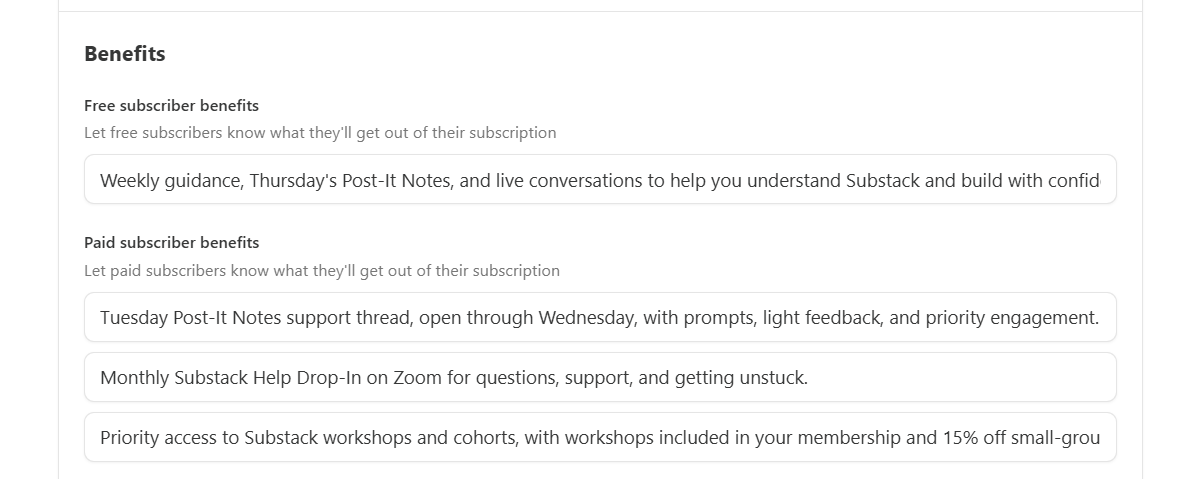
And when this is filled out correctly, your subscribers see something like this when subscribing or upgrading:
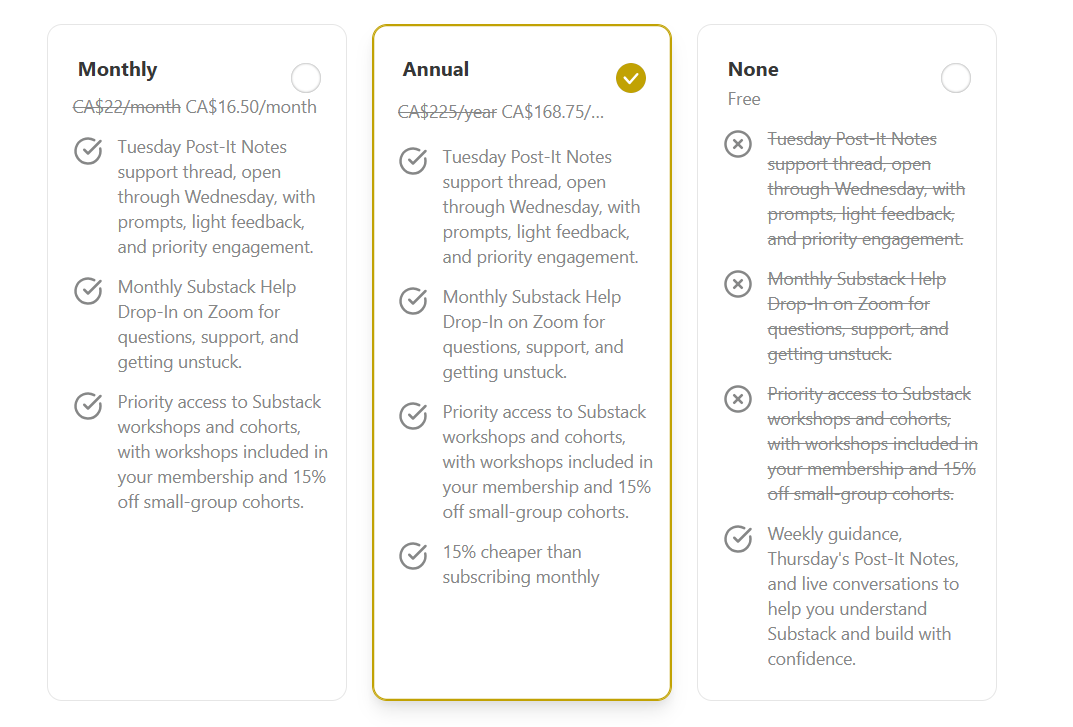
You don’t have to fill out all the boxes, and as we discussed last week, your paid benefit can be as simple as “support the work if you’re enjoying it”. But here’s the important point: whatever you’re offering, do not leave the generic benefits in place. Fill out something in the free and paid subscriptions. Whether it’s community, access to you, additional content, keep it short and sweet, and make it you.
Of course you also want to add what your offer is to your hero post, your about page, and your welcome email to subscribers. It’s important to communicate clearly with your readers.
Substack also has something called “Subscriber Perks” available. This is a way to share one-off items with your readers. You can create your perks in the payments section of your settings:
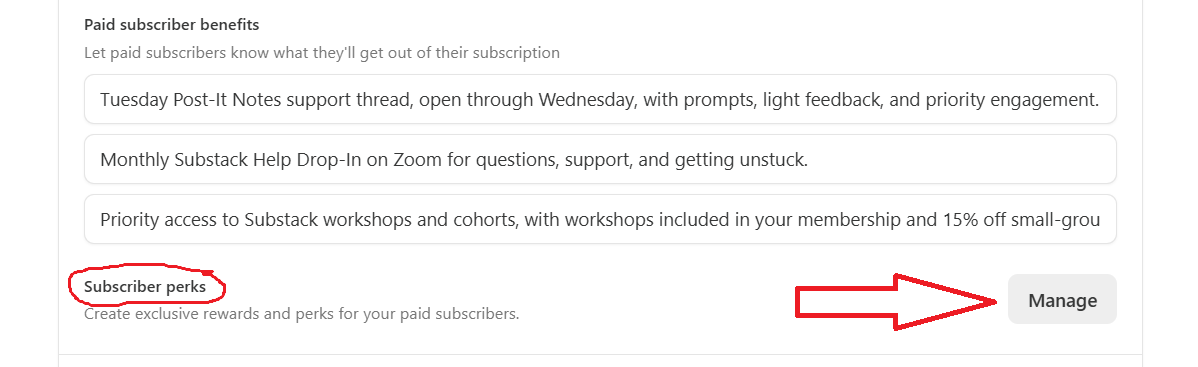
And (thankfully!) you don’t have to call it “perks” you can rename it.
The unique thing about subscriber perks is that you can create items that are unlockable to annual subscribers. In the original subscriber benefits, you could only create content for free, paid, and founding members, with no differentiation between monthly and annual subscribers, and no easy, integrated way to include one-off items.
With subscriber perks, you now have the ability to offer a pdf, an ebook, a recorded workshop, a link to something off site such as community access on an external platform, or maybe a link to an upcoming Substack Live that’s only for paid subscribers. This automatically creates a page for the subscriber perks, and you have the ability to share the page, or the individual items easily in your posts and emails.
So if you don’t have recurring content for your paid subscribers, but you do have some downloadable content, you can now add it to your perks page, and stipulate who gets to unlock it: monthly, annual, and/or founding member.
Now, one of the most commonly asked questions I get on coaching calls is: “What should I charge for my paid subscription.” There is no hard and fast rule, but I do have some guidelines based on the hundreds of coaching calls I’ve run.
Before I get into any actual numbers, let me cover a couple of mindset items:
If you legitimately have a good-quality offer (and most creators on Substack do), don’t undervalue yourself. But also, don’t price yourself out of the market, especially if you are just starting out on Substack and you do not have an existing audience that you’re bringing with you.
Don’t start out with a high-touch, high-price paid offer, you’re likely to burn out before you have enough paid subscribers to make your offer sustainable.
Understand your audience. This is arguably the most important point in deciding what to charge for your subscription. If your audience is burnt-out single mothers looking to purchase access to your yearly family schedule/calendar and your self-care tips and meditation circles, you will need to have a completely different price point then if your audience is high paid CEOs looking for guidance on how to invest this years bonus. Extreme examples I know, but you get the picture.
Now, with those two important points in mind, here are a few general guidelines to consider when deciding on the price point for your paid subscription:
Support the author and paywalled content models are usually on the lower end of the payment scale. $5-$8 monthly.
Extra content is typically a little higher - depending on the format of the content, as well as the frequency. One extra written post a month? Or weekly meditation audios? Or weekly written content plus a monthly video? All of these would have different price points, generally $7-$10
Community and access to you: Again, this varies, depending on the frequency of meetings, the depth of access and what is sustainable to you as a creator on Substack. The typical range for this is $10-$20, usually $10-$15
There are always exceptions to these guidelines, they are not hard and fast rules, this just gives you some ideas to think through.
My short answer is No.
Growth on Substack, and the corresponding growth of paid subscriptions is always a gradual process, regardless of what you’re charging. Also, remember that you’re marketing your paid subscriptions to your free subscribers, not to cold contacts. These are people that receive regular content from you and know how helpful you are, so if/when you’re ready to add paid subscriptions to your publication, you have a warm audience, who understands your offer and your price point.
Ask for a reasonable amount for what you offer. Something that makes sense for your reader and is sustainable for you. There are a couple of things to think through here:
If your free offer is monthly essays, and your paid offer is weekly deep dives into the month’s theme, ten subscriptions at $5/month doesn’t come anywhere close to paying for your time and work. 100 subscriptions is great, and 1000 subscriptions is amazing. With this kind of offer, once you have enough subscriptions, the amount of subscribers doesn’t change the amount of work you put in.
However if your paid offer is a writing club where you personally give feedback on someone’s essay, and you’re asking $20 per month, you have the opposite problem. Twenty to fifty subscriptions will be great, but at some point, you won’t have the time to read all the essays and provide the feedback. (I do not recommend this type of offer for your monthly or annual subscribers. It can work for Founding Members.)
This really comes back to something I’ve said before: Don’t overpromise. Keep things sustainable for you, and reasonable for your reader.
Strategic discounting works well on Substack: Christmas sales, summer sales, anniversary sales - how much you discount, and when you discount will depend on what you’re creating on Substack.
Habitual discounting is a little different. This is commonly used by news Substacks as a way to bring their monthly subscription down below Substack’s minimum of $5 per month. News publications are also the only kind of publication I’ve personally seen this work for.
For everyone else, a quality free subscription, a reasonable paid offer, and perhaps the occasional sale, are what will work the best in the long term.
Discounts are found in your settings - payments - discounts. You can set up a special offer with a percentage off your usual subscription price.

There are three steps to deciding your price for your Substack publication.
Decide on what your offer is: more content, expert guidance, downloadable PDFs, access to you, community.
Understand your audience: who they are, what they need and what a reasonable amount for them to spend on a subscription is.
Make your payment and offer sustainable for both you and your audience over the long-term.
If you can can clearly think through these three things, and come up with a solid offer, then - in time - you will have a substack that helps you reach your goals, instead of one that becomes an unwanted chore.
But are paid subscriptions the best fit for what you want to offer your free subscribers?
You can use your Substack to guide your free subscribers to paid offers that are not part of a paid subscription. This is - so far - acceptable on Substack, and doesn’t carry a penalty. We will be exploring what you can offer beyond subscriptions in next week’s post.
Want help with your specific Substack?
I offer one-to-one Substack coaching, setup help, and review sessions for creators who want focused guidance on their own publication.
If you want someone to look at your Substack with you and help you decide what to fix, simplify, or build next, you can learn more here:
Comments
Nothing yet. Say the first thing.
Sign in to join the conversation.