
When Substack introduced its new AI tool just over a week ago, opinions appeared almost immediately. I decided to wait, to give this time to settle, to think through my own mixed feelings on this, and see how the conversation on Substack would evolve. Over the past week I’ve read some interesting comments, notes, and articles written on this.
Some people are very happy to finally see a way to flag or check for “AI slop”, with good reason. Others have embraced the detector as a way to publicly distinguish between writers who do and don’t use AI in their writing process, as one note Substack quoted clearly stated, but was later removed by the author (screenshot instead of link included here):
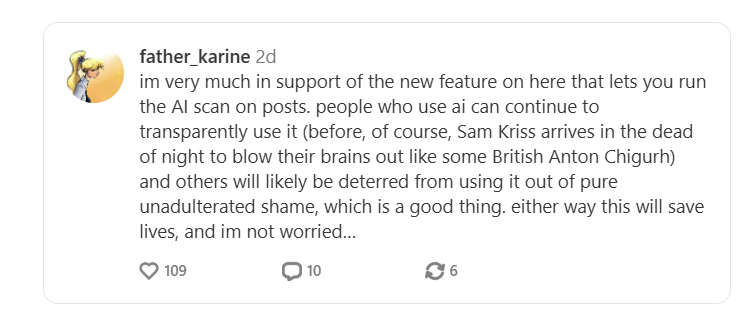
Others point to the paradox of using AI to police AI and how we’re trusting one machine to tell us whether or not we should trust that the writer hasn’t used a different machine. Oh the irony: Some of us give up our creativity to AI, and others give up their discernment.
And then there is the question of whether or not the AI detection tool actually works, as J.M. Gooding explains in this note:

But all of this disagreement over the AI detection tool actually points to the deeper discussion that’s been simmering under the surface of Substack for a while: If you’re a writer or creator, should you be using AI?
Honestly, I don’t believe there is a clear answer on this. If I were to say either “yes” or “no”, such a black and white answer would lose all of the nuance that exists in using AI.
When we discuss using AI, there aren’t many people who would disagree with the statement that it’s lazy and cheating to type a prompt like “give me a 1000 word essay on cars that will get lots of clicks and engagement” and then copy-paste whatever AI spits out into a Substack article and call it good.
But this isn’t all there is to using AI, it’s only one end of a spectrum. Some writers use AI as a copy-editor, others to brainstorm with, organize ideas, check facts, summarize research, translate, improve clarity, or analyze and challenge their own writing.
The AI detector doesn’t analyze the process, only the finished article or essay. It can’t know whether AI generated the entire article, corrected a few awkward sentences, or simply helped the writer organize their thoughts before they ever began drafting.
I’ve seen hints of this across Substack, but I don’t think we’ve talked enough about the role that access and resources play in this conversation.
There are publications on Substack who are making tens or hundreds of thousands of dollars from their subscribers. Many of the largest publications on Substack have teams behind them: editors, marketers, assistants, or colleagues to bounce ideas off. They have access to professional support throughout the writing and publishing process.
Long before AI existed, writers with more resources had advantages. They could hire editors, writing coaches, researchers, proofreaders, translators, virtual assistants, marketers, and publishers. None of that was considered cheating. It was simply part of having access to professional support.
People come to writing with very different circumstances and very different levels of support. Some writers have dyslexia and appreciate help catching spelling mistakes or improving sentence structure. Others have ADHD and use AI to help organize their thoughts or keep a draft focused. Some are building a publication alongside a full-time job or raising young children and simply can’t afford to hire an editor. For writers whose first language isn’t English, AI has opened doors that might otherwise have remained closed, allowing them to share their ideas with a much wider audience without being judged primarily on their grammar rather than the quality of their thinking. And many writers simply don’t have anyone else to read, analyze and discuss their work before they publish it.
AI is far from perfect, but it can be helpful in leveling the playing field for those who don’t have a team of human support.
Using AI doesn’t come without risks. AI can be incredibly good at producing confident flowing essays and articles that almost sound like you. That’s also one of its biggest dangers. Over time, if you’re not careful, it can slowly replace your own voice with something smoother, safer, and less personal.
I’ve done it myself. A certain paragraph or two that the AI suggested just sounded so much more polished than the one I had written. And soon I had an entire page of polished AI content that no longer sounded like something I wrote. It’s difficult to back track - to edit out the AI and edit in the human, and so I usually end up just starting from scratch again.
Losing your voice isn’t the only risk. AI can also be confidently wrong. We’ve all heard the stories of inaccurately cited articles that came from AI and no one bothered to fact check or edit. They sounded lovely, read smoothly, but were completely inaccurate.
Whether the risk is losing your voice or trusting information that isn’t accurate, the common thread is over-reliance. AI works best as a tool, not a substitute for thinking, experience, or judgment.
Each writer has to decide where the boundaries lie between using AI to help, and becoming dependent on AI and losing our authenticity. What makes a piece of writing authentically yours isn’t something an AI detector can measure, like polished grammar and elegant sentences. It’s your perspective, your experiences, and your way of seeing the world.
Ok, great. But that doesn’t mean your work won’t be flagged as AI. And if the AI detector flags your work, what then? Do you start editing your writing to satisfy the detector? Do you make it less polished so it appears more human? Do you disable the AI disclosure and worry that readers will assume the worst? Whether you use AI or not, AI detection affects everyone.
One comment I read came from a mother whose daughter was applying to college. Their guidance counselor had advised students to leave grammatical mistakes in their essays so the work would appear more human. Imagine if you were a high school student who loved English and intended to major in English in college or university, being told that you needed to make deliberate mistakes so that you didn’t trigger an AI detector? Is only AI allowed to produce perfectly written work now?
A detector can estimate whether AI may have been involved in the writing process. It can’t measure the quality of the ideas, the originality of the thinking, or the authenticity of the author’s voice. There is just as much poorly written human content as there is poorly written AI content. In my opinion, what matters isn’t whether AI touched the process, it’s whether the finished work reflects genuine thought, care, and something worth saying.
Transparency builds on trust, the writer choosing to share with the reader how they’re creating their work. Policing assumes suspicion and distrust, with the reader investigating how the writer works.
Besides the AI detector, Substack has added a “How I made this” statement, which you can edit by going to your settings, scrolling down to details and clicking the edit button beside the “How I make this” statement. This statement appears alongside the AI scan results and gives you an opportunity to explain your creative process in your own words.
Personally, I think this statement is a decent idea. Creators can have fun with it, personalize it and make it clear if and how they use AI. It’s voluntary rather than something imposed on every writer, whether they want it or not. If Substack’s goal was simply to provide clarity and help readers understand how a piece was created, I think this feature could have accomplished that on its own.
The AI detector moves from transparency and trust to policing and investigation. Writers may feel pressure to edit perfectly legitimate work until it satisfies a machine rather than their own standards. At the same time, readers are given a tool that encourages them to analyze one another’s writing instead of simply reading it, and using their own personal discernment.
I’d much rather see readers asking, “Did this article make me think?” than, “Did this paragraph score 30% AI?”
Substack has been about encouraging a relationship between writers and readers. Unlike platforms built around algorithms and endless scrolling, Substack has always felt more like a conversation. Readers choose who they trust, and that trust grows article by article, email by email, and year by year.
Every major tool and feature Substack has added until now — chat, notes, podcasts, live videos — has been to help us creators build that relationship. They’ve given writers more ways to show up as real people and readers more ways to get to know the people behind the publication. That’s one of the things that has set Substack apart from the corporate media world.
The new “How I make this” statement invites writers to be open about their process. That’s a conversation built on trust. Continually scanning every post to verify whether a writer has passed an algorithm feels like a very different kind of relationship.
As a writer, I trust my readers to decide what matters to them. As one Substack commentor put it, “most intelligent readers can detect slop without having to push a button.”
I hope the future we continue building here is a community where thoughtful writing earns trust over time and where readers judge ideas by reading them rather than by running them through a detector. Technology will continue to change, and AI will continue to evolve. But trust has always been at the heart of good writing, and I don’t think that’s something any algorithm can measure.
Want help with your Substack?
I offer one-to-one Substack coaching, setup help, and review sessions for creators who want focused guidance on their own publication.
If you want someone to look at your Substack with you and help you decide what to fix, simplify, or build next, you can learn more here:
Comments
Nothing yet. Say the first thing.
Sign in to join the conversation.