
My last day of school ends with quiet poignancy. It feels unsettling. In August, I met my students for the first time, and for months, I have been encouraging them, scolding them, trying to teach them, and sometimes fighting with them. I stood at our classroom doorway and welcomed them every morning. I held space for them as they navigated their final year of elementary school. As the last day nears, students realize that soon they will leave their familiar elementary school building for the last time. The last minutes hold disquiet as students seek out previous teachers to say goodbye.
The bond between a teacher and student is special. It feels familial. Teachers are not parents, but every day, we act in loco parentis, making sure students are fed, emotionally regulated, and intellectually challenged. I realize I am not my students’ parent, even if they accidently call me Dad. I am charged with preparing them for middle school. And so, every day, I work to teach, mentor, protect, and care for my students as best as I can. The school year never runs in a clear, straight line. Learning is messy and teaching to the humanity of my students is exhausting. I am preparing them for more than middle school; to be happy, healthy human beings. It would be far less stressful to be a cold, detached authoritarian, passing out worksheets. But this is not teaching. Real teaching puts connection and care first, academic content second.
My last day of school stings1 because I know there are so many ways I have failed my students. I failed to motivate all of my reluctant readers to pick up books. I failed to help my most recalcitrant students learn how to properly regulate their emotions. Some of my students ended this school year with little academic growth. A few did, but those students were already self-motivating children who love learning. The students who came to me apathetic to school, left with much of the same attitude.
When the last day of school finally arrives, students are nervous and excited, and I am exhausted and ready to bid them a fond farewell. I intentionally finish all instruction one week prior to the last day. During our last week together, I want to play games, deepen our connection, and give them opportunities to say goodbye. Some of my students have been in the same school building for six years (since Kindergarten), and so I do not rush them through their grief. I do not try to distract them from the inevitable sadness that comes with leaving a familiar place. This school has acted as a home for many of my students and I want them to be present in their sadness.
I, too, am leaving this school building after six years. On the last day of school, I packed up the majority of my classroom, save for the large furniture. All week, as others realized that I was not returning in the fall, some staff wished me well. Some expressed sadness at seeing me go, but the majority offered standard boilerplate messages like, Best of luck with your future endeavors! or Enjoy your next chapter! Everyone is well-meaning. The truth is that I am more connected to my students than the other teachers in the building. While teachers are in the hallway socializing before the morning bell rings, I am in my classroom socializing with my students. I check in with them to see how their evenings went or how they are feeling or encouraging them to eat breakfast. I am asking after family members who are in the hospital or whether they are nervous for their upcoming soccer tournament. I am not asocial. I prefer to focus my sociability toward my students. So, on the last day of school, it makes sense that my students want to stick close together. We play games, watch a movie, go on our last Pack Walk, have our last Family Meeting, and sit and talk.
I have had many last days of school. Last days are busy with packing, cleaning, and moving. Some years, teachers have to empty their classrooms for new carpets to be installed over the summer. Other years, teachers have to pack up to move to another classroom. From 2022-2025, I taught in a mobile classroom. Moving is a ton of work.
After the final dismissal bell, the staff congregates to have lunch and say goodbye to retiring teachers or those who will no longer be in the building next year. The principal gives exiting teachers a picture book2, signed by many of the staff, and says a few words. Veteran teachers usually get more fanfare, especially if they have been teaching for a long time. After lunch, teachers finish cleaning or packing and saying goodbye to each other. The parking lot is empty before 2:00 PM. Summer has started.
Knowing that I am not returning to the building next year, on my last day of school, I was more pensive than usual. I lingered longer completing my end-of-year checklist. Since I had been taking home boxes for the past few weeks, I did not have much packing left to do on the last day. I turned in my keys, said goodbye, and quietly left.
Driving home, I felt uneasy. My sendoff felt flat. Another teacher will move into my classroom, and before the first day of the new school year, my presence will be gone. Leaving a school after six years, knowing you are quickly displaced, is a poignant reminder of how replaceable teachers are in a dehumanized school system. Next year, new students will file in to my old classroom and be marched through the same curriculum, the same 15-Day Challenges, and experience the same hot mess soup.
It is a quintessential human quality to want to be recognized for one’s efforts. Likewise, people want to be valued and missed when they are absent. While I do not expect the building to fall apart without me, it is nice to hear from parents how much I will be missed at the school. On the last day of school, a few parents approached me to express their disappointment that I would not be returning the following year. The hardest part about leaving a school building is knowing the inevitable disappointment parents and students will feel when they learn you will not be their teacher next year. Did I expect more fanfare? Perhaps. Do I need fanfare? Perhaps. After six years of teaching in this community, a part of me wants to know that I will be remembered.
Driving home on my last day of school, I had an epiphany: my students will remember me. They will remember our Pack Walks, the times I lost my temper over disrespect, how much I cared for them, the mutiny, my morning fist bumps, my enthusiasm, and my endless cups of green tea. They will remember how I let them use my electric tea kettle to heat up water for their ramen. They will remember my impromptu dancing and the lunches we ate together. They will remember dragging me across the field with the tug-of-war rope during field day, asking me to read a piece of their writing I had already read five times, and our 90s cartoons and breakfast cereal surprise party.
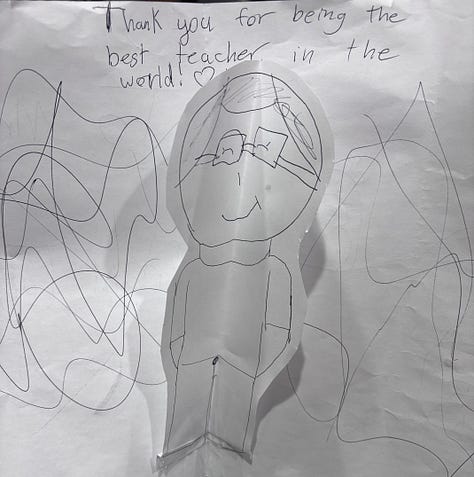

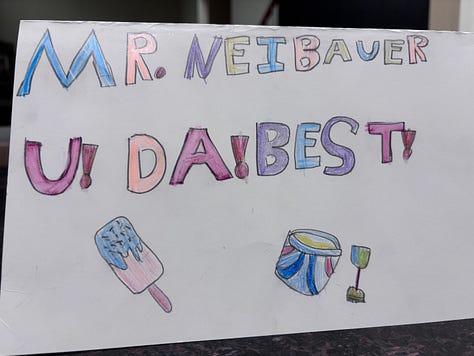
All teachers hope to have a positive impact on the students they teach. Teaching can be thankless job. Teachers do not teach for the fanfare, but every once in a while, a student or a parent shares their gratitude in such a genuine way, it fills you with love. In my twenty-five year teaching career, I have received many teacher gifts: mugs, tea, Superman paraphernalia, socks, school supplies, more tea, more mugs, and candy. I have read and saved all of the appreciative notes and cards from students and parents. Whenever I feel despondent, I open my box of gratitude and reread everything.

Thank you for making my year the best year probably of my life; making it full of joy and fun. I would not wish for any other teacher. You are my favorite teacher ever!
It is very apparent that you love your students!
You truly are the greatest teacher! I will always remember you!
If schools were filled with teachers like you, our students would be unstoppable. You truly are a tremendous give to every child lucky enough to have you for a teacher!
Thank you so much Mr. Neibauer for helping me and also being there for me. You are my favorite teacher. You have helped me grow in so many ways.
You have a gift and have made an unmistakable and profound impact on my child.
The way my son speaks about you and your class makes me know you see him and understand him. We are grateful for everything you do!
There are really no words to speak or write to express what a great teacher, role model, and mentor you have been for our son.
On my last day at this school, I have realized that the school system is not designed to value and appreciate teachers. It is designed to, as efficiently and effectively as possible, “educate” students. This type of education comes with high-speed internet, touch screens, and flashy edtech. But it also comes at the expense of one’s humanity. Students in this system are reduced to data points and behavior plans. Teachers are expected to be compliance monitors and authoritarian babysitters. Appreciation comes in the form of keeping students quiet and compliant; value comes from students scoring well on standardized tests. Life beyond the school is irrelevant. Joy, happiness, and growing as a human being are “nice-to-haves” instead of essential elements of teaching and learning. It does not matter whether I have taught in this building for six or sixteen years; what matters is there is now a vacancy to be filled.
At the end of my last day of school, I received a typed letter, in a sealed envelope, from one of my parents. It came with a thoughtful gift. I graciously accepted the gift and put the envelope in my bookbag. I forgot about it until I was at home, exhausted from loading and unloading a moving truck amount of classroom furniture. By the time I sat down to read the letter, I was numb from fatigue. It had been a long day, a long week, an especially long school year, and by 5:00 PM, I was weary and needed rest.
You nurtured and loved on these kids with a servant’s heart.
I stopped and read it again. And again. And again. You nurtured and loved on these kids with a servant’s heart. Having a servant’s heart is what has kept me teaching for twenty-five years. In these six challenging years, my servant’s heart is what has prevented me from fully burning out, and pushed me to continue showing up with a cup of tea and a positive attitude to be the most human teacher I can be for my students. Having a servant’s heart is what makes my classroom a safe and loving space for my students. The quote, frequently misattributed to Maya Angelou3, “I've learned that people will forget what you said, people will forget what you did, but people will never forget how you made them feel” is not merely performative wisdom. This quote may have become trite, but I believe it’s true intention is to capture the essence of a servant’s heart.
Teachers do not teach for accolades. We teach because we are servants. We choose a life of nurturing service to our students. Unfortunately, servants can be (and often are) disregarded, exploited, and abused. But teachers who have a servant’s heart can find appreciation in their students. It is in the handwritten cards and drawn pictures of me as Superman. Care is in the cabinet full of mugs and homemade cookies. Value feels like the tightening hugs of students on the last day of school, not wanting to let go.
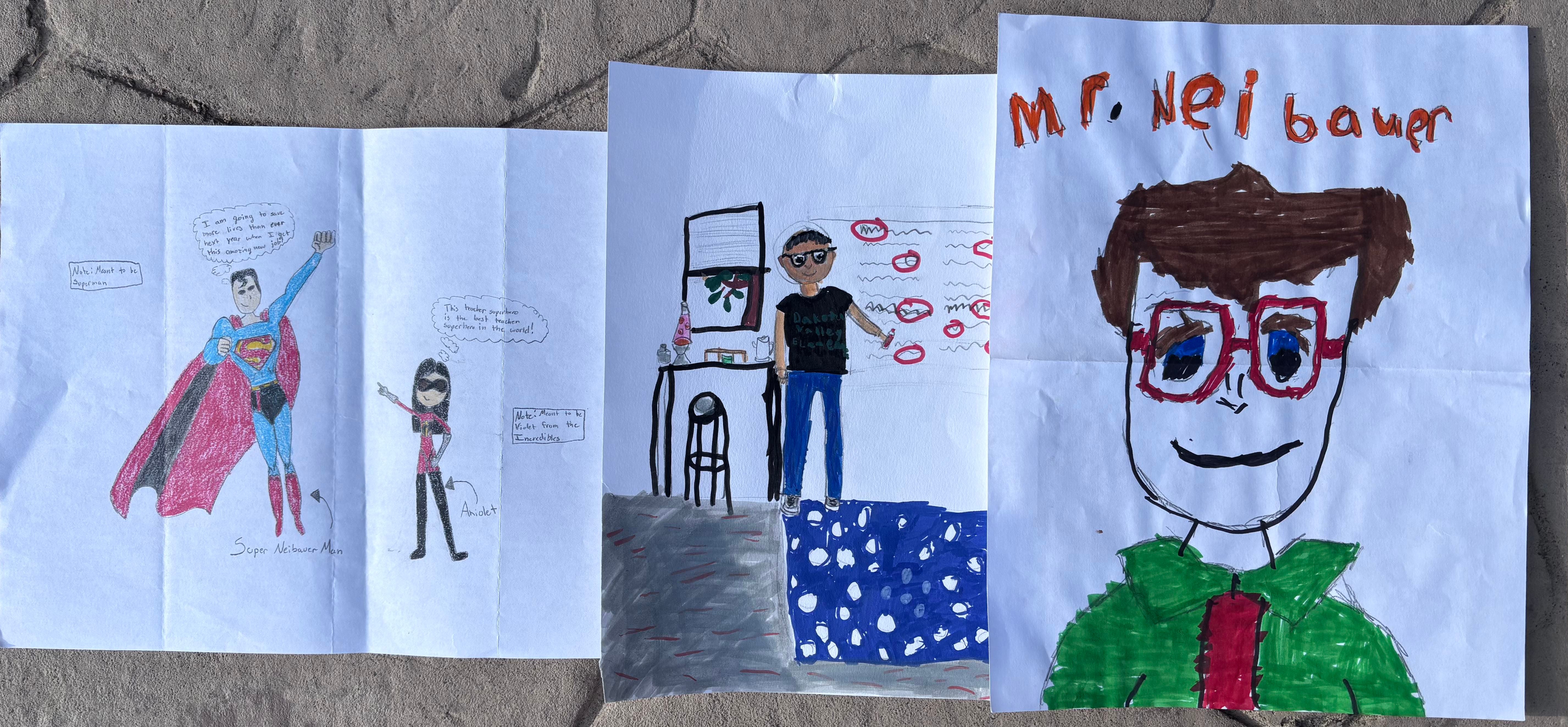
It does not matter if colleagues remember my pedagogy or if I receive a flashy sendoff. I do not need anyone to eulogize me. Poring through my joy and gratitude box, I remember that I have a quarter of a century’s worth of meaningful fanfare. I am not a servant to the system, the school building, or even the administrators and other teachers; I am a servant to my students. And when a servant’s heart is put in a dehumanizing system, it finds ways to provide care and kindness. I have spent twenty-five years nurturing and loving students because that is the way of teaching. Leaving this school building, after six years serving my students, is poignant. I want to stay and keep serving in this school’s community, but I am ready for a change. There are other students in other communities that will benefit from my servant’s heart. Every school building I teach in, every classroom I set up, I do so with the same intentional care and consideration. It is hard work, but it is very much worth the effort.
You nurtured and loved on these kids with a servant’s heart.
I can think of no higher praise for a teacher.
Have a great week!
— Adrian
The best way to find yourself is to lose yourself in the service of others.
Mahatma Gandhi
Finishing the School Year Strong | Larry Ferlazzo
I will always read anything Larry Ferlazzo writes. This piece may be fifteen years old (Ferlazzo has since retired), but his suggestions still work today.
Teachers Share How They Are Ending the School Year with Intention | Facing History & Ourselves
Facing History & Ourselves offers great teacher resources for civic education, U.S. History, English Language Arts (ELA), and anti-racist pedagogy. I appreciate how members of their highs school ELA educator Advisory Board highlight their favorite activities to help end the school year with care and celebration.
Joy Boxes | The GiveJoy Foundation
The GiveJoy Foundation is a 501(c)(3) nonprofit dedicated to spreading joy and empowering educators, students, and families with resources for a healthier, happier life. Their mission is to foster brighter futures by offering educators, youth, and families tools to thrive in today’s world. Joy Boxes are student-designed care packages that can be donated to students living in food deserts. Each box contains a protein, carbohydrate, and beverage.
In this essay, Rocky Wallace, Professor of Education at Campbellsville University, discusses the servant-leadership needed for teaching in higher education. His “best practice habits” that make the holistic learning experience for college students more memorable and fulfilling, apply to all classrooms at every level.
How to Create an Appreciation Station
This is such a great idea! If more schools normalized sharing appreciation (between students and staff), I am certain school cultures would be healthier.
Listening to teachers who are actively teaching in the classroom, you get the most up-to-date and accurate description of what teaching and learning are like. In this video, produced by the Southern Regional Education Board, teachers, coaches, counselors and administrators from across the South share what it will take to make teaching more attractive and sustainable. If you have time, please listen.
From now on, whenever anyone asks me about why they see so many teachers online complaining about teaching, I will send them this video. Bored Teachers gives four reasons why why so many teachers are burning out: students, parents, administration, and the system.
In case you need a good laugh, this SNL skit is hilarious!
The word, poignancy, traces back to the Old French word poindre (meaning “to prick or sting”), which itself derives from the Latin pungere, meaning “to prick, pierce, or sting.” So, even though I am exhausted and in desperate need of a summer break, the end still stings.
Originally attributed to Carl W. Buehner. The history of this quote is interesting.
Comments
Nothing yet. Say the first thing.
Sign in to join the conversation.