
Editor’s note: My earlier essay, Collapse: A Framework sets out the structural dynamics of ecological overshoot and collapse.
This essay focuses on the role of human ingenuity as it relates to the physical structure of industrial systems and the energy conditions that shape them. The structure of the system shapes the experience of those within it.
1. Introduction
A core assumption of modern industrial culture is that human ingenuity can overcome material limits through innovation.
When constraints emerge (resource scarcity, environmental pressure, declining system performance), the response is assumed to be technological substitution or optimisation, with innovation treated as a general solution.
The escalation of the US–Iran war in early 2026 triggered a rapid increase in global oil prices as markets anticipated disruption to supply through the Strait of Hormuz, a critical chokepoint through which approximately one-fifth of global oil flows.¹ Within days, this shift propagated through financial systems, inflation expectations adjusted, government bond yields rose, and mortgage pricing followed. In the UK, lenders withdrew products and repriced loans, while expectations of interest rate cuts shifted accordingly.²
This points to the central role of energy within industrial systems. Oil remains embedded across transport, food production, and manufacturing, and price movements propagate quickly because these systems depend on it directly or indirectly, while financial markets respond to anticipated constraints in their operation.
Modern economies are structured around specific energy conditions, which set the scale, structure, and viability of economic activity. Human ingenuity operates within these conditions, with the availability, density, and transformability of energy determining which technological systems can be built and sustained.
Here, I examine the implications of this claim. I argue that technological innovation does not remove fundamental constraints but displaces them, embedding systems more deeply within specific energy regimes. This dynamic is examined through transport and food production, before extending to financial systems, narrative formation, and system-level dependency, and finally to what this means for the future.
2. Creativity, Energy, and Constraint
Research on creativity situates ingenuity within systems rather than individuals. These ideas aren’t new, but show up across different fields, often without being connected.
Csikszentmihalyi’s model describes creativity as emerging from the interaction between individuals, cultural context, and institutional selection processes.³ Creative output depends on the conditions within which it occurs, and in this view creativity isn’t abstract, it’s shaped by the social and material conditions in which it’s expressed.
Other work frames creativity as a process of reorganisation under constraint. Gabora’s “honing theory” characterises creative cognition as the reduction of psychological entropy, in which mental structures reorganise in response to uncertainty.⁴
This perspective aligns with broader accounts of cognition as an energy-dependent process rather than a purely symbolic one, where the creative act becomes a restructuring of available mental resources within a bounded system. In simpler terms, creativity works by reorganising what is already available within the limits of the system.
At a more fundamental level, all computation and information processing are subject to thermodynamic limits. Landauer’s principle establishes a minimum energy cost for computation, linking information processing directly to physical law, while theories of dissipative structures describe how complex organisation arises through the dissipation of energy gradients.⁵⁶
These perspectives place cognition, organisation, and complexity within a thermodynamic framework rather than outside it. To state it clearly, thinking, computation, and organisation all depend on energy and are governed by physical limits.
These processes are also irreversible: energy transformations degrade the capacity to perform useful work, limiting the extent to which systems can be reorganised without increasing energetic cost.
Within energy economics, similar constraints are observed at the level of technological systems. Smil demonstrates that energy transitions are governed by the physical properties of energy carriers, including density, transportability, and conversion efficiency.⁷
Ayres and Warr show that economic output is closely tied to energy throughput and useful work, rather than to abstract notions of innovation alone, while Georgescu-Roegen situates economic processes within the entropy law, emphasising the irreversible nature of energy transformations and the impossibility of escaping physical limits through economic abstraction.⁸⁹ In other words, economic activity depends on energy use, and cannot escape the physical limits that govern how energy is transformed.
Tainter’s analysis of complex societies provides a complementary perspective, arguing that increasing social and technological complexity is associated with rising energy and resource costs, while the marginal returns to that complexity tend to decline over time.¹⁵
As problem-solving systems expand, they require greater inputs to maintain existing structures, making them progressively more sensitive to disruptions in underlying energy availability. This framing links the growth of complexity directly to energy throughput and highlights a mechanism through which constraints may reassert themselves at higher levels of organisation.
Across these domains, the same pattern consistently shows up. Creativity operates within conditions defined by energy availability, and when expressed through physical systems it is bounded by thermodynamic constraints. Ideas may be generated without immediate material limitation, but their implementation is governed by the properties of energy and matter.
Human thought may range widely in abstraction, but technological creativity, when realised in engines, grids, fertiliser systems, transport networks, and industrial infrastructure, runs into the hard boundary conditions imposed by physics.
What can be built, sustained, and scaled is determined by specific energy conditions. These constraints are not contingent on current technology but arise from physical limits on energy density, conversion efficiency, and dissipation, which define the boundary conditions within which all technological systems must operate.
3. Energy Density and the Structure of Transport
Modern transport systems are organised around liquid fossil fuels because their physical properties enable a specific system architecture.
Petroleum-derived fuels combine high gravimetric energy density, on the order of approximately 12,000 Wh/kg, with ease of storage, transport, and rapid energy release.⁷ These properties support long-range mobility, rapid refuelling, and relatively lightweight vehicles, and transport systems have developed in alignment with these characteristics.
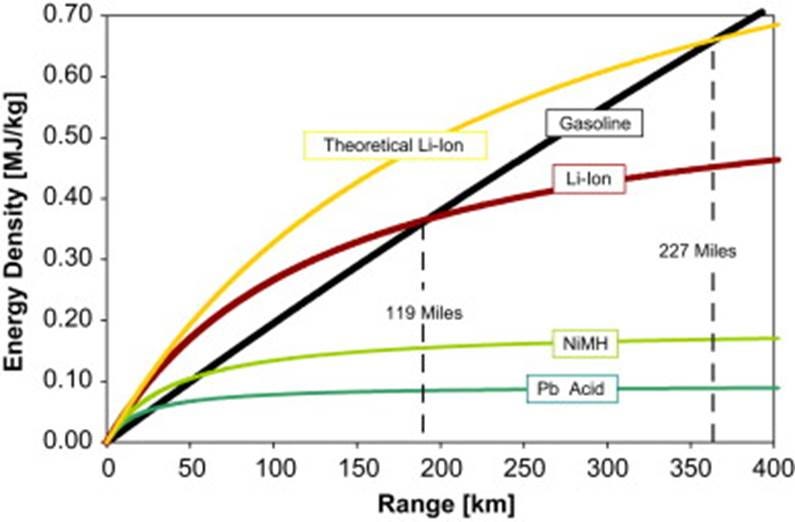
Fig 1: Effective energy density of transport systems as a function of range. Source: Fischer et al. (2009), Energy Policy.
The internal combustion engine, a nineteenth-century technology, persists because it is compatible with these energy properties. It is not retained because alternatives are unknown, it remains central because the energy carrier on which it depends, liquid fuels derived from oil, is unusually well suited to mobile applications requiring portability, range, and power density.
Battery-based systems operate under different constraints. Lower energy density, longer replenishment times, and higher system mass introduce trade-offs in range, utilisation, and infrastructure requirements.¹⁰ These are structural consequences of the underlying energy carrier, not temporary inefficiencies. When the properties of the carrier change, the performance envelope of the system changes with it.
While incremental improvements are possible, they occur within physical limits that constrain achievable energy density and system performance, preventing convergence with the operating characteristics of liquid fuels.
Transport systems therefore reflect the properties of the energy on which they depend. Vehicle form, refuelling infrastructure, road logistics, freight systems, and assumptions about mobility all develop in relation to the characteristics of the energy regime that supports them.
The continued dominance of the internal combustion engine is therefore a result of alignment rather than inertia. A system built around dense, portable liquid fuels does not reproduce itself in the same form under materially different energy conditions. The point is that alternatives do not inherit the same operating characteristics by default.
What is often described as technological lag is better understood as thermodynamic fit.
4. Nitrogen, Energy, and the Food System
The global food system exhibits the same pattern at a different scale.
Nitrogen availability constrains plant growth. Although abundant in the atmosphere, it is not directly accessible to most plants, and historically agricultural productivity was limited by biological nitrogen fixation, manure cycles, crop rotation, and other ecological processes, which in turn limited human population growth.
The Haber–Bosch process alters this constraint by converting atmospheric nitrogen into ammonia using high temperature, high pressure, and substantial energy inputs, primarily derived from natural gas.¹¹ This intervention changes the limiting condition on agricultural productivity, allowing food production to expand through industrial nitrogen fixation rather than ecological cycles.
This process underpins modern agriculture. An estimated 40–50% of the global population is sustained by food produced using synthetic nitrogen fertilisers, making the scale of contemporary food systems inseparable from this industrial process.¹²
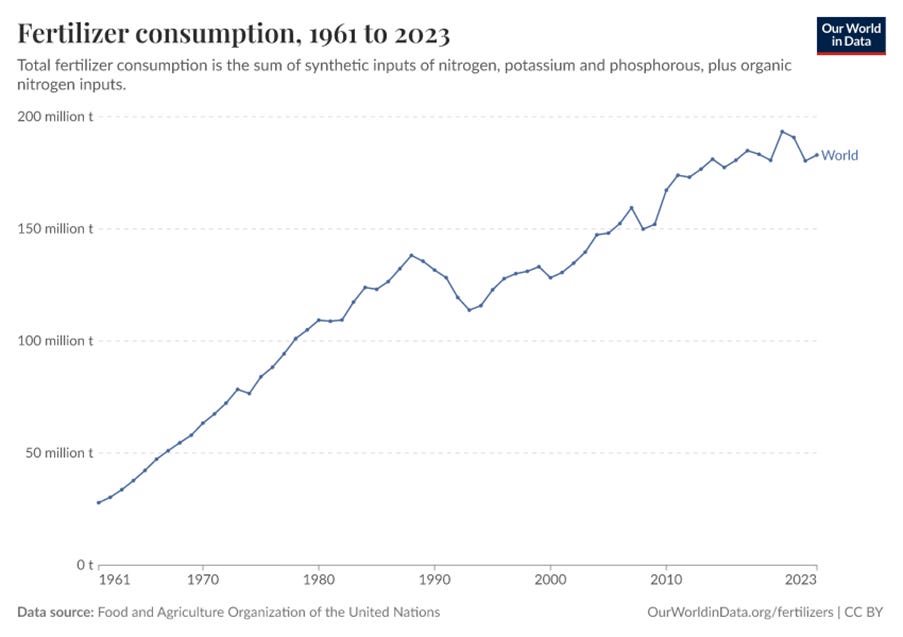
Fig 2: Global nitrogen fertiliser use over time. Modern food systems are tightly coupled to synthetic nitrogen inputs derived from fossil fuels. Source: Our World in Data, based on FAO data.
The constraint has shifted from biological limitation to energy dependence. Food production is now coupled to fossil fuel flows, and nitrogen availability follows energy throughput rather than ecological capacity.
This reconfiguration enables scale, while also introducing systemic dependency. A substantial proportion of the global population depends directly on Haber–Bosch-mediated fertility for food calories. This is a reorganisation of the food system around a new energetic basis, rather than an increase in efficiency.
The pattern is the same as in transport. A limiting condition is modified through energy-intensive intervention, the apparent release from one limit introduces dependence on another, and what changes is not the existence of constraint but its location within the system.
If the conditions that support the Haber–Bosch process were to weaken or disappear, billions who depend on it would be exposed to a dependency of enormous scale, with consequences that would unfold as a tragedy on a scale that is difficult to fully comprehend.
5. Constraint Displacement and System Formation
The preceding cases follow a consistent structural pattern.
In transport, the limitation imposed by energy density is addressed through the use of liquid fossil fuels, enabling high mobility. This removes an immediate constraint on movement but introduces dependence on continuous oil supply.
In agriculture, the limitation imposed by biological nitrogen fixation is addressed through the Haber–Bosch process, enabling large-scale food production. This removes an immediate constraint on yield, but introduces dependence on continuous energy input, primarily from natural gas.
In both cases, the original constraint isn’t eliminated, it’s displaced.
Technological innovation changes how a constraint is encountered, relocating it within the system and embedding it in new forms, with the system then developing in alignment with the conditions required to sustain that change.
A limiting condition constrains behaviour, a technological intervention alters how it is encountered, the system reorganises around the conditions required to sustain it, and dependence becomes structural.
This dynamic produces systems that are simultaneously more capable and more dependent. As scale increases, the conditions required for system operation become more specific and less easily substituted.
Constraint displacement therefore drives system formation. Technologies are not independent solutions applied to external problems, they are mechanisms through which systems reorganise around available energy conditions.
This process also explains why certain technologies persist. Technologies remain in place not because alternatives are unknown, but because systems have been structured around the conditions they require. The internal combustion engine persists because transport systems are organised around liquid fuels. The Haber–Bosch process persists because food systems are organised around industrial nitrogen fixation.
In each case, the constraint has not been removed. It has been relocated and embedded within system architecture. This dynamic can be represented as a recurring system-level pattern.
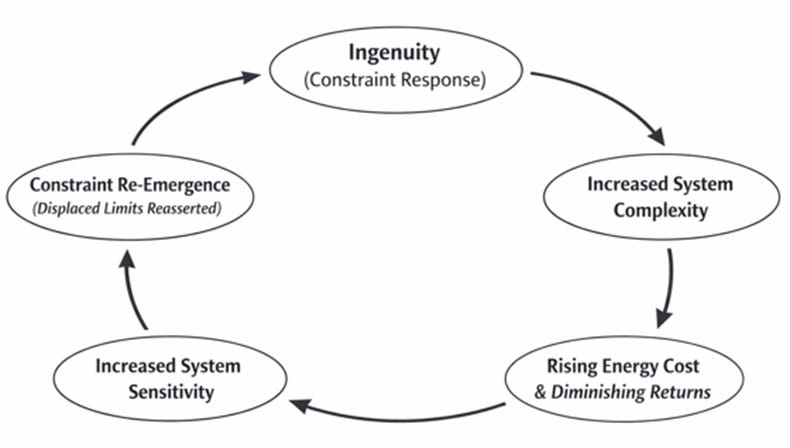
Fig 3: Constraint Displacement Loop showing how increasing complexity leads to diminishing returns and the re-emergence of constraints. Source: The Thermodynamic Limits of Human Ingenuity (2026). A Grand Unified Theory of Doom Substack.
As systems reorganise in this way, the complexity required to sustain them increases, raising the energy and coordination costs of operation and setting the conditions for diminishing returns at higher levels of organisation.
6. Energy Regimes and System Architecture
System architecture reflects the properties of the energy regime on which it depends.
Modern industrial systems are configured around the properties of fossil fuels: High energy density, continuous availability, transportability, and controllability.
These characteristics enable large-scale, integrated systems, including global supply chains, mechanised agriculture, high-mobility transport networks, and industrial production systems that depend on predictable throughput.
Alternative energy sources exhibit different characteristics: Lower energy density in many applications, intermittency, dependence on storage and conversion systems, and greater spatial and material requirements.
These differences shape how systems can be configured. Solar and wind generation, for example, produce variable outputs that require balancing through storage, overcapacity, transmission expansion, backup generation, or demand management, each introducing additional infrastructure and energy overhead.¹³
Energy sources are not interchangeable inputs. Their physical properties shape how systems are organised, including their scale, complexity, and operating conditions.
When energy regimes change, system architecture changes with them. Infrastructure, logistics, and operational practices developed under one set of energy conditions do not maintain the same performance under another, introducing friction and, in many cases, constraining achievable scale.
This extends beyond electricity systems into transport, agriculture, trade, settlement patterns, and the broader architecture of industrial civilisation. High-density, controllable energy allows certain kinds of systems to emerge and stabilise, and energy regimes participate in determining which systems are viable in the first place.
As these systems scale, the complexity they embody requires increasing energy throughput to maintain, reinforcing the link between energy regime and the cost of sustaining system organisation.
These differences become most visible when substitution is attempted.
7. The Limits of Substitution
Energy transition is commonly framed as the replacement of energy inputs while maintaining existing system structures. This assumes functional equivalence between energy sources.
The preceding analysis indicates otherwise. Energy carriers differ in density, availability, controllability, and conversion characteristics, and these differences define system behaviour.
The issue becomes how the system functions when energy arrives in different forms.
Solar and wind exemplify this. Systems configured around high-density, continuous energy flows operate under different conditions when supplied by lower-density or intermittent sources. Maintaining system performance under those conditions requires compensatory measures, including storage, redundancy, and overcapacity. Each adds infrastructure, complexity, and energy overhead.
Nuclear power provides a dense and continuous source of energy, but it operates within its own constraints. It is capital intensive, slow to deploy, dependent on complex supply chains and stable institutions, and primarily produces electricity rather than the portable fuels and feedstocks on which much of the system depends. It does not reproduce the flexibility, distribution, or functional range of fossil fuels, and does not sustain the system in its current form.
As these compensatory layers expand, a growing proportion of energy throughput is diverted to maintaining system stability rather than delivering useful work, reducing overall system efficiency and limiting scalable substitution. This reflects diminishing returns to complexity, where increasing system effort yields proportionally smaller gains in usable output.
Substitution changes how the system operates.
At scale, this produces structural tension. Systems designed for one energy regime must either absorb increasing complexity to maintain performance or adjust in scale and function to align with new constraints.
The assumption that existing levels of complexity, throughput, and integration can be maintained through substitution alone is not supported by the physical characteristics of energy systems.
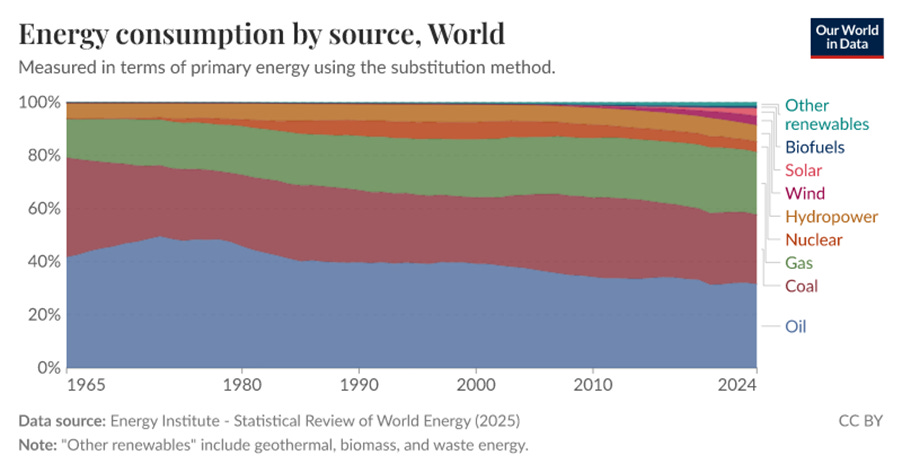
Fig 4: Global primary energy consumption by source. Industrial systems remain overwhelmingly dependent on fossil fuels. Source: Our World in Data; Energy Institute Statistical Review.
The system has been built around energy characteristics that alternatives do not reproduce at scale. Modern industrial civilisation, at its current scale, depends on fossil fuels.
The more tightly a system has been optimised around a particular energy regime, the more difficult it becomes to reproduce its prior behaviour under different conditions.
What matters is system compatibility.
8. Financial Systems as Energy Anticipation Mechanisms
Financial systems act as anticipatory mechanisms that translate expected changes in energy availability into present conditions.
The increase in oil prices following the Iran war propagated rapidly through financial markets. Government bond yields rose as inflation expectations adjusted, and mortgage rates followed as lending institutions repriced future costs.²
Anticipation of these constraints alone was enough to drive the repricing.
Financial systems compress time by converting expected future constraints into immediate price signals. Because economic activity is energy-dependent, anticipated disruption to energy supply is expressed through borrowing costs, investment decisions, and asset pricing.¹⁴
Because these expectations are embedded in credit systems, financial stability itself becomes contingent on continued energy throughput.
This matters because thermodynamic constraints do not only appear at the point of physical shortage, they are also registered in advance through financial expectations. Energy conditions influence not only production and transport, but credit, debt servicing, asset valuation, and household affordability.
Financial systems therefore act as anticipation mechanisms layered over physical systems, mediating and accelerating their social and economic effects.
This sits within the same dynamic described earlier. Energy constraints are not encountered only at the point of physical shortage, they are displaced and expressed through the systems built around them.
Financial markets are one such system. They translate expected changes in energy availability into present conditions, redistributing constraints across the economy before they appear in physical form.
9. Narrative Selection and System Alignment
Narratives in which technological ingenuity overcomes limits do not need to be deliberately promoted, they emerge as part of a self-organising system.
Within complex systems, variation in narratives is subject to selection pressures. Narratives that align with system stability, economic activity, and institutional continuity are more likely to be reproduced and amplified, while those that emphasise structural limits or constraints are less easily sustained.
This produces a stable pattern in which innovation is framed as the expansion of possibility, while the role of underlying energy conditions remains less visible.
A divergence appears between the narrative layer and the physical layer. At the level of narrative, limits appear temporary and subject to resolution. At the level of physical systems, they remain binding.
Their visibility increases during periods of disruption, evident in the transmission of energy shocks into financial conditions during the Iran war. Despite this, the dominant framing of technological progress persists.
This divergence is visible in the renewed emphasis on solar and wind following the Iran war, even as the underlying conditions that shape system behaviour remain.
Narrative selection operates alongside physical constraint. It does not remove or alter those constraints, but shapes how they are perceived and interpreted. This mismatch shapes system responses, with solutions framed as if limits can be resolved, while those limits continue to determine outcomes.
What can be built and sustained is determined by energy conditions. Innovation changes how limits are encountered, but does not remove them, instead embedding dependence on specific energy systems.
10. Ingenuity and Dependency
As systems scale, ingenuity increases dependency.
Technological systems that optimise energy use require higher levels of coordination, material input, and energy throughput, increasing complexity and reducing tolerance for disruption.
Efficiency and dependency rise together.
As complexity increases, the energy and coordination required to sustain it tend to rise faster than the benefits it delivers, producing diminishing returns that increase system sensitivity to disruption.
Systems become more capable under stable conditions and more sensitive when those conditions change, with ingenuity refining systems within existing constraints while increasing alignment with specific energy regimes.
This alignment can produce high levels of performance, integration, and reach, but also reduces resilience by making system operation contingent on narrow energetic and material conditions.
The more precisely a system is tuned to a specific energy basis, the more vulnerable it becomes to shifts in that basis.
Capability and dependency increase together. Expansion is enabled through deeper incorporation of specific energy conditions into system operation.
The issue is not that ingenuity fails, but that in succeeding within a given energy regime, it often increases structural dependence on that regime. In this sense, ingenuity does not move the system beyond its limits but often reinforces dependence on the conditions that define those limits.
This dynamic can be seen in contemporary attempts to extend system complexity.
NEOM, with its promise of a fully engineered urban environment in a resource-constrained region, depends on continuous energy input to overcome local limits on water, temperature, and material conditions. Its viability rests on the sustained availability of high-density energy to maintain an artificial environment at scale.
The Metaverse follows a different path but reflects the same structure. Framed as a digital expansion of economic and social life, it depends on data centres, computational infrastructure, cooling systems, and global supply chains, all of which require significant and ongoing energy throughput. What appears virtual is underpinned by physical systems with their own material and thermodynamic constraints.
In both cases, attempts to extend the system encounter the conditions on which it depends. The response to constraint is further expansion, but the underlying dependencies remain and become more visible as the conditions required to sustain the projects prove difficult to maintain at scale.
11. Conclusion
The Iran war shows how energy conditions shape system behaviour. A shift in oil supply expectations was rapidly expressed in higher borrowing costs, rising mortgage rates, and increased household expenses.²
This sequence reflects the structure of modern industrial systems. Transport, food production, and industrial processes are organised around the properties of dense, controllable energy, and their scale and viability depend on those properties.
The cases examined here show a consistent dynamic. Technological innovation, driven by human ingenuity, does not eliminate limiting conditions, because these are set by the underlying energy regime. It changes how they are encountered, relocating them within the system and embedding dependence on specific energy inputs.
This process of constraint displacement enables expansion while increasing dependency. Systems become more capable under stable conditions and more sensitive when those conditions change.
Energy does not just shape system architecture; it sets the limits within which ingenuity can operate. When energy conditions shift, systems do not simply adapt freely; they reorganise within new constraints, often with reduced flexibility or increased fragility.
Financial systems amplify this process by translating anticipated constraints into immediate economic effects, while narrative systems sustain interpretations in which limits appear temporary and solvable.
These layers mediate how those conditions are expressed and perceived.
As complexity increases, the energy required to sustain it rises while the marginal returns diminish, increasing system sensitivity to changes in underlying energy conditions.
For the reader, this is not abstract. If technological systems are structured by energy conditions, and those conditions are constrained, expectations of continuous expansion become less reliable. Problems framed as solvable through innovation may persist or return in different forms, and systems that appear stable can become sensitive to relatively small changes in underlying conditions.
The experience of volatility in energy costs, housing, and food is not incidental, it follows from how these systems are organised. Ingenuity remains important, but its role changes. It operates within limits, adapting to constraints rather than removing them.
As systems scale, the constraints they depend on are not only encountered but intensified, making further expansion increasingly difficult to sustain.
The constraints do not disappear; they remain embedded in the energy systems on which these structures depend.
My writing will always remain free to access. If you found this interesting or helpful, please consider liking and sharing - that’s how this work travels. You’re very welcome to subscribe if you want to follow where these ideas go next.
References
International Energy Agency (IEA) (2026). Oil Market Report and materials on global oil flows and the Strait of Hormuz.
Reuters (2026). Coverage of oil price movements, inflation expectations, bond yields, and mortgage repricing during the 2026 Iran conflict; see also Financial Times reporting on UK mortgage market responses.
Csikszentmihalyi, M. (1996). Creativity: Flow and the Psychology of Discovery and Invention. HarperCollins.
Gabora, L. (2017). “Honing Theory: A Complex Systems Framework for Creativity.” In The Cambridge Handbook of the Neuroscience of Creativity. Cambridge University Press.
Landauer, R. (1961). “Irreversibility and Heat Generation in the Computing Process.” IBM Journal of Research and Development.
Prigogine, I. (1977). “Time, Structure and Fluctuations.” Science.
Smil, V. (2010). Energy Transitions: History, Requirements, Prospects. Praeger.
Ayres, R. U., & Warr, B. (2009). The Economic Growth Engine: How Energy and Work Drive Material Prosperity. Edward Elgar.
Georgescu-Roegen, N. (1971). The Entropy Law and the Economic Process. Harvard University Press.
Nykvist, B., & Nilsson, M. (2015). “Rapidly Falling Costs of Battery Packs for Electric Vehicles.” Nature Climate Change.
Appl, M. (1999). Ammonia: Principles and Industrial Practice. Wiley-VCH.
Erisman, J. W., Sutton, M. A., Galloway, J., Klimont, Z., & Winiwarter, W. (2008). “How a Century of Ammonia Synthesis Changed the World.” Nature Geoscience.
IPCC (2022). Climate Change 2022: Mitigation of Climate Change. Working Group III Contribution to the Sixth Assessment Report (see chapters on energy systems and infrastructure).
Borio, C. (2014). “The Financial Cycle and Macroeconomics: What Have We Learnt?” Journal of Banking & Finance.
Tainter, J. (1988). “The Collapse of Complex Societies.” Cambridge University Press
No posts
Comments
Nothing yet. Say the first thing.
Sign in to join the conversation.