
Prologue: The Last Rites of Progress
Each year the same ritual unfolds.
Heads of state gather in conference halls lined with banners and slogans of hope. Speeches promise green growth, just transitions, and net-zero by 2050. Cameras capture the applause, the handshakes, and the photo of unity.
The performance still matters because the story still matters. For three centuries the idea of progress has been the faith that fused reason, politics, and morality together. It promised that history bent toward improvement, that human ingenuity could solve every problem, and that each generation would live better than the one before.
That story is dying. The death is slow, hidden by ceremony and masked by inertia, but the body is already cold. We cling to the gestures of progress because the alternative (its absence) is too heavy to face.
Collapse is not only ecological or economic. It is philosophical. The end of growth is the end of the worldview that made growth feel inevitable.
Liberalism is dead.
1. A Short History of a Beautiful Idea
Liberalism was born from the Enlightenment’s faith in reason. Seventeenth-century thinkers such as John Locke¹ and Montesquieu² imagined a society where individuals, liberated from superstition and monarchy, could govern themselves through rational law. The individual replaced the divine order as the centre of moral life.
This moral shift coincided with an energetic one. The coal fields of England and Wales began to yield the concentrated sunlight of ancient forests. The machine age released new surpluses of power, mobility, and wealth. Within this rising tide, liberty looked natural.
Eighteenth-century merchants and inventors didn’t just create goods and wealth; they created the psychological conditions for optimism. Material abundance made moral improvement plausible. Adam Smith’s invisible hand³ promised that private interest could serve the public good. In America and France, revolutions turned these ideas into political institutions. The modern liberal state, part democracy, part marketplace, was born inside the first fossil-fuel economy.
By the nineteenth century liberalism had become the moral vocabulary of the industrial world. Education, suffrage, and free exchange were its instruments. The language of equality expanded in step with empire. Nations exported both coal and conscience, believing that progress was universal and that civilisation could be delivered by steamboat and trade.
Through the twentieth century liberalism matured into the managerial creed of modernity. The welfare state, civil rights, and consumer prosperity were expressions of the same deep assumption: that economic growth and moral progress marched together. The Second World War seemed to confirm it; from the ruins rose an unprecedented boom. Development economics, social democracy, and American capitalism all relied on the same quiet condition; abundance of resources.
Ecologist William Catton described that condition in biological terms: democracy requires a carrying-capacity surplus⁴. Generosity and tolerance are affordable when there is more than enough to go around. Liberal democracies flourished in the centuries of surplus energy. Their moral optimism was a by-product of rising net energy per capita.
Liberal democracy is the political expression of surplus energy.
As long as that surplus held, the story of progress felt true. The moral project of the West appeared boundless - to extend rights, banish poverty, and replace superstition with science. Few noticed that the foundations of this idealism were geological.
Now the surplus is ending. The same energy pulse that fuelled reason and reform has entered decline. What happens to freedom when the surplus that sustained it disappears? What happens to equality when the material basis for generosity erodes?
The liberal tradition has never faced such questions. It grew inside expansion and believed expansion was its proof of righteousness. Confronted with contraction, it mistakes reality for failure and blames politics for what physics has already decided.
2. The Creed of Progress
The moral grammar of liberalism can be summarised in three propositions.
First, that reason can solve any problem.
Second, that material progress and moral progress move together.
Third, that inclusion and fairness will expand naturally as knowledge and wealth grow.
These ideas worked inside abundance. The open society could flourish while the energy supply expanded faster than population. Liberal democracies absorbed conflict by offering everyone a little more each decade. Compromise was easy when the future promised growth.
Now those assumptions meet the physics of a finite planet. Fossil fuels are no longer cheap or clean, climate stability has gone, and the ecological debt accumulated over centuries has come due. Yet the liberal imagination still treats contraction as an obstacle to be solved rather than a new condition to be lived within. Every difficulty becomes a moral challenge; something to fix through better policy, smarter technology, or stronger will.
This is the illusion of progress: that moral effort can reverse thermodynamics.
Reform cannot substitute for surplus. The world is shrinking, and our institutions cannot tell the difference between shrinkage and injustice.
Political theorist Isaiah Berlin⁵ captured the optimism that once underpinned this faith in reason: liberty was expansion, the widening of choices. But as biophysical limits tighten, choice itself contracts.
The virtues of abundance are being tested in scarcity, and the results are terrifying.
3. Overshoot: The End of Surplus
The physical foundation of modern liberalism was fossil carbon. Coal, oil, and gas multiplied the productive power of human labour by factors no previous civilisation could imagine. They also created the conditions for the political freedoms we in the global north came to view as universal.
It is important to recognise that liberalism’s moral confidence was financed by empire. The wealth and energy that made equality plausible at home were extracted from lands and peoples rendered invisible abroad. What was taken from others to build the modern world will return to balance, as every borrowed empire eventually does.
Every moral revolution of the modern era - the abolition of slavery, the rise of democracy, the expansion of rights - occurred alongside rising net energy. When the energetic base grows, moral horizons expand. When it contracts, they close.⁶
The debts of empire are being settled in the same collapsing biosphere that once underwrote them.
The energy return on energy invested for oil has fallen from around one hundred to one in the early twentieth century to below twenty to one today.⁷ Each decade the system devotes more of its effort to sustaining itself. The same dynamic governs economies, institutions, and even our own emotional lives: more energy spent just to stand still.
The Club of Rome warned of this half a century ago.⁸ So did ecologists Howard and Eugene Odum, whose energy-systems diagrams showed that every growth pulse is followed by descent.⁹ Yet the culture of progress refused to imagine decline. Policy makers converted the warnings into targets, pledging sustainable growth instead of managed contraction. The word degrowth remains taboo even as nature enforces it upon the unwilling.
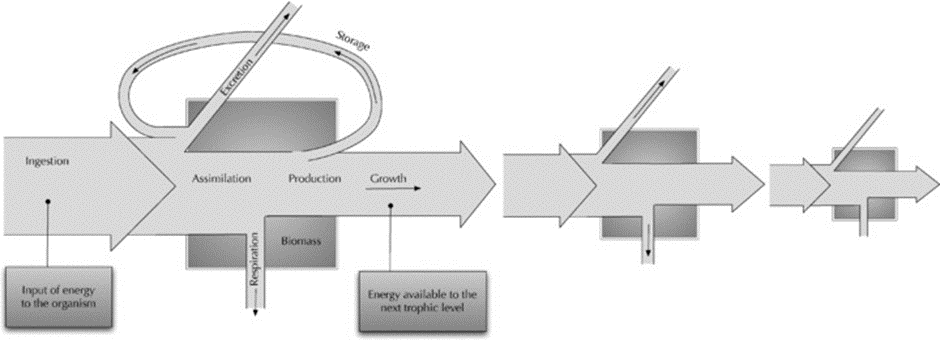
Fig 1: Odum’s “universal” model of energy flow modified from Ricklefs (2007) (Source: Researchgate) 2010
As abundance recedes, the language of reform becomes desperate. “Green transition” now means rebuilding the same industrial metabolism with new metals and deeper mines. “Net zero” means accounting tricks across borders and decades. The liberal instinct to save the world cannot admit that the project of saving it was built on the same surplus now collapsing.
Economist Herman Daly argued that a steady-state economy would one day be inevitable, either by design or by disaster.¹⁰ Overshoot is not a moral failure; it is a material condition. Our species grew too quickly and built its institutions on borrowed energy. The political culture of progress can only understand this as tragedy, yet in ecological terms it is simply rebalancing.
For three hundred years we lived as though the Enlightenment had freed us from ecology. Collapse is the end of that fantasy.
It is the return of the biophysical world to the centre of human affairs.
4. The Emotional Loop of Denial
Liberal culture has no language for limits.
When confronted with them, it turns physics into morality. Every new warning becomes another call to action: we must innovate, legislate, cooperate. The energy crisis becomes an opportunity, the climate crisis a challenge. The same vocabulary that once fuelled reform now shields us from recognition.
The loop is predictable:
Guilt: we must do better.
Hope: technology will save us.
Frustration: if only people would vote for the right leaders.
Despair: people just don’t care.
Renewed hope: a breakthrough is coming.
Each turn restores a sense of virtue without touching the cause. It is how liberalism metabolises grief. We are trying to reason our way through a boundary that reason itself created.
Economist and educator Nate Hagens describes the dilemma clearly: humanity is caught between what it feels it must preserve and what the biophysical world will allow.¹¹ The result is cognitive dissonance at civilisational scale.
Liberal democracies respond with optimism because optimism is the last civic duty they can still perform.
5. The Recoil of Rights
As surplus fades, the social mood changes. The freedoms of the liberal era depended on a sense that the future would be better than the past. When that faith erodes, fear, envy and hate replaces generosity.
Across the developed world, rights once considered permanent are shrinking. Governments restrict protest and increase surveillance. Minorities are scapegoated as competition for security and resources grows. Populist movements promise protection, not freedom. Authoritarian leaders rise to defend imaginary golden ages.
The liberal order cannot understand this regression. It treats each incident as a moral lapse rather than a structural inevitability. Yet rights are not self-sustaining; they are energetic luxuries. They survive when the collective feels safe enough to share. As energy per capita declines, so does the margin for empathy.¹²
The rollback arrives slowly and irrevocably. Cuts to welfare, restrictions on migration, censorship in the name of safety. Each step feels pragmatic until the aggregate becomes cruelty. Liberal societies once prided themselves on inclusion. Now inclusion feels expensive. This is the context of repression; we are learning what it means to defend compassion without the cushion of abundance.
It is hard to lose a story that once made the world make sense.
The faith in progress shaped how we raised our children, imagined our futures, and measured goodness itself. To watch it fail is to feel the ground of meaning dissolve. Many will cling to it, not from ignorance or vanity, but from delusion, and love for the world it once seemed to promise.
6. What Liberalism Leaves Us
Liberalism’s central insight, that individuals deserve dignity, remains essential. One of our tasks is to carry that insight through descent.
Some virtues will endure because they do not depend on energy: patience, kindness, honesty. Others must be reinterpreted or reframed. Freedom will mean self-restraint. Equality will mean mutual obligation more than personal ambition. Progress will mean continuity of care, not accumulation.
Historian Karl Polanyi warned that societies torn from their ecological base would eventually re-embed in the natural world, voluntarily or by force.¹³ The coming century will test whether any of us can do so with grace. Liberalism gave us moral language for abundance; we need moral language for contraction.
The end of progress is not the end of humanity. It is the end of a particular story about what it means to be human.
7. After Progress
The world that liberalism built is passing. The cities may endure, but the idea that improvement is destiny will not. The end of progress may feel like the end of meaning, yet it could mark the return of proportion. We are not the authors of the planet, only participants in its metabolism.
When the surplus vanishes, civilisation must remember older skills: belonging, restraint, and reciprocity. Perhaps then freedom will mean living within limits, and dignity will mean caring for what remains.
The age of progress gave us rights, comfort, and the illusion of control. Its death gives us something quieter: amidst the horror, the chance to live truthfully in a finite world.
Liberalism is dead.
Support this work
Everything I write here will remain freely available. If this essay has helped you think differently about the human predicament or find steadiness, please like, share, and subscribe.
References
Locke, J. Two Treatises of Government. London: Awnsham Churchill, 1689.
Montesquieu, C. de Secondat. The Spirit of the Laws. Cambridge University Press edition, 1989 (orig. 1748).
Smith, A. An Inquiry into the Nature and Causes of the Wealth of Nations. London: W. Strahan and T. Cadell, 1776.
Catton, W. R. Overshoot: The Ecological Basis of Revolutionary Change. University of Illinois Press, 1980.
Berlin, I. Two Concepts of Liberty. Oxford: Clarendon Press, 1969.
Tainter, J. The Collapse of Complex Societies. Cambridge University Press, 1988.
Hall, C. A. S., Lambert, J. G., & Balogh, S. B. “EROI of Different Fuels and the Implications for Society.” Energy Policy 64 (2014): 141–152.
Meadows, D. H., Meadows, D. L., Randers, J., & Behrens, W. W. The Limits to Growth. New York: Universe Books, 1972.
Odum, H. T. Environment, Power, and Society. New York: Wiley, 1971.
Daly, H. E. Steady-State Economics. Washington, DC: Island Press, 1977.
Hagens, N. The Great Simplification (podcast and lecture series, 2021–present).
Tainter, J., ibid., chapters 3–4.
Polanyi, K. The Great Transformation: The Political and Economic Origins of Our Time. Boston: Beacon Press, 1944.
No posts
Comments
Nothing yet. Say the first thing.
Sign in to join the conversation.