
Editor’s note: My earlier essay, Collapse: A Framework sets out the structural dynamics of overshoot and collapse. This essay follows on from that foundation. If the first asked what is collapse and why is it inevitable, this one asks how we might respond.
1. Introduction: A World Out of Balance
Collapse is not a distant possibility, but a process already underway. The signs are everywhere: glaciers retreating, Arctic sea ice thinning, topsoil eroding, aquifers depleting, forests burning, and insect populations crashing. Political systems strain under polarisation, economies lurch from crisis to crisis, and climate shocks compound each other in ways that overwhelm governance. These symptoms are not disconnected, but expressions of a civilisation that has grown far beyond the Earth’s capacity to sustain it.
Thanks for reading A Grand Unified Theory of Doom! Subscribe for free to receive new posts and support my work.
William Catton, in Overshoot (1980), described industrial humanity as Homo colossus: a species temporarily inflated by fossil fuels, living far beyond the renewable flows of ecosystems.¹ Joseph Tainter, in The Collapse of Complex Societies (1988), showed how complex civilisations unravel when the energy and material costs of maintaining complexity outstrip the benefits.² Both works remain foundational in collapse thinking.
My recent essay turned to a different question: why collapse remains invisible even as it unfolds. The data are overwhelming but our cultures behave as if continuity is assured. This blindness is not the result of lack of evidence, but of what we can call the consensus trance: a socially shared hypnosis sustained by myths of growth, progress, and salvation. These illusions pacify societies so expansion can continue regardless of the ecological consequences. Collapse inevitably unmasks them.
It is important to understand that every complex civilisation in history has either transformed beyond recognition or collapsed. Any future ones will too - not by accident or mismanagement, but by design. All civilisations grow through energy expansion until they hit ecological limits.
Collapse is the first rule of civilisation.
Further, collapse is not a single event. It is a drawn-out process of simplification, contraction, and dislocation. But its direction is clear: the decline and end of Homo colossus – industrial humanity.
The question that remains is how we might inhabit that contraction.
Civilisations in terminal overshoot do not return to equilibrium; they descend until the destabilising patterns dissolve – a polite way of saying a mass die-off of the offending species, leaving behind a damaged ecosystem. Yet within that inevitability lies a narrow channel. As the consensus trance breaks, humanity can rediscover itself not as Homo colossus, the destabilising outlier, but as Keystone Humanity: smaller, humbler, and ecologically stabilising.
In this essay, I use Robert Paine’s keystone criteria both literally and metaphorically, not as a strict ecological classification, but as a way of naming and describing humanity’s pre- and post-industrial roles.
This essay unfolds in four parts. First, it defines what a keystone species is and why the concept matters for ecological balance. Second, it explores what humanity once looked like when it acted as a keystone species - in hunter–gatherer lifeways that regulated trophic cascades and enhanced biodiversity. Third, it considers what Keystone Humanity could mean in an overshot and declining system, tracing both risks and possibilities.
Finally, it argues that the path forward is not to save ourselves, but to achieve re-alignment: small, local, embodied practices through which humans might once again become stabilisers of ecosystems, even as collapse unfolds.
2. What Is a Keystone Species?
Some species shape entire ecosystems in ways far greater than their numbers suggest. Remove them, and balance unravels. Protect them, and life flourishes. These are keystone species: anchors of ecological stability.
The idea of the keystone species was introduced by ecologist Robert Paine in 1969.³ By removing starfish from intertidal zones, he observed that the entire ecosystem shifted. Mussels overran the habitat, diversity collapsed, and the balance of species was lost. The starfish was a keystone: its influence on the ecosystem was disproportionate to its abundance. Remove it, and the arch collapses. Preserve it, and the system stabilises.
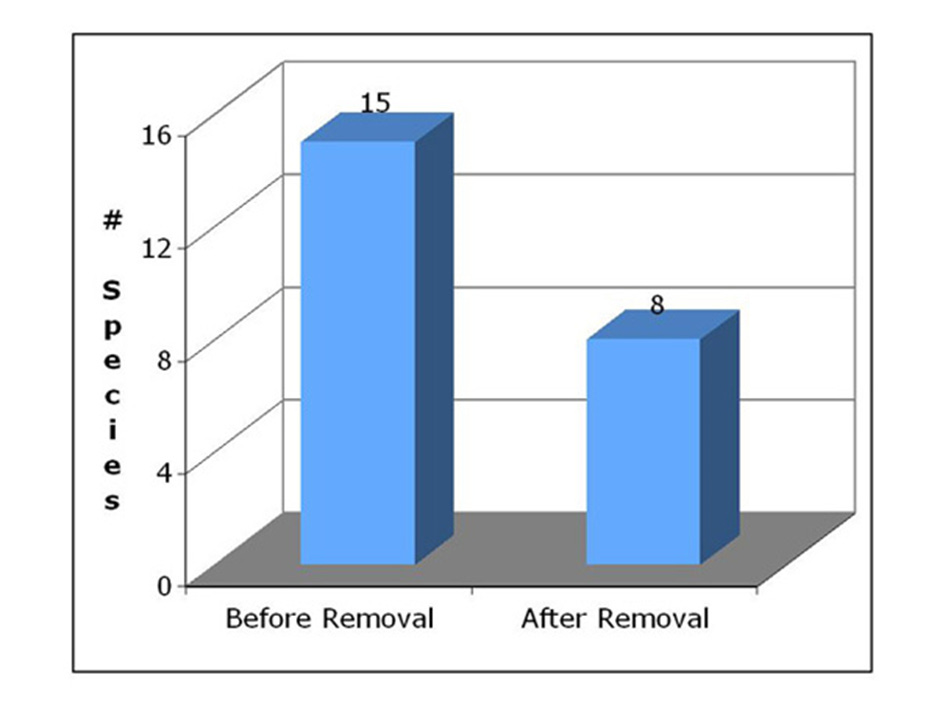
Fig. 1. Removal of a top predator (starfish) causes collapse in species diversity (Paine, 1969; Nature Education, 2010).
The keystone concept has since reshaped ecology. Wolves in Yellowstone regulate elk populations, triggering trophic cascades that regenerate forests and even reshape river courses.⁴ Beavers build wetlands that support hundreds of species and enhance groundwater storage.⁵ Sea otters suppress sea urchins, allowing kelp forests to thrive, sheltering fish and sequestering carbon.⁶ Elephants in savannahs knock down trees, creating grasslands that sustain ungulates and predators alike.⁷
Keystone species stabilise ecosystems through reciprocal relationships rather than domination.
Paine’s criteria are empirical, and they reveal how keystones shape the whole:
1) Regulate trophic cascades. Keystone species keep food webs in balance. For example, wolves check elk, preventing overgrazing and allowing forests to regenerate.
2) Enhance biodiversity. By holding dominant species in check, keystones make space for diversity. The removal of starfish in Paine’s experiment reduced species richness by half.
3) Shape nutrient cycling. Their behaviours influence the flow of nutrients: salmon bring marine nitrogen into forests, elephants distribute seeds across savannahs.
4) Increase predictability and resilience. Ecosystems with strong keystones can absorb shocks more effectively, maintaining stability even under stress.
5) Act as connectors across ecosystems. Migratory species, seed dispersers, and large herbivores link fragmented zones, transporting energy and sustaining interdependence.
For most of our history, humans fulfilled many of these criteria: regulating prey populations, enriching soils, spreading seeds, and linking ecosystems. Today, we meet their mirror image: destabilising cascades, driving extinctions, fragmenting habitats, and eroding resilience.
Two influential strands of ecological literature have begun to grapple with the idea of humans as keystone actors. Marine ecologist Boris Worm and colleagues (2016) coined the term hyperkeystone species to describe how humans exert influence not just directly on ecosystems, but indirectly by shaping the behaviour of other keystone species, multiplying our ecological reach.⁸
Similarly, Moll et al. (2021) proposed an “Eltonian niche of humans” framework, mapping how human roles as predators, dispersers, and ecosystem engineers cut across both ecological and sociocultural domains.⁹ These perspectives affirm the outsized impact of humans, but remain largely descriptive.
It’s important to note that in ecology, which species count as keystones is debated, and their roles shift by place and time. That variability is part of what makes the idea useful here. Humans also shape ecosystems differently across contexts, sometimes stabilising, more often destabilising.
Paine’s criteria, backed by subsequent research, point to a fascinating question: if humans once acted as a keystone species, how did that work? And could it work again?
3. Humanity as Keystone Before Homo colossus
For most of human history, humanity was not an ecological outlier but an ecological participant. Far from destabilising, our influence often increased biodiversity and resilience. Hunter–gatherers, early cultivators, and small-scale agriculturalists acted as ecosystem engineers, shaping landscapes in ways that stabilised rather than degraded. Low-energy, embedded human cultures were not primitive, but sophisticated in managing complexity within ecological limits.
Indigenous Australians practiced fire-stick farming: controlled burns that created patchwork habitats, preventing catastrophic wildfires and supporting grazing animals.¹⁰ In North America, Native peoples used fire to maintain prairies and oak savannahs, sustaining grazing animals and edible plants.
In the Amazon, people enriched soils with biochar and organic waste, creating terra preta that remains fertile centuries later.¹¹ Polynesian agroforestry integrated trees, crops, and animals into resilient systems. Seasonal hunting bans and fish weirs maintained balance.
Anthropologists now recognise that so-called “pristine wilderness” was often a human-shaped mosaic of high biodiversity. Humans acted as connectors, predators-by-proxy, dispersers, and soil-builders. We were not masters of ecosystems but participants in them.
The key was constraint, although not through morality. Pre-industrial societies were bounded by energy limits, and many developed reciprocal practices - though not all avoided ecological harm. Their keystone roles emerged from being embedded in the feedback loops of the ecosystems they inhabited. Humanity functioned as a stabilising species when our actions were small-scale, reciprocal, and accountable to ecological return.
However, balance was shattered when access to fossil fuels removed the energy limits, unleashing Homo colossus upon the Earth with devastating consequences.
4. Homo colossus and Overshoot
Fossil fuels did more than accelerate human history - they shattered the constraints that had kept humanity embedded within ecological limits. Coal, oil, and gas delivered energy subsidies of unprecedented scale, inflating human carrying capacity far beyond renewable bounds. This is the pivot point: energy abundance detached humanity from the ecological feedback loops that once constrained us.
William Catton called this enlargement Homo colossus: humans magnified into ecological super-predators destabilising the biosphere.¹
The results are catastrophic. Elizabeth Kolbert names the ongoing biodiversity annihilation the Sixth Mass Extinction.¹² Clive Hamilton describes a Defiant Earth where human activity destabilises planetary systems.¹³ Industrial humanity has become a negative keystone species: exerting disproportionate influence, but in destabilising ways. Species vanish at rates estimated to be 100–1000 times higher than the natural background rate.¹⁴
Climate systems destabilise as cryosphere, atmosphere, and hydrological cycles shift beyond Holocene norms.¹⁵ Soils erode 10–40 times faster than they regenerate, undermining the fertility on which human survival depends.¹⁶ Overshoot-driven ecological degradation ultimately reduces carrying capacity below its original threshold. In other words, the very abundance that enabled Homo colossus ensures the depth of its decline.
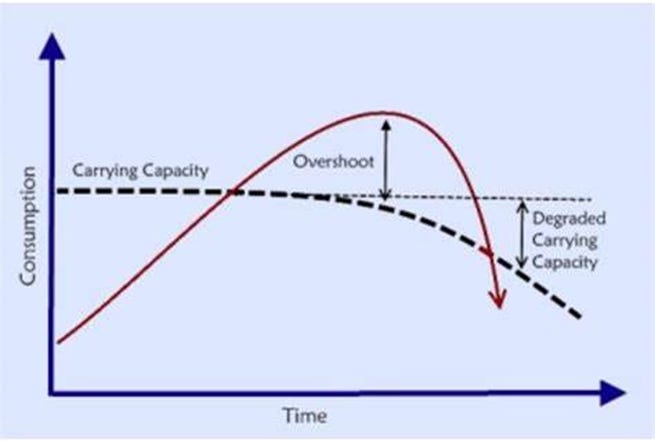
Fig. 2. Ecological Overshoot and Degraded Carrying Capacity (Source: Nate Hagens) 2025
For Homo colossus, overshoot is not only material but also cognitive. Growth is treated as destiny, technology as salvation, and mastery as progress. These stories are functional illusions, the cultural operating system of an industrial civilisation in overshoot. The dual curves of the Rhetoric-Reality Gap show one axis tracking symptoms of ecological overshoot, the other sustaining illusions. The steeper the overshoot, the more elaborate the illusions.
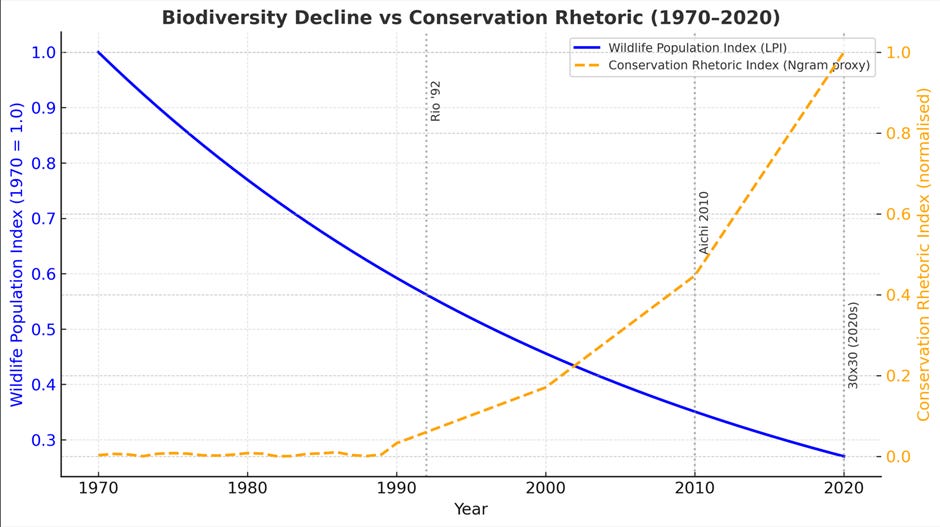
Fig. 3. Biodiversity Decline vs Conservation Rhetoric (LPI 1970–2020) (The Rhetoric-Reality Gap - Keystone Humanity. Adrian Lambert) 2025.¹⁷
Collapse is not a deviation from progress. It is the thermodynamic reckoning of a civilisation driven beyond limits, the moment when reality reclaims its gradients and myths collapse alongside the systems they upheld. In this light, Homo colossus is not only a phase of human history but an inversion of the keystone role: a species whose influence is immense, yet destabilising, degrading, and corrosive.
To understand what Keystone Humanity might mean, we must first grasp and accept how completely we became its negative image.
5. Keystone Humanity (Metaphorical Frame)
If Homo colossus is unsustainable, then contraction is inevitable. The choice is stark: vanish as destabilising outliers, or use the time remaining to us to rediscover roles that stabilise ecosystems at smaller scales. This is Keystone Humanity.
Keystone Humanity can be considered as consisting of three primary roles:
1. Ecological roles: regenerating soils through agroecology, restoring wetlands and forests, rewilding predators, creating corridors.
2. Social roles: building mutual aid networks, ensuring fair distribution during contraction, designing for redundancy rather than efficiency.
3. Psychological/spiritual roles: legitimising collapse-awareness, grieving extinctions, ritualising reconnection, cultivating humility before limits.
Metaphor matters because humans live by stories. We are not masters of nature, but participants within it. Keystone Humanity reframes collapse as a story of ecological belonging.
We can see the contrast in how different cultures relate to the systems that sustain them. Some are regenerative. Native American communities and Indigenous Australians, for example, returned nutrients to the soil, harvested within natural cycles, and built customs that reinforced reciprocity with land and water.
Others are extractionist, like the colonial British Empire, or our modern industrial culture. They take more than can be replenished, treat ecosystems as separate from themselves, and ignore the signs of exhaustion until breakdown follows. Extraction is visible not only in depleted soils and collapsing food webs, but in the erosion of trust, knowledge, and community.
Reinhabiting our role means relearning those regenerative patterns, even in small and local ways. Composting instead of discarding waste, polycultures instead of monocultures, and mutual care instead of isolation. These are not solutions to collapse, but they are steps back into the feedback loops that once kept us inside ecological limits.¹⁸
The metaphorical frame tells us why humans matter; the literal Paine frame shows us how we matter, in measurable ecological terms.
6. Keystone Humanity (Literal Paine Frame)
If we take Paine’s criteria literally (see Chapter 2), humans could again become a positive keystone species - but only if our influence shifts from destabilising to stabilising. Today, we are a negative keystone: our impact is vast but corrosive. Humans will continue to shape ecosystems; the challenge is whether our influence deepens collapse or helps anchor resilience.
1. Stabilising trophic cascades
For millennia, humans acted as predators-by-proxy, regulating prey populations and maintaining ecological balance. Keystone Humanity could re-assume that role: protecting predators rather than exterminating them, regulating hunting and fishing in ways that mimic natural predation, and supporting prey–predator balance through habitat restoration.
2. Enhancing biodiversity
Traditional land practices often created mosaics of diversity. Controlled burns can reintroduce patchwork habitats, regenerative grazing can mimic the movement of wild herbivores, and polycultural farming systems can sustain resilience while supporting reintroductions of missing keystone species. Urban food forests and pocket rewilding could enhance biodiversity in towns and cities.
3. Stabilising nutrient cycling
Soil fertility once depended on local cycles. Composting and humanure can close nutrient cycles, biochar and organic amendments can rebuild degraded soils, and relocalised fertility systems (circular economies of waste and return) can root productivity in ecological reciprocity rather than extraction.
4. Increasing predictability and resilience
Complex societies have pursued stability through scale and centralisation, but resilience is built on diversity and redundancy. Keystone Humanity would strengthen buffers against shocks: redundancy in food, water, and energy systems; relocalised production to reduce volatility; and diversity at every level of organisation.
5. Acting as ecological connectors
Humans once linked landscapes through corridors, seed dispersal, and seasonal migrations. We could again take on this role as gardeners of connectivity: restoring riparian corridors, reforesting watershed edges, and designing habitats that reconnect fragmented ecosystems across land and water.
I think about the magpies I feed each morning - at first a wounded bird and its mate, and then a fledgling, and then a family. That tiny act has rippled into a small corridor of care in my garden. Connection isn’t just a metaphor but something you can nurture and viscerally feel.
Taken together, these roles echo how humans once acted: small-scale practices that kept us within feedback loops, rather than breaking them.
These roles suggest a spectrum of human ecological impact during collapse.
A typology of human impacts
1) Destabilising Keystone (Homo colossus): disproportionate influence that degrades and unravels ecosystems.
2) Stabilising Keystone (Keystone Humanity): disproportionate influence that enhances stability, biodiversity, and resilience.
3) Neutral or niche-suppressed humans (post-collapse survivors, remnant populations): reduced impact, largely absorbed into local ecologies.
Right now, humans remain the first type: a negative keystone, exerting vast but destabilising influence. To be a keystone again, we must turn from extraction to reciprocity, from Homo colossus to Keystone Humanity.
If Paine’s lens shows how humans could be stabilising again, Earth system limits define the conditions in which that possibility must play out.
7. Keystone Humanity in Earth System Limits
Collapse does not unfold in the abstract. It plays out within the material boundaries of the Earth system - thresholds that define the conditions for life. Johan Rockström and colleagues identified nine such planetary boundaries: climate change, biosphere integrity, land-system change, freshwater use, biogeochemical flows, and others.¹⁹ At least six are already breached (see figure 4).²⁰
This sets the frame: Keystone Humanity is not abstract, but bounded by hard ecological thresholds.
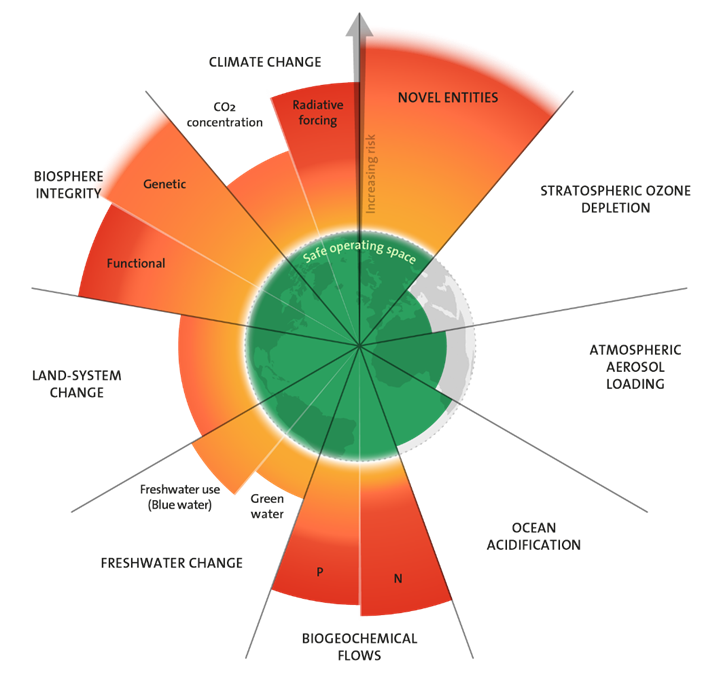
Fig. 4. The 2023 update to the planetary boundaries (Source: Azote for Stockholm Resilience Centre, Stockholm University. Based on Richardson et al. 2023, Steffen et al. 2015, and Rockström et al. 2009).
In this context, the idea of Keystone Humanity becomes clearer. Accepting that humans will always exert disproportionate influence, the question becomes: what happens if some begin to act as stabilisers within a toxic and hothouse Earth trajectory?
Climate change. Keystone Humanity cannot reverse locked-in heating. At best, reforestation, wetland restoration, and soil carbon practices can slow acceleration. Keystone practices drag against overshoot, but they cannot reverse it.
Biosphere integrity. Even small groups can create refugia: seed banks, habitat corridors, pollinator sanctuaries. At scale, significant fractions of species could persist further into collapse.
Land-system change. Stewardship can reduce fragmentation. With 20–30% adoption, landscapes regain ecological complexity.
Freshwater use. Retention practices can buffer droughts locally. At scale, hydrological systems re-regionalise. For example, in a town near where I live, the flood risk is growing in impact. Many buildings are required to have empty ground floors, due to increasing flood risk. Earth system disruption is increasingly written into the architecture of our daily lives.
Biogeochemical cycles. Closing nutrient loops through compost, biochar, and circular economies reduces eutrophication. At scale, it functions as planetary triage.
Other boundaries. Novel entities, aerosols, and ocean acidification remain largely outside human control now. Mitigation is possible locally, but global trajectories continue downward.
Each of these boundaries shows the same pattern: humans cannot reverse collapse globally, but we can still slow or soften its impacts locally.
Scale matters. Consider these hypothetical scenarios: At 1–5% adoption, Keystone Humanity creates islands of stability. At 10–20%, regional systems stabilise. At 30–40%, humanity shifts from negative to mixed keystone. At 50%+, biosphere integrity, land systems, water, and nutrients soften their decline, but climate disruption and ocean acidification still drive turbulence. This is heuristic, not predictive - a thought experiment in possibility, not a model of certainty.
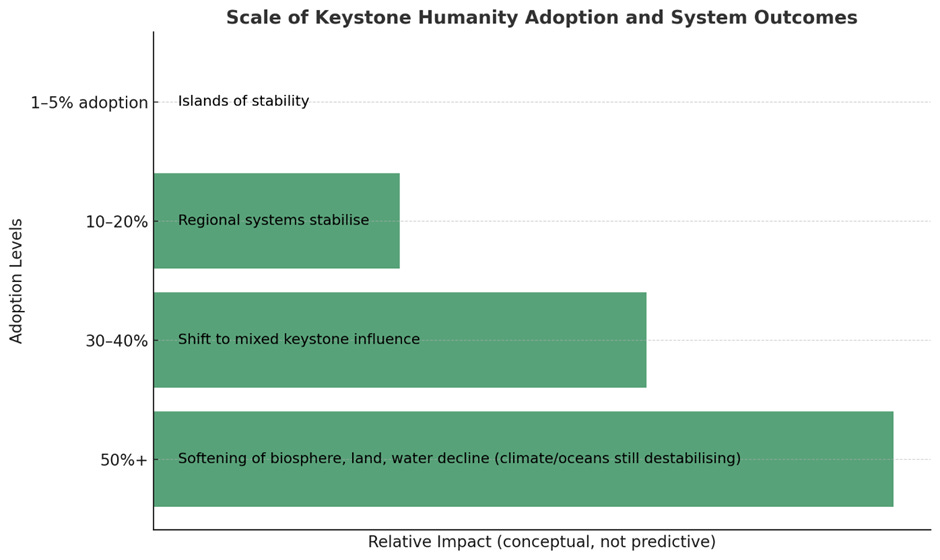
Fig. 5. Scale of Keystone Humanity Adoption and System Outcomes. (Source: Keystone Humanity. Adrian Lambert) 2025
The key point is not the numbers themselves, but the recognition that even minority adoption reshapes local trajectories.
Given the pull of the consensus trance and the grip of modernity, especially in the Global North, 1–5% adoption may be the realistic range. Yet even this minority presence matters. Keystone Humanity cannot restore Holocene stability - that world is gone. But it can help re-stabilise within turbulence, offering temporary reprieve for other beings as the hothouse Earth trajectory unfolds.
Even if Keystone Humanity re-emerges within Earth-system limits, it cannot undo the trajectory already in motion. Extinction remains the baseline condition, and any stabilising role we take on can only work within that reality.
Chapter 8. Extinction as Baseline
Collapse-awareness cannot skirt the question of extinction. To speak of overshoot is to acknowledge ecological limits, and to face ecological limits is to confront the reality that Homo sapiens - like so many species before us – will vanish. This is ecological realism.
Life on Earth has endured five great extinction events: the Ordovician–Silurian, Devonian, Permian, Triassic–Jurassic, and Cretaceous–Paleogene. Each removed 70–90% of species, resetting the evolutionary trajectory. The Anthropocene extinction is different. No asteroid or supervolcano drives it. The cause is a single species, Homo sapiens, inflated into Homo colossus by fossil energy. Unlike past civilisations, this collapse is planetary in scope, rapid in pace, and tied directly to industrial overshoot.
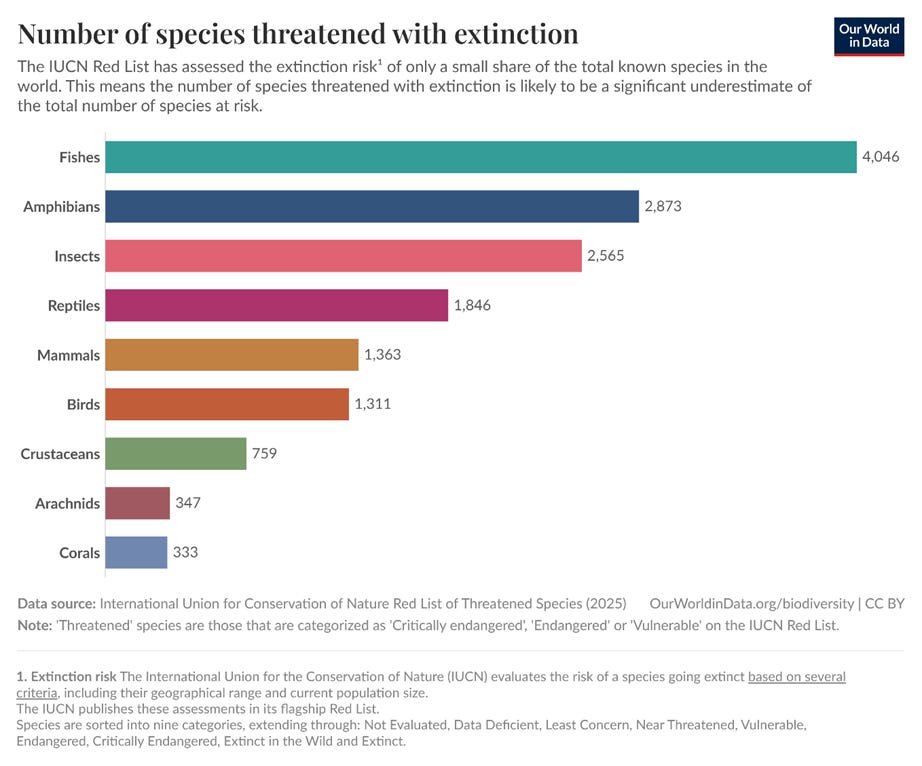
Fig. 6: Number of Species Threatened With Extinction (IUCN Red List of Threatened Species) 2025.²⁵
Some ecologists like Lyle Lewis remind us extinction is not a distant possibility but the most probable outcome of our trajectory.²¹ Paul Chefurka models civilisational collapse as a series of steps, with global population contraction the inevitable endgame.²² The late Michael Dowd reframes extinction within a spiritual register “post-doom” as a place beyond denial, bargaining, or despair.²³ Jem Bendell situates extinction as one pole of deep adaptation: not inevitable, but structurally likely.²⁴
Many collapse-aware people experience what environmental psychologists call species grief or anticipatory loss - a profound response to the unfolding disappearance of ecosystems, species, and futures. When I grasped the full implications of the Sixth Mass Extinction, I felt unmoored for months, as if I were existing outside of my own body. Grief is clarity. To allow yourself to grieve is to open the doorway to ecological realignment: to honour what is being lost and to root your actions in care rather than denial.
Extinction honesty unsettles because it strips away the last illusions of technocratic salvation. It punctures ambivalence, forcing us to admit what we know but do not want to face. To see collapse clearly is to accept extinction as the baseline.
Yet naming extinction is not an argument for passivity. It is a clearing of illusions - a deliberate step outside the consensus trance. Whether humanity survives in the deep future is uncertain, but life itself will endure, in one form or another. Within that endurance, other beings may carry forward continuities we cannot. Our responsibility does not evaporate in the face of extinction; it transforms and grows.
Every act of restoration, every seed saved, every species sheltered is a refusal to collapse into nihilism. When I build soil, I often wonder what lives might one day thrive in it – futures and species I will never see, but which may take root because of what we leave behind.
Extinction as baseline reframes meaning in deep time. The Earth is 4.5 billion years old; humans have existed for just 300,000 years - 0.006% of that span. Keystone Humanity is not about saving civilisation, or even our species, but about inhabiting collapse with ecological dignity.
If our continuity is uncertain, life’s continuity is not. In that distinction lies our role.
Chapter 9. The Compass of Keystone Humanity
If grief opens the doorway to ecological realignment, the compass provides bearings for walking through it. Paradigms shift through both theory and ethics - the bearings by which we navigate collapse. Keystone Humanity requires orientation as well as practice. I have named four bearings:
1. Care for the Earth: Treat Earth not as backdrop but as kin.
This echoes permaculture’s first ethic and Robin Wall Kimmerer’s call for reciprocity.²⁶ Keystone Humanity recognises Earth as a living community, not a stage set for human drama. Care for the Earth is enacted in the everyday: planting trees, rewilding patches, stewarding soil. It is less a principle than a reverence for the web of life.
2. Honour limits: Restraint is not deprivation but alignment.
Civilisation’s founding myth is that limits can be transcended. Keystone Humanity begins by refusing this myth. It treats limits as teachers, not enemies. This echoes Hans Jonas’s “ethic of responsibility” - acting as though the fragile conditions of life depend on our restraint.²⁷ Limits are not loss, but the discipline of belonging.
3. Stand with life: Solidarity must extend beyond the human.
Collapse invites competition and scapegoating. Keystone Humanity calls for solidarity not only with other humans but with other species. This recalls Aldo Leopold’s land ethic: “a thing is right when it tends to preserve the integrity, stability, and beauty of the biotic community.”²⁸ Solidarity is expressed in corridors for wildlife, pollinator gardens, seed networks, and the defence of habitats.
4. Share what remains: Justice in collapse is redistribution of decline.
Equity is often framed as the redistribution of abundance. In collapse, the task is redistribution of contraction: food, energy, water, space. Raworth’s doughnut economics hints at this framing - ensuring everyone has a social foundation within ecological ceilings.²⁹ Just Collapse is a movement focused on advancing socio-ecological justice as global collapse unfolds.³⁰ Fair shares become more urgent, not less, as systems fray.
These bearings map closely onto Paine’s keystone criteria. Care aligns with maintaining ecosystems. Limits prevent trophic imbalance. Standing with life creates connectivity. Sharing what remains shapes the distribution of energy and nutrients.

Fig. 7: Mapping Paine’s Keystone Criteria to Keystone Humanity Bearings (Source: Keystone Humanity. Adrian Lambert) 2025
Realignment is not imposed but chosen, enacted in ways as diverse as the ecologies we inhabit. The bearings do not guarantee survival; they reorient us toward integrity. In a collapsing civilisation, such orientation is not optional. It is the only way to inhabit collapse without reproducing the very patterns that undid us.
Chapter 10. Keystone Practice in Collapse
The compass provides bearings, but bearings demand movement. Keystone Humanity is not only orientation but revolution in practice. Keystone practice is love in action - Michael Dowd’s framing of aligning thought, ethics, and daily life with the conditions of collapse.²³ Albert Camus insisted that revolt is lived, not theorised.³⁴ Sisyphus pushing the rock is not an abstraction but an image of perseverance in the face of futility.
Keystone practice begins in the soil - community gardens, seed-saving networks, and agroecology projects are acts of ecological realignment. In Cuba’s “special period,” urban gardens provided half of Havana’s fresh produce.³¹ In Detroit, community gardens have become vital infrastructure where supermarkets withdrew. To plant a seed feeds bodies and roots hope in the ground. This practice is bioregional in spirit: rooted in the soils, waters, and communities that give shape to life in each place.
When I turn the compost, I see the scraps steaming on cold mornings, breaking down into soil, and the life thriving within it. It feels like collapse in reverse - waste becoming fertility. Small, ordinary acts like this prove that we can still root ourselves back into ecological cycles.
Keystone practice also includes rewilding. Beavers reintroduced to the UK transform hydrology, slowing floods and creating habitat.³⁵ Wolves in Yellowstone reshaped rivers by changing the behaviour of elk. When humans act as keystone species, they amplify such cascades. Rewilding is not withdrawal but participation: humans working with ecosystems to regain complexity.
But practice must also be cultural. Joanna Macy calls this the “work that reconnects”: rituals of grief, gratitude, and solidarity that metabolise despair into commitment.³² Rebecca Solnit writes of the “paradise built in hell” - the spontaneous solidarity that emerges in disaster.³³ Practice includes these small acts of mutual care: cooking for neighbours, sharing childcare and eldercare, and communities coming together in times of strain.
Examples of Keystone Practices
Reintroducing beavers: restoring hydrological balance, creating habitat, and buffering floods.
Urban food forests: turning derelict land into perennial systems that feed people and wildlife.
Seed cooperatives: preserving genetic diversity, sharing resilience across communities.
Mapping and restoring wild corridors: reconnecting fragmented ecosystems so species can move and adapt.
Shared childcare and eldercare networks: stabilising human communities so they can endure shocks and extend care beyond the individual household.
Keystone practice is local and plural. It is not coordinated by states or corporations. It proliferates in backyards, collectives, networks, and refuges. It does not wait for permission. It is ecological: emerging where needed, adapted to context. It is messy.
Keystone Humanity is lived in such dispersed practice, not in programmes or nation states.
Chapter 11. The Open-Source Ethos
Collapse-aware practice cannot be proprietary. Knowledge must circulate, or it dies. This is the logic of the open-source ethos: practices of regeneration, solidarity, and resilience belong to everyone.
History shows why. In medieval Europe, monasteries preserved texts through centuries of turmoil, keeping fragments of continuity alive. Andean farmers have preserved potato diversity for thousands of years through community seed-sharing and high-altitude cultivation. In war zones, farmers share seeds across borders. Knowledge that is privatised - held behind patents, subscriptions, or state monopolies - vanishes when institutions falter.
Contemporary collapse thinkers increasingly follow this ethos: Bendell released Breaking Together free online as well as in print;³⁶ Donald’s Planet Critical and Hagens’ The Great Simplification podcasts are freely accessible and donation-supported.³⁷ ³⁸
Collapse-aware knowledge must be designed to replicate and spread. Permaculture manuals, open-pollinated seeds, creative commons designs, oral storytelling, and free or subsidised community courses - these ensure continuity even when digital infrastructures fail. Collapse demands redundancy: practices must be shareable by print, memory, and practice, not only by cloud.
In future essays, I will share how my own permaculture practice - as one expression of what I call Keystone Practice - supports this approach.
This ethos contrasts sharply with technocratic responses to climate and collapse. Carbon capture patents, geoengineering schemes, genetically modified crops - these concentrate control and enclose resilience within corporate monopolies. Such responses entrench dependency. Keystone Humanity resists enclosure by insisting that survival knowledge is commons.
Open-source collapse practice is not utopian. It does not presume cooperation at global scale. It presumes breakdown and decentralisation, where resilience depends on portability and replication. The open-source ethos is ecological: like seeds carried by wind, knowledge must disperse widely and unpredictably.
To act as Keystone Humanity is to treat knowledge itself as ecological - resilient when diverse, abundant, and shared. Keystone Humanity is not a movement to join, but a remembering to enact. Find your patch. Begin. Share it, so others can begin too.
Chapter 12. Conclusion: Belonging on the Edge
This essay has exposed the dynamics of overshoot, traced the contours of the consensus trance, and reframed humanity’s role through the lens of Keystone Humanity.
The paradigm shift here is simple, yet profound: humans are already a keystone species. The question is whether we act as a keystone of collapse (simplifying, destabilising, extinguishing) or a keystone of continuity (restoring, reconnecting, rebalancing). What remains open is how we inhabit our ecological role.
Keystone Humanity reframes collapse as disclosure: the unmasking of stories that no longer serve. The myth of progress, the illusion of boundless growth, the fantasy of salvation - these dissolve, revealing the terrain of renewal: remembering ourselves as ecological beings.
The compass provides bearings: care for the Earth, honour limits, stand with life, share what remains. Practice gives them flesh: gardens, rewilding, rituals, solidarity. The open-source ethos ensures they endure beyond collapsing institutions. Together, these shape how we can live within collapse. We are not trying to save the world, but to live locally, ecologically, and with integrity - simply because it is the right thing to do.
Where Catton showed civilisation’s ecological trajectory, and Tainter its systemic fragility, Keystone Humanity illuminates our ecological role in collapse - and how we might realign it as individuals and as communities. This isn’t hopium, but a coherent response untethered from outcomes – it is important work that has already begun.
Plant where you stand. Share what you learn. Grieve what you lose. Protect what you can.
Collapse may strip away the stories of mastery, but it also returns us to a deeper story: that we are a part of life, not apart from it. To realign is not to be saved. It is to belong.
This is part of an ongoing series on overshoot, collapse, and the pathways that remain open to us. You can subscribe to get the next piece direct.
References
Catton WR Jr. Overshoot: The Ecological Basis of Revolutionary Change. University of Illinois Press; 1980.
Tainter JA. The Collapse of Complex Societies. Cambridge University Press; 1988.
Paine RT. A note on trophic complexity and community stability. The American Naturalist. 1969;103(929):91–93.
Ripple WJ, Beschta RL. Trophic cascades in Yellowstone: The first 15 years after wolf reintroduction. Biological Conservation. 2012;145(1):205–213.
Brazier RE, et al. Eurasian beaver: Ecological effects, benefits, and impacts of reintroduction. Mammal Review. 2021;51(1):1–24.
Estes JA, et al. Trophic downgrading of planet Earth. Science. 2011;333(6040):301–306.
Western D, Maitumo D. Woodland loss and recovery in a savanna park: a 20-year experiment. Biological Conservation. 2004;122(2):113–130.
Worm B, Barbier EB, Beaumont N, et al. Humans as a hyperkeystone species. Trends in Ecology & Evolution. 2016;31(8):600–607.
Moll RJ, Redilla KM, Mudumba T, et al. The Eltonian niche of humans: Comparative roles of humans in food webs of Africa and North America. Ecological Monographs. 2021;91(2):e01433.
Gammage B. The Biggest Estate on Earth: How Aborigines Made Australia. Allen & Unwin; 2011.
Lehmann J, Kern DC, Glaser B, Woods WI, eds. Amazonian Dark Earths: Origin, Properties, Management. Kluwer Academic Publishers; 2003.
Kolbert E. The Sixth Extinction: An Unnatural History. Henry Holt; 2014.
Hamilton C. Defiant Earth: The Fate of Humans in the Anthropocene. Polity; 2017.
Pimm SL, Russell GJ, Gittleman JL, Brooks TM. The future of biodiversity. Science. 1995;269(5222):347–350; and Pimm SL, Jenkins CN, Abell R, et al. The biodiversity of species and their rates of extinction, distribution, and protection. Science. 2014;344(6187):1246752.
IPCC. Sixth Assessment Report, Working Group I: The Physical Science Basis. Intergovernmental Panel on Climate Change; 2021.
Montgomery DR. Soil erosion and agricultural sustainability. Proceedings of the National Academy of Sciences (PNAS). 2007;104(33):13268–13272.
Lambert A. Biodiversity Decline vs Conservation Rhetoric (1970–2020). Figure from Keystone Humanity; 2025.
Maturana HR, Varela FJ. Autopoiesis and Cognition: The Realization of the Living. D. Reidel; 1980.
Rockström J, Steffen W, Noone K, et al. A safe operating space for humanity. Nature. 2009;461:472–475.
Richardson K, Steffen W, Rockström J, et al. Earth beyond six of nine planetary boundaries. Science Advances. 2023;9(37):eadh2458; and Steffen W, Richardson K, Rockström J, et al. Planetary boundaries: Guiding human development on a changing planet. Science. 2015;347(6223):1259855.
Lewis L. Racing to Extinction: Why Humanity Will Soon Vanish. 2024.
Chefurka P. World Energy to 2050 (online essay). 2007.
Dowd M. Post Doom (website and conversations). 2019–present.
Bendell J. Deep Adaptation: A Map for Navigating Climate Tragedy. IFLAS Occasional Paper 2; 2018.
IUCN. The IUCN Red List of Threatened Species, Version 2025-1. International Union for Conservation of Nature; 2025.
Kimmerer RW. Braiding Sweetgrass: Indigenous Wisdom, Scientific Knowledge, and the Teachings of Plants. Milkweed Editions; 2013.
Jonas H. The Imperative of Responsibility: In Search of an Ethics for the Technological Age. University of Chicago Press; 1984.
Leopold A. A Sand County Almanac. Oxford University Press; 1949.
Raworth K. Doughnut Economics: Seven Ways to Think Like a 21st-Century Economist. Random House; 2017.
Just Collapse Collective. About Just Collapse (movement statement). 2023–present.
Murphy C. Cultivating Havana: Urban Agriculture and Food Security in the Years of Crisis. Food First Development Report No. 12; 1999.
Macy J, Johnstone C. Active Hope: How to Face the Mess We’re In Without Going Crazy. New World Library; 2012.
Solnit R. A Paradise Built in Hell: The Extraordinary Communities That Arise in Disaster. Viking; 2009.
Camus A. The Myth of Sisyphus. (Trans. J. O’Brien). Hamish Hamilton; 1955.
Puttock A, Graham HA, Cunliffe AM, Elliott M, Brazier RE. Eurasian beaver activity increases water storage and attenuates flow: Implications for natural flood management. Science of the Total Environment. 2017;576:430–443.
Bendell J. Breaking Together: A Freedom-Loving Response to Collapse. Good Works; 2023.
Donald R. Planet Critical (podcast and essays). 2020–present.
Hagens N. The Great Simplification (podcast), Institute for the Study of Energy & Our Future; 2022–present.
Thanks for reading A Grand Unified Theory of Doom! Subscribe for free to receive new posts and support my work.
Comments
Nothing yet. Say the first thing.
Sign in to join the conversation.