
1. Introduction: “If You’re Going to Talk About Overshoot for an Hour, at Least Start Cooking Dinner”
I am a collapse-aware human, or what today’s urban youth would call a “doomer”.
Whether I’m pondering the heat death of the universe (most Mondays) or reading about the huge volume of human shit despoiling UK rivers, collapse is always there, lurking in the background like the ghost of Paul Ehrlich at COP33.
I’ve litigated collapse elsewhere, but I will lay out my position briefly because, well, I’m 100% doom, 100% of the time (keep up).
Despite the inexplicable human ability to construct our own symbolic realities, we still remain fully bound by biophysical reality.
Our industrial civilisation requires the extraction of enormous and ever-increasing flows of energy and materials from a finite planet. We then mindlessly dump the waste back into the very ecosystems that keep us alive.
At the beginning of the Industrial Revolution, there were around one billion humans on Earth. It took the entire history of our species to reach that number. Barely two centuries later, there are more than eight billion of us, each consuming more energy, more stuff, and producing more waste.
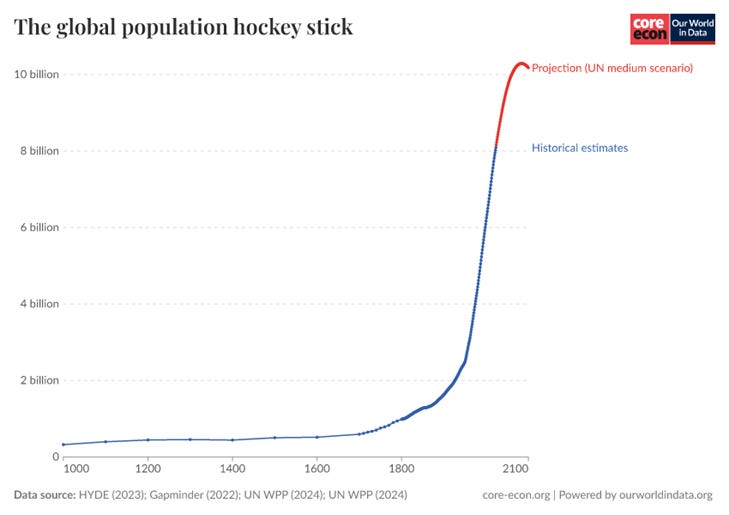
Fig 1: Human population over the last 12,000 years (Source: Our World in Data, 2023)
Ecological overshoot means we are consuming beyond the planet’s regenerative capacity, breaking down the very systems that provide the conditions for future freshwater, soil, biodiversity, and forests.
We hit that point sometime in the 1970s and have been living on the overdraft ever since.
Industrial civilisation tapped into hundreds of millions of years of stored sunlight (fossil fuels) and burned through it in a few generations, giving rise to the first global civilisation.
Most of us still believe this was a spontaneous flowering of human ingenuity.
Stop laughing.
Fossil fuels allowed us to transcend ecological limits; we mechanised agriculture, turned fossil gas into fertiliser, extracted resources from increasingly inaccessible places, and maintained human populations at a scale that the immediate productivity of the biosphere could never have supported.
We turned fossil fuels into billions of humans.
Now those energetic and material resources are running out, at the exact same time our planet’s environmental indicators are flashing red.
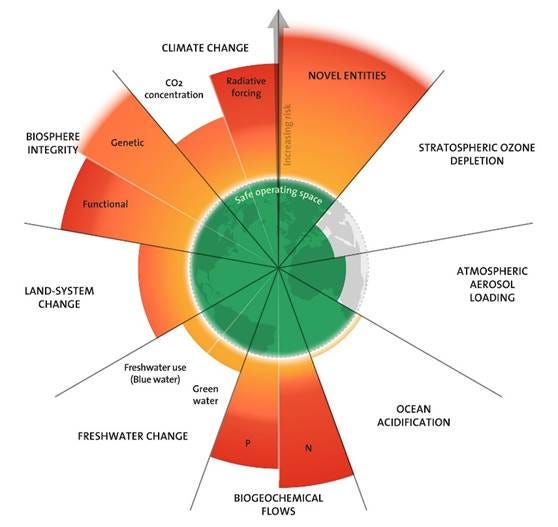
Fig 2: Planetary Boundaries 2025 Update (Source: Stockholm Resilience Centre)
I have taken it upon myself to study and understand the interactions of physics, politics, ecology, culture, and cognition.
This is why I believe with 100% certainty, that we are 100% fucked.
This is the backdrop to every moment of my life.
So, there’s a rule in my house now: I’m allowed to talk overshoot, ecological collapse, and the death of the biosphere for as long as I like, provided I’m chopping onions while I do it.
2. The Apex of Civilisation: A Doomer with 70kg of Rice Under His Bed
There is, at time of writing, 70kg of rice under my bed. Why? Because collapse isn’t a single event, it’s a long decline with a very long tail - and rice, unlike hope, has a shelf life you can actually plan with.
I’m a Joseph Tainter fan, and he describes this perfectly in his seminal work, “The Collapse of Complex Societies.”
Tainter’s theory is that complexity is how civilisations solve problems. Need to move food around? Build roads. Need to maintain the roads? Collect taxes. Need to collect the taxes? Create an administrative class. Before long, you have an entire department maintaining a spreadsheet that nobody really understands.
Tainter describes how increased complexity demands increased resources which provide diminishing returns on investment.
For example, in the UK, early investments in the health service, sanitation, and antibiotics delivered a profound improvement in population health. 80 years later, entire sub-organisations are dedicated to administering the financial complexity of a vast health service, including managing an internal marketplace.
When the cost of maintaining a society’s complexity is greater than the return on investment, societies involuntarily simplify (collapse).
I work in the public sector, so none of this feels particularly theoretical. I see it. Every. Single. Day.
I see it in the collapse of public services, in the increased hospital waiting times, in the worsening mortality rates, and in the growing dysfunction of the political class.
In the UK we’re on our 7th prime minister in 10 years. Why is that?
Well, politics cannot replenish depleted fossil fuels. Politics cannot restore ecosystems. Politics cannot deliver economic growth, when growth requires an energy and material surplus from a planet that we have already sucked dry.
I get so frustrated with the sustainability movement and the techno-optimists, who are often in bed with the media and political class to keep us consuming.
I was at an airport recently, and saw a bank advert with two people sat around a campfire with the slogan “Can we do more with less?” The notion of living more sustainably while about to board a plane that will ignite 150 tonnes of jet fuel under your arse is profoundly absurd.
Greenwashing at it’s worse.
In his excellent new paper, “Climate Gandalf” James Hansen expresses concern that the media coverage of El Nino will lead to the public misattributing man-made global warming to natural variability.
This is a ridiculous thing to be concerned about. Our problem is the cognitive and cultural filtering that enables us to discount the information.
Selective perception is how humans stabilise themselves when things are falling apart around them.
Hansen’s position also points to a more serious lie we tell ourselves; the notion that humans are capable of responding to ecological overshoot once it is recognised.
This is a false assumption.
All species will use all resources available to them in order to achieve their biotic potential (rate of reproduction). This is how nature works – our evolutionary drive to reproduce is undeniable.
For example, bacteria in a beaker will consume the nutrient medium to fuel binary fission until the jelly is gone. Without nutrients, the bacteria population will swiftly crash and die.
Despite our peculiar cleverness, humans are subject to the same energy constraints.
Humans have not escaped our beaker (The Earth). We found a vast store of fossilised nutrients, made the beaker eight times more crowded and established a sustainability committee to discuss the declining jelly.
If this resonated, or ruined your evening, hit like and subscribe - more doom, every month, guaranteed.
No posts
Comments
Nothing yet. Say the first thing.
Sign in to join the conversation.