
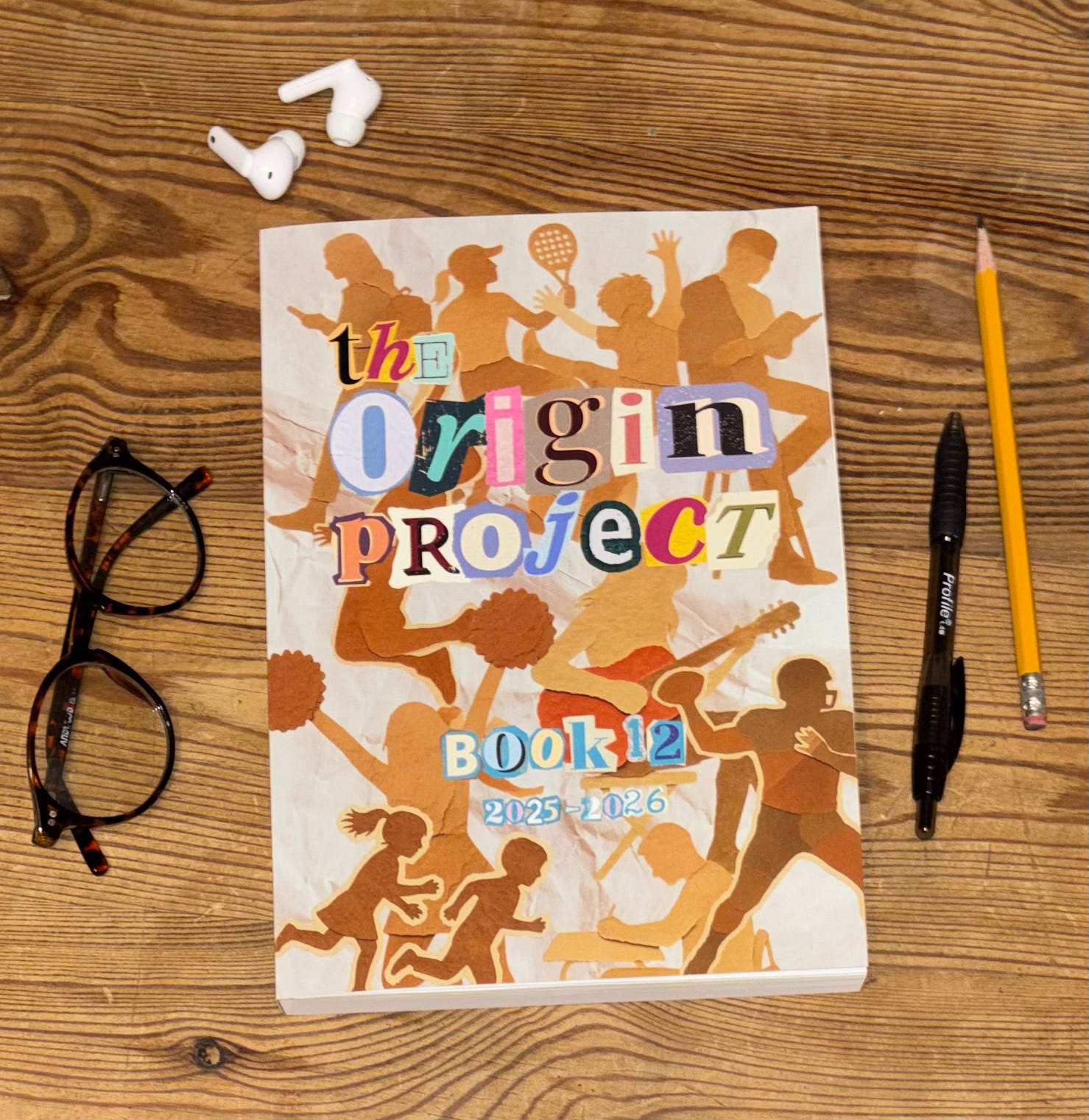
Every May, we mark our calendars to deliver the annual Origin Project anthology to its authors—the authors are students ranging from kindergarten to twelfth grade. For those of you unfamiliar with The Origin Project, it is an in-school writing program that began fourteen years ago with forty students in Big Stone Gap, Virginia. The late Nancy Bolmeier Fisher cofounded the mission with me and gave the organization its wings. Since its inception, the program has grown to serve over 30,000 students across the state of Virginia. For fourteen years, we have encouraged students to share their unique origin stories through the art of writing, and we are honored to publish them every school year in an anthology. The work of our students—from stories of fictional worlds, to poetry about their families, to coming-of-age essays—is diverse, thoughtful and brilliant.
Students are given a journal at the start of the school year to put their ideas to paper. The students write one article, essay, poem, play or interview, using their origins as the prompt. Their work is gathered, reviewed and published at the end of the school year by the Gupta Foundation.
A key tenant of the Origin Project is gathering in assembly, to introduce community as an essential aspect of sharing art. Our assemblies (or unveilings) are an opportunity for students to read from their stories in public and present their creations. This encourages self-confidence and the notion that the audience tells us everything we need to know about our work.
We would like to thank our generous donors for believing in our mission. Because of their support, we are able to provide our students with engaging programs and necessary resources throughout the school year. An incredible lineup of guest authors joined us during the 2025-2026 school year, and students at our events received copies of books from every single author. Donations go directly to our students and the programming that keeps our organization alive.
This school year, the Origin Project gathered for events across the Commonwealth. In the fall of 2025, students came together at the Library of Virginia in Richmond for our Fall Literary Festival. The Newbery Award-winning author Kate DiCamillo (The Tale of Despereaux, Flora & Ulysses, Because of Winn-Dixie) was our keynote speaker. Finalists for the Library of Virginia Literary Awards, Remica Bingham-Risher (Room Swept Home), Carter Higgins (Round and Round the Year We Go) and JoAnna Lapati (Guts for Glory), led various writing workshops. We met again in December for the Festival of Trees at the Southwest Virginia Museum in Big Stone Gap, Virginia. Here, students could write about the exhibit and their own holiday traditions. Local author Kathy McElyea read her short story, When An Old Dog Prays, enchanting our students.
In the spring of 2026, our friends at Emory & Henry University welcomed us for our Spring Literary Festival. Kate DiCamillo visited our students, once again, for a virtual keynote. Bestselling cookbook author Jimmy Proffitt (Seasoned in Appalachia) brought our cuisine and storytelling to the students. An essential part of our mission is to bring students, teachers and artists together in conversation. We are grateful for our friends and supporters who sponsor our guest artists and assemblies.
Our team is hardworking, amazing and dedicated. Our gratitude to our Executive Director, Linda Woodward, and to our editor and publisher of the anthology, Carmen Baumann. We thank Andrea Rillo and Lucia Stephenson for their superb editorship of the book.
As the program grows, we find new ways to serve our students.
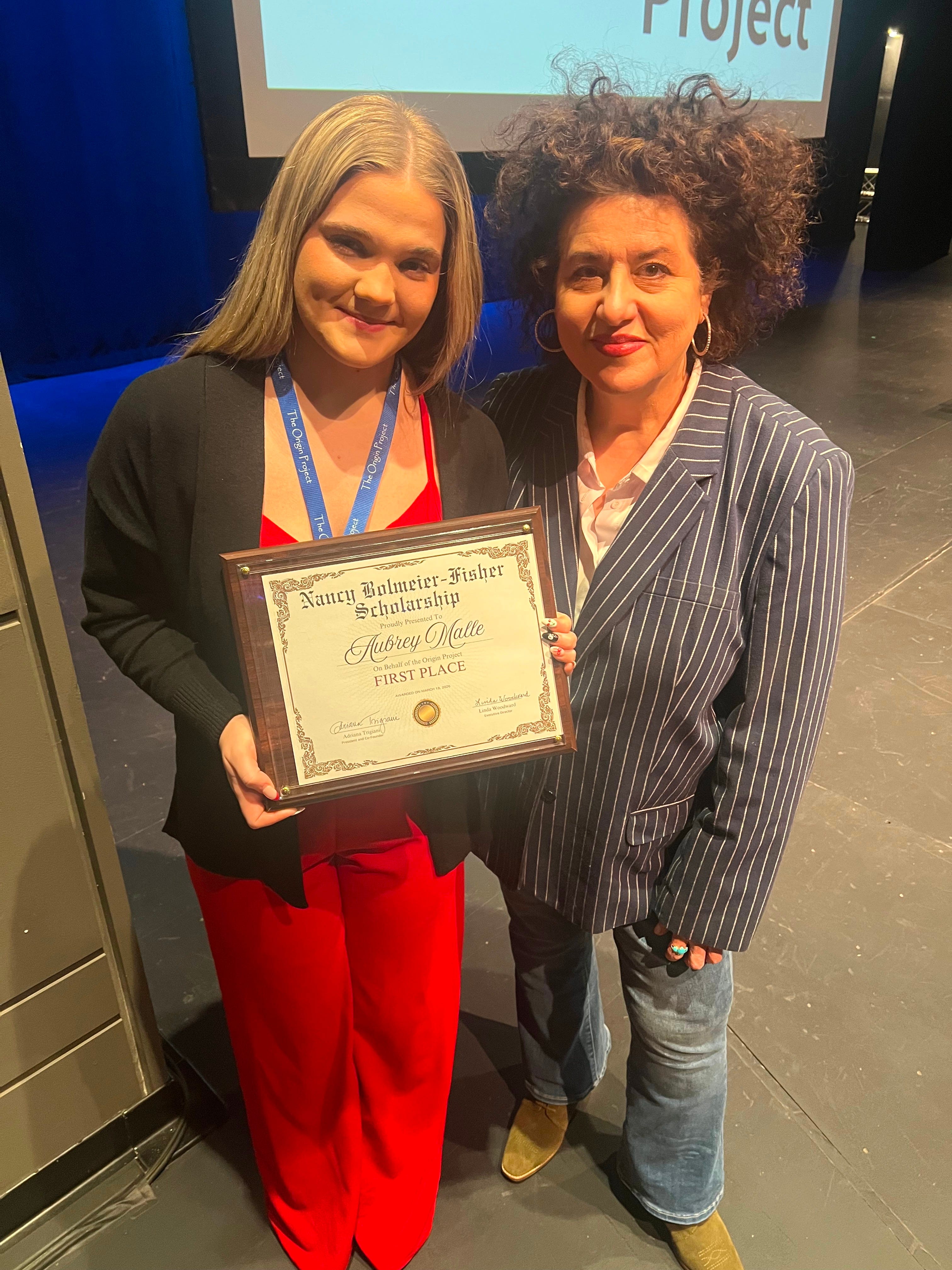
This school year, we were proud to introduce the first-ever scholarship competition in memory of our co-founder and director Nancy Bolmeier-Fisher. Nancy was the heart and soul of the Origin Project who believed that writing was the basis for every endeavor and a mastery of it and connection to the craft could change the world one story at a time. The Nancy Bolmeier-Fisher (NBF) Scholarship aims to support the winning students and their future endeavors. A selection of our Origin Project seniors opted for their Anthology submissions to be considered for the NBF Scholarship. We are happy to congratulate the 2025 - 2026 winners.
First Place: Everyday Calls by Aubrey Malle, Lee High School
Second Place: Green by Isabella Lyons, Appomattox Regional Governor’s School
Third Place: Barbie by Danika Doyle, Governor’s School of Southside Virginia
As part of the scholarship competition, we also promised that winning essays would be featured on this Substack. We hope you enjoy reading the work of these impressive seniors who have exhibited emotion, talent and resolve on the page.
To learn more about the Origin Project, you can visit us online at www.theoriginproject.net. To support our program, you can donate here.
First Place - Aubrey Malle, Lee High School
Everyday Calls
Every afternoon, right around the same time each day, my phone would ring.
I didn’t even have to look at the screen to know who it was.
“Hey, Aubrey Lynn,” Papa would say, his voice warm and steady, like it had all the time in the world just for me.
Papaw was the kind of person who never missed a day. No matter how busy he was, no matter what was going on, he called. Sometimes we talked about big things like my future school, life, worries I didn’t want to tell anyone else. Sometimes we talked about nothing at all.
But somehow, even those small conversations felt important.
He had been in the fire department for years. When he told stories about those days, his eyes would light up. He didn’t talk about being brave, but everyone knew he was. He ran toward the fires when others ran away. He helped people on their worst days. But to me, the bravest thing he ever did was show up every single day with love.
When I was younger, I thought firefighters were heroes because of the sirens and the flashing lights. As I got older, I realized real heroes are the ones who answer the phone every time you need them. The ones who listen without judging. The ones who say, “I love you,” and mean it like it’s the most natural thing in the world.
Last July, the calls stopped.
At first, the silence felt too big. I’d still catch myself thinking, I should tell Papaw about this. I’d reach for my phone before remembering. Grief is strange like that—it sneaks up on you in ordinary moments.
But then I started noticing something else.
When I’m unsure about a decision, I hear his steady voice in my mind.
When I feel alone, I remember that for years, someone chose to call me every single day just to make sure I was okay.
And sometimes, when the afternoon gets quiet, I swear I can almost hear the echo of the phone ringing.
Papaw may not be here to dial my number anymore, but his love still shows up daily. It’s in the lessons he taught me. It’s in the way I try to listen better, care deeper, and tell the people in my life that I love them every day.
He was a firefighter, yes. But more than that, he was my safe place. And that kind of hero never really leaves.
Second Place - Isabella Lyons, Appomattox Regional Governor's School
Green
green (grēn) > noun 1. Any of a group of colors whose hue is that of growing grass or of emerald, lying between yellow and blue. 2. My birthstone, dangling on an inherited gold chain, resting on my chest, held up by a tarnishing angel. 3. My mother, her mother’s, and my favorite color. 4. My curtains draped on a dead window, cloth pulled across the solemn face of my home.
green (grēn) > verb 1. To mother. 2. To buy curtains in your daughter’s favorite color to stretch her into the sleeve of a house, clothing the warmth of her skin. 3. To contradict. 4. To bury your mother back into the green earth. I was four when my mother’s body, my grandmother’s body, curled into a knot in a corn maze. I knew red snow cone glaze, autumnal lips, and my mother’s hand as she sat by her sister, her eyes a dead window into the heat of the homeland, into the heat of the nightsweats, into the heat of her mother, her back bent over a stove in a dirt floor hut, roof full of snakes, curtains green. Cooking up something in coconut milk, never kissing her daughter, but always dusting her emerald curtains.
(First definition is adapted from Merriam-Webster)
Third Place - Danika Doyle, Governor’s School of Southside Virginia
Barbie
When I was younger, I thought bleach could fix things. I don’t mean the kind you use to clean your bathroom, the smell of clean, like everything is fixed, although maybe that too. I’m talking about bleach for your hair. That harsh, burning stuff that smells like regret and stings like insecurity. See, there were these girls. You know the type: effortlessly confident, hair like golden sunshine that shines in the light, all the right clothes, who all laugh at moments I didn’t quite understand yet. I wasn’t trying to be them, not really. I just wanted to grasp that confidence. I never wanted to orbit someone else’s universe. I thought, maybe if my hair looked like theirs, I’d feel like I belonged. If my hair stayed pinned straight, gleamed in the sun, and made me buzz around the school. So, I did it. I bought a box of drugstore bleach and locked myself in the bathroom like I was doing something brave.
Soon, my nose turned up as I smelled the 2 parts mixing in the bowl like a science experiment, a purple mixture that would change my life forever. YouTube videos, specifically non-scholary, shouted in the background as I carefully painted my scalp like a longscape painting. Half an hour later, my head was on fire and I smelled like a chemical plant. As I stared in the mirror, the reflection looking back, I saw an adolescent mind with a Walmart bag tied to her head. I did not recognize myself. But when that 30-minute timer buzzed and beeped, I saw the orange, patchy, but blonde
hair I had longed for in my dreams. Honestly, I hated it, but I didn’t say that. I walked into school the next day pretending to be confident, my head held high while my mind was running a million miles an hour, palms sweaty, pretending this was the real me. For a second, I felt it. That little hum of approval, “Oh, your hair!”, that middle school high of being noticed. When you feel like you are on top of the world. After the first few awkward conversations of approval, it wore off, because when you change yourself to fit in, you’re just wearing a costume. This wasn’t me. I could feel it, in my hair, in my skin, in the awkwardness of pretending to be someone I wasn’t.
The thing is, my natural hair? It’s wild. It doesn’t always cooperate, but it’s who I am. It curls in waves that shoot out in all directions, it frizzes up when it’s humid, and it has this personality that I didn’t realize I was trying to bleach out of existence. Slapping on alkaline agents that burn through confidence like a match to wood not only damaged my hair, but my self-image. I thought I needed to change to be beautiful. I then realized all I really needed was to stop apologizing for being myself.
So yeah, that day I bleached my hair? It was about learning the hard way that authenticity is louder than any trend, stronger than any insecurity. Now, I wear my hair the way it grows out of my head. I love it. I honor it. Even on the messy days, especially on the messy days, because it is mine. Imagination will make your hair smell strong, weaken your smile, and question what you know. Most importantly, I’ve realized the people worth keeping around don’t need you to bleach away anything.
Comments
Nothing yet. Say the first thing.
Sign in to join the conversation.