
Ann Godoff (1949 - 2026) was a great American editor and publisher of books. She had a keen eye for discovering talent and proceeded to provide support to her authors in the ways they needed. No two authors are alike, there’s no postage stamp art that gives you a picture of what an author is, neither color, pedigree, education, country of origin, gender or age defines a storyteller. To that end, Ann understood that every author had a specific and personal world view—and within that particularity, it was her job to enhance, elevate and promote the author’s voice on the page.
Ann had style. Dear reader, it’s just my street corner observation: good taste is apparent in all aspects of a person’s life when they possess it—good taste in the manner in which they speak, how they dress, how they move through the world, do their work, create their homes, cook their meals or write a story. “Good style must be clear, it must be appropriate,” Aristotle (and my mother) would say. Ann was always clear and appropriate.
Ann gave the kind of support that would sustain a writer in her darkest hours.
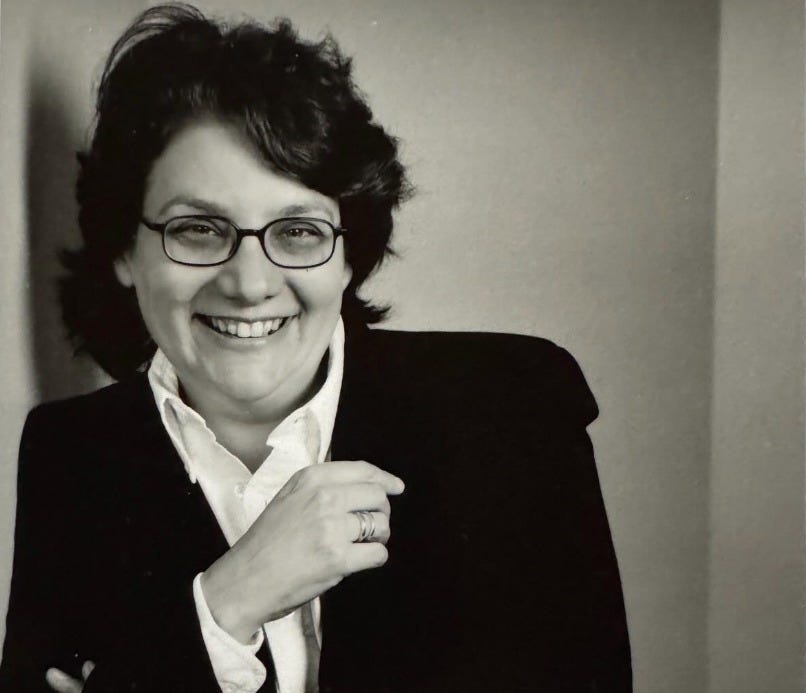
Ann also had exquisite taste in music, art and film, but it never felt snobbish. She dressed in a sort of uniform: jacket and slacks, chic loafers, a white shirt with pressed collar and cuffs, her thick hair cut in chunky layers, wire rimmed glasses and a warm smile. She appeared tall, but I believe she was just well proportioned. Her natural beauty was magnified by her brilliant mind. She was the definition of beautiful inside and out. If a keen intellect is sexy, then Ann owned the joint. She wasn’t one for a big bash, she seemed to prefer the one-on-one conversation, so much so, I can remember details of meetings I had with her because she would offer the kind insight and encouragement that you can hear and accept privately. Ann gave the kind of support that would sustain a writer in her darkest hours. She would say something so wise, it would stay with me. When she made a suggestion, I listened. If she offered advice, I took it. There was nothing loud or bombastic about her except for her laugh. She was clear in the way she communicated. She possessed a curiosity and love of knowledge that is essential for the person who decides to make books and publishing a career.
In 1999, I had been writing for television, wrote screenplays for hire and had written and directed a documentary film. I took one of those unproduced screenplays with the encouragement of my wise friends Suzanne Gluck and Ruth Pomerance and wrote a novel from the story. I delivered it in the spring of 1999 to Suzanne, who had made her name at ICM representing talent that included Caleb Carr, John Berendt and Spalding Gray. Suzanne went to work. It was Ann who bought Big Stone Gap at auction at Random House and assigned her young editor Lee Boudreaux to edit the book.
Ann had been a film major at NYU, so she appreciated the dramatist as novelist. Later I asked her how she knew I could do it. She said, “You create worlds.” I took her observation seriously and began to build a world of characters inside books to give to readers outside of it. It was like being a librarian (my aspirational career which my mother followed) who liked being in touch with readers and talking books. I collected addresses of readers wherever I went on tour—we called it “The World’s Biggest Book Club”. When I told her about it, she said, “Keep doing it.” She was the reason I took to writing a novel a year. I had fallen in love with the form. Ann continued to encourage me.
By 2002, I had written three novels in the Big Stone Gap series and was ready to write a New York City story. I also wanted to have a baby. Women (at least this one) must plan every moment to fuse satisfying work and great love in their lives if they hope to achieve their dreams. Most planning is usually an exercise in futility, but we do it anyway hoping for some control. So much for that. I found out that I was pregnant. I went in to Random House to meet with Ann, my editor Lee and agent Suzanne to pitch the story of the New York City novel.
Before I was married, I lived alone in a small brownstone apartment on West 10th Street owned by an Italian family. I had gotten to know the upstairs neighbor Aunt Sarah, the maiden aunt of the family who told me her life story one rainy afternoon. Ann was immediately intrigued. The aunt’s birth name was Serafina. At the time there was a hit musical with the same title, so that was out as a potential title. As I pitched the story, I told the ladies that Sarah’s nephew shared that his aunt was so beautiful in her youth that the boys in the village used to shout her name twice to get her attention when she passed them on the street. I had substituted my grandmother’s name, Lucia, for Serafina during the pitch—because my short term memory waned when I was pregnant. I could remember Lucia because that would be the name of my baby if she were to be a girl. Ann said, “That’s the title. Use it twice. Lucia, Lucia. You know, the way the boys got her attention.”
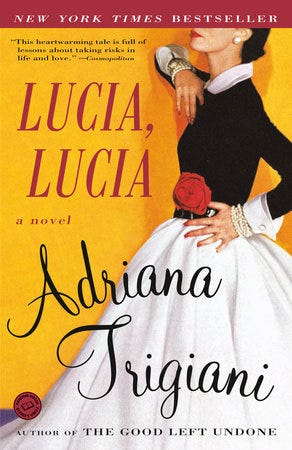
On the way home from the meeting, I was sorry I had used Lucia. My baby wasn’t born, and I was the guardian of her privacy and I had failed. My husband dismissed my fear, “It’s good luck.” My friend Michael Patrick King said, “Maybe you’ll have a boy.” Then he asked me what I would name a boy, and I said, “Francesco Bonicelli Stephenson.” Michael said, “Why don’t you just name your son, Throw the ball at my head at recess?” Lucky for the mythic Francesco, I had a daughter. And Ann got her title.
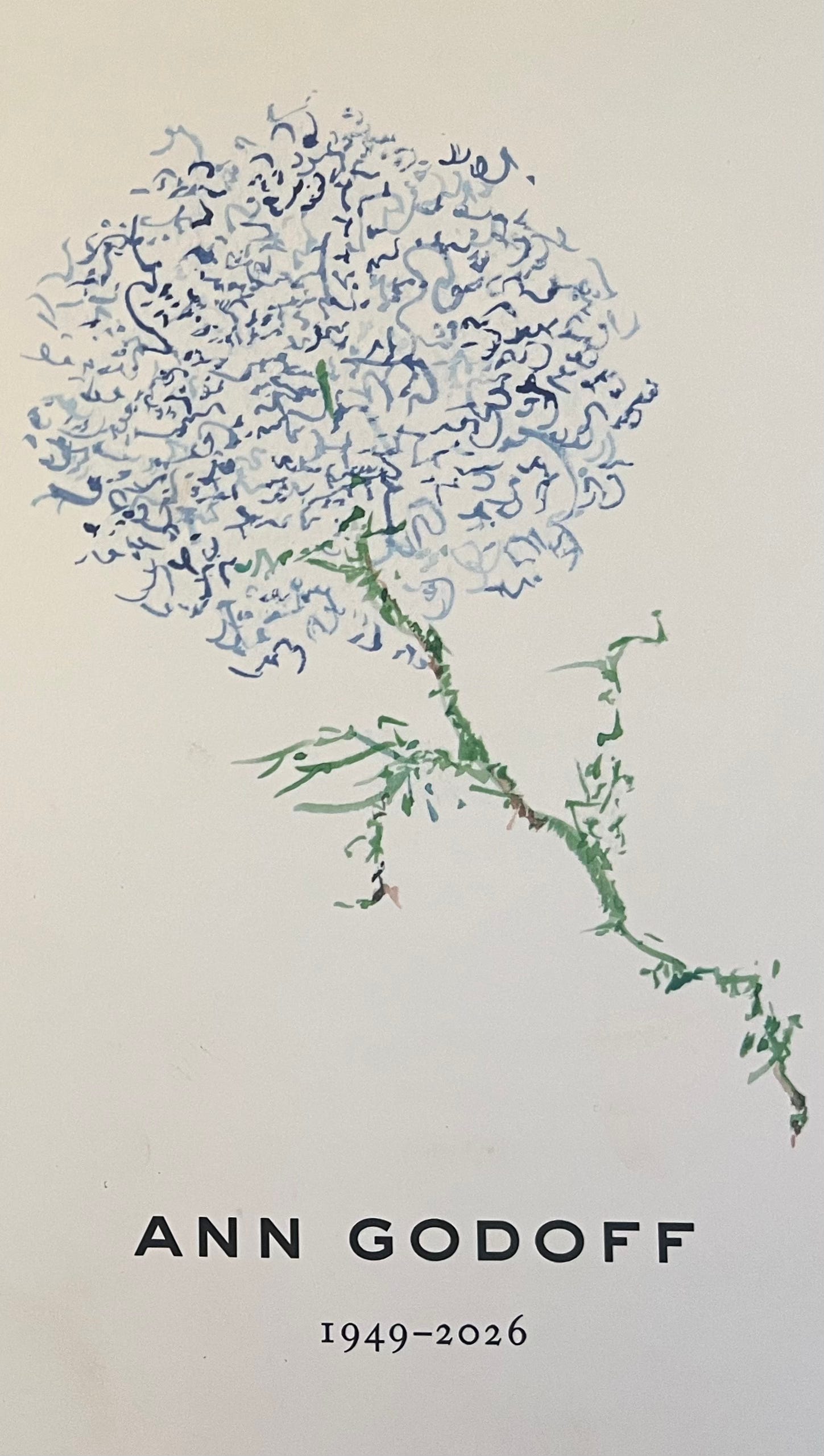
Ann was a connector of people. Her wife, Annik LaFarge, worked in publishing and is a beautiful writer (I loved Chasing Chopin). Annik’s mother, Ann LaFarge, a former editor and teacher, wrote a book review column “The Constant Reader” for a newspaper in the Hudson Valley. Ann LaFarge was always the first critic to write about my novels, and I treasured her insight. When Ann Godoff took you in, soon you had a bouquet of new friends by extension. What a family. Ann knew how to build families, and to be a person of integrity within one. At Ann’s memorial service her brother, sister-in-law, nieces and nephew were bereft. There were stories told that were illuminating and moving. And of course, there were surprises. We found out that Ann painted watercolors, her glorious painting graced the screen on the stage, along with a Steinway piano, played by the brilliant Dan Tepfer throughout the service.
We found out that Ann’s path to becoming an editor and publisher was similar to hacking a path in a dark forest. She had a myriad of jobs that eventually informed her love of storytelling and a commitment to readers and their need to be heard. She was raised in Hollywood, and found her way to New York City. She did odd jobs, struggled, but because she read and possessed a keen intellect, the world of books would present itself to her, and she would enter it and never look back. It wasn’t easy. It’s a glorious community, and a demanding one. An editor is essential to the writing process- she or he reads with a keen eye and may be the only person in the world who is honest with the author. Ann as editor and publisher was a lover of the word fighting for the word. For the reader of the books she published, across non-fiction, fiction, autobiography and biography, it was a journey to excellence. Readers gained knowledge, and ultimately, illumination through the books she edited and published.
The folks who spoke at her service were all wonderful. Allison Dobson, president of Penguin Random House, described Ann beautifully. Scott Moyers, Michael Pollan, Zadie Smith, Ron Chernow, Elif Batuman and Ocean Vuong (who pointed to Ann’s art and commented on its whimsical charm) spoke from their hearts about the editor and publisher who pushed them to do their best work. But, it’s Dr. Jerome Groopman, the great healer and author, who honored Ann with a reading of The Kaddish. Dr. Groopman recited the prayer in Hebrew. The prayer of sanctification sanctified us as we listened. When I went home, I looked up the prayer, and a translation of it in English. Here’s an excerpt:
Blessed and praised, glorified and exalted and uplifted, honored and elevated and extolled be the Name of the Holy One, blessed is He, above all the blessings and hymns, praises and consolations which we utter in this world - and say Amen.
The prayer tells us that in our deepest grief, we are loved by a God with a love so great for us it can not be described, and yet, as vast and unimaginable as that love is, it will also redeem us. In the loss of Ann, I reflect on her family, on her beloved Annik, on her brother Peter, his wife Heidi, and her niece Lara and nephew Nick, on her extended family which included her mother-in-law, the late Ann LaFarge, on the children she godmothered including (our) Nick Dyja.
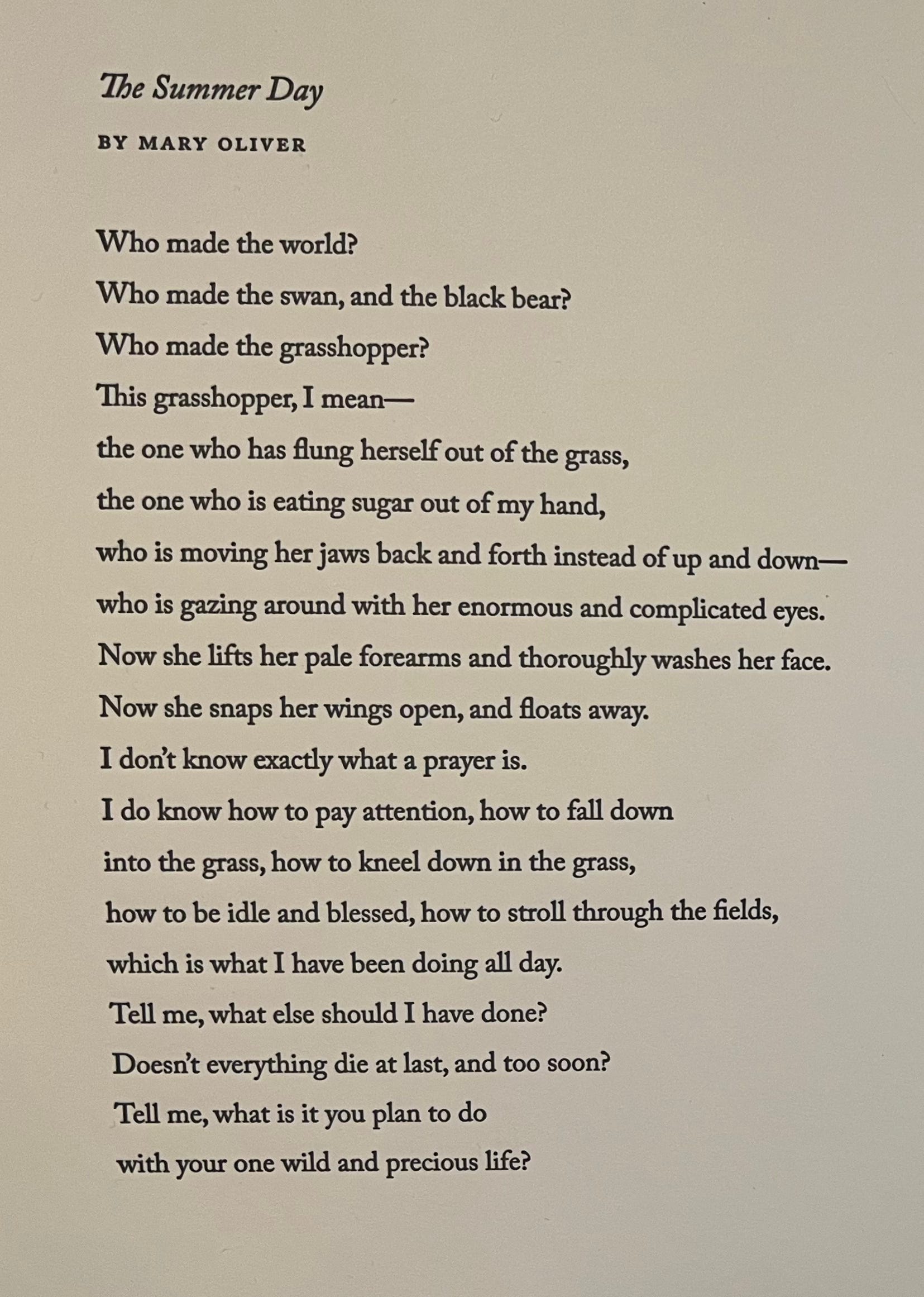
I thought about her professional achievements, about all of the authors she championed, all of the books she put on the shelves of libraries, all of the conversations the books she published encouraged, and how she knew the soul was fed by the written word and exalted by them. Ann changed many lives for the better through the books she edited and published, and we will never know the extent of it—her reach can not be calculated. What is the power of a library over centuries, how do we quantify its connectivity and power? If words were stars they would clutter an endless sky leaving no room for the sun. That’s the beauty of books. They continue to reach readers long after we pass, and it’s in that mystery that souls sustain storytelling through time. Ann taught us that to create a world is to make this one better—one book at a time. We know what Ann did with her one wild and precious life, and we are forever grateful.
No posts
Comments
Nothing yet. Say the first thing.
Sign in to join the conversation.