
The Princeton Review released its new book on Aug. 18, and if you have a rising senior, you already know. The group chat lit up by lunch. Someone’s cousin’s daughter is applying somewhere that ranked No. 3 in something. Your kid, who has not opened the Common App, would now like to discuss the dining hall situation at Bowdoin.
The stakes here are not imaginary. In a new Ellucian survey of more than 2,000 current and prospective students, 89% said they would have chosen a different college for more scholarship money. Nearly 9 in 10!! That’s not a preference, friends, that’s a market.
So here’s a decoder. Four rules for reading these lists the way an admissions officer reads them, which is to say skeptically and with a calculator open. None of the lists are wrong. They’re just answering questions you didn’t think to ask.
“The Best 392 Colleges: 2027 Edition” is in its 35th year. It isn’t one ranking. It’s 50 of them, each naming 25 schools, and all of them come from the same place: about 172,000 students who filled out a 98-question survey about their own campuses. That’s about 439 students per school.
There is no specific formula for selection, no endowment math and no reputation scoring from provosts who’ve never visited the campus they’re grading. Just students, answering questions about their own lives at college.
Rob Franek, the editor-in-chief, says the same thing every August and it’s worth repeating: no school is best overall. The book refuses to name one. The question it’s built to answer is “which college is best for me,” which is a different question and a much harder one.
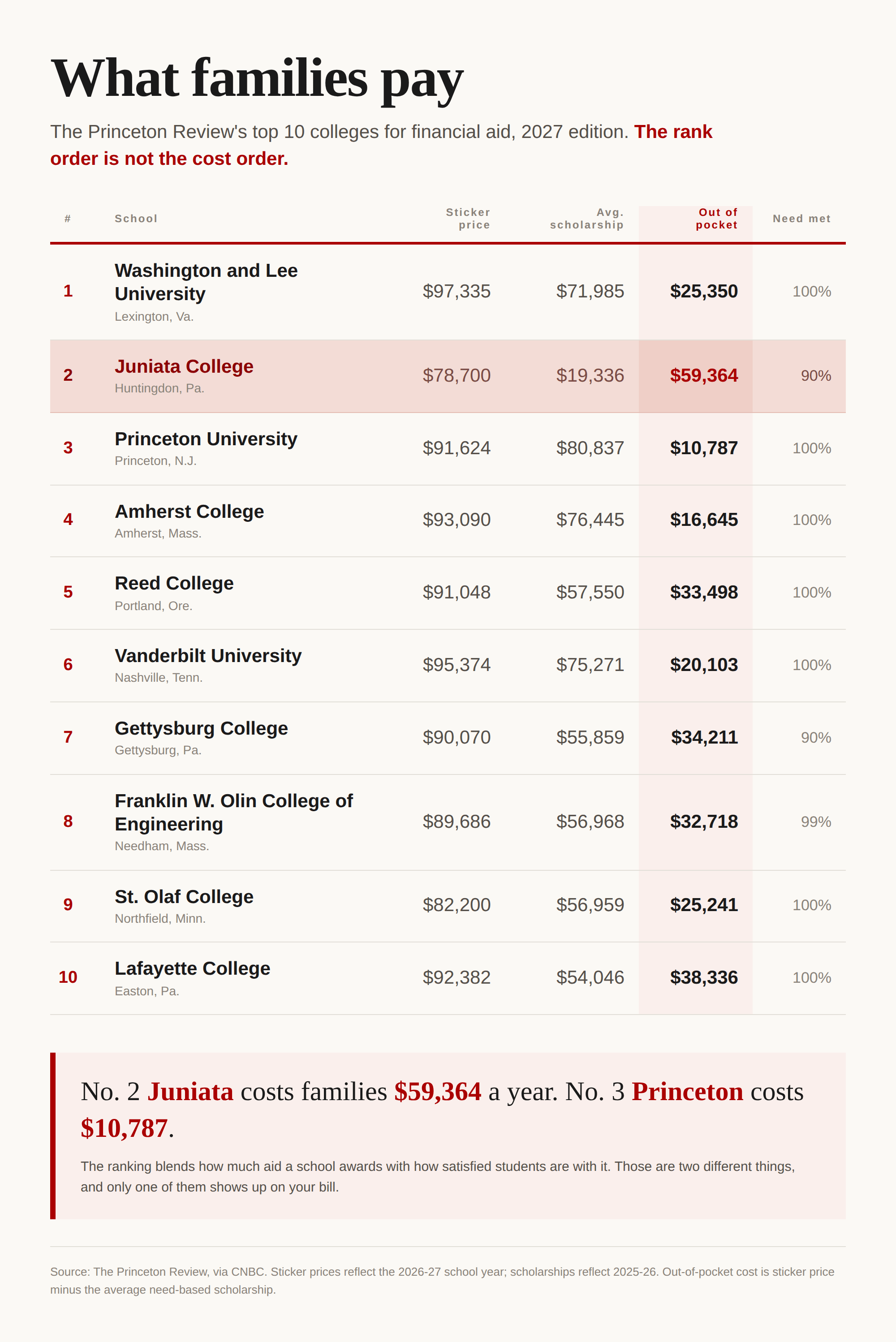
This is the one I’d tattoo on a parent’s forearm, and the numbers make it obvious. Here’s the financial aid top 10 with what The Princeton Review says families pay.
The school ranked No. 2 has the lowest sticker price in the top 10 and the highest out-of-pocket cost. Both are true at once, and that’s the whole problem with reading these lists from the top down.
Now look at No. 2 and No. 3.
Juniata College, a private liberal arts college in Huntingdon, Pa., ranks above Princeton University. A family at Juniata pays about $59,364 out of pocket. A family at Princeton pays $10,787. Princeton’s average need-based scholarship is $80,837, the largest in the country. Juniata’s is $19,336.
So how does Juniata finish ahead? Because the ranking blends how much aid a school awards with how satisfied its students are with what they got, and Juniata’s students are, by their own account, delighted. That satisfaction score is a real signal. It usually means somebody answered the phone, the award letter was legible and nothing mysterious happened sophomore year. It is a different signal from “this school will be affordable for your family.”
Both columns are useful. Read them separately!
Washington and Lee is the most expensive school on the list at $97,335 a year, and it’s No. 1. The average need-based scholarship there is nearly $72,000, which puts the real number closer to $25,350. The school meets full demonstrated need without loans, admits need-blind and hands full-ride Johnson Scholarships to 10% of each entering class.
Zoom out and the same pattern holds everywhere. Average published tuition and fees at private nonprofit four-year colleges reached $45,000 for 2025-26, per the College Board, while average net tuition and fees came to about $16,910. Families ultimately spent around $34,000 on the whole package last year, according to Sallie Mae. That figure includes room, board, books and the laptop.
Institutional grant aid, meanwhile, climbed 24% over the past decade to $85.1 billion. Roughly half of all grant aid now comes from the colleges themselves.
“There is money out there, great big buckets of money,” Franek said.
You will not find out how much of it has your kid’s name on it until you run each school’s net price calculator. Every college is required to post one. Almost nobody opens them. Do it in October, not in April when you’re comparing award letters and someone is crying.
There’s a new category this year: “Great Outdoors: Students Get Outside.” The University of the South, in Sewanee, Tenn., is No. 1, with St. Lawrence University and College of the Atlantic right behind it.
I love this list, and not because I own hiking boots. I love it because it’s the rare thing a 17-year-old can have a genuine opinion about. “Do you want to be somewhere people hike on Saturday morning?” is a far more productive dinner conversation than “what’s your reach school.” The odd categories get at fit, and fit is the variable that decides whether your kid transfers.
Same goes for Happiest Students, where Vanderbilt University finished first this year, with the University of San Diego and Denison University next. One warning: if a version of that list comes across your feed with Texas Christian University on top, you’re looking at an older edition. Check the year before you forward it to anyone.
The best use of this book is discovery. Sort by whatever your kid says matters, pull four schools you’d never heard of and put them on the list. Juniata. St. Olaf. Denison. Sewanee. These are the schools that compete for a strong applicant with money.
The worst use is treating No. 4 as meaningfully better than No. 11 when both came out of students circling numbers on a survey. The rankings aren’t precise enough for that, and they don’t claim to be.
Run the net price calculator for the three most expensive schools on your kid’s list. Then call one financial aid office and ask, out loud, whether they award merit money to students who don’t qualify for need-based aid. Plenty of families assume the answer is no and never ask.
“Merit aid is an underutilized resource,” Franek said. “These are grants, money that students don’t have to pay back. That is significant.”
Take a breath and close the laptop. Your kid is going to be fine in more places than either of you currently believes.
Send this to the parent in your life who’s three tabs deep in a college’s tuition page. The free half alone will change how they read an award letter.
No posts
Comments
Nothing yet. Say the first thing.
Sign in to join the conversation.