
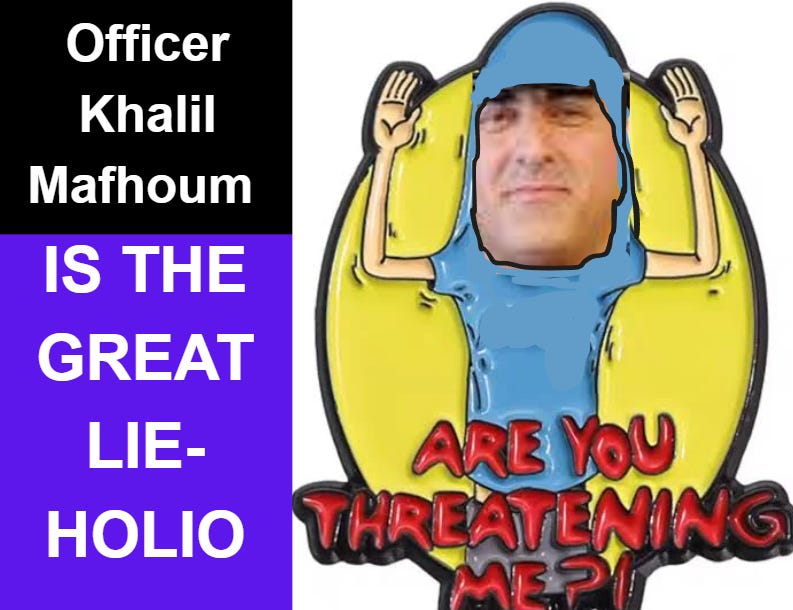
Picture a dimly lit room in a Massachusetts police department. Two figures sit slumped on a worn precinct couch, staring blankly at a glowing computer screen as a public records request notification pops up.
“Heh-heh... someone sent an email to the City Council,” one mutters.
“Are they threatening me, Unsworth?!”
“Uhhh, yeah!” replies Unsworth. “That’s an attack! Total shakedown street, uh-huh-huh!”
Welcome to the administrative comedy of errors starring Watertown Police Officer Khalil Mafhoum and Captain Daniel Unsworth.
Armed with badge numbers, zero grasp of constitutional law, and an impressive talent for venue-shopping, this poor, not-so-dynamic duo managed to turn a routine public records audit into a pure courtroom comedy.
Let’s crack open the court transcripts, dockets, and deeds to review how Officer Khalil Lie-holio sidekick, Danny Unworth, attempted to criminalize the First Amendment—and why paying a flat fee for legal defense is the best investment a whistleblower can make.
Before Mafhoum was crying on the stand in West Roxbury, he was starring in his own legal drama with the Massachusetts State Police (MSP).
Back in July 2018, Trooper Mafhoum was involved in an on-duty motor vehicle accident in his cruiser in Boston. Did he report the crash immediately to his superiors as required by MSP policy?
Absolutely not.
Instead, the Great Lie-holio, Pinocchio Mafool, took matters into his own hands, tried to negotiate a private payoff with the driver of a Kia Optima, and demonstrated a rather creative (and unlawful) interpretation of search and seizure laws by searching a vehicle based solely on the mere suspicion of burnt marijuana.
When the dust settled, the MSP terminated his employment for violating Department Policy TRF-20 and showing a profound “lack of candor”.
Unfazed, Mafhoum launched a legal odyssey:
The State Court Saga: Officer Khalil Lie-holio sued the MSP under G.L. c. 151B, which was promptly dismissed on statute of limitations grounds and affirmed by the Massachusetts Appeals Court (Docket 23-P-483).
The Federal Reboot: Undeterred by state jurisprudence, Pinocchio Mafhoum refiled his grievances in federal court (Khalil Mafhoum v. Massachusetts State Police, Case No. 1:24-cv-11339-LTS), where the Attorney General’s office filed a motion to dismiss, pointing out that his claims were barred by claim preclusion and utterly failed to state a plausible claim under Title VII.
When an officer is repeatedly told by multiple courts that his termination was lawful and his lawsuits are dead on arrival, the logical next step apparently isn’t self-reflection—it’s filing a retaliatory restraining order against anyone who dares mention public records about it.
Let’s clear up the fiction that Mafhoum and Unsworth tried to sell to the court: The whistleblower never contacted Mafhoum or Unsworth directly.
Zero Direct Contact: By Mafhoum’s own admission under oath, he and Dubé have had no contact since October 2022.
The Public Paper Trail: The emails in question were sent to public oversight bodies—including the Watertown City Manager, the nine Watertown City Councilors, the Secretary of State, the District Attorney’s office, Homeland Security, and the press.
Unsworth’s Administrative Role: Captain Unsworth didn’t receive these emails personally in his private inbox; they were forwarded to him by the Chief of Police strictly because of his administrative position overseeing records and internal affairs.
Exercising one’s constitutional right to petition the government regarding police corruption, residency fraud, and public safety is not harassment—it is a core civic duty.
Yet, the Watertown Police Department treated public accountability like a personal attack, choosing to weaponize the legal system to intimidate a citizen.
To execute this retaliatory strategy, Mafhoum needed a friendly venue. Bypassing his own local jurisdiction, he marched into West Roxbury District Court (Case No. 2606RO00082, before Judge John Garner). He testified that he couldn’t sleep, his 5th wife was crying, and negative emails were portraying him in a negative light.
Silly boy.
Records of his own lack of common sense are what casts him in a negative light. The Great Lie-holio Mafhoum, doesn’t let that stop him though. He continues acting with total disregard for law and truth.
Take for instance his residency fraud.
While Mafhoum swore under oath in Boston that he resided in West Roxbury to anchor his preferred venue, Hillsborough County New Hampshire registry records told a very different story.
Just days prior, on February 17, 2026, Mafhoum signed and recorded a federal mortgage and residency affidavit swearing under penalty of perjury that his primary residence was at 110 North Bend Drive in Manchester, New Hampshire.
It’s the ultimate Beavis and Butt-head multi-state multitasking maneuver:
To the federal mortgage lender: “I live in New Hampshire with my 5th wife as a primary resident!”
To the Massachusetts trial court: “I live in West Roxbury, please protect me from public emails that are sent, not to me; government officials and agencies receive them and forward them to the Administrative Services Captain!”
The Watertown Police Department’s campaign of harassment and intimidation deployed against the whistleblower reached an alarming, Kafkaesque peak in late February and early March 2026.
The Barrage of Anonymous Calls and “Shakedown Street”: The whistleblower’s phone records transformed into a relentless switchboard of intimidation, logging a barrage of calls from a dizzying array of disparate area codes (including 386, 202, 321, 786, 603, 209, 430, 551, and dozens more) beginning the exact day public inquiries were launched on February 13, 2026. This digital siege culminated on February 27, 2026—the very day the temporary restraining order was served—with a text message from a Manchester, New Hampshire number flashing the message: “What a great shakedown street” alongside a stylized image.
The Mental Health Smear (Echoes of Donahue v. Watertown): Lacking any legitimate legal or factual footing to counter the public records, the department resorted to psychological delegitimization. Captain Unsworth took it upon himself to testify before the court regarding vague “concerns about health issues” surrounding the whistleblower. This tactic of weaponizing speculative medical or psychological framing to smear a critic is a tired, retaliatory playbook chillingly reminiscent of Donahue v. Watertown.
The Wellness Check Assault: This administrative smear campaign leaped from the courtroom into reality on March 5, 2026, when officers from an outside jurisdiction attempted to execute an unwarranted “wellness check” directly at the whistleblower’s school in the middle of the school day. Captain Unsworth openly admitted on the record to placing intrusive phone calls to the school’s Human Resources division under the guise of an ongoing “criminal investigation” into the whistleblowing emails.
The School Lockdown and Suffering of Students: This retaliatory police spectacle forced a sudden hallway lockdown, plunging a public school into unnecessary chaos. Every time thin-skinned municipal officials orchestrate a police presence at an educator’s workplace, the real victims are the children. Forcing a 6th-grade English Language Arts classroom into lockdown over a baseless, vindictive police maneuver robs students of a safe, stable learning environment, subjecting children to frightening, manufactured confrontations entirely for the bruised egos of adult public servants.
During cross-examination by defense counsel Attorney Timothy Bradle, the courtroom comedy reached its peak as Mafhoum and Captain Unsworth attempted to redefine the English language.
Q: Has she ever made a threat to you [since 2022]?
A: Um, no.
Q: Are there any threats in any of the emails that you’re mentioning here?
UNSWORTH: Um, not threats to his physical well-being.
Q: Well, isn’t that what a legal threat is?
UNSWORTH: Uh, no, I mean there’s other ways of threatening folks, their livelihood...
According to Captain Unsworth, petitioning the government, forwarding public records requests, and pointing out that an officer was fired for lack of candor constitutes a “threat” because it might hurt someone’s career. By that logic, every negative Yelp review and every public employment record is a violent assault.
Fortunately, Judge John Garner wasn’t buying the Beavis and Butt-head routine. On March 18, 2026, the court delivered a definitive ruling:
“I did have the opportunity to review the law and the law is quite clear... it is clear that the types of actions engaged against you do not qualify as harassment under the statute... your fear has to be a fear of physical harm or fear of physical damage to your property... and specifically case law says that it must be that fear must be more than a fear of economic loss... Unfortunately it doesn’t qualify. So the court will terminate the order forthwith.”
The court confirmed that expressing concern over public corruption, sharing public records, and petitioning government officials is 100% constitutionally protected activity.
The only thing actually threatening Officer Mafhoum is his own poor choices, pathological lying, New Hampshire mortgage deeds, and court dockets documenting his lack of candor.
And thankfully, because the whistleblower had the foresight to pay a flat fee for her lawyer, she got to watch this entire retaliatory legal circus get dismantled piece by piece while absolutely getting her money’s worth.
No posts
Comments
Nothing yet. Say the first thing.
Sign in to join the conversation.