
There is a fundamental rule in crisis communication that every first-year public relations major learns on day one:
Effective PR is proactive, not reactive.
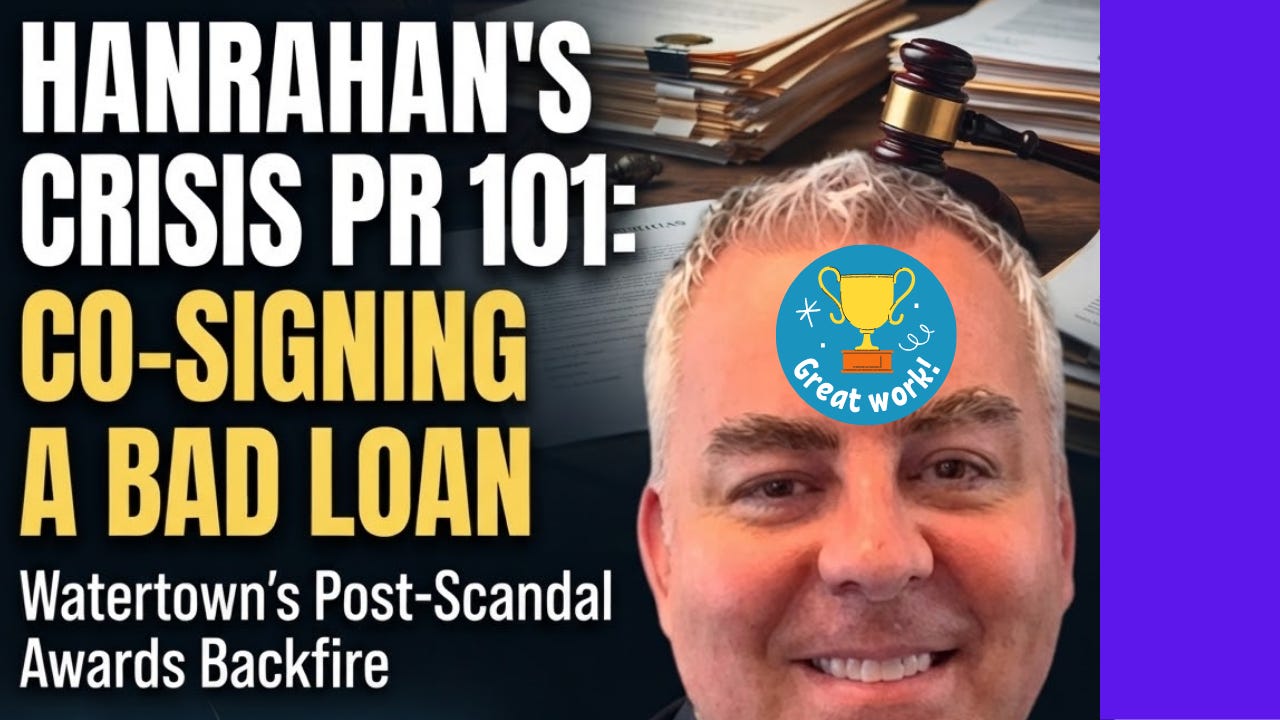
Getting ahead of a story means building a reservoir of institutional credibility, transparency, and goodwill before the proverbial shit hits the fan. That way, if a bump in the road occurs, the public and the stakeholders have a baseline of trust to fall back on.
But what happens when an institution throws that rulebook out the window? What happens when a police department waits until internal affairs files, Hillsborough County mortgage affidavits, state police terminations, and West Roxbury court losses are already part of the permanent public record—and then decides to launch a massive, glowing positive PR campaign?
Spoiler alert: You aren’t managing a reputation anymore. You are co-signing the mess.
Let’s look at the two distinct operational modes of modern municipal optics:
Proactive PR (Reputation Management): This is building a clean record, holding people to high standards, and ensuring your house is in order so that when you hand out an “Officer of the Month” award, nobody has to Google the recipient’s name with a container of bleach nearby.
Reactive PR (Co-Signing the Shit): This is what happens when an organization panics after being caught red-handed. Instead of addressing the systemic vetting failure or owning a compromised hire, they grab a megaphone, slap a gold star on a plaque, and try to drown out a mountain of certified paperwork with local cable access fluff pieces.
When you push positive PR after the facts are already public, you aren’t spinning a narrative—you are shouting to the world, “Not only do we know about the cruiser crash cover-ups, the unconstitutional searches, and the fake residency addresses... we endorse them!”
Think of a municipal department’s credibility like a financial loan.
If someone has a pristine credit score and a flawless history, co-signing their loan is a safe bet. But if someone has a history of financial defaults, cross-state shell games, and court-shipped legal failures, attaching your name to them is financial suicide.
Yet, that is precisely what Watertown Police leadership did when they handed Officer Khalil Mafhoum a post-scandal spotlight.
The Evidence Was Already Framed: By the time the award was handed out, the public record was already locked in concrete. The dockets were stamped, Judge Garland had formally thrown out their emergency restraining order as Constitutionally Protected Petitioning Activity, and the State Police IA files authored by Captain Thomas McCarthy were already a matter of public fact.
The Streisand Effect in Action: If leadership had just kept quiet and let him fade into the background noise of the department, casual observers might never have looked twice. But crowning a disgraced, multi-state residency-dodger “Officer of the Month” after the scandal broke was the administrative equivalent of ringing a dinner bell for every investigative eye in the Commonwealth.
Tying Your Anchor to a Sinking Ship: Every single official who co-signed that PR stunt effectively tied their own professional reputation to a sinking ship. They didn’t insulate him from criticism; they just ensured that their own poor judgment is now permanently indexed right alongside his.
The fatal flaw of defensive bureaucracy is the belief that volume can defeat truth. They genuinely seem to think that if they produce enough shiny plaques, local media spots, and press releases, the physical laws of documentation will simply cease to exist.
A glossy local cable segment cannot rewrite a Hillsborough County registry deed.
An “Officer of the Month” plaque cannot delete a State Police termination letter for lack of candor.
A defensive press release cannot talk a judge out of ruling that reporting police misconduct is Constitutionally Protected Petitioning Activity.
At the end of the day, trying to cover up a paper trail with post-scandal PR is like trying to fix a sinking cruise ship by rearranging the deck chairs and handing out participation ribbons to the band.
The paperwork is permanent, the receipts are stamped, and reality always wins in the end. And the next time leadership tries to draft a PR campaign for a compromised hire, they might want to remember the golden rule:
If you weren’t smart enough to vet them right the first time, don’t be foolish enough to autograph their wreckage.
When you look at the executive roster running this entire municipal circus, the comedy practically writes itself. You have a trifecta of high-end credentials, professional consulting firms, and Harvard-adjacent pedigrees attempting to manage a crisis, only to get completely outplayed by a middle-school teacher with a red pen and a registry deed.
Let’s break down the resume of Watertown’s finest management squad:
The Pitch: Chief Hanrahan operates Hanrahan Consulting, LLC, a private enterprise dedicated to training police supervisors, writing custom promotional exams, and authoring the definitive field manuals on Massachusetts criminal law, procedure, and tactical management.
The Reality: The man who literally builds the testing modules and trains departments on legal compliance somehow oversaw a vetting process that greenlit a multi-state residency dodger and a post-scandal award rollout. Watching a professional police trainer stumble over a basic public records audit is like watching a master locksmith lock themselves out of a paper bag.
The Pitch: City Manager George Proakis brings heavy-hitting municipal planning credentials to Watertown, complete with a teaching role at the Harvard Graduate School of Design (GSD), where he lectures future leaders on structural development, strategic zoning, and large-scale systems.
The Reality: You can lecture on advanced spatial design at Harvard all day long, but apparently, no amount of Ivy-League curriculum prepares a city manager for the sheer load-bearing reality of a certified registry deed. They tried to engineer an impenetrable PR fortress around a compromised hire, only to watch their entire structural framework collapse under basic math.
The Pitch: The administrative brass projects an air of rigid, institutional dominance, treating local governance like a tightly controlled tactical operation.
The Reality: Their high-tier crisis response strategy consisted of filing a rushed, panic-driven emergency ex parte legal motion that got tossed forthwith in West Roxbury District Court for violating Constitutionally Protected Petitioning Activity. So much for advanced tactical oversight.
You have a police chief running a private legal instruction business, a city manager teaching design frameworks at Harvard, and an administrative tier accustomed to absolute control.
Yet, when put to the test, their multi-million-dollar municipal machinery completely short-circuited against an ordinary citizen armed with public documentation, an expert legal defense, and an educator’s refusal to accept sloppy homework.
Turns out, no amount of consulting logos or academic prestige can save an institution when the paper trail is completely airtight.
No posts
Comments
Nothing yet. Say the first thing.
Sign in to join the conversation.