
When an administrative apparatus decides to panic, it rarely looks graceful. Instead of sober introspection or adherence to due process, institutions under pressure tend to thrash—pulling every available lever of state power to muzzle a public records audit, only to realize too late that they have engineered their own legal trap.
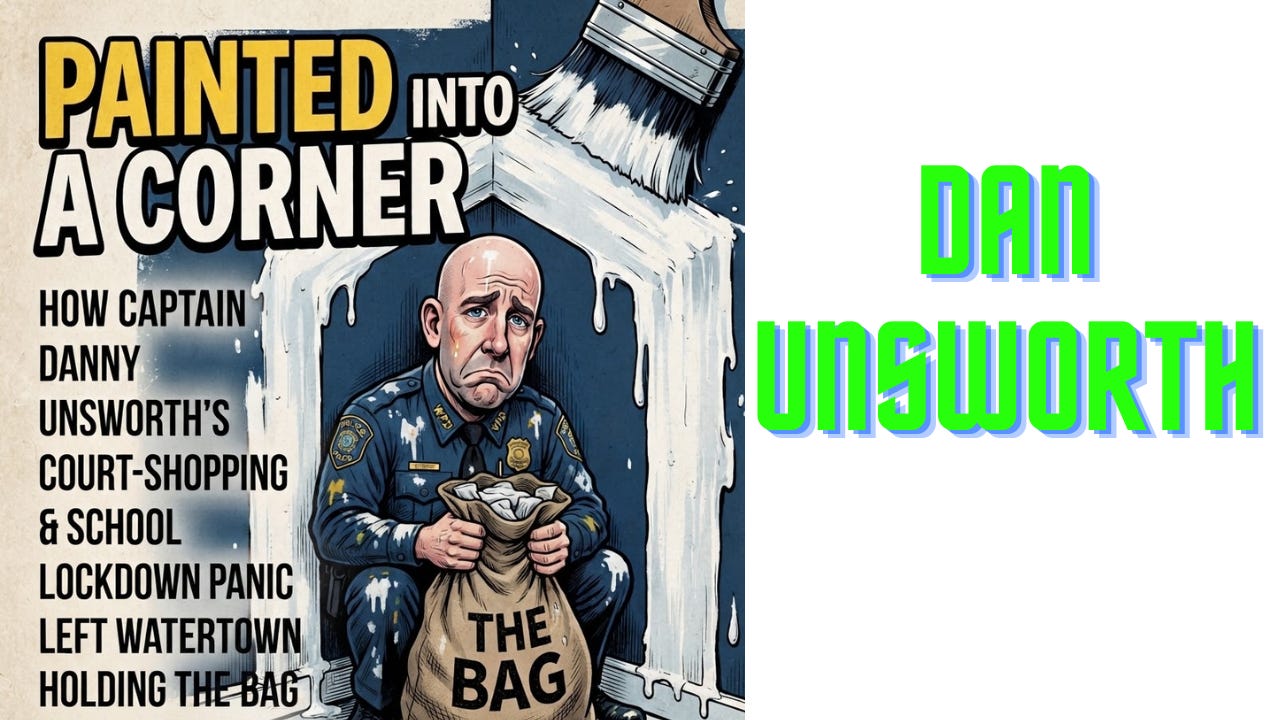
Nowhere is this phenomenon better illustrated than in the spectacular, self-inflicted collapse of the Watertown Police Department’s attempt to weaponize a 258E harassment prevention order against a public records whistleblower. Led by Captain Daniel Unsworth—whose ambitions at the time included a finalist run for the Police Chief position in Belmont—the department’s command staff sprinted headfirst into a legal cul-de-sac.
Now, with the dust settled and the court records locked in, the city is left holding an embarrassing bag of their own making.
The anatomy of a municipal panic usually starts with uncomfortable facts that cannot be refuted by standard PR. When a forensic paper trail exposes residency inconsistencies and a historical “lack of candor” firing from the Massachusetts State Police, standard accountability dictates a quiet internal review.
Instead, the response was theatrical redirection.
Seeking a friendlier forum outside local oversight, a petition for a harassment prevention order (Docket No. 2606RO00082) was filed in the West Roxbury District Court. To anchor jurisdiction where neither party lived or worked, a complex staging of addresses was utilized—all while public records and registry deeds clearly mapped out multi-state property realities in Manchester, New Hampshire.
The immediate catalyst?
A flurry of March 1 and March 2 emails to the Watertown City Council, the City Manager, and external oversight bodies documenting public records and residency mandates.
Rather than answer the substance of the audit, the command staff treated basic civic petitioning as a personal assault.
To fully understand the desperate velocity behind Captain Unsworth’s legal overreach, you have to look at his calendar. On Friday, February 20, 2026, Unsworth was sitting before the Belmont Select Board as a top finalist for their Police Chief position. He was pitching his administrative record, his command experience, and his vision for leadership.
But leadership dossiers have a funny way of colliding with reality.
Just days later, as the Watertown command staff was scrambling to contain a mounting forensic audit regarding officer residency fraud and historical “lack of candor,” the whistleblower did what any engaged citizen does: she went straight up the administrative ladder. On March 3, 2026, an email dropped directly into the inbox of the Belmont Select Board, detailing how Watertown’s command staff was weaponizing the court system to silence public records inquiries.
For a career-focused captain vying for a chief’s office, having a meticulous, unassailable paper trail of institutional retaliation land in front of your prospective new bosses is the ultimate nightmare. Belmont Select Board member Elizabeth Harmer Dionne politely acknowledged receipt of the files as “useful information to have”.
That wasn’t just a professional embarrassment—it was a direct threat to his promotional trajectory. Is it any wonder the department’s response shifted from administrative stonewalling to frantic, unhinged retaliation? When your resume says “competent administrator,” but the public record says “retaliatory legal wrangler,” a quiet cover-up becomes an absolute emergency. Unfortunately for Captain Unsworth, his attempt to bully the courts only ensured that his career ambitions and his administrative blunders became permanently linked for the entire Commonwealth to see.
When an ex-parte order stands on toothpicks, desperate actors look for heavier artillery. On March 3, 2026—staring down the barrel of an upcoming two-party hearing—a rushed criminal complaint was fast-tracked through Waltham District Court, alleging a violation of the civil order based entirely on protected emails sent to public officials.
The tactical overreach didn’t stop at the courthouse docket. In a move that stunned educators and administrators, police presence and wellness-check maneuvers were directed straight toward an inner-city school during instructional hours, triggering a disruptive hallway lockdown.
The goal was transparently obvious: create enough chaos, intimidation, and social friction to force a capitulation. Captain Unsworth appeared in court to validate the department’s “research” and amplify the narrative of institutional distress. They desperately needed that restraining order extended for a full year to validate their retaliatory posture.
Every house of cards meets its judge, and for this particular scheme, that moment arrived on March 18, 2026, before Judge John Garner in West Roxbury.
Defended by heavyweight counsel Tim Bradl, the defense relied on an unassailable framework: the First Amendment, the anti-SLAPP statute, and the bedrock legal standard established in O’Brien v. Borowski.
When Judge Garner systematically dismantled the petitioner’s claims, the core weakness of the department’s entire strategy was laid bare. The court drew a bright, unyielding line under Massachusetts law:
Economic Fear vs. True Threats: The judge explicitly noted that the petitioner’s stated “fear” was entirely a fear of economic loss and professional exposure—worrying about losing a job or facing scrutiny over background qualifications.
The Legal Threshold: Under c. 258E, generalized professional anxiety or embarrassment does not constitute harassment; the law requires a credible threat of physical harm or property damage.
Protected Activity: Documenting residency requirements, highlighting public disciplinary history, and petitioning government leaders are 100% constitutionally protected activities.
With those foundational truths established on the record, Judge Garner did not hesitate: the order was terminated forthwith.
Here is the ultimate irony of the department’s tactical overreach: even though Judge Garner completely vaporized the underlying civil restraining order on March 18, declaring it legally meritless and an infringement on protected speech, the retaliatory criminal charge fast-tracked through the Waltham District Court back on March 4 is still dragging through the system.
Think about the legal absurdity of what Captain Unsworth and the WPD prosecutors engineered. The entire criminal complaint rests on the premise that a “violation” occurred. But how do you prosecute someone for violating a restraining order when the higher court subsequently rules that the order itself was constitutionally baseless, protected petitioning activity, and legally dead on arrival?
It is the administrative equivalent of demolishing a house, finding out it was built on public property without a permit, and then trying to fine the neighbor for tracking mud across the nonexistent floorboards.
Now, the city’s legal handlers are stuck with a hollow, retaliatory prosecution grinding away in Waltham. They can’t win it on the merits because the foundational civil order is gone, but dropping it outright means admitting to the public, the DA, and the risk managers that the whole thing was a bad-faith retaliatory stunt from the start. They wanted a weapon to bully a whistleblower, and instead, they handcuffed themselves to an embarrassing, runaway criminal docket they don’t know how to close.
When you paint yourself into a corner with a rushed, retaliatory criminal charge that relied entirely on a now-vacated civil order, your strategic options shrink dramatically.
The Ghosting Strategy: They can quietly let the remaining docket items wither away in procedural limbo, hoping the public loses interest while they back away slowly.
The Bureaucratic Shuffle: They can attempt internal reassignments, burying the fallout in back-office paperwork to keep command staff out of the line of fire.
The Risk Manager’s Nightmare: Behind closed doors, municipal insurance pools and risk analysts are looking at the ghost of past multi-million-dollar civil rights liabilities (such as the Donahue verdict) and sweating through their collars.
The exquisite humor of the situation lies in the utter mismatch of forces. The department rolled out a heavy-handed, tactical play-acting routine, expecting a quiet target to fold under the lights. Instead, they walked straight into a masterclass in public accountability, complete with an unassailable paper trail, forensic audits, and an audience that treats their administrative thrashing as dark comedy.
Let them search for their off-ramps. The public record is written, the court has spoken forthwith, and the soundtrack is already playing.
No posts
Comments
Nothing yet. Say the first thing.
Sign in to join the conversation.