
In local government, emails come and go. Most are swallowed by the quiet void of municipal inboxes, read lazily or ignored entirely.
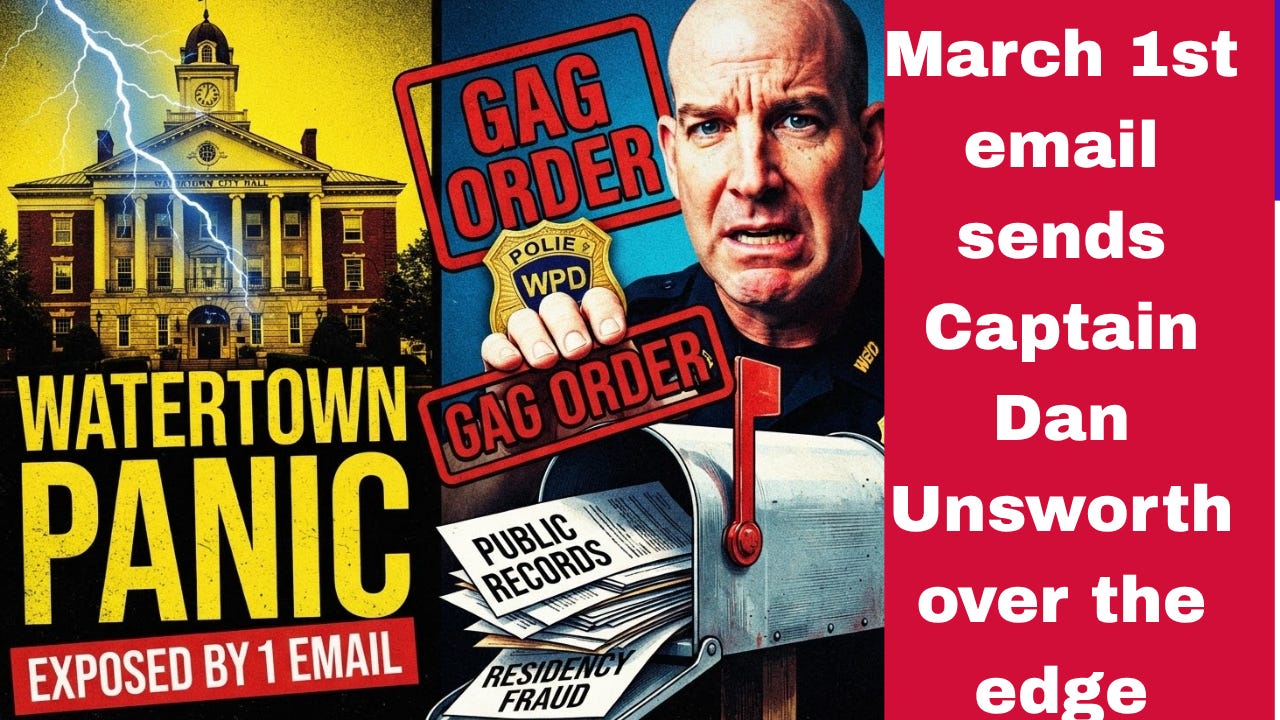
But every so often, a single piece of correspondence arrives that acts like a lightning strike, illuminating the entire structural rot of an institution.
For the Watertown administration, that lightning bolt was the email sent on March 1, 2026.
It was a comprehensive, meticulously organized dossier containing public records, registry deeds, and state police internal affairs files. It laid out the uncomfortable truth about a compromised hire, multi-state residency gymnastics, and systemic failures of oversight.
Yet, how Watertown leadership handled that single email reveals a profound, almost comical split personality within the town's governance—and exposes the desperate, obsessive lengths to which they went to avoid looking at the facts.
Two Reactions to One Email: Governance vs. Panic
When the March 1 email landed across municipal desks, it triggered two completely opposite human reactions, perfectly capturing the divide between ordinary public service and institutional self-preservation:
The Rational Response (Vincent Piccirilli): Watertown City Councilor Vincent Piccirilli—noted as the rare councilor who actually reads and responds to his correspondence—performed a radical, human act. He replied, thanked the sender for the documentation, and confirmed he would pass the information along to the appropriate parties. No hysterics. No police escorts. Just basic, functioning governance.
The Criminal Retaliation (Captain Danny Unsworth): On the exact other end of the spectrum, Watertown Police Captain Danny Unsworth looked at that very same email and decided it was a criminal act.
Instead of initiating an internal review of the residency fraud outlined within its pages, Unsworth weaponized the department, drafted a criminal complaint, and had a criminal summons slapped onto the sender.
To Unsworth and the department, an email exposing a bad hire wasn't an administrative wake-up call; it was a threat to their brand that needed to be prosecuted.
The Gag Order Blueprint: Why Captain Unsworth Weaponized a Restraining Order Against the Mailbox.
When Captain Danny Unsworth and Officer Khalil Mafhoum walked into a West Roxbury courtroom to secure a temporary restraining order, they weren't acting out of a genuine fear for their physical safety. They were engaged in a desperate, last-ditch salvage operation.
To understand why they panicked over a routine March 1 email, you have to look at what Danny Unsworth was actually trying to achieve: a total information blockade.
The Phantom Lawsuit and the "Indirect Contact" Delusion
It was almost as if Captain Unsworth was personally invested in Mafhoum’s failed federal civil litigation against the Massachusetts State Police. Unsworth operated under a bizarre, defensive legal delusion: he seemingly believed that if a government official—like a City Councilor or the Town Manager—received an email from the whistleblower and forwarded it to Danny or the department, it could somehow be misconstrued as "indirectly contacting" Mafhoum or violating an order.
Instead of recognizing that public officials are legally required to field constituent correspondence and public records, Unsworth treated every forwarded public document like a biological hazard.
Why Danny Refused to Look at the Real Record
To understand why Unsworth fought so hard to criminalize an email, you have to look at what he was trying so desperately not to talk about.
Danny Unsworth wanted nothing to do with the actual, verified facts of Khalil Mafhoum’s personnel file:
He didn't want to explain why a recruit fired by the State Police for a cruiser crash cover-up and a lack of candor was put in charge of training Watertown rookies.
He didn't want to address the glaring multi-state residency fraud—how Mafhoum could sign a federal mortgage affidavit swearing he lives in Manchester, New Hampshire, while collecting a taxpayer-funded paycheck under Watertown’s strict 15-mile residency mandate.
He didn't want to admit that his department’s vetting process was an absolute, negligent failure.
Using a Restraining Order as a Censorship Tool
Because addressing those truths would expose his own administrative complicity, Unsworth attempted a brilliant, highly unethical sleight of hand. He tried to use Mafhoum’s temporary restraining order not as a shield against a threat, but as a gag order on the government itself.
By manufacturing a legal narrative of "harassment" out of public records requests, Unsworth hoped to intimidate city councilors, town managers, and state agencies into stopping the circulation of her emails. If he could legally muzzle the messengers inside the government, the paper trail would die quietly in the dark. They weren't trying to stop a stalker; they were trying to stop public officials from reading the truth.
The Courtroom Obsession: Why Did She Say "Mandated Reporter"?
When the conflict finally spilled into a courtroom, you would expect the legal proceedings to center around the core allegations: the 2018 State Police firing for lack of candor, the conflicting New Hampshire mortgage deeds, and the multi-state venue shopping.
Instead, the petitioners and their legal cheerleaders locked onto a microscopic detail with the intensity of detectives solving a decades-old mystery: Why did she mention that she was a "mandated reporter"?
In the courtroom transcripts, the phrasing became a focal point of bizarre fascination. They parsed it, turned it over, and treated the title like a cryptic confession. They acted as though a professional educator identifying her legal and ethical obligation to report wrongdoing was some sort of sinister psychological tic.
Why It Was Entirely Relevant
The obsession with the term "mandated reporter" completely misses—or intentionally obscures—its foundational legal relevance:
The Duty to Disclose: As a licensed public educator and professional working under state oversight, a mandated reporter is trained to recognize, document, and report systemic harms, child safety risks, or institutional corruption.
Grounding the Context: Mentioning her professional standing wasn't a threat; it was an explanation of why an ethical citizen cannot simply look away when they discover a public safety official operating under color of law with a falsified residency or a concealed disciplinary record.
The Contrast in Ethics: By highlighting her status, she was drawing a sharp line between a professional bound by a code of accountability and an administrative apparatus bending the rules to protect a liability.
Yet, rather than address the substance of what a mandated reporter was bringing to light—actual public records—the department preferred to squint at the punctuation and interrogate the vocabulary.
No posts
Comments
Nothing yet. Say the first thing.
Sign in to join the conversation.