
Whenever an institution is caught with its guard down, it immediately abandons the facts and focuses entirely on the person holding up the mirror.
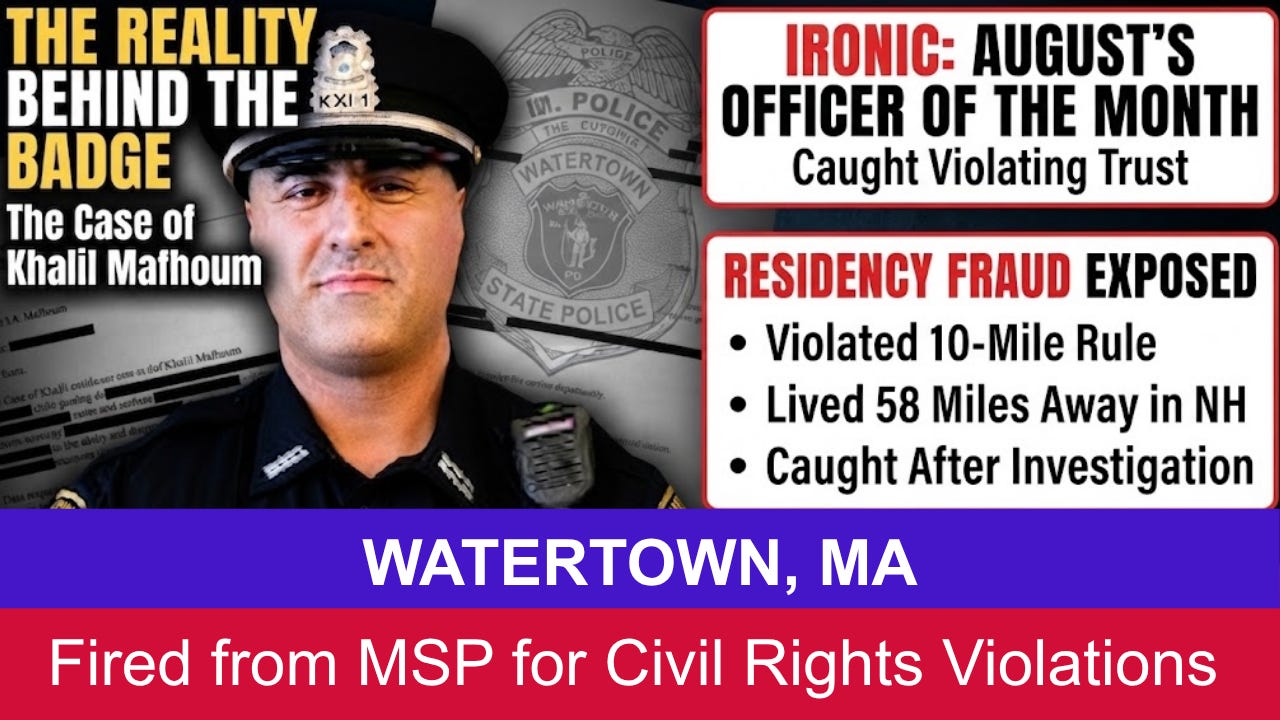
When a citizen steps forward with certified public registry deeds, state mortgage affidavits, and State Police internal affairs files exposing a compromised hire, the defensive PR machine doesn’t pause to audit the paperwork. Instead, they pivot instantly to character assassination, scrambling to manufacture a convenient label to explain away the exposure:
“Oh, she’s just an angry ex.”
“He only reported it because he wanted the promotion.”
“They’re just a social justice warrior.”
“What do you expect from a woman?”
“That’s the problem with woke teachers these days.”
“They’re just mad about a traffic ticket.”
“I bet she has blue hair and a nose ring too.”
“They lost an election / hold a grudge / are totally obsessed.”
It is a lazy, automated deflection designed to distract from the rot beneath. But it raises a fundamental, unanswerable question for Watertown leadership: What messenger would ever be acceptable to them?
The reality is simple: Anyone reminding the Watertown Police Department of their own negligent vetting would be attacked somehow. If an outsider pointed it out, they’d be dismissed as a meddling busybody. If an insider brought it up, they’d be branded as a disgruntled employee. If a political rival noticed, it would be written off as partisan sniping.
Chief Justin Hanrahan and Captain Danny Unsworth don’t actually hate the messenger; they hate the message because they cannot refute the math.
A bank robber could point to Watertown Officer Khalil Mafhoum’s public records, registry deeds, and State Police termination files, and those documents would still be entirely, immutably true. The paperwork does not care who is holding the binder.
When Captain Danny Unsworth and Officer Khalil Mafhoum marched into a West Roxbury courtroom on February 26, 2026, to secure an emergency ex parte restraining order, they tried desperately to frame the whistleblower through a lens of personal malice. Mafhoum spun an elaborate, theatrical yarn claiming the whistleblower was uniquely out to destroy him, absurdly suggesting she was even personally responsible for his 2018 termination from the Massachusetts State Police.
You know who is one of the messengers? Massachusetts State Police Captain Thomas McCarthy.
The official Massachusetts State Police internal affairs file—authored and sustained by Captain Thomas McCarthy—doesn’t care about personal feelings or vendettas. Captain McCarthy’s sustained findings—that Mafhoum caused a cruiser crash, executed an unauthorized cover-up, conducted an unconstitutional search based on a fabricated “marijuana odor,” and lacked basic candor—were generated by his own supervisors and his own admissions. No whistleblower wrote those disciplinary reports for him; he authored them entirely through his own conduct.
To understand why nobody can “let go” of Mafhoum’s 2018 Massachusetts State Police firing, you have to look at the sheer, unmitigated audacity of how it happened.
Most recruits go through the standard Academy and the mandatory break-in period where they ride alongside a seasoned training officer, learning how to walk the line. Mafhoum struggled so fundamentally with the basics that he required extra months of hand-holding just to scrape across the finish line. Then came his very first month flying solo in a cruiser. What did he do? He promptly drove into a civilian’s Kia Optima.
Instead of following standard operating procedure, notifying the barracks, and preserving the scene, Mafhoum’s default operating system kicked in:
The Illegal Search: He claimed he smelled “burnt marijuana”—a classic, unconstitutional pretext used to justify a warrantless search on the spot.
The Warrant Evasion: He noticed the young male driver wasn’t operating his own registered vehicle (a flashing neon sign for anyone looking for active warrants). Running a check would create a paper trail and expose warrants that would complicate the back-alley deal he was about to pitch.
The Off-the-Books Settlement: He promised to pay for damages out of pocket to keep it entirely off the books.
When the female car owner got the repair estimate and called him back, Mafhoum didn’t handle it like a state trooper; he handled it like a mob fixture. He invited her to meet him at an unlisted, shady auto body shop in East Boston. What sensible citizen drives to a back-alley garage in East Boston at the private invitation of a shady trooper? It sounds straight out of a Martin Scorsese film or a lost chapter from Whitey Bulger’s playbook. When the woman refused to play along with his sketchy setup, he ghosted her entirely.
When the MSP internal affairs division finally investigated, they sustained findings for failing to report a crash, unconstitutional search and seizure, and a total lack of candor. That wasn’t a “mistake”; it was a masterclass in evading accountability.
Fast forward to the West Roxbury courtroom, and Mafhoum’s testimony was a study in convenient vagueness. Lacking hard facts, physical evidence, or actual direct contact, he leaned entirely on melodrama, begging the judge to let the court’s imagination do the heavy lifting:
“Through her hatred towards my family and me, and her inability to let go of the past and move forward, she would do the unthinkable. I’m tired of looking over my shoulder, Your Honor. I’m tired of trying to hide every place I move to, afraid that one day she might show up at my front door... I’m literally here pleading with the court, asking please to extend the order. This person just wants to hurt me whichever way she can.”
And when pressed on the looming specter of what might happen next, Mafhoum solemnly warned the bench that he simply shuddered to think what she might do “if she doesn’t get what she wants.”
In Mafhoum’s cinematic imagination, the whistleblower isn’t just an educator with a binder of public records; she is a relentless, tactical mastermind starring in an intense psychological thriller. He wanted the judge to picture:
An elite covert operative: Tracking his every cross-state movement across New Hampshire and Massachusetts with CIA-level precision.
A chaos agent of pure malice: Dedicated full-time to orchestrating his professional demise simply for the sheer, unbridled thrill of ruining a guy who just wanted to casually crash cruisers and dodge residency laws in peace.
A phantom menace: Lurking behind every lamppost in Manchester and West Roxbury, waiting to pounce with a certified registry deed like it’s a lethal weapon.
In his script, Mafhoum is the humble, persecuted hero caught in a tragic Greek tragedy, while she is cast as an unyielding avenging angel who wakes up every morning asking, “How can I dismantle a Watertown police officer’s life today?” He genuinely believes her motivation is personal, obsessive, and driven by an intense desire to watch him suffer.
Let’s be entirely honest: what she actually wants is profoundly unglamorous.
She doesn’t want a cinematic showdown, an Emmy for best supporting drama, or a starring role in his fever dreams. She simply wants:
Basic institutional accountability: For police departments to stop hiring and promoting disgraced officers with sustained internal affairs files for lying and covering up accidents.
Basic math and municipal compliance: For public servants to actually live where they claim they live (preferably within the legally mandated 15-mile radius instead of 58 miles away in New Hampshire).
Truth in paperwork: For mortgage affidavits, registry deeds, and court testimony to match reality without requiring a masterclass in interstate shell games.
In short, she isn’t trying to hurt him; she’s just holding up a mirror—and for a scofflaw, looking into a mirror feels like a personal attack.
To a man who has built an entire adult life on shifting residency claims, paper marriages, and concealed internal affairs files, an educator with a red pen and a certified registry deed is the “unthinkable.” She represents the one thing his career cannot survive: verifiable truth.
On the stand, Mafhoum tried to frame his life as a hunted odyssey—insinuating that he had to flee Brockton, MA, and hide out in Manchester, NH, because he was terrified of the whistleblower.
It is a completely fabricated narrative. Mafhoum didn’t move to Manchester because of a whistleblower; he moved there because that is where his family lives. His older brother, Yacine, and relative Ayoub reside there. It was a family footprint, not an evasive tactical retreat.
So why hide Manchester so fiercely? Why invent a fictional “Manchester Street” in West Roxbury during his court testimony? Because Manchester, NH, is 58 miles away from Watertown, and Watertown enforces a strict 15-mile residency radius for its police officers. Mafhoum hides Manchester because he simply hates following laws.
When an individual’s career is built on a foundation of shifting narratives, setbacks are rarely accepted as final. Khalil Mafhoum’s legal history is a textbook study in serial litigation and cross-jurisdictional forum shopping.
Act I (State Court): On June 10, 2022, Mafhoum filed a civil action against the MSP in Suffolk Superior Court (Docket No. 2284CV01308) alleging race and age discrimination. The Superior Court dismissed his claims, and the Massachusetts Appeals Court affirmed it on April 2, 2024 (Docket No. 23-P-483).
Act II (Federal Copy-Paste): Rather than accepting defeat, Mafhoum took his old state complaint, swapped state statutory references for federal Title VII claims, and refiled in federal court (Case No. 1:24-cv-11339-LTS before Judge Leo T. Sorokin). The Massachusetts Attorney General’s Office invoked claim preclusion (res judicata), noting further that Title VII does not recognize age as a protected class and Mafhoum was 39 at termination anyway.
Stop 1 (New Hampshire, 2022): Mafhoum sought a protective order in Manchester, NH (Docket No. 656-2022-DV-00355). Judge Previtt recognized that a citizen’s compilation and dissemination of public records does not constitute harassment and refused the order.
Stop 2 (West Roxbury, MA, February 2026): Blocked in New Hampshire, Mafhoum crossed state lines. Just nine days after signing a federal primary residency mortgage affidavit in Manchester on Feb 17, 2026, he enlisted Watertown Captain Danny Unsworth to walk into West Roxbury District Court (Case 2606RO00082) on Feb 26, 2026, swearing under oath to a fictitious “Manchester Street” address to manufacture standing.
In his federal filings, Mafhoum’s defense against his MSP firing wasn’t that he was innocent, but that other troopers did worse and weren’t fired—pointing to anonymous comparators who hit side mirrors, were rude to superiors, or rolled cruisers avoiding deer. As the Attorney General’s Office noted, none of those troopers willfully covered up an on-duty crash and brokered back-alley settlements. Blaming “unconscious bias” for getting caught running a payoff scheme is throwing a tantrum.
When fighting the MSP in federal court, Mafhoum’s legal team leaned heavily into emotional distress and psychological trauma from his 2018 termination. Yet, concurrently in the real world:
He was hired by the Watertown Police Department as a “Gold Standard” lateral transfer.
He was immediately installed as a certified instructor in Defensive Tactics and Officer Health and Wellness.
You cannot claim to be legally incapacitated by trauma in federal court while simultaneously serving as a department’s apex physical specimen tasked with training raw rookies on use-of-force and tactical survival.
The entire house of cards collapsed when the West Roxbury case reached a two-party hearing before Judge John Garland on March 18, 2026, with Attorney Tim Bradl systematically dismantling their claims.
The court terminated the order forthwith, ruling definitively that the whistleblower’s actions—reporting police misconduct, sharing public records, and petitioning the government—constituted Constitutionally Protected Petitioning Activity.
As Judge Garland noted, Mafhoum’s alleged “fear” wasn’t a fear of physical harm; it was simply the panicked terror of economic loss—the dread of finally losing a paycheck because his own documented lack of candor had caught up with him.
In today’s polarized political landscape, lazy observers love to force every conversation about law enforcement into a rigid binary: you’re either blindly “pro-cop” or you subscribe to “ACAB” rhetoric. This case shatters that false narrative entirely.
True support for law enforcement means having zero tolerance for individuals who tarnish the uniform, break the law, and treat constitutional protections as optional guidelines. When a department shields a multi-state residency-dodger, welcomes back a disgraced trooper fired for dishonesty, and puts him in charge of training rookies, they aren’t supporting policing—they are running a protection racket.
Watertown Chief Hanrahan, Captain Unsworth, and Officer Mafhoum can try to label the messenger however they want. They can run to sympathetic courts, file retaliatory summonses, and spin wild tales about phantom threats.
A scofflaw who lies under oath, dodges municipal residency rules, and treats federal mortgage documents like temporary suggestions has no business wearing a badge. The dockets, deeds, and MSP filings are permanently stamped.
The messenger was never the story—the corruption was.
No posts
Comments
Nothing yet. Say the first thing.
Sign in to join the conversation.