
Series: Decision Architecture for Bitcoin
Part: 6 of 9
Series roadmap:
Why most traders misread signalsWhich metrics matter firstHow to read conflicting signalsWhen macro breaks a beautiful on-chain pictureWhere the real holder pain sitsHow to Read Flow Signals Without Myths ← you are here
How derivatives distort the spot market
How to compress 20 signals into one verdict
Why even good signals can lead to losses
What you will get after this lesson:
Understand why coin flow is not a directional signal, but a fact of movement whose meaning is set by context
Learn to read the same outflow or inflow in four different ways depending on the market regime and who the sender is
Get the Flow Context Matrix - a map that translates a raw flow number into a meaningful conclusion
Learn to separate the supply side (BTC flow) from the demand side (stablecoin inflows) and stop mixing them together
Read flow in the current July 2026 data and see that flow confirms rather than predicts
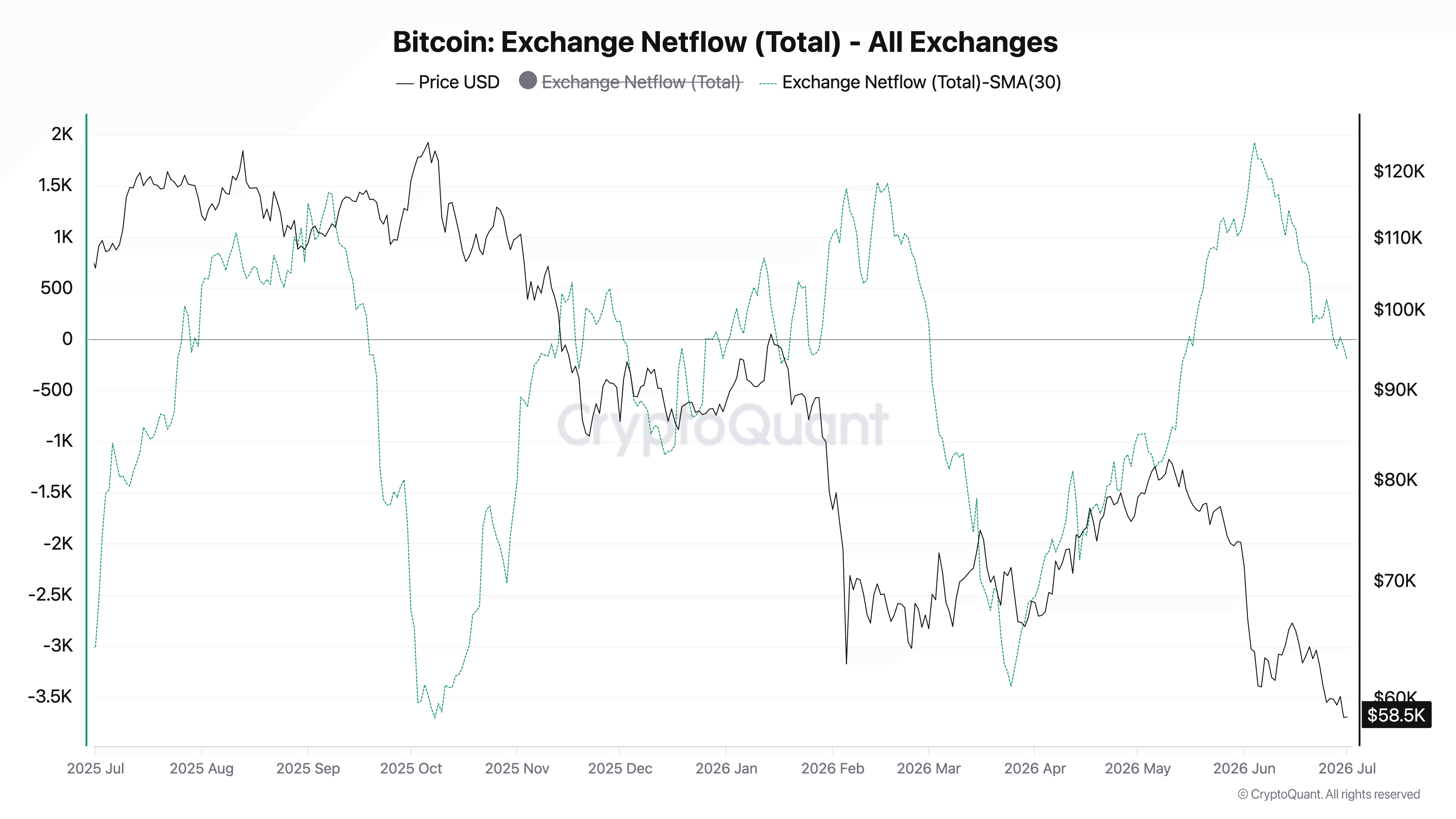
Coins are leaving exchanges en masse. Is this confident accumulation, a structural migration to cold storage, or preparation for selling through OTC? And why is the direction of coins not the direction of price?
In the previous issue, we built the Holder Pressure Map: a cost basis map by cohort. It answers the question of “who and where” - who among holders is underwater relative to their cost basis. But that is static. The pressure map shows position, not movement.
Flow signals are the dynamic part. They show where coins are actually moving: onto exchanges or off them, into ETFs or out of them, whether stablecoins are coming in as dry powder for buying. And this is exactly where the biggest myths in on-chain analysis are born.
Because flow is the most tempting metric for false causality. Coin outflows from exchanges are emotionally read as a “bullish signal”, inflows as “bearish”. It is convenient, intuitive, and too often wrong. This issue is about how to read flow the way the system reads it: not by the direction of the arrow, but by context and by sender.
Flow by itself is not a directional signal. The same coin movement can mean opposite things depending on the regime the market is in and who the sender is. Outflow in strength and outflow in panic are two different markets. Inflow in a rising market and inflow in a falling market are too.
The key skill is not to read the flow number itself, but first to identify its context (strength or stress) and its cause (whale or retail, spot or derivatives, selling or internal transfer). Only then does flow turn into a signal.
And separately: BTC flow is the supply side, while stablecoin inflows are the demand side. People constantly mix them into one thing called “liquidity”, even though they answer different questions.
Key takeaways:
Flow is not a directional signal, but a fact of coin movement - meaning comes from context, not the arrow
The same outflow or inflow means four different things depending on the regime (strength or stress) and the sender (whale or retail)
BTC flow is the supply side, stablecoin inflows are the demand side - they cannot be merged into one “liquidity” measure
Exchange Reserve in USD is distorted by price and is a slow structural level, not a tactical buy signal
Flow is a confirming signal, not a leading one
An analyst sees a large coin outflow from exchanges, opens the Exchange Netflow chart, sees a sustained red zone, and delivers the verdict: “supply shock, coins are leaving exchanges, get ready for upside.”
He reads not the context of the flow, but only the direction of the arrow. Outflow equals bullish, inflow equals bearish. And he never asks the only two questions that matter: what regime this flow is happening in, and who exactly is creating it.
Because flow creates a false physical intuition. Coins left the exchange - so they “won’t be sold.” Coins came to the exchange - so they are “being prepared for sale.” It sounds like a conservation law, but markets do not work like that.
An outflow can be confident accumulation, or it can be protective withdrawal in a panic - and those are two opposite signals. An inflow can be preparation for selling, or it can be an internal transfer between exchange wallets, a market maker rebalance, or a deposit that will never be sold. The arrow is the same. The meaning is different.
By reading flow as direction, the analyst systematically catches false signals. He buys an outflow during distribution - because “coins are leaving exchanges” actually meant that whales had already sold what they wanted, and the remaining outflow was retail at a local top.
He reads not the context of the flow, but only the direction of the arrow. Both mistakes come from the same belief: that coin movement has built-in direction. It does not.
Comments
Nothing yet. Say the first thing.
Sign in to join the conversation.