

Ever wondered how fast-growing companies manage to expand internationally without the hassle of setting up a full local entity? The secret is in the Employer of Record (EOR) model. It’s like hiring a local partner to manage all the compliance, payroll, and HR admin, letting you focus on what matters most—growing your business.
In this post, I’m breaking down the EOR model—how it works, why it’s a game-changer for international hiring, and how it stacks up against setting up a full legal entity.
An Employer of Record (EOR) is a third-party service provider that takes on the responsibility for managing employment-related tasks for your employees in a foreign market.
Simply put, the EOR is the “official” employer while your company maintains control over the day-to-day activities of the employee. This setup allows you to hire talent quickly without needing to establish a legal entity in the country.
Speed, simplicity, and risk mitigation—that’s what it comes down to. Setting up a local entity, while necessary in some cases, can take months. You’re dealing with endless paperwork, local regulations, and complex compliance issues. With an EOR, you sidestep all of that.
Here’s why an EOR might be your best bet:
Quick to Implement: In a matter of days, you can have someone working in your target market.
Low Risk: The EOR manages compliance, which reduces your legal and financial risks.
Flexible: You can hire one or dozens of employees without worrying about the administrative burden.
Cost-Effective: Setting up an entity often involves significant upfront costs. An EOR offers predictable monthly fees.
Let’s take a look at how the EOR model compares to setting up a full local entity. It’s easy to see why more companies are turning to this model to speed up hiring while avoiding the complexity of entity formation.
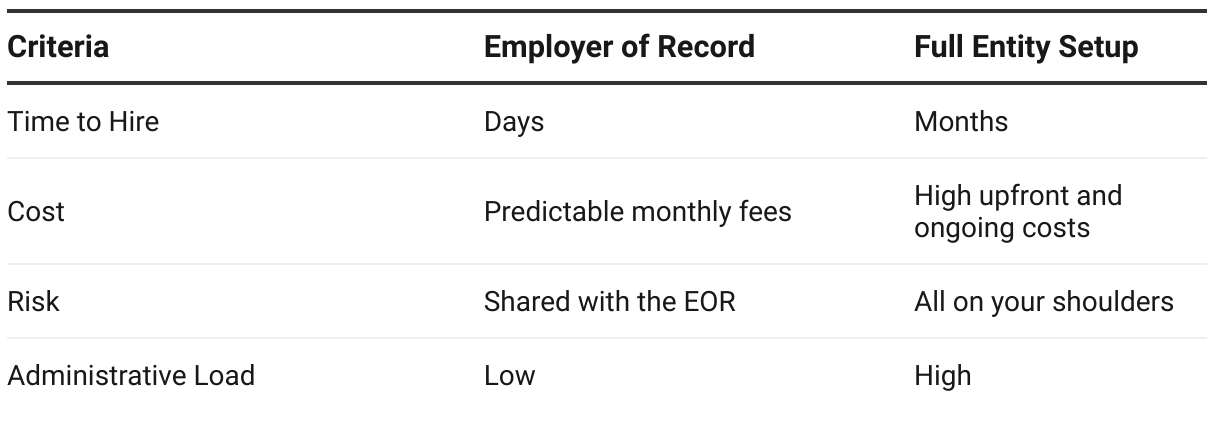
The process for using an EOR is straightforward, and you can typically get up and running in under a week.
Onboarding Employees: Once you’ve decided to use an EOR, you’ll share the job details, such as role, salary, and contract terms. The EOR will take care of the rest, including issuing contracts and handling payroll.
Compliance Management: The EOR ensures compliance with local labour laws, tax regulations, and employee benefits.
Payroll and Benefits: The EOR handles all aspects of payroll—tax withholdings, pension contributions, and insurance. This allows you to focus on scaling operations rather than worrying about payroll nuances.
No need for a local office: You can hire employees without the hassle of setting up a physical presence in the country.
Tax Compliance: EOR providers ensure you comply with local tax laws, which vary significantly from market to market.
Payroll & Benefits Management: The EOR manages everything, ensuring employees are paid on time and receive the proper benefits.
If you're a startup or small-to-medium business (SMB) expanding internationally, an EOR is an invaluable solution. It lets you tap into global talent without the administrative burden of setting up local offices or legal entities.
The cost and time savings are undeniable. If you’re looking to test the waters in a new market or hire talent quickly, an EOR helps you get the job done without unnecessary delays.
The process is designed to be simple, fast, and cost-effective, making it the ideal choice for businesses looking to scale without the typical hassle of international expansion.
In our experience, many businesses—especially those in competitive talent markets—find that an EOR model allows them to remain nimble and cost-effective while taking on new markets.
While the EOR model is increasingly popular, some businesses still prefer the traditional approach: setting up a full legal entity. But it’s worth noting that this route comes with its own set of challenges.
Setting up a company in the UK or any other international market requires time and money. You’ll need to deal with registration, accounting, payroll systems, and local taxes. For larger enterprises or businesses looking to establish a significant presence in a new country, this might be the best approach—but it’s not always the quickest or easiest solution.
Permanent presence: If your business intends to have a long-term presence in a market, a full entity might make more sense.
Control: Some businesses prefer complete control over their local operations and employees, which an EOR does not offer.
Industry-Specific Needs: Certain industries have strict regulations that might necessitate direct control over employment and payroll.
But remember, this option typically requires a significant investment of time, money, and effort. So if you’re testing the market or need quick scalability, the EOR model is likely a better choice.
Expanding into a new market is a big deal. Whether you’re eyeing talent in the UK or looking to hire overseas, you need to make sure your business is set up for success. For many businesses, choosing the right model for hiring international employees can make all the difference.
The Employer of Record model is perfect for companies that need speed, flexibility, and cost-effectiveness without the complexity of setting up a full local entity. If you're planning to expand internationally or need to hire in a new market, an EOR could be the perfect solution to get your business up and running quickly.
Thanks for reading Adleo Relocation! This post is public so feel free to share it.
Comments
Nothing yet. Say the first thing.
Sign in to join the conversation.