
If you've spent any significant time building with LLMs, you know the feeling. You write a prompt, get an output, realise it's missing something, write another prompt, fix a bug, and repeat. It quickly starts to feel less like software engineering and more like... babysitting.
The problem is not that Ai is incapable. The problem is our interface. We are stuck in a manual, single-turn mindset.
Welcome to Loop Engineering. This is the paradigm shift from writing static prompts to designing systems that execute continuous, autonomous loops.
This visual guide breaks down the core architecture of loops across 10 logical sections. Let’s trace this journey from fundamental problem to the future of AI development.
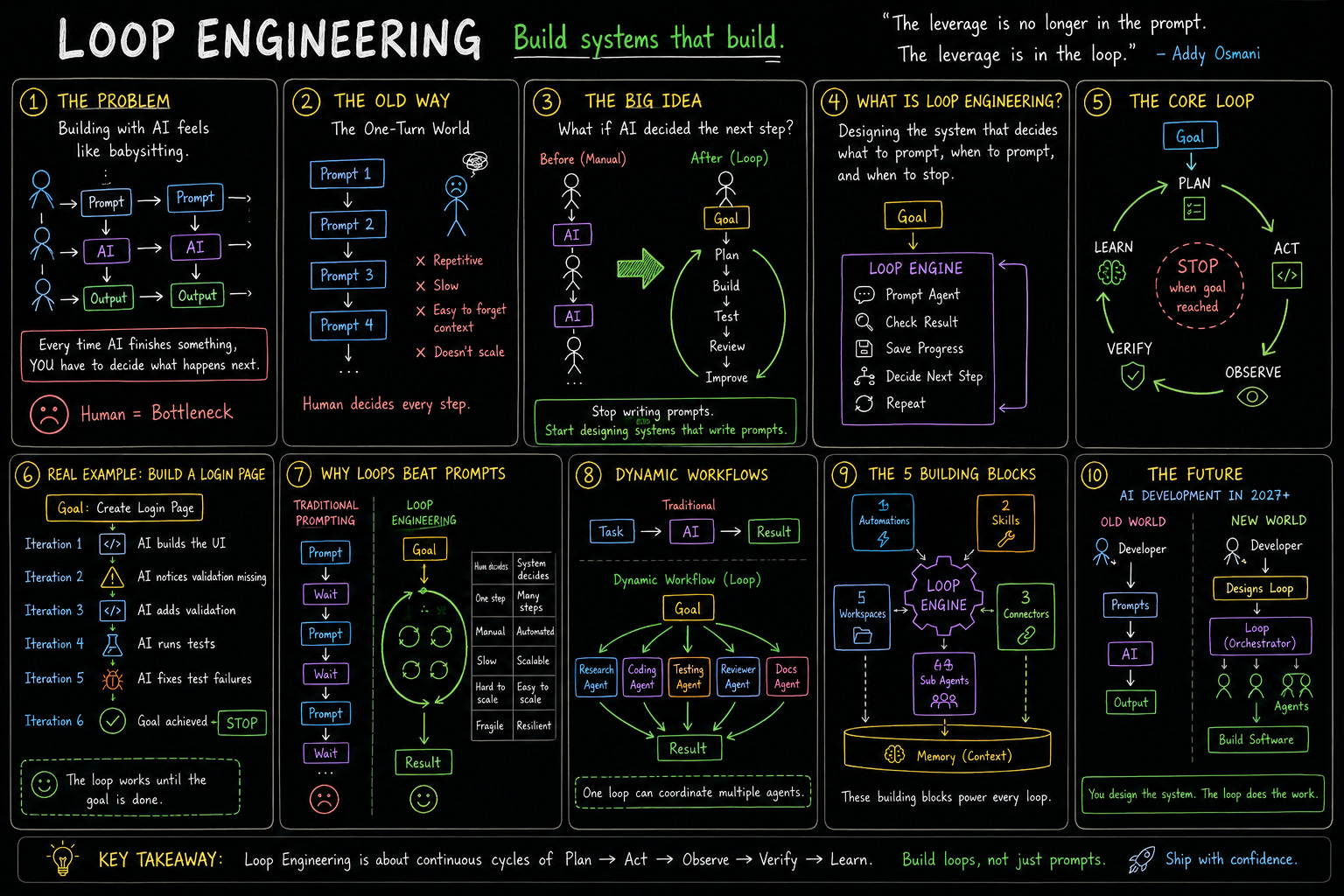
The current state of interacting with AI relies entirely on a human supervisor manually micro-managing every transaction.
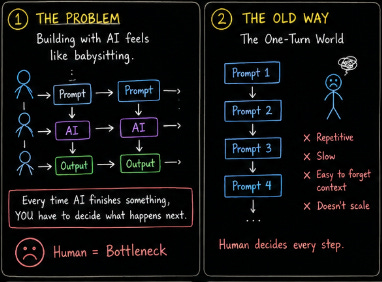
When every output requires a new human decision, building with AI becomes incredibly repetitive, slow, and fragile. Because humans must decide what happens next every single time the AI finishes a task, the human becomes the ultimate bottleneck.
What if we removed the human from the micro-management layer entirely?
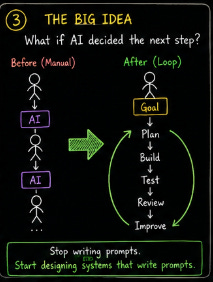
The core premise of Loop Engineering is shifting from a linear sequence to a continuous cycle. Instead of a human executing every turn, a high-level goal is fed into an autonomous loop: Plan —> Build —> Test —> Review —> Improve.
The mindset shift is clear: Stop writing prompts. Start designing systems that write prompts.
To bring this big idea to life, we need a standard operational architecture. This is managed by the Loop Engine.
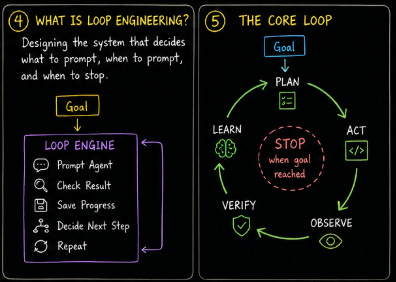
The core premise of Loop Engineering is shifting from a linear sequence to a continuous cycle. Instead of a human executing every turn, a high-level goal is fed into an autonomous loop: Plan —> Build —> Test —> Review —> Improve.
The mindset shift is clear: Stop writing prompts. Start designing systems that write prompts.
How does this look in practice? Let's take a common development task: creating a functional application feature.
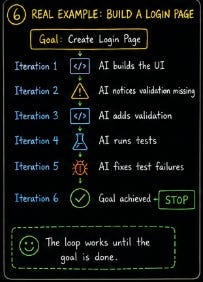
Instead of a human developer reviewing code, spotting a lack of input validation, writing a new prompt, running tests, seeing an error, and writing another prompt—the Loop Engine manages it natively. The system generates code, tests it, catches its own omissions, fixes its own bugs, and delivers a finished, verified asset in a fraction of the time.
When we compare traditional prompting side-by-side with Loop Engineering, the structural advantages become undeniable.
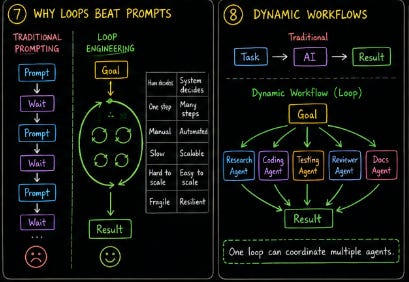
Traditional prompting is fundamentally linear, fragile, and manual. Loop Engineering is cyclical, scalable, and resilient.
Furthermore, loops break down the limitation of a single LLM instance. A single Loop Engine can orchestrate a Dynamic Workflow composed of multiple specialized sub-agents—such as Research, Coding, Testing, Reviewer, and Documentation agents—all collaborating within the same loop to deliver a unified result.
To construct a reliable Loop Engine, you need to bring together five core architectural building blocks, shifting the entire developer paradigm.
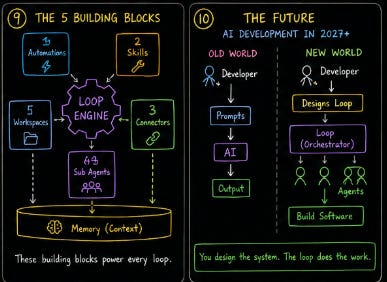
The robust loop environment relies on a shared Memory (Context) foundation supporting:
Automations: Background triggers and handlers.
Skills: Specific capabilities or tool executions.
Connectors: Integrations to external systems and data.
Sub-Agents: Specialized LLM personas.
Workspaces: Isolated sandboxes where code can be executed and tested.
This entirely reimagines the role of the software developer. In the old world, developers spent their time writing individual prompts to get individual outputs. In the new world, the developer designs the loop, and the loop builds the software.
The era of manual, chat-based micro-management is coming to a close. To build truly powerful, autonomous software systems, we must look past the individual prompt window.
Design the engine, orchestrate the sub-agents, and establish robust verification layers.
Comments
Nothing yet. Say the first thing.
Sign in to join the conversation.