
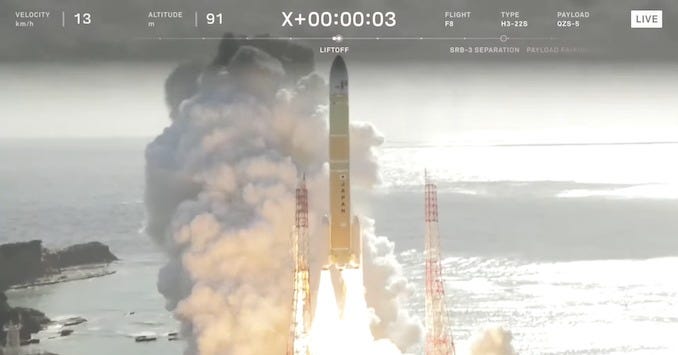
At 01:51 UTC on 22nd December 2025, Japan's H3 Flight F8 rocket experienced a catastrophic second-stage failure during the launch carrying QZS-5 from Tanegashima Space Center, delivering the satellite into a sub-optimal altitude. This represents the second major H3 failure in eight flights. We analyze whether this throws a spanner into Japan's constellation replenishment and expansion timelines.
The loss of QZS-5 delays constellation expansion by approximately 18 months. However, the Quazi-Zenith Satellite Systems (QZSS) — Japan’s regional GNSS — continues delivering full service with its the 4-satellite constellation (QZS-1R, QZS-2, QZS-3 and QZS-4) and QZS-6 being the first of the expansion plan.
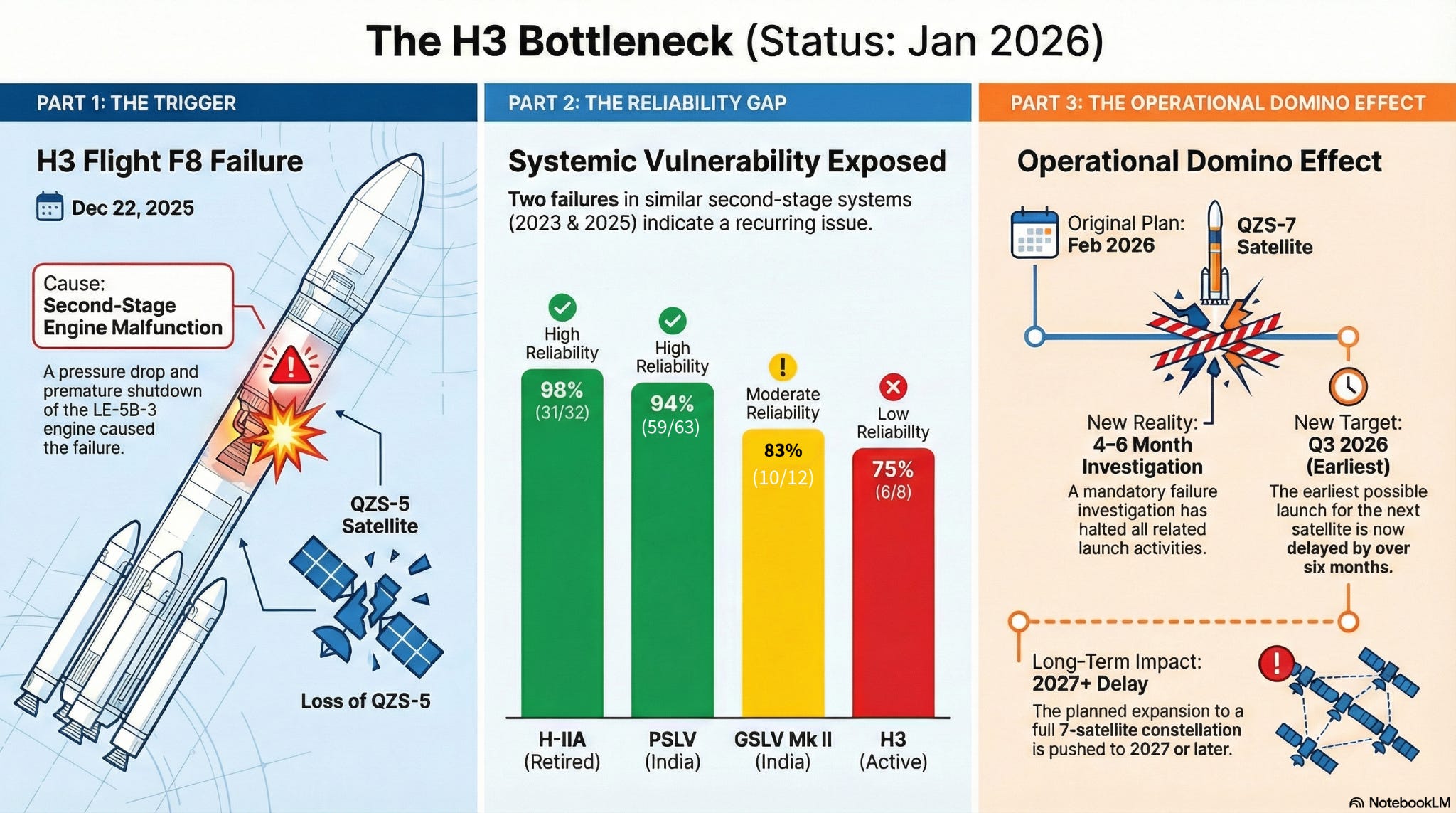
While service degradation is not an immediate concern, the December failure introduces strategic risk. Japan’s 2023 revision of the Implementation Plan of the Basic Plan on Space Policy, anticipated launch and commissioning of QZS-7 by late 2025 (moved from 2023). The H3 failure pushes this timeline further to mid-2027, extending the period during which constellation expansion relies entirely on a single launch vehicle with a 75% success record.
The critical difference from NavIC: When NVS-02 failed to reach orbit in January 2025, NavIC lost a planned replacement but maintained 4 operational satellites. However, the March 2026 IRNSS-1F clock failure reduced the operational constellation to just 3 satellites — below the minimum threshold of 4 required for reliable positioning. From peak operational capacity, NavIC has lost 25% of its constellation and now operates at 43% of design capacity (3 of 7), while QZSS maintains 71% (5 of 7) despite the QZS-5 loss.
The architectural contrast: NavIC’s satellite losses immediately degrade service below operational thresholds. QZSS’s loss delays planned enhancements but maintains full service capability. We will get into the ‘why’ shortly.
Check out Space-PNT Report #1 from December 2025 that analysed the health of the NavIC system in detail.
Continuous orbital monitoring through April 4th, 2026 reveals a constellation performing largely within design parameters. Our health scoring methodology integrates four weighted components: inclination stability (30%), maintenance pattern adherence (25%), drift control (20%), longitude deviation (15%), and maneuver uniformity (10%).
The current orbital analysis shows varying degrees of longitude slot adherence across operational satellites. QZS-1R is positioned at 135.43° longitude, representing a 12.57° westward offset from its designated slot at 148° (see note below). QZS-2 operates at 139.99°, exhibiting a small eastward deviation from its assigned 139.00° position. QZS-3 maintains its station at 123.03°, very close to its designated 127.00° longitude, while QZS-4 operates at 140.54°, showing a 1.54° eastward offset from 139.00°. The newest satellite, QZS-6 maintains a very fine station at 90.44°, close to its designated 90.50° slot. These longitudinal positions directly influence the constellation’s geometric configuration and affect the spatial distribution of satellites as observed by receivers within the Asia-Pacific service area.
Note on longitude slots: There are 2-3 sets of designated longitude slots of the QZSS constellation. The original 4-satellite constellation required all the QZO satellites to have a central longitude of 135°E. With the constellation transitioning to a 7-satellite system, the new designations are 148°E for QZS-1R and 139°E for QZS-2, QZS-4 and the now-failed QZS-5. We are tracking the adherence to the planned 7-satellite build-out. We welcome reader feedback on the basis of assessment.
Health Score 53.7
Design inclination: 43.0° ± 4.0°
Current inclination: 37.31° (deviation: 5.69°)
The inclination deviation seems to be a deliberate operational choice: trading short-term North-South geometric repeatability for extended service life. The steady inclination drift (May 2025: 36.5° → Apr 2026: 37.31°) indicates conservation of propellant rather than malfunction.
For IGSO satellites in QZSS’s quasi-zenith configuration, inclination drift has asymmetric impact. Vertical geometry — critical for urban canyon performance — is maintained through apogee positioning over Japan, which QZS-1R preserves despite inclination drift. The four-satellite IGSO configuration maintains coverage redundancy across East Asia.
The trade-off: By accepting inclination drift, JAXA extends QZS-1R’s operational life by 2-3 years while the constellation maintains required performance through geometric redundancy. This strategy only works because QZSS has surplus IGSO capacity — exactly what NavIC lacks.
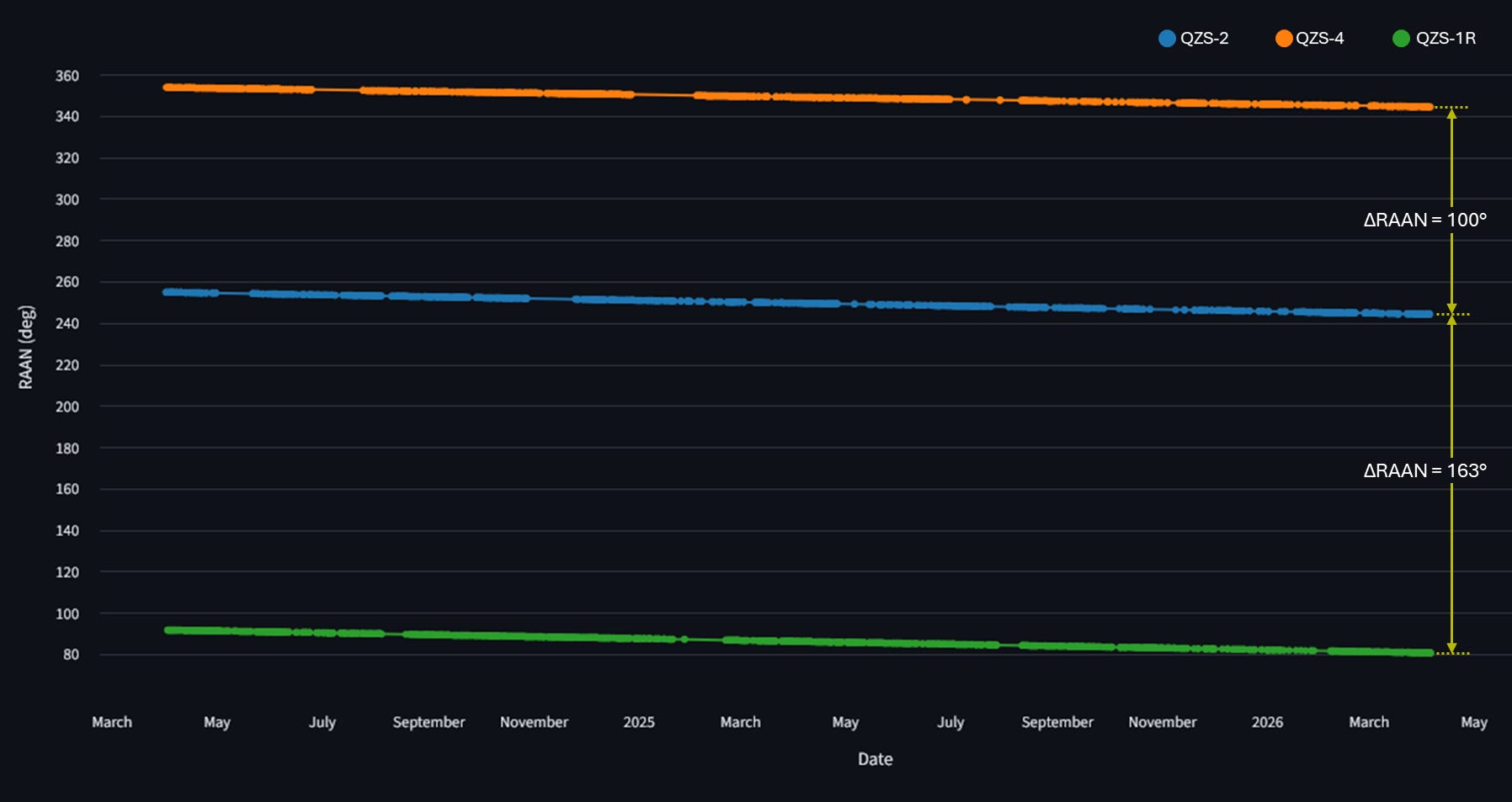
The above chart adds another dimension to the lack of active inclination control. With QZS-1R having a much lower inclination than its fellow QZO satellites, its peak elevation for users in Japan is lower than the others. With orbital planes of QZS-2 and QZS-4 being closer than they should (as per the 4-satellite configuration), and the gap between QZS-2 and QZS-1R planes being wider, there is now a longer temporal gap in visibility of a high-elevation QZO satellite. Of course, if QZS-5 were to have successfully reached orbit, then it would have reduced the 163° gap between QZS-2 and QZS-1R and the planes would be eventually spaced 90° apart — which would match the needs of the 7-satellite configuration. Currently, the constellation seems out of specification compared to the 4- as well as 7-satellite configuration.
Health Score 94.4
Maneuver Frequency: Every 21 days
Design Life: 15 years
Operational since October 2024, QZS-6 exhibits aggressive station-keeping reflecting a unique mission: broadcasting Japan’s L6 CLAS (Centimeter Class Augmentation Service), enabling 6 to 10cm positioning accuracy for specialized applications (construction, surveying, autonomous vehicles).
The CLAS service requires:
Precise orbital ephemeris (<2.7cm RMS accuracy in correction generation)
Minimal longitudinal variation to preserve correction message validity
Predictable Doppler shift for 2 kbit/s high-rate L6 downlink
To maintain these parameters, QSS (Quasi-Zenith Satellite System Services Inc.) keeps QZS-6 within a box measuring ±0.02° in longitudinal span versus the ITU requirement of ±0.1°. This five-fold tighter tolerance demands more frequent maneuvers.
Current maneuver frequency (~17 per year) is elevated compared to standard GEO satellite operations (7–14 day cycles for typical chemical propulsion). However, this reflects deliberate design choice: QZS-6 was engineered with significant propellant allocation (2,800 kg vs. 2,300 kg for earlier satellites) to support this requirement throughout its 15-year operational life. With 2,800 kg propellant reserves, QZS-6 retains between 800kg and 1,300 kg after circularization, enabling operations beyond its 15-year design life at current consumption (~80 kg/year) rates.
The steeper 21.969° drop-off for QZS-6 and its higher 1.682 km/s ΔV requirement suggest that the H3 has not yet matched H-IIA’s optimized low-ΔV injection performance for heavy GEO payloads. QZS-6 had to expend a significantly larger fraction of its onboard propellant to achieve operational orbit.
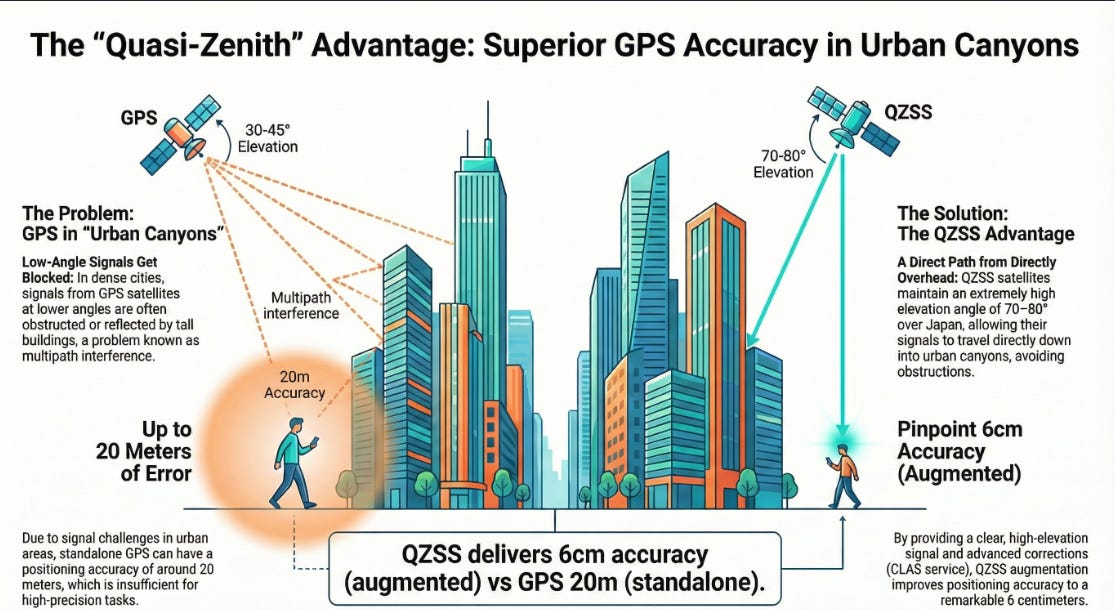
QZSS accomplishes its core mission of enhancing GPS accuracy across Japan and extended Asia-Pacific regions through:
3x IGSO Satellites (QZS-1R, QZS-2, QZS-4):
Inclination: 43° ± 4°, 24-hour period
Quasi-zenith ground track delivers 70-80° elevation angles over Japan
At least one satellite above 70° elevation during each 24-hour cycle
2x GSO Satellites (QZS-3, QZS-6):
Geostationary positioning at 127°E (QZS-3) and 135°E (QZS-6)
Continuous signal availability and augmentation service
CLAS correction transmission (QZS-6)
QZSS + GPS (MADOCA service): 10cm horizontal accuracy
QZSS L6 CLAS (centimeter augmentation): 6cm horizontal accuracy
This exceeds dedicated global navigation systems (GPS alone: 20m, Galileo alone: 20m) within QZSS’s regional footprint, validating the augmentation-first design.
The primary near-term challenge for the constellation centers on launch vehicle capability, reliability and availability.
Based on the orbital deployment analysis presented in the table, Japan’s launch vehicles for the QZS constellation employ a staged orbital insertion approach. The available launch capabilities deliver satellites to initial transfer orbits at altitudes between approximately 17,804 km and 17,952 km, with final circularization to geostationary altitude (35,744-35,793 km) achieved through on-board propulsion systems. This operational strategy requires delta-v budgets ranging from 0.51km/s to 1.17 km/s, corresponding to propellant allocations of 1,115kg to 2,082kg per satellite. While this two-stage insertion method is a common and proven approach for geostationary missions, the propellant mass represents a notable fraction of the total satellite mass (2,750-2,985 kg), which influences the overall mass budget allocation between propulsion requirements and operational payload capacity.
However, this launch vehicle constraint has prompted JAXA to employ an innovative orbital design strategy that leverages natural gravitational perturbations and orbital mechanics to passively maintain the satellites’ inclination characteristics, thereby minimizing active station-keeping requirements and optimizing propellant utilization over the mission lifetime.
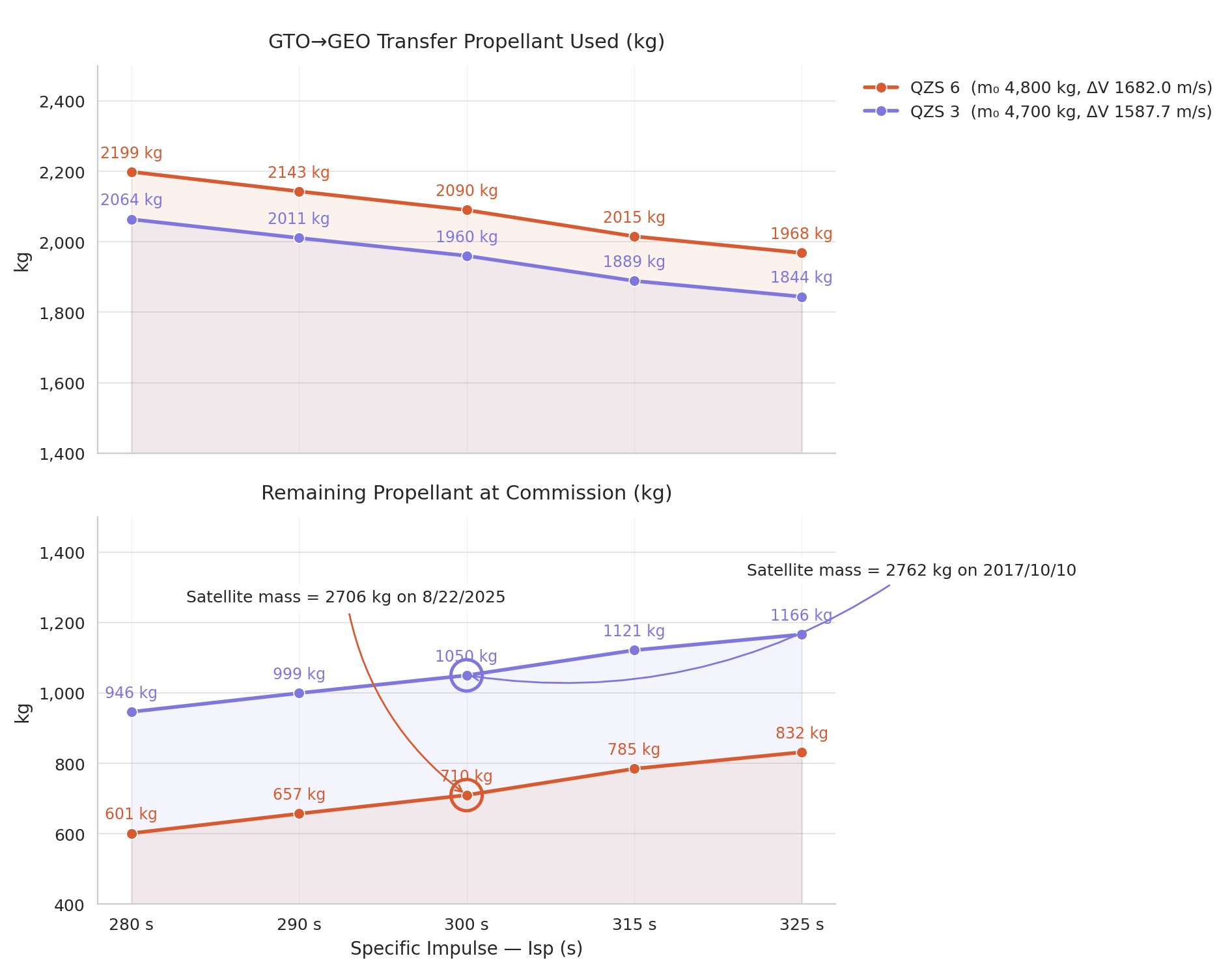
When analyzing the orbital insertion strategies of the Quasi-Zenith Satellite System (QZSS), a clear contrast emerges between the legacy H-IIA launch vehicle (used for QZS-3) and the newer H3 rocket (used for QZS-6). The shift highlights a redistribution of the ΔV burden from the launch vehicle to the spacecraft’s onboard propulsion system.
For QZS-6, the H3 inserted the spacecraft into an intermediate transfer orbit at 17,873 km altitude and 21.969° inclination. This relatively steep inclination imposed a significant penalty. To reach its final GEO slot at 0.08° inclination, QZS-6 had to perform a demanding combined orbit-raising and plane-change maneuver, requiring 1.682 km/s of ΔV. From its initial launch mass of 4,800 kg (including 2,800 kg of propellant), the satellite burned 2,090.15 kg of fuel, leaving just 709.85 kg (assuming dry mass = 2000 kg @Isp = 300 s) at commissioning—substantially reducing its remaining station-keeping margin.
In contrast, QZS-3, launched by the mature H-IIA, was inserted at a similar altitude (17,875 km) but a lower inclination of 19.869°. This more optimized trajectory reduced the spacecraft ΔV requirement to 1.588 km/s to reach 0.09° inclination. As a result, QZS-3 consumed 1,844.08 kg of propellant and retained a healthier 1,165.92 kg upon commissioning.
The steeper 21.969° drop-off for QZS-6 and its higher 1.682 km/s ΔV requirement suggest that the H3 — while offering manufacturing and cost advantages — may not yet match H-IIA’s optimized low-ΔV injection performance for heavy GEO payloads.
JAXA had targeted six H3 launches per year in the long-term but has been able to achieve close to 2 per year currently due to development issues. QZSS aims for 11 satellites total (7 operational + 4 spares) with production continuing through 2030s. The H3's performance gap compared to H-IIA creates a strategic dependency: until H3 matures to match H-IIA's low-ΔV injection capability, every QZSS satellite will commission with reduced station-keeping margins.
Original Plan (Pre-H3 Failure):
QZS-5: Launch Dec 2025 → IOC Mar 2026
QZS-7: Launch mid-2026 → IOC Sep 2026
7-satellite constellation: Operational Q3 2026
Revised Timeline (Post-H3 Failure):
QZS-5 replacement: Launch Q2 2027 (assumes H3 returns to flight Q4 2026)
QZS-7: Launch Q3 2027
7-satellite constellation: Operational Q1 2028
Strategic Gap: 18-month delay in achieving full constellation redundancy creates extended period where QZSS expansion depends on single-vehicle success.
The December 2025 H3 failure’s impact on QZSS reveals a fundamental truth about space-based PNT systems: architectural choices made during constellation design determine resilience to production and launch disruptions.
Key Findings:
QZSS’s augmentation architecture provides buffer capacity: Unlike NavIC, where each satellite loss immediately degrades service, QZSS can absorb expansion delays because the baseline 5-satellite constellation already exceeds minimum service requirements
Operational flexibility enables strategic trade-offs: QZS-1R’s inclination drift shows that constellation operator are extending satellite life by selectively relaxing specifications when geometric redundancy permits
Precision services demand precision operations: QZS-6’s aggressive station-keeping for CLAS service indicates that next-generation GNSS applications impose operational costs that may conflict with the realities of launch vehicle performance
Launch vehicle maturity is constellation infrastructure: The H3’s 75% success rate transforms every QZSS launch into a strategic risk event
For NavIC: The contrast is instructive. India’s path to constellation resilience requires either accelerating NVS production and launch cadence to create operational buffer (QZSS model), developing life-extension capabilities for aging IRNSS satellites, or accepting augmentation-first philosophy.
We had originally planned for a launch of the GNSS Health Monitor in this edition, but due to a combination of events - this was not possible. The Monitor is currently under closed beta with a few users and will be open to public access in the next edition of the Space-PNT Report. Thank you for your patience.
No posts
Comments
Nothing yet. Say the first thing.
Sign in to join the conversation.