
It’s a late October evening, 2 a.m., and pitch black throughout the house. A red light cuts through the night’s monopoly of color. A tiny voice breaks the silence of sleep. Her name is Eleanor and she is hungry. This is her first night in a new space. She has only known fluorescent lights, the rhythm of chirping monitors, and walls made of clear plastic. Now her space is familiar, yet different. She is warm and cozy. The smells and presence seem familiar, but silence is new. Eleanor’s eyes are still adjusting as she wakes to that all too familiar ache in her belly. As she cries out, she is lifted into the air and sat upright leaning against someone’s warm skin. The familiar texture and warm food greet her mouth, as she settles into the arms of her father. Her mother looks on with a red light shining down, admiring this moment. The parents with heavy eyes look at each other and smile. They’ve arrived home after years of waiting.
Nights like this became a reoccurring event in our home following Eleanor’s return home from the NICU. She spent 2 weeks in a plastic dome, with IVs and monitors all adorning her body. NICU nurses became our closest friends during that seemingly infinite stretch of time. Bringing her home felt like a new kind of homecoming. We never thought we’d arrive here. The surreal feeling anchored to exhaustion made time slow down, as we soaked in the moments we’ve dreamed about for 7 years. All the doctor’s appointments, tests, shots, and tears paved the way to seeing Eleanor being carried through our home’s threshold. Looking back on it now, we thought we’d never escape the endless waiting room that kept us from parenthood. Eleanor is not the child that made us parents, but is the little one that filled our halls with newborn cries.
Each little cry came with a feeding. Thankfully, our NICU nurses provided Ellie with a schedule of her own making. A fortified bottle every three hours to make up for her early arrival. Being only 4 lbs coming home, she needed calories more than we needed sleep. That was the trade, hours of uninterrupted sleep for grade-A breast milk and formula. This is a familiar story for most newborn parents. For my wife, her healing process had just begun. Hormones from IVF, preeclampsia, and a C-section were scars from a soldier fighting for motherhood. Each sleepless night was a treasure for the both of us, no matter who took the next shift. Yet, those nights do begin to weigh us down, as the world moves on without us.
As time goes on, we lose touch with the wonder and sacredness of those early days. The laundry piles up, the kitchen is in disarray, and the little one still must be fed and changed. What was once sacred to you becomes a part of the routine. Sleep debt catches up and reminds you that 2 hours of rest isn’t going to cut it much longer. The days are becoming longer, but the weeks shorter. Time all at once is stretching and collapsing. A child bears their weight on time. As they grow, so does their influence on it. Losing track of days is more common now. If it wasn’t for work, the days would disappear entirely. Yet, there are moments that give you pause. A look, a coo, or a milestone reached.
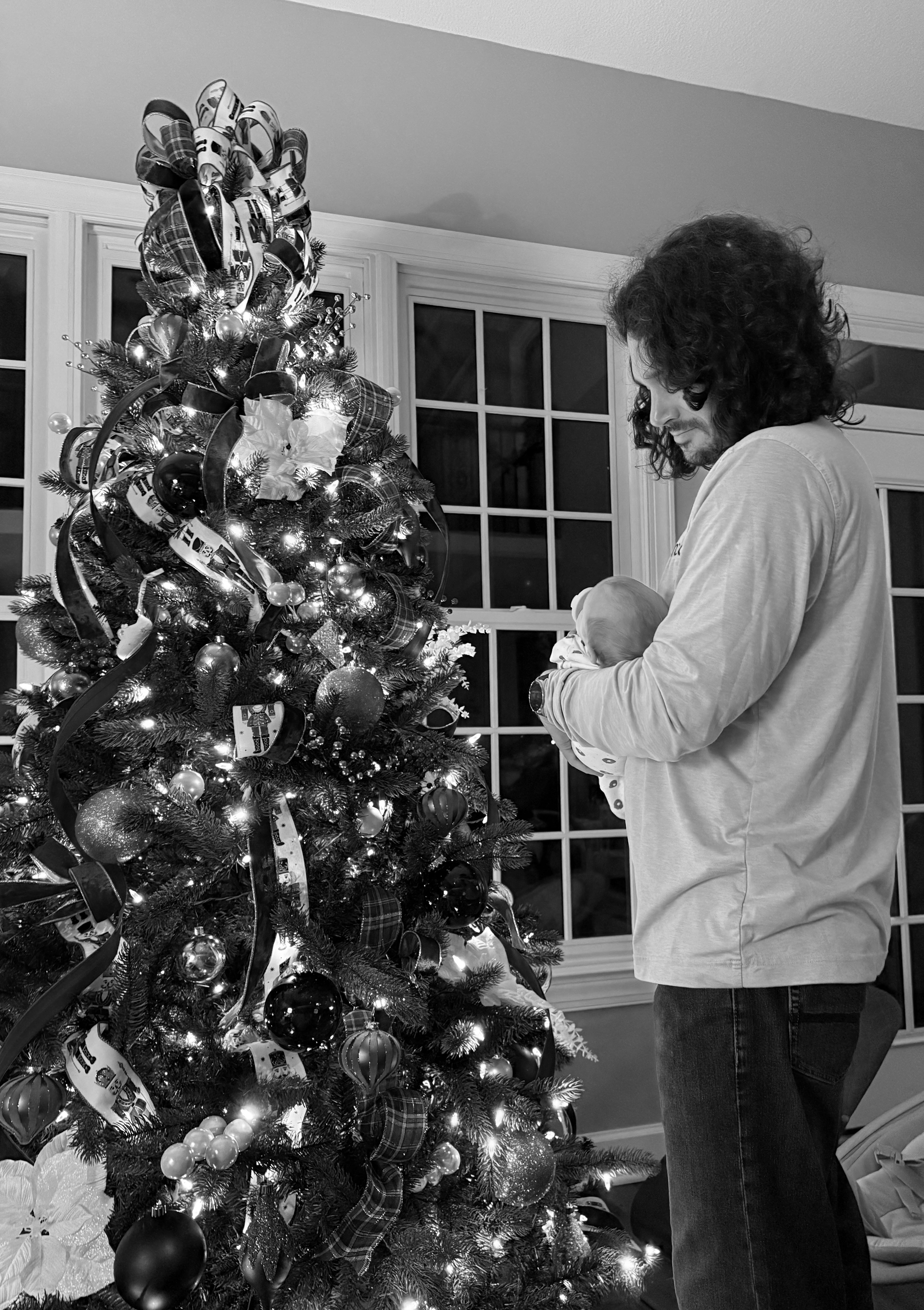
Watching Eleanor gaze in awe at our Christmas tree was such a moment. My gaze and hers were transfixed. I on her and her on the lights. No one but time could take me away from this moment. The wonder and awe shine down upon us, and I don’t want to leave her. After those moments fade away, I can’t help but ponder my shortfalls. The times I fell asleep holding her, or nights staring at the ceiling waiting for the next “alarm” to go off. We can so easily question our worth as parents and ask whether we are missing more moments like this in our passivity. Returning to our previous state of exhaustion, we move on, searching for more times like the Christmas tree.
Ellie and I listen to music or an audiobook during her last bottle at bedtime. We sit in the dark as the music plays and her eyelids grow heavier with every sip from the bottle. John Mayer’s song “Stop This Train” starts to play. My wife converted me to a John Mayer fan years ago after attending one of his concerts in Atlanta. In the dark, I start to pay attention to this song’s lyrics in particular. If you are not familiar with this song, go listen to it after you’re done reading this post. Preferably the live at Nokia Theater version. In the song, the songwriter is lamenting how fast life is moving. The train is time moving faster and faster, and all he wants to do is go home. Everyone is growing older, and youth is leaving him with each passing day. There’s a part in the song where he speaks to his father, struggling to understand why life is passing him by so quickly. This is where the writer’s revelation comes to pass. His father tells him:
“Turn 68, oh, you’ll re-negotiate,
Don’t stop this train.
Don’t for a minute change the place you’re in.”
-from the live recording on “Where the Light Is: John Mayer Live in Los Angeles” (2008).
It’s in this moment that he understands time is not something to be managed or controlled. We are to sit with each moment presently without wishing for the next or longing for the past, for this is when time slips away. If we live in the now, our attention finds more of those Christmas tree moments where time seems to slow down. In chapter 2 of “How to Make Your Brain Your Best Friend: A Neuroscientist’s Guide to a Healthier, Happier Life” (Penguin Random House, 2025), Rachel Barr quotes psychologist William James:
“My experience is what I agree to attend to. Only those items which I notice shape my mind.”
While it may seem obvious saying it aloud, we don’t guard our attention as we should. The temptation to be somewhere else, or the opposite, our desire to capture every moment results in us truly missing it. It’s as if when we try to measure or document these times, it becomes less sacred, because we think we can return to it whenever we want. While the pictures we capture are precious, we cannot recreate that moment again. We fall prey to nostalgia for better or worse, thus losing the moments in front of us, saying nothing will ever be as good as it was then. This is only true if we turn our attention away from the sacredness of the now.
Listening to this song, I sigh and gaze at Ellie, soaking in this beautifully mundane moment. It is sacred to me, and the routine has become a liturgy. One day she won’t need me to feed her, or rock her to sleep. In a world where attention is treated as a commodity, I’m learning to pay attention to where it is going. I can not make more time, but the currency in which it is spent, I can spend wisely. I can participate in the “sacrament of the present moment,” a phrase Richard Rohr borrows in “Everything Belongs: The Gift of Contemplative Prayer” from 18th-century writer Jean-Pierre de Caussade. Even when the bottles are traded in for sippy cups, the crib turns into a queen bed, and bedtime is filled with conversations with her friends, I will choose to still be present from the sidelines cheering her on. There’s one more song I will leave you with. “You Have My Attention” by Copeland. The lyrics echo as Ellie falls asleep this evening.
“You have my attention
Like you’ve had all the while
Since that first day when you made
my heart smile
With loving eyes and tired sighs
that flow.”-Written by Aaron Marsh and Bryan Laurenson, from the 2005 album “In Motion.” Attribution line: from “In Motion” (2005).
Even in the darkest of nights, she has my attention.
Comments
Nothing yet. Say the first thing.
Sign in to join the conversation.