
Initiation is one of the most frustrating executive functions to explain — especially if you live with ADHD. From the outside, it looks like laziness or disinterest. From the inside, it feels like standing at the edge of a canyon. You know what you want to do. You can even picture it getting done. But you can’t step forward.
There’s no ramp. No foothold. Just fog.
Initiation paralysis isn’t solved by reminders or pressure. It’s a nervous system blockade — often rooted in decision fatigue, perfectionism, low dopamine, or even fear of starting the “wrong way.”
Many ADHDers lean on body doubling, timers, and accountability partners. These can help — but they depend on external logistics or social support, which aren’t always available. Some try “just starting anywhere,” which works… until the friction wins.
AI doesn’t give pep talks. It gives scaffolding. It responds instantly. It doesn’t care if your task sounds ridiculous. And — most importantly — it doesn’t expect you to have a plan. You can just say:
“I want to do [thing] but I feel stuck. Can you help me start with one absurdly easy step?”
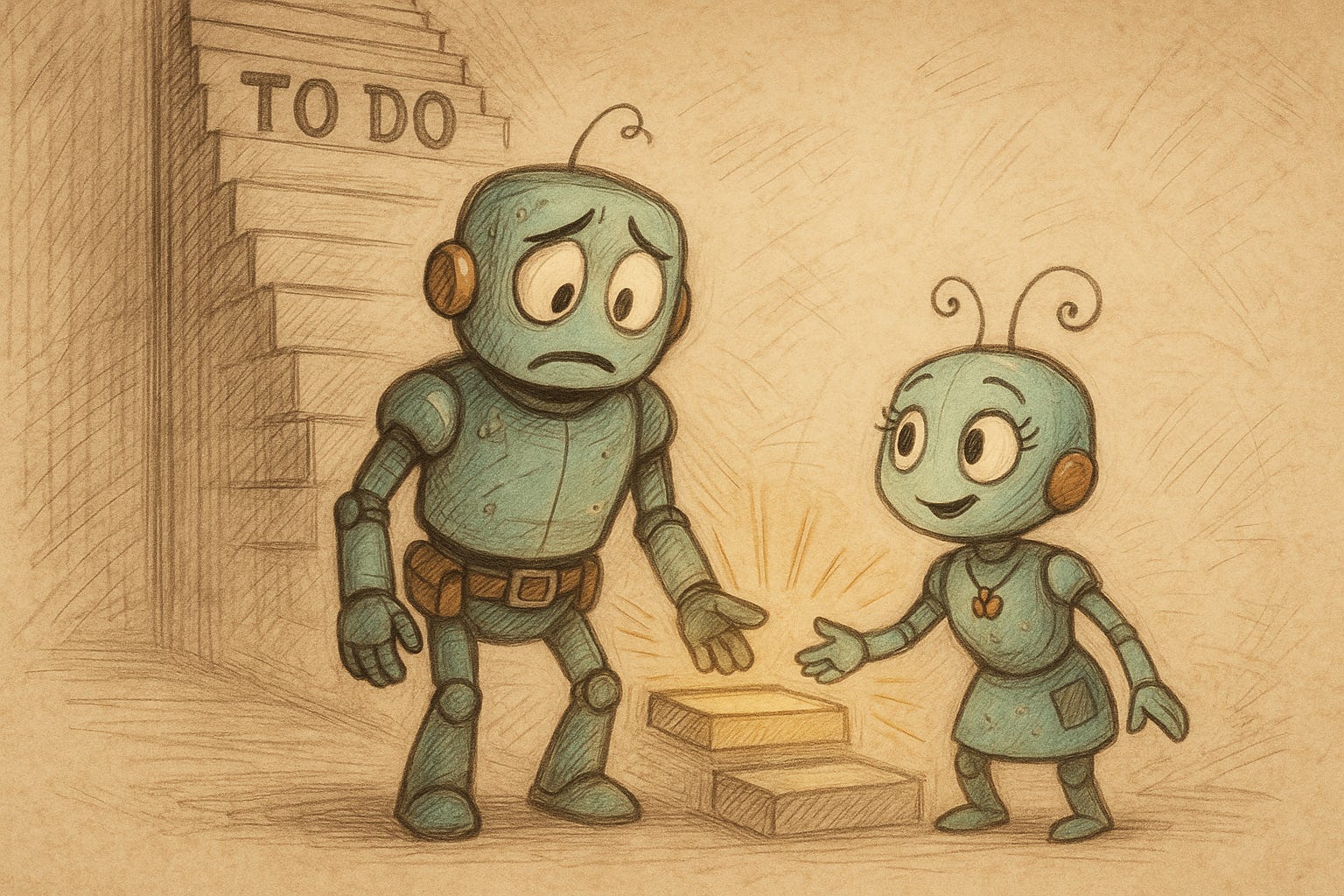
It creates the first plank of the bridge.
“I want to start [insert task] but I feel frozen. Can you give me a tiny, no-pressure first step I could take right now?”
Prompt: “I want to start cleaning my kitchen but I feel frozen. Can you give me a tiny, no-pressure first step I could take right now?”
AI Response: “Step 1: Walk into the kitchen and put one thing in the trash. That’s it. Come back and let me know.”
Sara didn’t need a cleaning checklist. She needed to move. And once she did? She took out two more things without even asking. The momentum clicked.
You’ve been thinking about the task for hours and haven’t started.
You’ve written it on a list, rewritten it, and still feel blocked.
You’ve got time and energy but can’t make the first move.
You’re ashamed that “something so small” feels this hard.
This isn’t a motivational hack. It’s a bridge.
Clarify your task: Instead of “my work,” try “writing the first slide of a deck” or “opening the inbox.”
Soften the language: Ask for a “no-pressure” or “silly” step to bypass emotional resistance.
Add constraints: “Make it something I can do from my chair.”
Use humor: “Make the step sound like a dare from a kind robot.”
Follow up smartly: After finishing, say “Okay, what’s the next smallest step?”
“Can you walk me through this task one step at a time, like a video game tutorial — and only give me the next step once I finish the last one?”
This creates micro-doses of progress with feedback loops built in.
If you’re emotionally dysregulated (shame spiral, panic), even small steps may feel unsafe. Try a nervous system check-in first:
“Can you help me figure out what state I’m in before I try to start anything?”
If the task has no clear shape or you’re avoiding it for values-based reasons, consider pivoting to a prioritization prompt instead.
“I want to start [task] but I feel stuck. Can you give me a gentle, no-pressure first step I could take right now — even if it’s silly?”
Comments
Nothing yet. Say the first thing.
Sign in to join the conversation.