
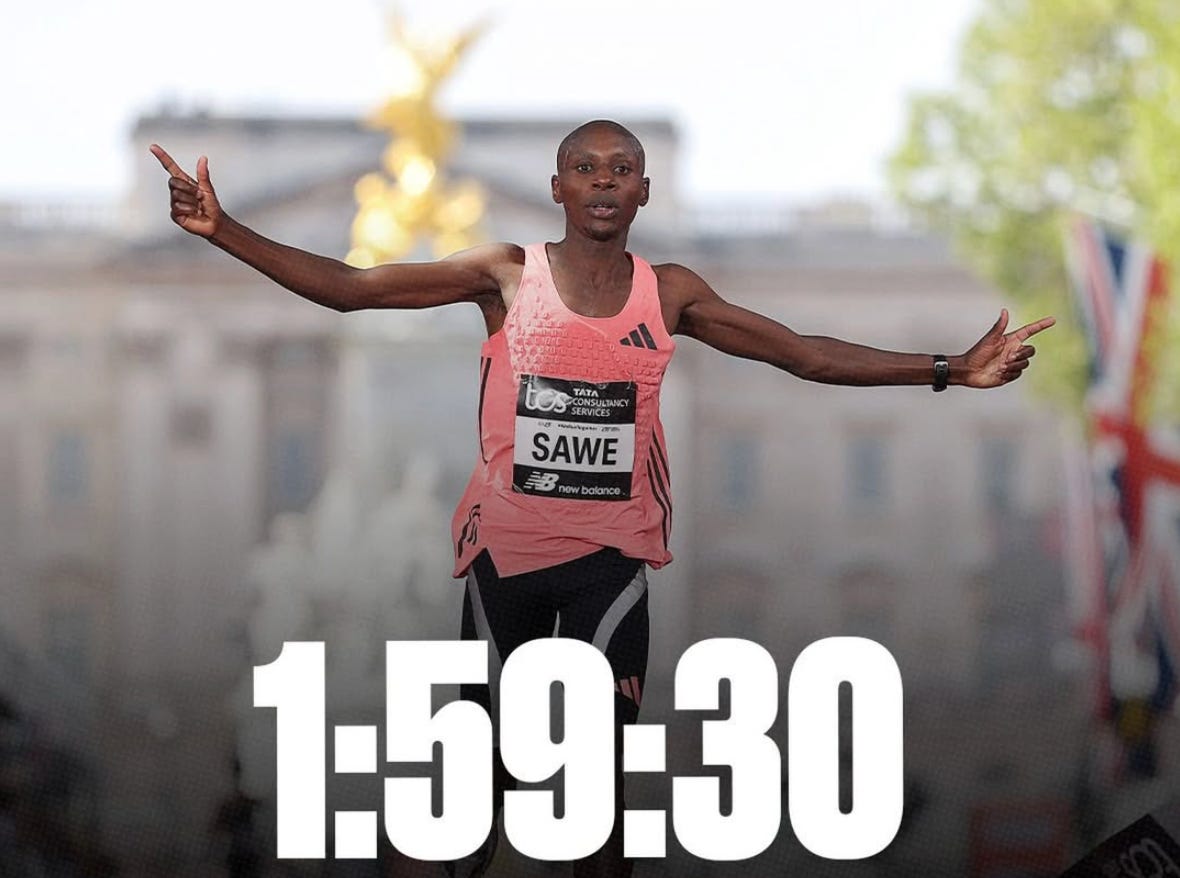
As a commentator, Steve Cram is great at capturing the energy and essence of the moment. As Sebastian Sawe and Yomif Kejelcha turned off the embankment with less than a mile to go in the London Marathon yesterday, the two of them in full flight, stride for stride, a graphic popped up on the screen. It projected, for the first time in the race, that they were on schedule to finish in under two hours.
“Run outside, folks,” buzzed Cram excitedly, “grab anyone you can, and say there’s a bit of history being made here.”
With the unrelenting pressure from Kejelcha - in his marathon debut incredibly - Sawe was forced to speed up even more over the final mile, bounding smoothly, his form still perfect, still fluid as he came in under the finishing arch in 1:59:30.
I was stunned. Oh my god. Just look at those numbers. After Kelvin Kiptum died in a car crash a few years ago, I thought we’d lost the only man on Earth capable of running a sub two-hour marathon. I didn’t know if I’d ever see a real sub two hours in my lifetime. Yesterday, Kejelcha ran 1:59:41 and only finished second. Jacob Kiplimo broke the world record and finished a distant third. What. A. Race.
Every single way you turn it over and look at it, it blows your mind. Sawe ran the SECOND HALF of the marathon in 59:01. The two leaders ran the 10K stretch from 30km to 40km - the part of the marathon where most people are hitting the wall, struggling to maintain anywhere near their goal pace - in 27:36. If you’ve ever run a 10K, you’ll know how insanely fast that is even in a straight 10K race - let alone 30km deep into a super-fast marathon. I can barely sprint 200m at the speed they averaged the entire race, and I consider myself a fairly decent runner.
If you want it in parkruns, that’s eight and a bit parkruns, back to back, each and every one in just over 14 minutes.
In all the history making, the women’s race got a little forgotten, but that too had been a race for the ages, with three women turning that final corner off the Embankment together, under the gaze of Big Ben, with less than a mile to go, all three of them surging and pushing until Tigst Assefa eventually prevailed in a women’s only world record of 2:15:41.
After watching the two races, I had to go and lie down. Geeny Mac, as they say in Ireland.
***
I know some people will see the results of Sunday’s London Marathon and raise their eyebrows and say, “they’re probably all doping”. So it’s worth pointing out that Sawe has been undergoing an unusually rigorous testing process (overseen by the official body for catching dopers, the Athletics Integrity Unit) for the last two years in an effort to prove as best as he possibly can that he is running clean. The Guardian covered the project in an article in 2025 headlined: The marathon star on a mission to be drug tested as much as possible
Kejelcha and Kiplimo, meanwhile, have been two of the most brilliantly consistent runners of the last 10 years, coming up through the junior ranks.
If you want to know how it’s possible to run so fast - if they’re not doping - and why people are running so much quicker now than in the past, then Steve Magness is always a good person for drilling down into the detail. He posted this breakdown yesterday, which is worth a read: The 2-hour barrier has been smashed
***

I was a bit bleary-eyed watching Sunday’s marathon after having had my own particularly epic day of running on Saturday. My friend Ed, who had one 100km race run to his name, decided to step up to the big one: the 100-mile distance. He’d been considering it for a while, but when a new path was opened up where we live here in south Devon, called the South Hams Way, which just happened to be 100 miles long, he couldn’t resist.
Comments
Nothing yet. Say the first thing.
Sign in to join the conversation.