
This is the first of two parts, and along with the next post, it’s being offered to paying and non-paying subscribers alike. The content is so fundamental to the central theme of this Substack page that I believe it ought to be available to anyone who may wonder what I mean by the term “pragmatic mystic.” These posts can also be regarded as something of an invitation to those who haven’t yet become paid subscribers. Although some criticize the practice, I don’t apologize for charging a comparatively low subscription rate, since writing demands research and effort (I do not and will not use AI), helps put food on my table, and I think it’s justifiable on grounds articulated by both Christ and St. Paul: Luke 10:7, Matthew 10:10, and 1 Timothy 5:18. (For those who want a subscription but really can’t afford it, please contact me; I’ll take care of it.) Lastly, in keeping with this as a mini-introduction, by “mystic” I mean one who is sincerely engaged in the Christian “mysteries” (sacramental, devotional, theological, contemplative); by “pragmatic” I mean one who is concerned with doing (“ascetically” and morally) what the “theory” demands for the sake of spiritual/interior development.
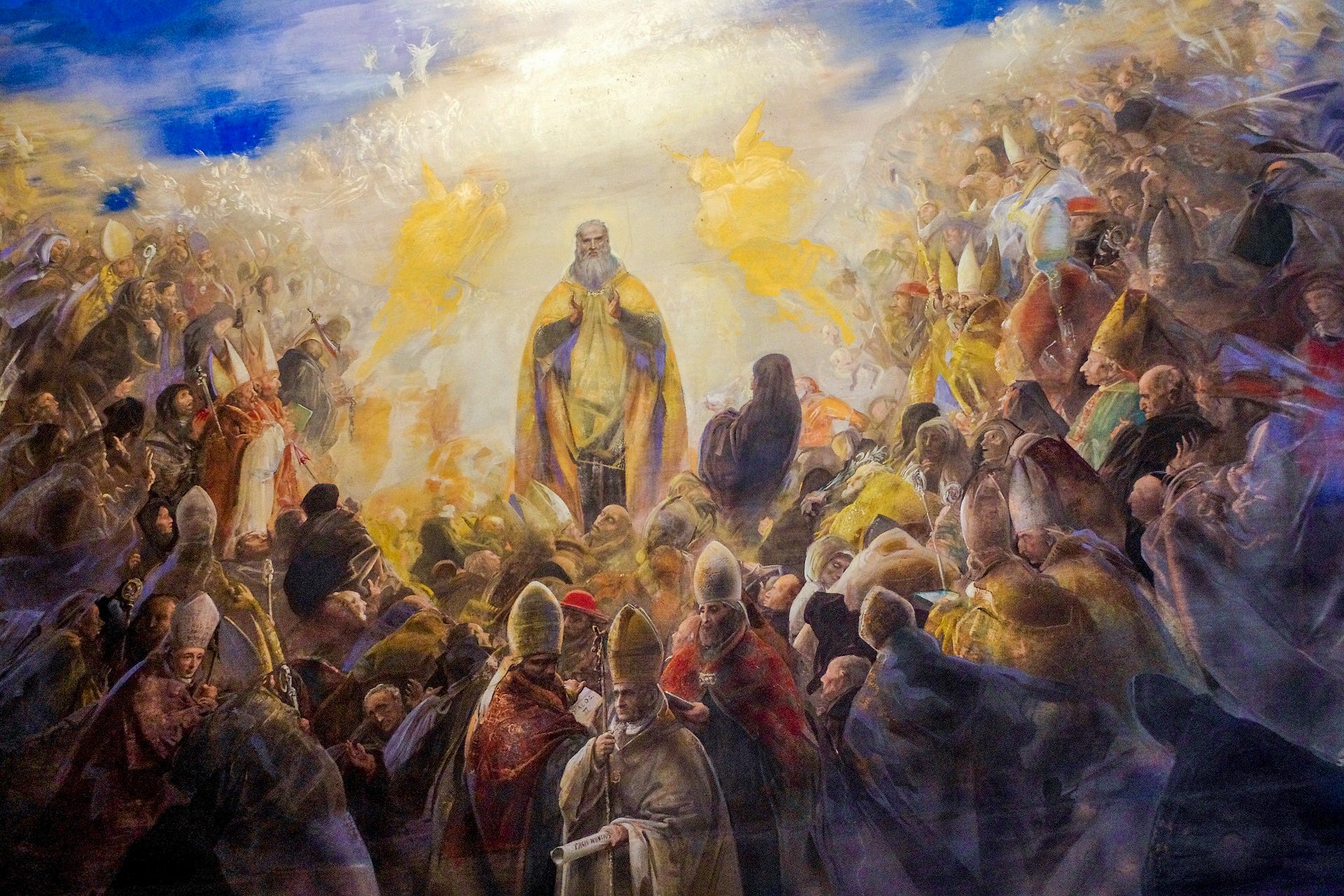
(La Gloria di S.Benedetto by Pietro Annigoni, 1979)
1. Our interior sanctuary
In a celebrated passage, Thomas Merton presented an idea similar to one I mentioned in my two previous posts concerning what exists at the core of every human soul (what I mean by “interior sanctuary” above). I must make the caveat that an orthodox reader should study Merton critically, and sometimes warily. Even in the instance that I cite with sympathy below, which made an impact on me in my twenties, I believe, nevertheless, that he misleads the reader when he should have been more precise in his choice of words. The difficulty is that he uses the ambiguous word “nothingness,” and one might perhaps see in that a suggestion of his growing romantic intellectual affair with Buddhism. I won’t say more about it here (one can see some of my views about Zen Buddhism in particular here and here), but the passage below will be familiar to a few of you, and as I say, there’s truth in it:
At the center of our being is a point of nothingness [I think Merton might have argued that the word “nothingness” indicates that the reality at our personal “center” is not a “thing”] which is untouched by sin and by illusion, a point of pure truth, a point or spark which belongs entirely to God, which is never at our disposal, from which God disposes our lives, which is inaccessible to the fantasies of our own mind or the brutalities of our own will. This little point of nothingness and of absolute poverty is the pure glory of God in us…[1]
Merton’s observation is sound when he notes that, within us, there abides an “untouched” and untouchable “point or spark which belongs entirely to God.” Christian anthropology, to put the matter as simply as possible, teaches that each human being is individually created in “God’s image.” That is the most distinctive feature, in fact, of what it means to be human. That “image” certainly can’t be described adequately as a “thing”; in that sense (only) it can be said to be “no-thing.” To advance another simile, it’s the created “imprint” within our spiritual intellects of God’s uncreated mind. It is, in essence, created to grow through grace (i.e., as a “gift”) into the spiritual freedom that God possesses by nature (thus, the need to be creatures conditioned by time: see my post on this subject here). Freed from death and sin by Christ in his Incarnation (in which God, who by nature is incorporeal, became materially corporeal), our humanity “in Christ” has within it the restored potential to grow into the likeness of its Maker in cooperation with the Spirit (“Breath”) of God.

(Everhardus Koster (Dutch, 1817-1892), Lost in thoughts)
This basic “untouchableness” at the core of our individual selves – our inner “sanctuaries” – means that we are all, at heart, “solitaries,” even in our most social contexts. At our most sober, we know this, perhaps a little wistfully, to be true. At its best, we find in it some respite from the hurly-burly of life; at its worst, we may experience it as alienation. As greatly as we might yearn for union with, say, another person or with some social entity or with “nature” itself (nature-mysticism exists for good reason), and even if we have had temporary experiences of such a blissful unitive state (perhaps with chemical help), that union doesn’t last. It doesn’t last because, put bluntly, it can’t: we’re not made for that. The only everlasting, absorbing, fully blissful union – the one for which each immortal soul is created – is the transformative union with God; and only in that union can be found a richer unity with all else besides. God intends to be “all in all” in us. It’s not simply a matter of his exercising on us his raw will or power, either. It’s because we have that seed of God’s “pure glory” planted in our very nature – the “image” of God – that only our willed union with God (the missing piece of the puzzle that we are, to mix our metaphors) can cause it to spring into (eternal) life.
It may seem strange, at first, that I bring all this up in order to discuss prayer and the maintenance of the internal and external stability that one needs for prayer. I hope to show that it isn’t. To do that, I will draw from the Seventh Conference of St. John Cassian. As I said in passing not too long ago, it could be convincingly argued that all robust ascetical and moral theology after Cassian, both East and West, constitutes a series of footnotes to his two major works, The Institutes and The Conferences. After citing Cassian, I will bring in an insight of Fr. Martin Thornton’s (see my post on Fr. Thornton here) and then, in the follow-up post, I’ll offer in summary a few pragmatic suggestions for personal practice.
In the seventh of Cassian’s Conferences, he and his fellow-traveler, Germanus, are instructed by a certain Abba Serenus. The latter’s name is, as Cassian remarks, noteworthy in itself: serenity is what he exhibits and offers the two visitors. Serenus’ wisdom merits two conferences in the book, this and the eighth, both dealing with the important topic of evil spirits (chapter 7) and principalities (chapter 8). There is no questioning the existence of such entities in these dialogues, since the experiences of the desert ascetics recurrently confirmed their reality (some of those experiences are passingly recounted in this very chapter, in fact, and anyone familiar with academically researched, documented, and verified paranormal cases – for example, as met with again and again in poltergeist cases – will recognize all the same patterns).
Along with the acceptance of literal demonic or intelligent evil forces, Cassian reflects the keen psychological insights of the Egyptian ascetics. This is not to suggest at all that the demonic is reducible to our own psychological impulses or thoughts. Evil spirits may respond to those things, but they come at us not from within us but from without — they are not psychological constructs. That distinction must remain crystal clear and fixed in our minds, and it should be seen as an implicit warning concerning what influences we allow to come in – especially those that enter through our senses (the result of not being on guard or “watchful” is gradually to become spiritually desensitized). We should, as we will see below, erect a sort of noetic barrier in our lives (we will call it a Rule), precisely to guard our hearts.
Through Abba Serenus, Cassian emphasizes that the nous – the mind – is “changeable and… manifoldly changeable.”[2] This capacity for change – transformation – isn’t in itself a problem of the mind (2 Cor. 3:18!); indeed, its temporal nature is that it must develop and change, and its will must be energized by the Spirit to cooperate more and more freely. But unless the nous (the guiding principle, the “pilot,” so to speak) is properly directed and focused, the demonic can swing it, twist it, and push it towards a seemingly endless variety of false directions. Changeableness doesn’t mean that we should simply wander from one thing to another.
Because of its nature [Abba Serenus tells Germanus and Cassian], then, [the mind] can never stand idle but, unless it has some foresight into where it will move and what will preoccupy it, it will inevitably run about and fly everywhere due to its own changeableness until, having become accustomed by lengthy practice and constant habituation [“habituation,” it should be noted, means to “acquire certain habits”]… it gains experience and learns with what things to equip its memory, to what purpose it should direct its unceasing flights, and why it should acquire the power to remain fixed in one place. (Emphasis added.)[3]

(Santiago Rusiñol (Spanish, 1861-1931), The Garden at Aranjuez, c. 1899)
I’ve put in italics above what deserves emphasis. We are told that we must have “foresight” regarding the direction into which our mind should move and what should preoccupy it. A more common term for this kind of “foresight” is “discernment,” and that has to be learned, with the help of reliable spiritual guidance. It’s not related to intellectual pursuit, the study of theological “systems,” the mastery of a “subject” or philosophical niceties, and so on, as valuable as such things may be, but only after they have lost all power to “puff up” a person (as St. Paul put it).
What we are stressing here is actualized in daily practice: “lengthy practice and constant habituation,” as Cassian says. Or, put differently, the weight here is placed on what we do and what habits we are forming in our hearts and behaviors that will, over time, become permanent. So it is that the “memory” must become equipped, “purpose” must be settled, and stability should be sought. We dealt with the subject of stability last time and said that, for many of us, it must be more a state of mind than actually to abide in a single locale. That said, so important is physical stability for the monk that Serenus even tells Germanus and Cassian at one point: “The elders are in the habit of telling [their hearers] of this powerful remedy: Stay in your cells, and eat and drink and sleep as much as you want, so long as you remain in them constantly.”[4] The translator, Boniface Ramsey, cautions the reader, though, not to take this advice at face value: “This counsel,” he writes in a footnote, “is almost surely an exaggeration for the sake of emphasizing the importance of physical stability.” That noted, spiritual stability – which outer stillness and a place “set apart” for our prayer abets – is essential.
But here, rather crucially, I wish to highlight something that should – I hope – encourage us. It is Abba Serenus’ insistence to Germanus and Cassian that, as was noted above, the evil spirits do not have access to the deepest layer of our being. As I said, their attacks come from without. Our essential core, our heart in the spiritual sense, cannot be penetrated by any other entity than God. Even the “possessed,” for whom Serenus displays a remarkable compassion, even saying that they should receive Holy Communion, retain an inviolable core within themselves.[5] (The Gadarene demoniac, for example, had an inviolable “self” that was salvageable by Christ, despite the Legion that had possessed him.)
The key distinction to be stressed – which may fly in the face of assumptions commonly held and disseminated – is that the demons, like us, are created beings, and therefore they have “bodies.” The “go-to” text here is 1 Corinthians 15, which notes both “different kinds” of bodies and – on the material level – “different kinds” of “flesh” (i.e., animal species). All creatures have bodies, and – this is of some importance – not all bodies are made of “flesh and blood.” Even the angels have angelic “bodies,” subtle and immaterial, and only perceptible to our fleshly sense organs as they wish or are directed. The demons, therefore, as bodily creatures, cannot fully and perfectly penetrate the essential nous. They can attack it, delude it, lead it astray, smother it, but – not being incorporeal themselves – they can only take up partial residence in a human being (they “are by no means to be considered incorporeal”[6]); they can manage only to be partially united to a human “spirit”: “[I]t is completely impossible for them to enter into and be united with [the human spirit] in such a way that one can contain the other.”[7]
Serenus continues:
Nor even if a spirit is mingled with this dense and solid matter (that is, with the flesh) which can very easily be done, is it therefore to be believed that it can be united to a soul, which is also a spirit, that it can make it the bearer of its own nature. This is possible to the Trinity alone, which so penetrates every intellectual nature that it is able not only to embrace and encompass it but even to flow into it and, being itself incorporeal, to be poured into a body.[8] (Emphasis added.)
The demons can “read our minds,” not by penetrating them, but only by observing us (the ascetics from experience assumed that we are surveilled by unseen presences; again, serious paranormal researchers today would not find the notion implausible in the least): “No one doubts,” says Abba Serenus, “that unclean spirits can understand the characteristics of our thoughts, but they pick these up from external and perceptible indications – that is, either from our gestures or from our words, and from the desires to which they see us inclining… from movements and indications of the outer man.”[9]
Thus, the need for “lengthy practice and constant habituation” in prayer, for “equipping the memory,” setting our purpose (or course), and practicing prayerful stability. How we practically establish and maintain stability in prayer is the subject of what follows.

(Simon Palmer (British, b.1956), "Sunday Lunchtime")
2. The fence we must construct
St. John of Damascus, in his monumental Exposition of the Orthodox Faith (it is, it seems, the first identifiably scholastic theological work[10]), describes prayer as “an uprising of the mind to God or a petitioning of God for what is fitting.”[11] That’s not an exhaustive definition, obviously, but the emphasis on the mind is noteworthy. At the center of prayer is the engagement of the nous.
Our prayer practice is always both corporate and individual. When we pray in church, our individual hearts are engaged; when we pray individually, we are still praying liturgically or in a priestly capacity (more about that assertion in the next post), as baptized members indissolubly joined to Christ and the whole communion of saints (the Church, in other words) in heaven and on earth. When we pray privately, God indwells our “inner sanctuary,” and, in Christ, the departed are our surrounding witnesses (see Hebrews 12:1), angels are present – and so also is the demonic. Christians have always believed that, as a rule, the “unseen realm” is merely outside the range of our material senses, though sometimes that veil may be withdrawn. They have always believed, too, because experience attests to it, that spiritual conflict is a reality.
Our prayer life can be – and probably should be – seen as a “Rule” or regula (it should, not to put too fine a point on it, be regular). We can see the outlines of the basic Christian Rule in the first church in Jerusalem: “And they devoted themselves to the apostles’ teaching and fellowship, to the breaking of bread [i.e., Holy Communion] and the prayers [i.e., corporate prayer – what we might call the “office” or the “duty” of praying in common]” (Acts 2:42). Helpfully, Fr. Martin Thornton presented the perennial threefold Rule of the Church this way (and it applies equally well to the Orthodox Church as it did to his own Anglo-Catholic context in the 1950s):

The Rule… can be summarized as consisting of (1) the Office… (2) The Mass [or Divine Liturgy]… (3) Private prayer…
The conception of Rule as a threefold system, an interconnected framework, might be illustrated by the idea of a fence. We are constructing a fence – to keep the devil out of the garden of the soul… This carefully constructed fence of the spiritual life is built around a series of big strong posts, firmly embedded in the ground, and placed at regular intervals; these represent the Mass, which acts as the central support of all else. A more numerous series of smaller stakes, embedded in the ground and placed at more frequent intervals between the main posts are the Offices. Finally there are a number of horizontal, parallel cross-pieces which may vary in number, size, strength, or material, which link up the verticals and which are dependent upon them: this is private prayer.[12]
This passage requires, it should go without saying, some necessary “unpacking,” and I will do that in the next post. I will also offer some practical, doable suggestions for actual “fence-construction.” In the meantime, I leave you here with both Cassian’s insights and Martin Thornton’s basic Rule for consideration.
[1] Merton, Conjectures of a Guilty Bystander (New York, 1968), p. 158.
[2] In Boniface Ramsey’s complete translation (Newman Press, 1997), which is the version from which I will quote throughout, the Seventh Conference is found on pages 241-283.
[3] IV, 2
[4] XXIII, 3
[5] About the possessed, Serenus says to Germanus and Cassian: “[W]e shall not only never despise them but we shall even pray ceaselessly for them as for our own members and suffer along with them from the depths of our being and with all our hearts… But we do not recall that Holy Communion was ever forbidden them. Rather, it was thought that, if possible, they should be given it every day… When it is received by a person it burns out as it were by a kind of fire the spirit that occupies his members and that is trying to hide in them, and it flees.” (XXXI, 1 – 2)
[6] XIII, 1
[7] X, 1
[8] XIII, 1
[9] XV, 1 – 2
[10] We may not appreciate what Scholasticism became much later in the Latin West, but applying it to St. John of Damascus is neither incorrect nor a negative criticism.
[11] Exposition, III, xxiv, 1
[12] Martin Thornton, The Heart of the Parish: A Theology of the Remnant (Cowley republication, 1989), pages 205 – 206. Thornton presents a more basic version of this in his Christian Proficiency (first published 1959; Cowley reprint, 1988).
Comments
Nothing yet. Say the first thing.
Sign in to join the conversation.