
Artificial intelligence is rapidly becoming the defining technology of the 21st century, influencing everything from healthcare and education to manufacturing, finance and national security. Against this backdrop, the signing of the Agreement on the Establishment of the World Artificial Intelligence Cooperation Organization (WAICO) by 29 countries in Shanghai marks more than the birth of another international institution. It signals the emergence of a new platform through which countries hope to shape the future of the global digital economy.
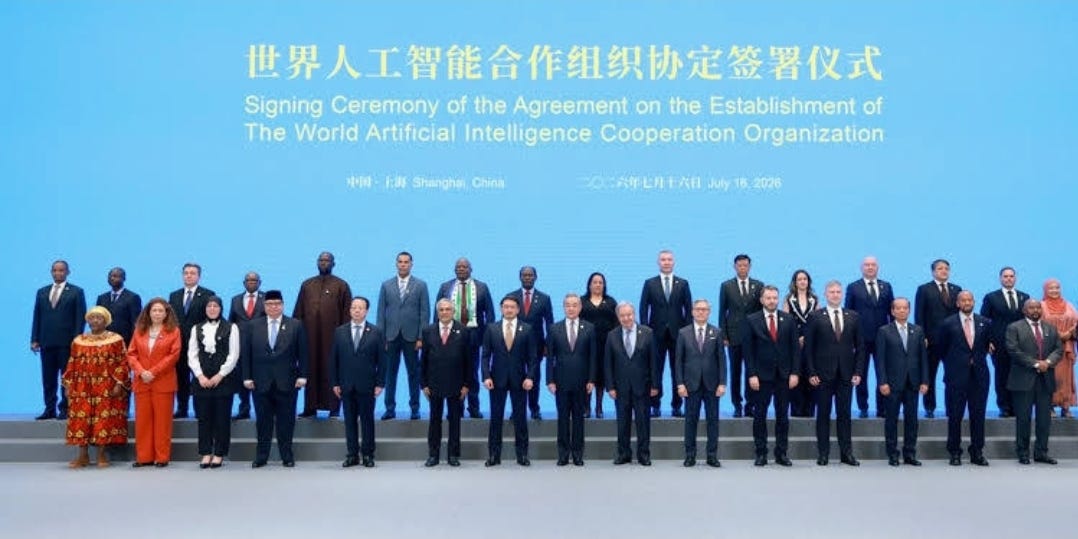
The founding members—including China, Russia, Pakistan, Indonesia, Kazakhstan and Laos, alongside countries from Africa, Asia and Latin America—share a common belief that access to artificial intelligence should not remain concentrated in a small group of technologically advanced nations. Instead, they argue that AI should become a driver of inclusive development, enabling emerging economies to leapfrog traditional stages of industrialization and participate more fully in the global knowledge economy.
At its core, WAICO seeks to promote cooperation in AI research, governance, standards, education and innovation. While many international discussions about artificial intelligence have focused on managing risks and regulating powerful technologies, this new organization places equal emphasis on expanding opportunities. Its vision is that countries with limited technological capacity should be able to benefit from AI rather than become passive consumers of technologies developed elsewhere.
For developing nations, the implications could be profound. Artificial intelligence has the potential to transform nearly every sector of society. In healthcare, AI can assist doctors in diagnosing diseases more accurately, improve medical imaging and support remote healthcare services for rural communities. Countries struggling with shortages of medical professionals may find AI becoming an indispensable partner in delivering quality care.
Education is another area poised for significant change. AI-powered learning platforms can personalize lessons, translate educational materials into local languages and provide teachers with tools to monitor student progress more effectively. Such innovations could help reduce educational inequalities and expand access to quality learning, particularly in underserved regions.
Agriculture, which remains the backbone of many developing economies, also stands to benefit. AI can analyze weather patterns, predict crop diseases, optimize irrigation and improve harvest planning. For millions of smallholder farmers, these technologies could increase productivity while reducing losses caused by climate change and unpredictable weather.
Public administration may experience one of the most immediate transformations. Governments are increasingly using AI to improve tax collection, process official documents, manage traffic systems, detect fraud and deliver faster public services. Countries that successfully integrate these technologies could build more efficient institutions while reducing administrative costs.
The economic implications are equally significant. Artificial intelligence is expected to become a major engine of productivity, enabling businesses to automate routine tasks, improve manufacturing processes, optimize logistics and create entirely new industries. Participation in WAICO could facilitate technology transfer, joint research projects and workforce training that help member states build competitive digital economies rather than relying solely on imported technologies.
Scientific research is another area where collaboration could accelerate progress. Shared computing resources, research partnerships and open scientific exchanges may enable universities and research institutions across member countries to tackle complex challenges ranging from climate modelling to pharmaceutical development. Such cooperation could narrow the technological gap that has long separated advanced economies from much of the developing world.
Infrastructure development is also likely to evolve. Modern AI systems depend on robust digital networks, cloud computing, data centres and reliable electricity. As member countries invest in these foundations, broader economic modernization may follow, stimulating growth in telecommunications, renewable energy, cybersecurity and digital services.
The benefits may also extend to disaster management and environmental protection. AI systems can monitor floods, droughts, wildfires and disease outbreaks with unprecedented speed, allowing governments to respond more effectively to emergencies. For countries increasingly vulnerable to climate-related disasters, these capabilities could save lives while reducing economic losses.
For Africa, where many nations are seeking to diversify their economies, WAICO could offer an opportunity to participate more actively in the global technological revolution. Instead of remaining primarily exporters of raw materials, African countries could develop AI applications tailored to local challenges in agriculture, healthcare, education and financial inclusion. Success, however, will depend not only on international partnerships but also on investments in digital infrastructure, research institutions and human capital.
The creation of WAICO also carries important geopolitical implications. Artificial intelligence has become a strategic resource comparable to energy, finance and advanced manufacturing. Countries that lead in AI research and deployment are likely to enjoy considerable economic and diplomatic influence. By establishing a multilateral AI organization, China and its partners are seeking to shape international norms and expand cooperation beyond the existing technology landscape.
For the rest of the world, WAICO introduces both opportunities and challenges. Increased cooperation among developing countries could accelerate innovation, stimulate competition and broaden access to AI technologies. At the same time, the emergence of multiple centres of AI governance may encourage healthy competition over standards, ethics and regulatory approaches. If managed constructively, this diversity could produce more inclusive global rules that reflect the interests of developed and developing nations alike.
The United Nations has an important role to play in ensuring that these parallel initiatives reinforce rather than fragment global AI governance. As artificial intelligence increasingly influences trade, security, employment and human rights, international cooperation will be essential to establish shared principles that promote innovation while protecting societies from misuse.
Ultimately, WAICO is about far more than artificial intelligence. It represents an effort to redefine how technological progress is shared across nations. If the organization succeeds in fostering genuine collaboration, investing in human skills and promoting responsible innovation, it could help narrow the global digital divide and create new pathways for sustainable development. In an era where knowledge has become the world's most valuable resource, cooperation in artificial intelligence may prove as transformative as cooperation in trade, finance or energy was in previous generations.
Mohamed Mohamoud Adde is an academic and a geopolitical analyst
No posts
Comments
Nothing yet. Say the first thing.
Sign in to join the conversation.