
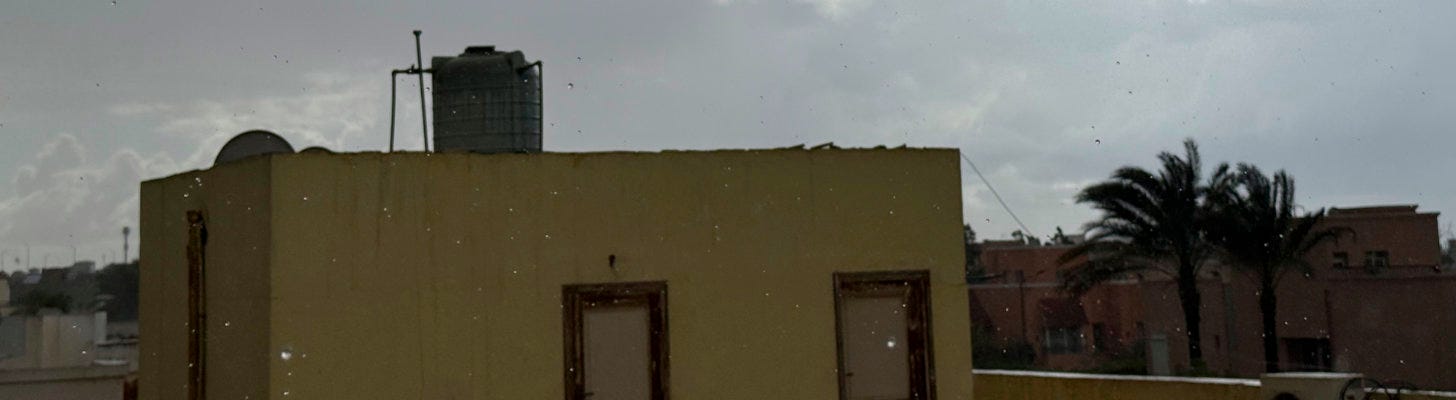
Here in Cairo, this morning feels like the world is catching fire.
US Airborne troops being sent to the Middle East. Iran and Israel and America all hammering each other. Lebanon being bombed again. And on our borders, the less talked about wars. Sudanese refugees flooding into Egypt, and facing increasing hardship here. Gaza just going on and on. On top of it all, an apocalyptic rain storm this morning (spread across the whole region) with roads flooded and schools cancelled. The last time that happened was in March 2020, right as Covid hit… so it’s evoking some of those stored emotional nuggets.
Thanks for reading! Subscribe for free to receive new posts and support my work.
I’ve now lived 35 years in a conflicted region. Gulf wars, the Egyptian Revolution, ISIS/Daesh, insurgency, Sudan, Libya, Gaza, Lebanon again and again. These days, Iran. I think a lot about crisis, and have lived through my fair share of them.
It’s always challenging to talk about your own situation in any crisis, because there are simultaneously people whose experience of it is infinitely more difficult than yours, while at the same time there are multitudes who talk about experiencing it from far away. Some people living in crisis zones talk as if they are experts on everything. But others - maybe most - just generally don’t talk about it because they don’t know where to begin.
Not knowing where to begin is where I have found myself for a long time. But I would like to write out some of my thoughts - mostly for myself - on living in a place where crisis seems to be the norm. I’ll think out loud about one or two things each time I write here on Substack.
Anxiety, boredom, and isolation
One of the weird characteristics of living in the midst of war and conflict is that you are assaulted with both anxiety and boredom at the same time.
Anxiety makes sense. Bad stuff is happening, and you worry that those you love, and to a lesser extent yourself, will be caught by that. You worry about where it’s all going. There are moments where the guns shoot or the bombs hit or the crowd gets angry and you just act - fight or flight. But those moments are usually few and far between. Most of the time, your mind is processing scenarios that could happen.
Then there’s boredom. It is a factor that most people who have not lived in a conflict zone do not expect, but is real. My now-adult kids, who lived through the Egyptian Revolution in 2011 (and our house was in one hot spot of many, where things got a bit intense), sometimes get comments from people who say to them something along the lines of how that must have been wild and crazy. Their response is that revolutions are actually boring. You are stuck at home, can’t see your friends, and can’t even order a pizza.
Conflict brings uncertainty, which means that the normal activities of everyday life get canceled, which means you get bored. Boredom is often a symptom of something more dangerous, which is isolation. In Covid, we all learned about the dangers of isolation in terms of our mental health. If you have not experienced what it means to live as a civilian in a conflict zone, one way you can imagine it is by thinking back to those isolated, boring, anxious days of Covid.
The information paradox
When you are surrounded by crisis, good information is essential. It helps you with decision making.
Although it is worth noting that even with good information, making quality decisions about your family, your business, your community, or yourself is fraught with uncertainty. Even the best decisions can be subject to unexpected and sudden changes. In the famous words of Mike Tyson, “everyone has a plan until they get punched in the face”. But good information helps you be agile and responsive, and that is usually a helpful thing.
The problem is that information, as we receive it today, is not neutral.
It is natural that conflicts produce radically different takes on the news from each side. Propaganda and news manipulation are real. That is a concern, but it is no longer my primary concern for myself. I have developed lenses for how I read or view or listen to news that help with this.
My primary concern is what the need to know information does to my state of mind. War and conflict foster feelings of helplessness, which feeds the anxiety described above. That anxiety demands information, because we hope - consciously or subconsciously - that in it we will find key knowledge that will help us understand and mitigate the danger to us. It becomes a hungry void.
Then there’s the boredom, which creates empty space that feels unnatural and uncomfortable. Our anxiety pushes us to seek information in the news that will help us. Our boredom keeps us engaged in it when we have exhausted whatever useful information there might be. It kills time.
Add to that weaponized algorithms that earn big corporations money by keeping you in the doom scrolling loop. War and conflict is great for companies that have revenue models based on algorithmically targeted advertising. It is no secret that anxiety, anger, and fear generate engagement, and engagement means that advertising generates revenue for your social media company. If you want good investing advice, invest in social media companies and news outlets in times of war. Excellent financial prospects.
Guarding space and rhythm of information
Over the decades, the people I have watched navigate crises well seem to be able to stay informed without being consumed. The difference between the two is sometimes a fine line.
Being informed means you know how to do your job, love your people, make good decisions (or the best decisions possible in the circumstances), maintain your sanity, and experience restfulness and serenity in the midst of it all. Being consumed means that the crisis has moved into your head and taken over the space, crowding out everything else.
The challenge and discipline is to get the amount of information you need, and then deliberately step away. This sounds simple. But with the unpredictability of life in a crisis/war zone, and the constant pressing in by a sense of danger, whether genuinely close or otherwise, can make this hard to do.
I have found that guarding space and rhythm in my life makes a real difference for me. For those who know me (and anyone reading this unknown Substack probably falls in that category), you will know that my views on this are deeply influenced by the Christian desert fathers and mothers, and historic desert spirituality in Egypt and in our region. Desert writers and practitioners were surprisingly prescient of the concerns and language of today’s world when it comes to self awareness, mental health, and self-leadership. More on that in future posts.
But for now, regardless of the merits or drawbacks of viewing space and rhythm through that lens, I will share a few things that I use to help me maintain my space and rhythm in the midst of crises that generate overwhelming amounts of information.
Practical things that work for me
The first is intentional, time-boxed news consumption. In the past 6 months I have developed an app that helps me do this, and I have been reflecting recently on how it has been shaped around my thinking on information and mental/emotional margin. I created it initially to scratch my own itch for news that went deep, not wide, but have found in these past days that it really helps me focus and limit my news consumption.
I’m not going to mention it here in this post, because I am not trying to advertise for it. I am sharing about a thing I created because it reflects my thinking on information and crisis, and protecting margin and rhythm in your life. For those of you who are creators, you know the difference between something you create that has the primary intent of generating revenue, and something you make because you feel the world needs it in some way.
It creates a personalized audio news briefing for me each day based on topics I have chosen. I listen to it as a part of my morning routine (usually on my way to the gym, physical exercise being another key element of my sanity) for about 6-8 minutes. It gives me what I need, and then I can usually avoid much of the news dipping I used to do later in the day.
It also has the benefit of no advertising and no algorithm shaping what news I get. It generates my briefing based on my topic for that day alone. No cookies, no purchase history, no listening in on my living room conversations. I made it specifically with my cortisol levels in mind. Honestly, I love that part of it.
But my main point is, however you do it, limiting your news consumption is something that can help you keep the space you need in your mind to navigate war and crisis more effectively. Information helps. But too much is not helpful. Limiting your news consumption is something I have found essential to staying sane when the world is catching fire.
A second thing is physical disconnection from my devices. I’ve started using the Brick app, which lets you lock yourself out of the distracting parts of your phone for set periods (thank you to who set me up with this). No willpower required. The phone is physically in your hand, but the noise is gone. I have found this helpful, and recommend it for anyone who finds themselves reaching for the phone compulsively during high-anxiety news cycles.
Ever since I first read John Duhigg writing about how research shows that willpower is a finite resource in a human being, and resets when we sleep at night, I have been on a quest to focus my decision making on things that matter.
So I brick my phone at night as I am getting ready for bed. When I wake up, my first hour is phone-free. I try to leverage the power of pre-made decisions to govern my morning routine so that my first use of willpowe
r in the day comes after I have woken up, done my stretches worked out, prayed, had breakfast, and showered. I am not always successful. But the Brick app has helped me a lot by taking away the need to make constant micro-decisions to stay off my phone when habit is telling me to check. Give it a try if you want. Or use any other way that works for you. In the old days of the early 2020s I used to wrap my phone in a plastic bag and duct tape to do the same thing.
The third, and honestly the most important, is that rhythm doesn’t come from just restricting your information intake. It comes from cultivating things of beauty and meaning. Prayer. Community. Music. A meal with people you love. Reading something that has nothing to do with current events. Meaningful work. Serving. Helping those in need.
These aren’t escapes from reality, they actually become the core of reality that frame our daily lives in the things that matter. They are what I’m protecting when I refuse to let the compulsion for information eat my entire day, and what get crowded out when I don’t.
Handling information in a way that benefits me, not works against me, is one important part of staying sane in the midst of crisis and war. I plan to write on a few more. Hopefully that will happen. If you’ve come this far, thanks for taking time. I’d love to hear your thoughts.
Thanks for reading! Subscribe for free to receive new posts and support my work.
Comments
Nothing yet. Say the first thing.
Sign in to join the conversation.